By Joel Richard, Technical Coordinator, Biodiversity Heritage Library
Published June 2026
Executive Overview
The Biodiversity Heritage Library (BHL), the world’s largest open-access digital repository for literature pertaining to biodiversity and natural history, has officially embarked on a major operational migration. Over a critical three-week transition window, BHL’s core technical infrastructure is shifting from its long-standing home at the Smithsonian data center just outside Washington, D.C., to a new permanent digital sanctuary at the Field Museum in Chicago, Illinois.
This multi-phase architectural migration represents more than a routine logistical relocation of servers, switches, and databases. It is a vital infrastructural evolution designed to secure the long-term resilience, accessibility, and continuity of global biodiversity knowledge. Millions of digitized pages—comprising centuries of scientific observations, taxonomic descriptions, illustrations, and field notes—rely on this underlying hardware.
To ensure uninterrupted service for the global scientific and educational communities, BHL’s technical teams have meticulously structured the migration into discrete, calculated phases. While the website will remain operational throughout the process, minor, temporary disruptions to specific advanced database functions, such as full-text search capabilities, are scheduled for late June.

With the generous backing of the Field Museum’s administration and IT specialists, BHL is poised to seamlessly transplant its digital ecosystem into the heart of the American Midwest. In a playful nod to the natural history literature the platform preserves, the migration team has even evaluated the "habitat suitability" of Chicago compared to Washington, D.C., utilizing historical agricultural, ecological, and climatological maps.
Detailed Chronology: The Three-Week Migration Roadmap
Executing a zero-downtime (or near-zero-downtime) migration for a repository housing tens of millions of pages of complex digital assets requires surgical precision. The BHL Technical Team has mapped out a strict operational schedule for June 2026, balancing the safety of physical hardware in transit against the continuous uptime demands of an international user base.
Phase 1: Network Configuration and Preliminary Testing (Early June 2026)
Before a single physical server rack was powered down in the Washington, D.C. data center, rigorous groundwork was laid in Chicago. The Field Museum’s technical infrastructure was thoroughly tested and configured to absorb BHL’s complex network architecture.
During this preparatory phase, BHL’s staging environments and secondary services were quietly initialized on the Field Museum’s network. This dry-run phase allowed the engineering teams to validate routing, test firewall configurations, and confirm bandwidth capacities. By running redundant systems concurrently ahead of time, the team built a high degree of confidence that the physical shipments would integrate smoothly into the new environment.

Phase 2: The Warm-Up Shipment (June 11, 2026)
The physical transition officially kicks off on June 11, 2026, with the first wave of server and hardware shipments. This initial transit serves as a tactical warm-up for the logistics team.
Crucially, users accessing the BHL portal will experience no disruption to regular site functions during this first phase. Core catalog navigation, metadata queries, item viewing, and PDF downloads will proceed uninterrupted as secondary nodes and auxiliary infrastructure are safely transported and re-established in Chicago.
Phase 3: The Production Migration & Full-Text Search Interruption (June 25, 2026)
The definitive operational milestone occurs on June 25, 2026. On this day, the primary production databases and the specialized full-text-search servers are packed and shipped to the Field Museum.
While the overarching BHL website will remain accessible—allowing users to search titles, authors, subjects, and other vital catalog metadata without interruption—the full-text search function will be temporarily taken offline. Because the physical index servers themselves will be in transit across the country, users will be temporarily unable to query words and phrases deep within the text of scanned books and articles.

This localized outage is projected to last a brief 5 to 6 days, deliberately spanning a weekend to minimize disruption to academic researchers, historians, and taxonomists. By Monday following the installation, the full-text search index will be brought back online, officially marking the completion of BHL’s operational transition to Chicago.
Supporting Context, Metrics, and Technical Architecture
The relocation of BHL’s technical infrastructure from the Smithsonian to the Field Museum represents a strategic alignment between two titans of natural history curation.
The Value of Institutional Partnerships
The success of this monumental undertaking is deeply anchored in the collaborative support extended by the Field Museum. Transitioning petabytes of historical scientific data, complex relational databases, and high-throughput web servers demands elite institutional backing. The administration and technical teams at the Field Museum have provided invaluable resources, physical space, power infrastructure, and network bandwidth to ensure that biodiversity knowledge remains freely and rapidly available to researchers worldwide.
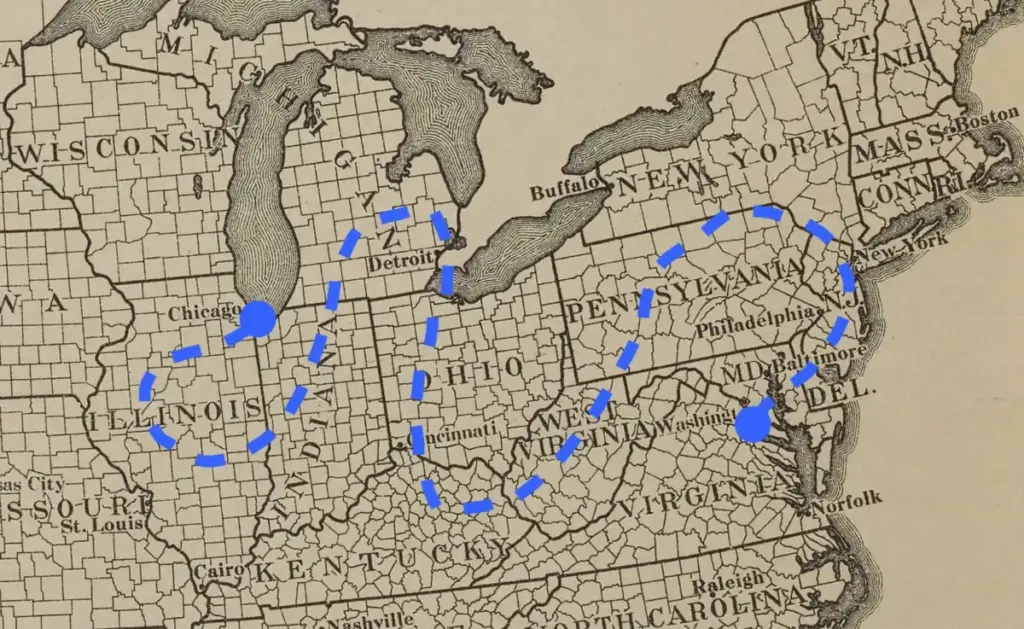
To keep the global community fully informed, the BHL technical coordination team has launched a dedicated Field Museum Move Project Page. This portal features real-time progress updates, technical documentation, and even a tongue-in-cheek routing map tracking the literal journey of the servers across the American landscape (utilizing cartographic assets drawn directly from BHL’s historical collections).

Ecological Analogy: Acclimating BHL’s Servers to Chicago
In keeping with the spirit of a library dedicated to the natural world, the BHL technical team decided to evaluate whether their digital infrastructure would "feel at home" in its new Midwestern habitat. Using historical cartographic data sourced directly from the BHL archives—specifically the Atlas of American Agriculture—the team conducted a comparative environmental assessment between the U.S. East Coast and the Windy City.
1. Hydrological Conditions (Rainfall and Water Resources)
- East Coast Baseline: Historically, the mid-Atlantic and northeastern regions experience annual precipitation rates averaging 35–40 inches (85–100 cm).
- Chicago Environment: Chicago receives a slightly lower historical average of 30–35 inches (75–88 cm) of rainfall per year.
- The Mitigation Factor: While baseline precipitation is lower, BHL’s new physical home is situated directly adjacent to Lake Michigan, one of the largest freshwater bodies on Earth. However, the team notes that contemporary climate factors must be considered; the north-central United States frequently navigates shifting weather patterns, including periods of moderate drought.
2. Soil Mechanics and Substrata
- East Coast Baseline: The Smithsonian data center region rests predominantly upon Gray-Brown Podzolic soils, typical of eastern deciduous forest zones.
- Chicago Environment: In Chicago, the local geological profile transitions to the Soils of the Northern Prairie.
- Transition Analysis: A close inspection of historical soil survey maps reveals that BHL’s familiar East Coast soil types sit in geographic proximity to the complex prairie soils of Illinois. The migration team joked that this close ecological adjacency should help the digital hardware integrate smoothly into its new subterranean foundation.
3. Floral Assemblages and Vegetation Zones
- East Coast Baseline: The flora of the mid-Atlantic is defined by dense Oak-Pine and Chestnut-Oak-Yellow Poplar forests.
- Chicago Environment: Shifting westward introduces the vast expanse of the Tall Grasses of the Prairie Grasslands.
- Transition Analysis: Much like the soil profiles, the presence of neighboring Oak-Hickory forest zones across the Midwest provides a comforting ecological bridge. The technical team expressed cautious optimism that the proximity of familiar oak signatures will ease the server’s cultural transition from coast to prairie.
Official Statements and Future Outlook
Reflecting on the culmination of the project, Joel Richard, BHL Technical Coordinator and Head of Web and IT for the Smithsonian Libraries and Archives, emphasized the smooth nature of the transition.
"We’ve been testing and configuring the network at the Field Museum, and BHL is already quietly running on their network," Richard noted ahead of the physical deployment. "We are entirely confident the process will go smoothly as we ship and install the production database and full-text-search servers."
With the physical servers loaded onto transport vehicles, the network links verified, and the digital pathways tested, BHL stands firmly positioned for its next chapter. Backed by sufficient digital "water," familiar ecological neighbors, and the robust hospitality of the Field Museum, the Biodiversity Heritage Library’s technical infrastructure is officially ready to put down deep, enduring roots in Chicago.

Discover More from the Biodiversity Heritage Library
The transition to the Field Museum marks a new era for open-access scientific literature. To stay informed on the final stages of the infrastructure move, access digitized historical maps, or explore millions of pages of biodiversity literature, subscribe to the official Biodiversity Heritage Library Blog and visit the BHL Portal.