Executive Overview
China’s dual carbon goals—peaking carbon emissions before 2030 and achieving carbon neutrality by 2060—have encountered a major structural obstacle. During the first half of 2026, coal-fired power generation across the country expanded by 3% year-on-year, breaking a period of stagnation and decline. This resurgence occurred despite historic deployments of clean energy infrastructure, as record amounts of wind and solar capacity were systematically sidelined through grid curtailment.
A joint investigative report published by the Centre for Research on Energy and Clean Air (CREA) and Global Energy Monitor (GEM) reveals that the Chinese electric grid brought 30 gigawatts (GW) of new coal-fired generation online between January and June 2026. Over the same period, retired coal capacity amounted to a mere 2.7 GW, resulting in a net expansion that vastly outstrips global fossil fuel reductions.
H1 2026 China Coal Capacity Movements:
==================================================
New Coal Capacity Brought Online:  [████████████████████] 30.0 GW
Retired Coal Capacity:             [█                   ]  2.7 GW
Net Coal Fleet Addition:           [██████████████████  ] 27.3 GW
==================================================
Pipeline (Under Construction/Permitted): 274 GW (~20% of active fleet)
This structural rebound in fossil fuel reliance is not an accident of market forces, but rather the cumulative result of a multi-year permitting boom triggered by provincial energy security fears. As clean power generation expands faster than grid architecture can accommodate, local power authorities are falling back on coal assets to manage base-load stability and protect regional economic interests. With a massive 274 GW pipeline of permitted or under-construction coal capacity, industry analysts warn that China risks locking in carbon-intensive infrastructure for decades, directly undermining global climate stabilization efforts.
Detailed Chronology
          2021                    2022–2024                 2025                    H1 2026
    ┌──────────────┐          ┌──────────────┐        ┌──────────────┐        ┌──────────────────┐
    │ Power Crunch │ ───────► │ Permitting   │ ─────► │ Grid Bottle- │ ─────► │ Paradox Realized │
    │ & Blackouts  │          │ Surge        │        │ necks Emerge │        │ +3% Coal Output  │
    └──────────────┘          └──────────────┘        └──────────────┘        └──────────────────┘
The 2021 Crisis and the Security Shift
The foundation of the current coal surge was laid during the late summer and autumn of 2021. A spike in global coal prices, combined with rigid domestic power price caps, led utility companies to curtail generation to avoid operating at a loss. The resulting energy crunch paralyzed manufacturing across nearly 20 provinces, forcing factory shutdowns, rationing domestic electricity, and disrupting global supply chains.
The political fallout was immediate. Central and provincial authorities recalibrated their energy strategy, elevating "energy security" to equal standing with decarbonization targets. Local governments began treating coal-fired power plants not as legacy assets slated for phase-out, but as essential security guarantees against future supply disruptions.
The 2022–2024 Permitting Boom
Between 2022 and 2024, provincial governments accelerated approval processes for new coal-fired power projects. Authorities issued permits for new facilities at speeds not seen in over a decade. While national policy frameworks maintained that these new plants were intended primarily for "peak-shaving"—operating flexibly to balance intermittent renewable energy—the physical specifications of the approved units told a different story. The majority were high-capacity, standard baseload thermal power stations optimized for continuous, high-volume generation.
2025 Grid Strains and Infrastructure Lag
By 2025, China’s massive buildup of solar and wind infrastructure in the resource-rich northern and northwestern provinces (such as Inner Mongolia, Xinjiang, and Gansu) ran into physical infrastructure limits. The expansion of Ultra-High Voltage (UHV) direct-current transmission lines failed to keep pace with the installation of clean energy generation. Concurrently, regional power markets remained fragmented along provincial lines, preventing efficient cross-border power trading.
H1 2026: The Paradox Realized
The structural tensions reached a crisis point in the first six months of 2026:
- Thermal Generation: Coal-fired power generation rose by 3%, reversing previous declines.
- New Additions: 30 GW of new thermal capacity entered commercial operation.
- Retirements: Only 2.7 GW of inefficient, legacy coal units were decommissioned.
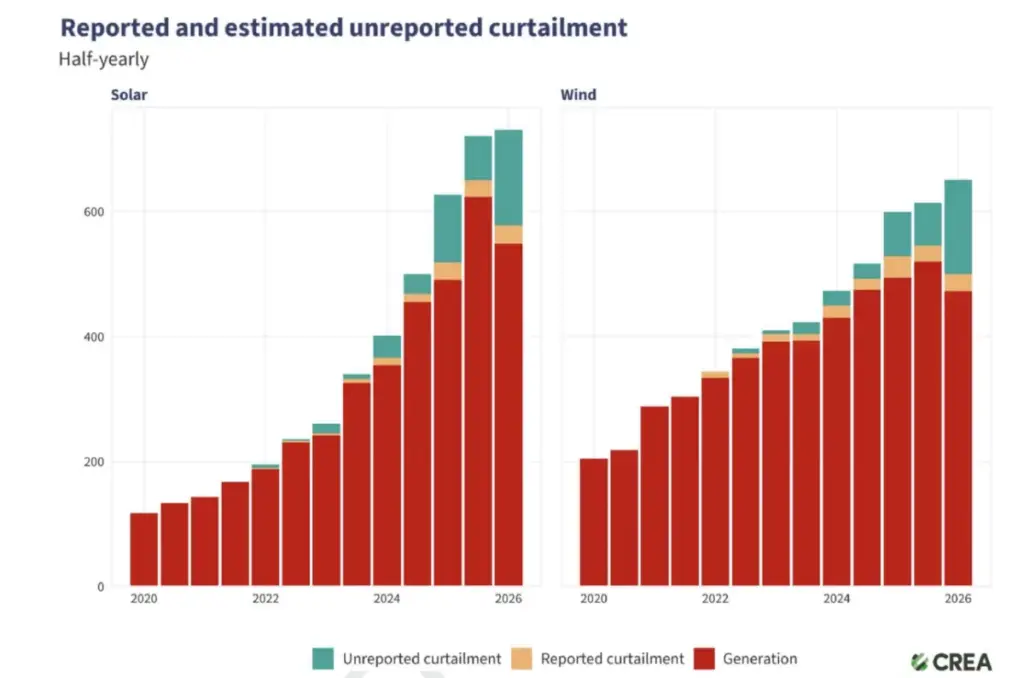
- Curtailment Rates: Solar and wind power waste reached historic highs, with clean generation intentionally discarded because local grids could not absorb or transmit the surplus electricity.
Supporting Context & Metrics
The contrast between China’s renewable energy construction and its physical grid capacity highlights a severe operational bottleneck. While China continues to build more solar and wind projects than the rest of the world combined, the structural inability to move that power across regions has created a crisis of energy waste.
+-----------------------------------------------------------------------------------+
|                           THE GRID TRANSMISSION MISMATCH                          |
|                                                                                   |
|   WESTERN & NORTHERN REGIONS                       EASTERN & SOUTHERN REGIONS     |
|   (Xinjiang, Inner Mongolia, Gansu)                (Guangdong, Jiangsu, Zhejiang) |
|                                                                                   |
|   ┌─────────────────────────────┐                  ┌──────────────────────────┐   |
|   │ High Renewable Generation   │                  │ Massive Power Demand     │   |
|   │ (Solar & Wind Surplus)      │                  │ (Industrial Hubs)        │   |
|   └──────────────┬──────────────┘                  └────────────▲─────────────┘   |
|                  │                                              │                 |
|                  │           UHV TRANSMISSION BOTTLENECK        │                 |
|                  └─────────────── [ ╳ ╳ ╳ ╳ ╳ ] ─────────────────┘                 |
|                                                                                   |
|   RESULT: Western Clean Power Curtailed ──► Local Eastern Coal Plants Dispatched  |
+-----------------------------------------------------------------------------------+
The Anatomy of Renewable Curtailment
Curtailment occurs when power grid operators deliberately restrict electricity generation from operational plants because the transmission network lacks the capacity to transport it, or because regional demand is insufficient. In H1 2026, curtailment shifted from an isolated seasonal issue to a structural liability:
- Geographic Mismatch: China’s primary renewable energy installations are located in the sparsely populated north and west, thousands of kilometers away from the dense industrial demand centers along the eastern and southern coasts (such as Guangdong, Jiangsu, and Zhejiang).
- Transmission Lines Lag: Building UHV transmission infrastructure requires long planning horizons, major land approvals, and complex technical coordination. Transmission construction has lagged behind the rapid, modular installation of solar farms and wind parks by 18 to 24 months.
- Institutional Flexibility Deficits: Many regional grid systems still operate under rigid scheduling practices that grant coal-fired generators minimum baseline operating hours, forcing grid operators to disconnect variable renewables first during periods of lower demand.
The Scale of the Pipeline
The report by CREA and GEM highlights the scale of China’s ongoing fossil fuel commitments:
| Metric | H1 2026 Status / Volume | Impact & Context |
|---|---|---|
| New Coal Capacity Operational | 30.0 GW | Equivalent to the entire power grid capacity of a medium-sized industrialized nation. |
| Coal Capacity Retired | 2.7 GW | Indicates a near-total halt in the decommissioning of older, inefficient plants. |
| Coal Generation Growth | +3.0% YoY | Reverses previous trends where renewable integration offset demand growth. |
| Active Construction & Permitted | 274.0 GW | Equals roughly 20% of China’s total operational coal fleet (~1,200 GW). |
The 274 GW in the pipeline presents a direct financial and environmental liability. If fully constructed, these assets will require long-term capital recovery, creating economic incentives to maintain their operational hours regardless of renewable power availability.
Provincial Protectionism and Capacity Tariffs
The expansion of coal is also driven by local economic policy. China’s power market structure gives provincial governments strong economic incentives to protect local coal assets:
- Tax and Employment Dependencies: Coal plants generate significant local tax revenues and secure employment for state-owned utility workers.
- Capacity Payment Rules: Recent capacity tariff mechanisms guarantee fixed payments to coal plant operators simply for keeping units operational as back-up capacity. However, in practice, provincial dispatch centers often operate these plants as baseload units rather than reserve facilities to help them recover operational costs faster.
Official Statements and Expert Analysis
Energy market analysts, climate policymakers, and grid engineers view the H1 2026 data as a warning that physical grid design and local economic incentives are working against national climate goals.
Warnings over Economic "Lock-In"
Qi Qin, lead author of the CREA-GEM joint report, pointed out the long-term economic risks associated with the continuous expansion of thermal generation infrastructure:
"The ongoing buildout of coal infrastructure creates a systemic climate concern. After coal power plants are built, they will seek revenue and operating hours for decades. That necessity inevitably crowds out clean power dispatch and slows the retirement of older, less efficient coal power units. We are seeing a structural lock-in effect where financial capital is committed to legacy fossil assets at the direct expense of zero-carbon integration."
Energy policy researchers at global institutes emphasize that the systemic priority assigned to thermal generation limits the yield of China’s massive renewable energy investments.
       CAPITAL INFLOW                          SYSTEMIC RESISTANCE
┌──────────────────────────┐               ┌──────────────────────────┐
│  Record Investments in   │               │ Guaranteed Coal Dispatch │
│   Wind & Solar Assets    │               │  & Fixed Operating Hours │
└────────────┬─────────────┘               └────────────┬─────────────┘
             │                                          │
             ▼                                          ▼
┌─────────────────────────────────────────────────────────────────────┐
│                       RENEWABLE CURTAILMENT                         │
│   Clean Power Discarded ──► Asset Underutilization ──► Grid Inefficiency │
└─────────────────────────────────────────────────────────────────────┘
The Institutional Dilemma
According to power sector specialists, China’s central energy planners face an internal policy disconnect:
- National Energy Administration (NEA) Position: The official line maintains that new coal construction is purely dedicated to grid stabilization, flexibility, and emergency back-up supporting high penetration levels of variable renewables.
- On-the-Ground Reality: Local grid dispatch practices continue to favor thermal generators due to long-term power purchase agreements, provincial protectionism, and slow progress in implementing real-time spot electricity markets.
"The technical capability to operate coal power as a flexible peak-shaving unit exists," notes Dr. Zhang Lin, a senior energy analyst specializing in East Asian power markets. "However, the commercial compensation models for flexible operation remain underdeveloped. As long as a coal plant owner makes significantly more money generating steady baseload power than acting as a standby reserve, they will press local authorities for grid access—leading directly to the curtailment of wind and solar assets."
Future Outlook
The developments in the first half of 2026 present a critical test for China’s broader energy transition strategy. Without immediate structural reforms to electricity markets and grid operation, the continued growth of coal capacity threatens to delay the country’s carbon peaking timeline and increase the long-term cost of decarbonization.
                        CRITICAL PATH TO 2030 / 2060
                                      │
        ┌─────────────────────────────┴─────────────────────────────┐
        ▼                                                           ▼
SCENARIO A: Market & Grid Reform           SCENARIO B: Sustained Infrastructure Lock-In
--------------------------------           --------------------------------------------
• Mandatory Spot Market Rollout            • Continued Coal Permitting & Construction
• Expanded UHV Interconnections            • Unchanged Provincial Market Barriers
• Storage Infrastructure Scaling           • Rising Renewable Curtailment Rates
• Accelerated Coal Phase-Down              • Higher Risk of Stranded Capital Assets
Immediate Policy and Structural Requirements
To resolve the grid transmission paradox and absorb the 274 GW coal pipeline without derailing carbon targets, energy analysts point to four critical policy changes:
- Accelerated Market Integration: Transitioning from long-term administrative power contracts to functional spot markets across provincial borders. Unifying regional power markets would allow excess renewable energy generated in northern regions to be traded in real-time to high-demand eastern industrial hubs.
- Reforming Grid Dispatch Protocols: Implementing "green dispatch" rules that mandate grid operators to prioritize zero-marginal-cost renewable energy over thermal power, strictly limiting coal assets to flexible peak-shaving duties.
- Expanding Grid Storage and UHV Corridors: Directing capital investments away from thermal capacity additions and toward grid-scale battery storage, pumped hydro storage, and cross-regional UHV transmission links.
- Restructuring Capacity Payment Systems: Refining capacity tariffs so that thermal operators are compensated exclusively for providing operational flexibility and reserve readiness, rather than for delivering raw bulk electricity.
The Risk of Stranded Assets
If China proceeds with constructing the full 274 GW of permitted and under-construction coal capacity while simultaneously deploying renewables at a record pace, the domestic thermal fleet faces plummeting capacity utilization rates.
Operating coal plants at a fraction of their capacity will worsen the financial standing of state-owned power generators, increasing financial pressure on local governments and state banks. Eventually, these units risk becoming stranded assets—forced into premature retirement or operating at heavy economic losses to meet international climate commitments.
Global Climate Implications
As the world’s largest emitter of greenhouse gases, China’s internal power market design carries global consequences. The 3% uptick in thermal power generation during H1 2026 demonstrates that installing record clean energy capacity is not enough on its own to reduce absolute carbon emissions.
For China’s emissions to peak decisively before 2030, systemic reform of physical grid infrastructure and market dispatch mechanics must match the pace of renewable energy deployment. Until these grid bottlenecks are unblocked, the world’s largest clean energy expansion will continue to coexist with a resilient, expanding coal fleet.