Executive Overview
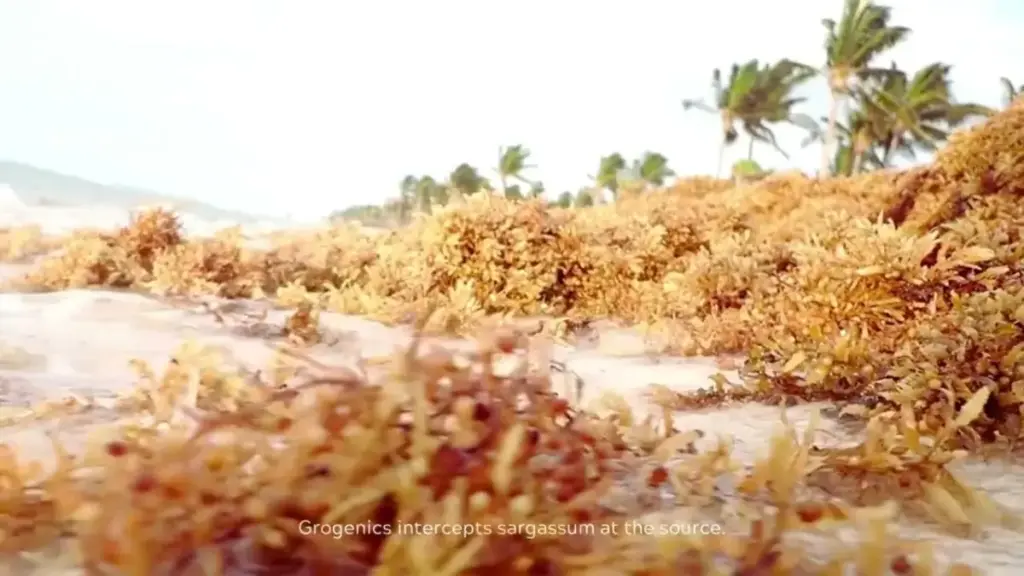
Along the sun-drenched coastlines of the Mexican Caribbean—stretching from the pristine shores of Cancún down through the Riviera Maya and into the biosphere reserves of Tulum—a relentless ecological and economic challenge is washing ashore. Massive, record-breaking blooms of brown macroalgae known as sargassum are inundating beaches by the hundreds of thousands of tons. While pelagic sargassum plays a vital ecological role in the open ocean as a habitat for diverse marine species, its unprecedented accumulation near coastal zones has created a multi-layered crisis. As towering walls of seaweed pile up on beaches, they rapidly decompose, releasing toxic hydrogen sulfide gas, suffocating nearshore marine life, leaching heavy metals into the coastal fringe, and releasing immense quantities of methane—a greenhouse gas far more potent than carbon dioxide in the short term.
For years, the standard response was reactive and rudimentary: heavy machinery scraped the beaches, hauling the rotting biomass to local landfills where it exacerbated methane emissions and leached harmful pollutants into local water tables. The tourism industry—the lifeblood of the region’s economy—suffered billions of dollars in losses as visitors were greeted by foul odors, unsightly coastlines, and restricted beach access.
Enter a paradigm-shifting intervention: the Sargassum Recovery for Clean Coasts project. Moving far beyond simple waste management, this pioneering initiative intercepts the sargassum directly as it approaches or lands on the shore, preventing the destructive decay cycle before it can begin. Through an advanced process of local collection and rigorous bioremediation—developed and supported in partnership with innovators like Grogenics—the harvested seaweed is systematically detoxified and transformed.
Rather than remaining an environmental hazard, the noxious biomass is upcycled into high-grade, biochar-enriched compost. This finished product serves a dual purpose: it revitalizes depleted agricultural soils, supporting local farming communities, and permanently locks carbon deep into the ground. Operating as a cornerstone of the Sustainable Travel International Climate Impact Portfolio—bolstered by dedicated carbon offset funding—this initiative exemplifies the promise of a circular blue economy. It proves that coastal ecosystems, thriving tourism sectors, and vulnerable local communities can coexist and flourish through regenerative innovation.
Detailed Chronology: From Pelagic Drift to Coastal Catastrophe and Circular Redemption
To understand the magnitude of the Sargassum Recovery for Clean Coasts project, one must trace the evolutionary timeline of the sargassum crisis and the technological evolution required to combat it.
Phase I: The Shift in the Atlantic (Pre-2011 to Mid-2010s)
Historically, sargassum was primarily confined to the Sargasso Sea in the North Atlantic, a gyre defined by weak ocean currents where the golden seaweed floated in manageable, ecologically beneficial patches. However, oceanographic researchers have pinpointed a profound shift beginning around 2011. Driven by a combination of rising ocean temperatures, changing wind and current patterns, and massive nutrient runoffs (originating from deforestation and agricultural fertilizer use in the Amazon and Orinoco river basins), a new pelagic sargassum belt emerged. Spanning thousands of miles from the coast of West Africa across the tropical Atlantic and into the Caribbean Sea—often referred to as the Great Atlantic Sargassum Belt—this colossal expanse began generating unprecedented volumes of macroalgae.
Phase II: The Onset of the Mexican Coastal Crisis (2015–2019)
By the mid-to-late 2010s, the Mexican Caribbean experienced its first major shockwaves. Tourism operators, hoteliers, and government officials watched in dismay as unprecedented tides of seaweed began smothering world-renowned beaches. Initial efforts to manage the crisis were chaotic and fragmented. Heavy tractors tore up delicate dune ecosystems, while hastily constructed offshore barriers proved ineffective against the sheer volume of the incoming tide. Dumped in inland landfills without regulation, the rotting sargassum generated noxious gases that plagued nearby residential neighborhoods and severely damaged the brand image of Mexico’s premier tourism corridor.
Phase III: The Birth of Proactive Interception and Bioremediation (2020–Present)
Recognizing that traditional disposal methods were ecologically and economically unsustainable, environmental engineers, marine scientists, and sustainability advocates pivoted toward a circular economy model. This era marked the birth of localized interception and biological detoxification programs.
- Strategic Interception: Instead of waiting for the seaweed to rot on the sand, teams began capturing sargassum closer to the shoreline and using specialized, low-impact removal techniques that protect nesting sea turtles and fragile dune vegetation.
- The Bioremediation Breakthrough: Because raw sargassum naturally absorbs heavy metals (such as arsenic, cadmium, and lead) from industrial and agricultural runoff during its oceanic journey, it cannot be safely applied directly to food crops. The breakthrough came through advanced bioremediation—a biological treatment process utilizing beneficial microorganisms, fungi, and specific composting techniques to break down toxins and stabilize the organic matter.
- Integration into the Climate Impact Portfolio: With organizations like Sustainable Travel International channeling carbon offset financing directly into the initiative, the project scaled its operational capacity. By transforming the detoxified seaweed into biochar-enriched compost, the initiative bridged the gap between coastal conservation and regenerative agriculture, establishing a blueprint for climate resilience across the wider Caribbean basin.
Supporting Context & Metrics: The Science of the Blue Economy
The success of the Sargassum Recovery for Clean Coasts project rests upon rigorous scientific foundations and measurable environmental metrics. To fully grasp why this initiative is revolutionary, one must examine the chemistry of sargassum, the mechanics of biochar production, and the broader economics of the circular blue economy.
The Chemical and Ecological Challenge of Raw Sargassum
Pelagic sargassum (Sargassum natans and Sargassum fluitans) is a complex brown algae featuring gas-filled vesicles that allow it to float. While harmless and productive on the open ocean, its chemistry changes dramatically when it mass-accumulates and dies:
- Methane and Carbon Emissions: As massive piles of sargassum decompose anaerobically on beaches, they release vast quantities of methane ($CH_4$) and carbon dioxide ($CO_2$). Methane possesses a global warming potential roughly 28 to 36 times greater than carbon dioxide over a 100-year timescale, making unmanaged sargassum decomposition an acute climate threat.
- Hydrogen Sulfide ($H_2S$): The putrefaction process generates toxic hydrogen sulfide gas, recognizable by its characteristic rotten-egg smell. Prolonged exposure to $H_2S$ causes respiratory distress, headaches, and nausea among beachgoers and hospitality workers, while devastating coastal property values.
- Heavy Metal Bioaccumulation: Operating as an oceanic sponge, sargassum concentrates heavy metals present in polluted marine waters. Direct land application of untreated seaweed poses severe risks to soil health and food safety. Bioremediation effectively neutralizes or sequesters these contaminants, rendering the final compost safe for agricultural use.
The Power of Biochar and Soil Restoration
The transformation process goes beyond standard composting by incorporating biochar—a stable, carbon-rich charcoal produced by heating biomass in the absence of oxygen (pyrolysis).
- Carbon Sequestration: By converting sargassum-derived biomass into biochar and burying it within agricultural soils, the carbon that the algae absorbed during its growth cycle is permanently locked away for centuries, effectively acting as a powerful carbon sink.
- Soil Revitalization: Mexican agricultural soils, particularly in the Yucatán Peninsula’s karst topography, are often nutrient-deficient and prone to erosion. Biochar-enriched compost dramatically improves soil water retention, enhances microbial activity, increases pH balance, and boosts crop yields without the need for synthetic chemical fertilizers.
The Circular Blue Economy Framework
A circular blue economy reimagines marine and coastal resources as regenerative engines rather than finite commodities. The Sargassum Recovery for Clean Coasts project actualizes this framework through a closed-loop operational cycle:
| Stage | Action | Environmental/Economic Impact |
|---|---|---|
| 1. Collection | Low-impact coastal interception of sargassum | Protects sensitive marine ecosystems, sea turtle nesting sites, and tourism assets. |
| 2. Detoxification | Biological remediation via specialized composting protocols | Neutralizes heavy metals and eliminates pathogens and salt content. |
| 3. Upcycling | Blending with biochar and organic matter | Creates nutrient-dense agricultural compost while permanently sequestering carbon. |
| 4. Distribution | Providing soil amendments to local farmers | Enhances regional food security, lowers input costs for agriculture, and builds climate-resilient soils. |
Official Statements and Stakeholder Perspectives
The integration of community action, technological innovation, and corporate sustainability funding has garnered widespread acclaim from environmental leaders, project partners, and local stakeholders.
Reflecting on the overarching mission of the initiative, representatives from Sustainable Travel International emphasized the necessity of systemic adaptation:
"The sargassum influx is not a temporary inconvenience; it is a permanent ecological reality driven by shifting global climate and pollution patterns. Treating it merely as waste to be buried in landfills is a catastrophic missed opportunity. Through the Sargassum Recovery for Clean Coasts project, we are demonstrating that communities can take control of their environmental destiny. By intercepting the algae before it decays, we eliminate catastrophic methane releases and toxic gas production, turning an overwhelming environmental burden into a powerful catalyst for soil health and carbon sequestration."
Project partners at Grogenics, who provide vital operational video documentation and technical execution expertise, highlighted the transformative power of regenerative agriculture in coastal zones:
"When you look at a beach choked with rotting sargassum, you are looking at two crises simultaneously: a coastal emergency and an agricultural crisis. Yucatán farmers struggle with depleted, acidic soils that require expensive chemical interventions. By converting detoxified sargassum into biochar-enriched compost, we heal the land and clean the ocean in a single stroke. This is what true circularity looks like—connecting the health of the coral reefs directly to the health of the farmer’s field."
Local agricultural and tourism stakeholders in the Riviera Maya have similarly voiced profound relief over the initiative’s dual impact:
"For years, our hotels fought a losing battle against the seaweed, spending fortunes on cleanup while our beaches degraded. Knowing that the sargassum collected from our shores is now being processed locally to help Mexican farmers grow crops sustainably changes the narrative entirely. We are no longer just cleaning up a mess; we are participating in a regenerative movement that protects our tourism economy while supporting our rural neighbors."
Future Outlook: Scaling Climate Resilience Across the Caribbean
As climate change continues to warm tropical waters and nutrient runoff persists globally, scientists project that massive sargassum blooms will remain a defining feature of the Caribbean landscape for the foreseeable future. Consequently, the long-term viability of coastal economies depends heavily on the replication, scaling, and institutional backing of proactive management models like the Sargassum Recovery for Clean Coasts project.
Expanding Carbon Offset Integration
A critical pillar for the future growth of this initiative lies in the expansion of voluntary carbon markets and corporate climate commitments. By integrating sargassum upcycling and biochar production into rigorous carbon crediting standards, the project can unlock new streams of international climate finance. Corporations seeking authentic, nature-based solutions to offset their unavoidable emissions can invest with confidence, knowing their contributions yield verifiable co-benefits: biodiversity protection, reduction of potent methane emissions, and direct support for marginalized farming communities.
Technological Refinement and Industrial Scaling
Future phases of the project aim to optimize the logistics of offshore interception and onshore processing. Innovations in automated harvesting, solar-powered pyrolysis units for biochar production, and advanced bioreactor systems will dramatically increase processing speeds and reduce unit costs. Furthermore, ongoing academic research partnerships are exploring high-value commercial derivatives from sargassum extracts, including natural biopolymers, animal feed additives, and pharmaceutical compounds, which could further subsidize the cost of coastal cleanups.
Policy Harmonization and Regional Replication
For the circular blue economy to achieve continental scale, municipal, state, and federal policies in Mexico must harmonize to support decentralized waste-to-resource infrastructure. By establishing regulatory frameworks that incentivize the beneficial reuse of sargassum over traditional landfill dumping, governments can encourage public-private partnerships across the entire Caribbean basin. Neighboring nations currently grappling with identical sargassum inundations—from Belize and Honduras to the Lesser Antilles—are already looking to the Mexican Caribbean model as a blueprint for regional adaptation.
Conclusion
The Sargassum Recovery for Clean Coasts initiative—proudly supported through Sustainable Travel International’s Climate Impact Portfolio—proves that even the most daunting environmental crises harbor the seeds of systemic transformation. By turning an oceanic scourge into an agricultural asset, this project transcends traditional mitigation, offering a beacon of hope and a practical roadmap for climate resilience. As travelers, conservationists, and local communities unite under the banner of the circular blue economy, the tides are finally turning toward a sustainable, thriving future for Mexico’s precious coastlines.