Executive Overview
As the Biodiversity Heritage Library (BHL) marks its momentous 20th anniversary through its ongoing retrospective series, BHL at 20: Treasures from the Biodiversity Heritage Library, the spotlight often falls heavily on the breathtaking illustrations, rare botanical volumes, and centuries-old zoological treatises housed within its digital archives. Yet, behind every high-resolution page viewable by a researcher in a remote laboratory or a student in a rural classroom lies a monumental human effort—an intricate, behind-the-scenes mosaic of international collaboration, meticulous curation, and unyielding persistence.
For Bianca Crowley, Digital Collections Manager for the BHL, the true "treasures" of the library are not confined to the ink and paper of any single historical title. Instead, they reside in the tireless labor of the individuals across BHL’s global partner institutions who bridge the gap between physical library shelves and global digital screens.
A prime embodiment of this philosophy is the complex, 11-year crusade to digitize the complete public-domain legacy of the Journal of The Asiatic Society and its associated publications. Spanning from June 2010 to June 2021, this arduous undertaking stands as a defining case study in the power of distributed labor networks. It illustrates both the extraordinary achievements possible through open-access cooperation and the systemic hurdles facing underfunded cultural heritage organizations in the digital age. This article explores the history of The Asiatic Society, the anatomy of an 11-year digitization marathon, the essential tools that coordinated it, and what this milestone means for the future of global biodiversity literature.
Detailed Chronology: A Decade-Long Archival Journey
To understand the weight of the Journal of The Asiatic Society project, one must first understand the historical gravity of the society itself. Founded in 1784 in Kolkata (then Calcutta) by the eminent philologist and orientalist Sir William Jones through British India’s highest court, the Asiatick Society was established with a sweeping, interdisciplinary vision. Its foundational mandate was to study the "History, Civil and Natural, the Antiquities, Arts, Sciences, and Literature of Asia."
Over 240 years later, The Asiatic Society endures as a cornerstone of scholastic learning in India, proudly holding the distinction of being the nation’s oldest surviving publishing house. Its publications, running uninterrupted from 1788 to the present day, encompass an extraordinary breadth of research topics spanning the cultural and natural sciences, including medicine, literature, and anthropology. Recognizing its profound legacy in "promoting a comprehensive understanding of humanity’s intellectual and practical endeavors," the Indian government officially designated the organization as an Institution of National Importance.

Bringing this vast intellectual repository into the digital era was never going to be a simple afternoon project. In June 2010, founding institutions of the BHL consortium initiated a sweeping project centered on the various series and title changes that comprise the Journal of The Asiatic Society and its companion volumes, such as the Memoirs.
What followed was an 11-year operational odyssey. By the time BHL formally declared the digitization of all public-domain volumes "complete" in June 2021, the initiative had mobilized:
- 9 distinct BHL partner institutions across international borders;
- 19 individual staff members, contributors, and curators;
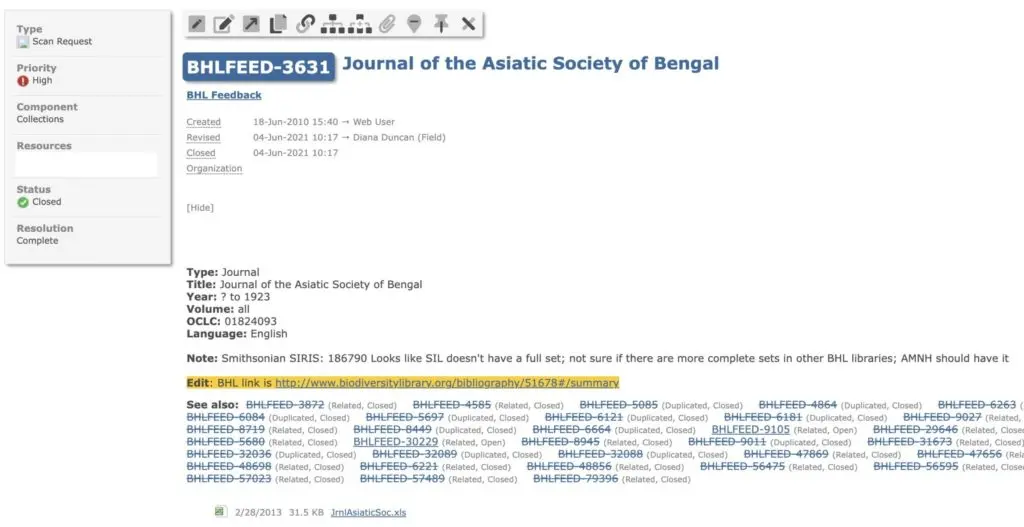
- 40 specialized tracking tickets within BHL’s internal issue-management infrastructure;
- 82+ detailed collaborative comments, troubleshooting notes, and curatorial logs;
- Countless unrecorded hours of physical scanning, quality control, metadata tagging, and platform integration.
The project encompassed numerous historical title iterations and name changes over centuries of publication, requiring catalogers to meticulously trace bibliographic lineages, verify publication dates, source missing issues from scattered library holdings, and ensure that every page met modern open-access standards.
Supporting Context & Metrics: Scanning Locally, Coordinating Globally
The sheer logistical challenge of coordinating 19 people across multiple institutions over an 11-year span cannot be overstated. Without a centralized, enterprise-grade workflow management system, the project would have collapsed under its own weight.
For BHL, that backbone has long been Gemini, an internal issue-tracking and project-management system. Utilized for decades, Gemini serves as the single source of truth for running the BHL website, scaling collections, troubleshooting services, and executing complex, multi-year digitization pipelines.

However, configuring an issue tracker originally designed for software development to handle the nuanced workflows of library digitization is no small feat. Gemini features a dizzying array of configuration and customization options—arguably too many for standard library use cases. Crafting an optimal information architecture to categorize tasks, track physical scan requests, identify collection gaps, and manage cataloging bottlenecks took years of trial, error, and administrative refinement.
This tracking environment proved indispensable. Managing the continuous back-and-forth between distributed team members—addressing physical book conditions, resolving software bugs, clarifying bibliographic metadata, and verifying page sequences—required a platform capable of maintaining transparent, candid collaboration. It transformed isolated local scanning rooms into a cohesive, globally synchronized collective.
The Reality of Decentralized Labor and Funding Pressures
Why did it take 11 years to complete the task? The answer reveals the structural realities of the Biodiversity Heritage Library.
Despite operating as the world’s largest open-access digital library for biodiversity literature and archives, BHL maintains no dedicated, centralized digitization or cataloging staff, nor does it possess a massive permanent endowment specifically earmarked for scanning. Instead, BHL operates on a distributed labor model. Each of its participating consortium partners contributes what they can, leveraging their own institutional staff, equipment, and resources to integrate and curate content.
This collaborative framework has sustained BHL for two decades, but it is intrinsically vulnerable to shifting institutional priorities and financial landscapes. A major inflection point occurred following the conclusion of BHL’s foundational grant funding through the MacArthur Foundation in 2013. In the wake of that transition, consortium partners experienced noticeable ebbs and flows in their internal digitization capacities.

Routine obstacles frequently disrupted the pipeline:
- Fluctuating institutional budgets and staffing shortages;
- The fragile physical condition of rare, centuries-old paper materials;
- Aging or incompatible digitization hardware and scanning equipment;
- Unforeseen software bugs and metadata schema incompatibilities;
- The continuous need for specialized staff documentation and cross-training.
Because BHL’s model allows partners to "come as they are," participating autonomously when time, funding, and resources permit, long-term multi-institution projects naturally require extended timelines. While this decentralized approach fosters deep community buy-in and resilience, it also underscores the chronic underfunding that underpins much of the digital preservation sector.
Official Statements and Strategic Insights
Reflecting on the completion of the Asiatic Society project and looking toward BHL’s future, Bianca Crowley emphasizes the urgent need to streamline these workflows as the organization enters its next chapter.
In recent months, BHL has undergone a significant organizational transition, moving toward a shared ownership model that is increasingly autonomous, globally distributed, and structurally independent of any single founding host institution. Guided by the core tenets of its new strategic framework, BHL is actively drafting a platform modernization plan designed to bolster efficiency.
According to Crowley, future-proofing the library’s operations requires prioritizing four foundational pillars outlined in BHL’s collection development policy: access, usability, discovery, and breadth. To achieve these goals and shorten turnaround times for complex historical collections, Crowley highlights several key imperatives for the organization’s evolution:

- Streamlining Metadata Pipelines: Reducing friction between disparate institutional cataloging systems to ensure ingested texts are instantly searchable and discoverable.
- Enhancing Cross-Platform Interoperability: Upgrading internal tools—moving beyond the friction of heavily customized trackers like Gemini—to create more intuitive, unified project management interfaces for global partners.
- Expanding Training and Documentation: Lowering the barrier to entry for new institutional partners by standardizing digitization best practices and documentation protocols.
- Securing Sustainable Centralized Support: While decentralized autonomy is a core strength, long-term financial sustainability requires exploring new funding streams to help subsidize the heavy processing and digitization costs of massive historical runs.
"Sustainability means not simply keeping the website running," Crowley notes, "but maintaining and growing its unique collection of biodiversity literature and archives."
Future Outlook: The Next Chapter for BHL
The successful conclusion of the Journal of The Asiatic Society digitization project is much more than a historical footnote; it is a profound testament to the persistence, grit, and shared vision of BHL’s global community. It demonstrates that when librarians, archivists, technologists, and researchers across continents unite under a common banner of open access, centuries of human knowledge can be rescued from physical decay and made freely available to anyone with an internet connection.
As BHL celebrates its 20th anniversary, the organization stands at a critical crossroads. The lessons learned from an 11-year archival marathon are already shaping its future trajectory. By embracing a more agile, autonomous organizational model and modernizing its technological infrastructure, BHL is positioning itself to tackle even greater archival challenges in the decades ahead.
However, the continuity of this vital work depends heavily on global engagement and community support. The treasures of the Biodiversity Heritage Library are not merely the rare texts resting on digital servers—they are the people whose daily care, collaboration, and determination bring those texts to the light of day.
Ensuring that this collaborative engine continues to hum for the next 20 years and beyond requires sustained investment. Supporters of open access, historical research, and global biodiversity are encouraged to explore ways to contribute to the Biodiversity Heritage Library through recurring donations, institutional partnerships, or planned gifts, ensuring that humanity’s shared intellectual heritage remains open and accessible for all generations to come.