For two decades, the Biodiversity Heritage Library (BHL) has served as the world’s premier digital repository for the foundational literature of the natural sciences. As part of the global celebration marking BHL’s 20th anniversary—highlighted through the curated special series BHL at 20: Treasures from the Biodiversity Heritage Library—attention turns to the American Midwest, specifically the pioneering contributions of two exceptional 19th- and early 20th-century scientists: Stephen A. Forbes and Charles Robertson.
Through rare archival materials and publications contributed by the University of Illinois Urbana-Champaign Library, modern researchers, historians, and environmental advocates are granted unprecedented access to the meticulous life’s work of these two intellectual giants. Forbes revolutionized ecological thinking by conceptualizing lakes and river systems as holistic, interconnected organisms, while Robertson amassed an astonishingly granular, decades-long dataset cataloging the exact relationships between hundreds of flowering plants and thousands of insect pollinators in Carlinville, Illinois.
Today, as contemporary science grapples with accelerating biodiversity loss, habitat fragmentation, and rapid climate shifts, the historical records left by Forbes and Robertson are far more than dusty relics of a bygone era. They represent irreplaceable ecological baselines. By integrating their hand-written collection logs, detailed correspondence, and masterworks such as The Fishes of Illinois and Flowers and Insects into digital ecosystems like the BHL, the scientific community can look backward to move forward, utilizing historical data to model ecological resilience and measure species decline across modern landscapes.
Detailed Chronology: A Century of Discovery
The scientific trajectories of Stephen A. Forbes and Charles Robertson spanned decades of profound industrial and agricultural transformation in the American Midwest. Their parallel lives reflect a time when rigorous, boots-on-the-ground natural history was rapidly evolving into formal, institutionalized ecological science.
[1844] Stephen A. Forbes born in Silver Creek, Illinois.
  │
[1858] Charles Robertson born in Carlinville, Illinois.
  │
[1886] Forbes receives the first-class medal from the Société d’Acclimation de France.
  │
[1894] Forbes establishes the Forbes Biological Station on the Illinois River.
  │
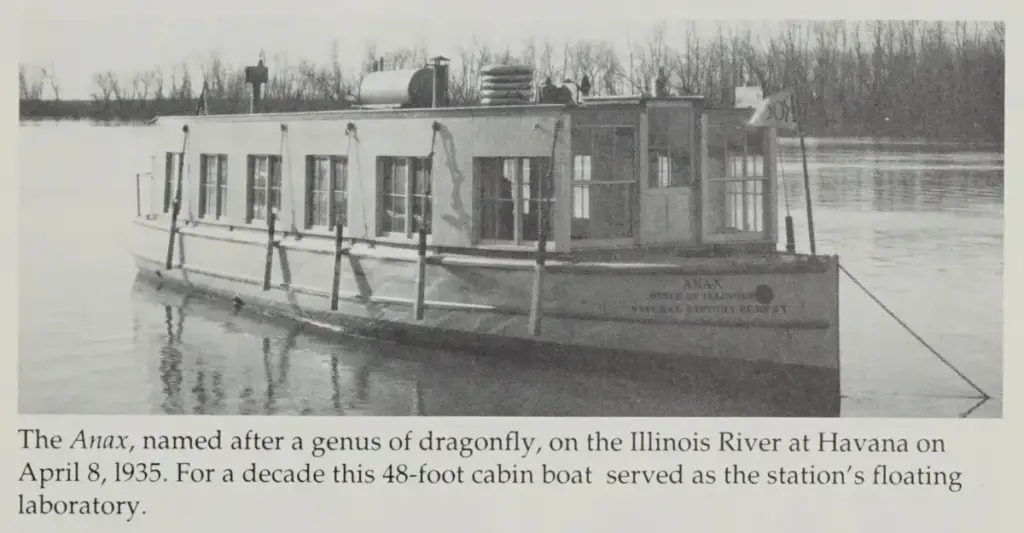
[1896] A 48-foot floating biological laboratory is constructed in Havana, Illinois.
  │
[1928] Robertson publishes his masterwork, "Flowers and Insects."
  │
[1930] Stephen A. Forbes passes away in Urbana, Illinois, at age 85.
  │
[1935] Charles Robertson passes away in Carlinville, Illinois, at age 76.
  │
[1994] The Illinois Natural History Survey celebrates the 150th anniversary of Forbes’ birth.
  │
[2026] BHL celebrates its 20th anniversary, spotlighting Illinois archives and data science analyses.
The Life and Times of Stephen A. Forbes (1844–1930)
Born on May 29, 1844, in Silver Creek, Illinois, Stephen Alfred Forbes emerged as one of the most versatile and influential natural scientists of the American nineteenth and early twentieth centuries. Serving as a professor of zoology and entomology, Forbes shaped the intellectual framework of the University of Illinois Urbana-Champaign and directed the Natural History Survey Division until his death on March 13, 1930.
Forbes’ early research broke conventional disciplinary boundaries. Rather than studying insects, fish, crustaceans, and birds in isolation, he examined how these organisms interacted with one another and their physical environments. This holistic vision culminated in his landmark 1887 essay, The Lake as a Microcosm, which is widely regarded as a foundational text in the development of modern ecological science. In this essay, Forbes conceptualized a body of water as a complex, dynamic system where predator-prey dynamics, resource competition, and environmental pressures maintain a delicate equilibrium.
His monumental 1908 publication, The Fishes of Illinois, co-authored with illustrative contributions from Lydia M. (Hart) Green and Charlotte M. Pinkerton, remains a masterclass in regional ichthyology. Documenting over 150 fish species across more than 200,000 specimens collected from every single county in Illinois (102 counties in total), the volume combined breathtakingly detailed color paintings with precise geographic distribution maps.
Recognizing the need for continuous, in-field aquatic research, Forbes established the Forbes Biological Station in Havana, Illinois, in 1894. Two years later, he oversaw the construction of a 48-foot floating biological laboratory on the Illinois River—a daring innovation that allowed researchers to live and work directly upon the aquatic ecosystems they studied. Today, this facility houses the Frank C. Bellrose Waterfowl Research Center and anchors a network of field stations operated by the Illinois Natural History Survey (INHS).
The Life and Times of Charles Robertson (1858–1935)
Born on June 12, 1858, in Carlinville, Illinois, Charles Robertson spent nearly his entire life anchored to his hometown. After pursuing formal studies in botany and zoology at Blackburn College and later at Harvard University, Robertson returned to Carlinville, where he taught biology and Greek.
While Forbes looked at aquatic systems on a regional, macro scale, Robertson focused his lens on the intimate, microscopic choreography occurring in Midwestern meadows and woodlands: the ecological relationship between flowering plants and insect pollinators. For over two decades, Robertson engaged in systematic, patient field observations that defied the fast pace of the industrializing world. He meticulously recorded 1,429 pollinating insect species—ranging from specialized bees and butterflies to flies and beetles—visiting 456 distinct plant species within a concentrated radius around Carlinville.
His comprehensive 1928 book, Flowers and Insects, stands as a monumental achievement in pollination ecology. Every single insect collection was cross-referenced directly with the host plant upon which it was gathered. Robertson’s personal life mirrored the methodical nature of his scholarship. He lived quietly in the town of his birth, maintained a tight circle of enduring friendships, and approached plant-pollinator interactions with a tranquil, unwavering focus. He was actively collecting insect specimens in Florida just months before his death on June 1, 1935.
Supporting Context & Metrics
The digitization efforts spearheaded by the University of Illinois Urbana-Champaign Library and hosted on the Biodiversity Heritage Library platform have unlocked vast arrays of historical metrics that continue to drive modern ecological investigations.
Quantitative Breakdown of Historical Datasets
150+ Fish species meticulously cataloged and illustrated in Stephen A. Forbes’ The Fishes of Illinois.
200,000+ Individual fish specimens collected across all 102 counties of Illinois to build Forbes’ definitive ichthyological baseline.
1,429 Distinct insect pollinator species recorded by Charles Robertson over a 20-year period in Macoupin County, Illinois.
456 Native plant species surveyed by Robertson to map exhaustive plant-pollinator interaction networks.
1877–1935 The comprehensive chronological span of Robertson’s surviving personal papers, correspondence, five field ledgers, and specialized bee data books preserved in the University of Illinois Archives.
The Modern Utility of Historical Data
The rigorous record-keeping of Forbes and Robertson is not merely of academic or historical interest; it provides modern scientists with irreplaceable empirical controls. In a landmark study published in Ecology & Society, researcher John Marlin—an affiliate with the Illinois Sustainable Technology Center and the INHS—utilized Charles Robertson’s meticulous collection logs to re-survey the exact geographic footprint of Carlinville, Illinois.
By comparing Robertson’s 19th-century pollinator inventories with contemporary surveys, researchers were able to quantify dramatic shifts and local extinctions within Midwestern plant-pollinator networks, directly illustrating the impacts of habitat conversion, intensive agriculture, and land-use change over the span of a century. Furthermore, a quantitative analysis published in the Data Science Journal highlighted how natural history archives can be computationally parsed to map historical biodiversity shifts at scale.
Official Statements and Institutional Tributes
The profound institutional and cultural impact of Stephen A. Forbes was formally captured during his lifetime and memorialized by his academic peers. Upon his passing, the University Senate at the University of Illinois put forth a sweeping resolution honoring his legacy:
"The Senate knew him as Professor of Zoology and Entomology and Dean of the College of Science; it admired his sagacity and patience as chairman of its Committee on Educational Policy; its members loved him for his simplicity, sincerity and broad human interests. The University and the State are immeasurably indebted to him as one of their most useful and eminent laborers for the common good."
Reflecting on the broader mission of bridging historical archives with digital accessibility through the Biodiversity Heritage Library, project contributors emphasize the unique intersection of human narrative and hard scientific data. Archival documents—ranging from personal field ledgers to handwritten correspondence—reveal the cultural values, institutional identities, and personal resilience that shaped the Illinois Natural History Survey.
As Abubakari Ssemwogerere, graduate assistant at Funk ACES and Veterinary Medicine Libraries at UIUC, notes through his work in academic librarianship and digital collections:
"Archival documents such as these reveal the values, culture, and identity that shaped the Illinois Natural History Survey and science in Illinois. Being able to trace the legacy of scientific research and lives of those behind these discoveries provides richer context and understanding for future scientific research."
Future Outlook: Bridging Past Discoveries with Modern Conservation
As the Biodiversity Heritage Library celebrates its landmark 20th anniversary, the inclusion of rare archival collections from institutions like the University of Illinois Urbana-Champaign underscores the vital role of open-access digital repositories in shaping the future of global conservation.
Environmental challenges in the 21st century—including climate change, invasive species proliferation, and catastrophic declines in insect biomass—cannot be fully understood by looking exclusively at contemporary data. Without historical baselines, modern ecologists run the risk of falling victim to "shifting baseline syndrome," where each generation accepts the degraded environmental conditions of their youth as the natural norm.
The life’s work of Stephen A. Forbes and Charles Robertson shatters that limitation. By preserving hand-drawn color plates, fragile specimen logs, field journals, and out-of-print monographs in freely accessible digital formats, BHL ensures that researchers worldwide can consult the ecological reality of the American Midwest as it existed more than a century ago.
Moving forward, the integration of historical natural history archives with machine learning, spatial mapping, and advanced data science pipelines will allow conservation biologists to model ecosystem recovery with unprecedented precision. The legacy of Forbes and Robertson lives on—not only in the physical field stations and preserved museum specimens scattered across Illinois, but in the global digital commons, where their meticulous observations continue to instruct, inspire, and protect the natural world for generations to come.