

Executive Overview
In a stunning and entirely unprecedented wildlife event, Southern California’s sun-drenched coastline has played host to a biological milestone. Marine biologists, wildlife officials, and stunned beachgoers are still processing an occurrence previously thought impossible: the first-ever recorded natural nesting of sea turtles anywhere on the United States West Coast.
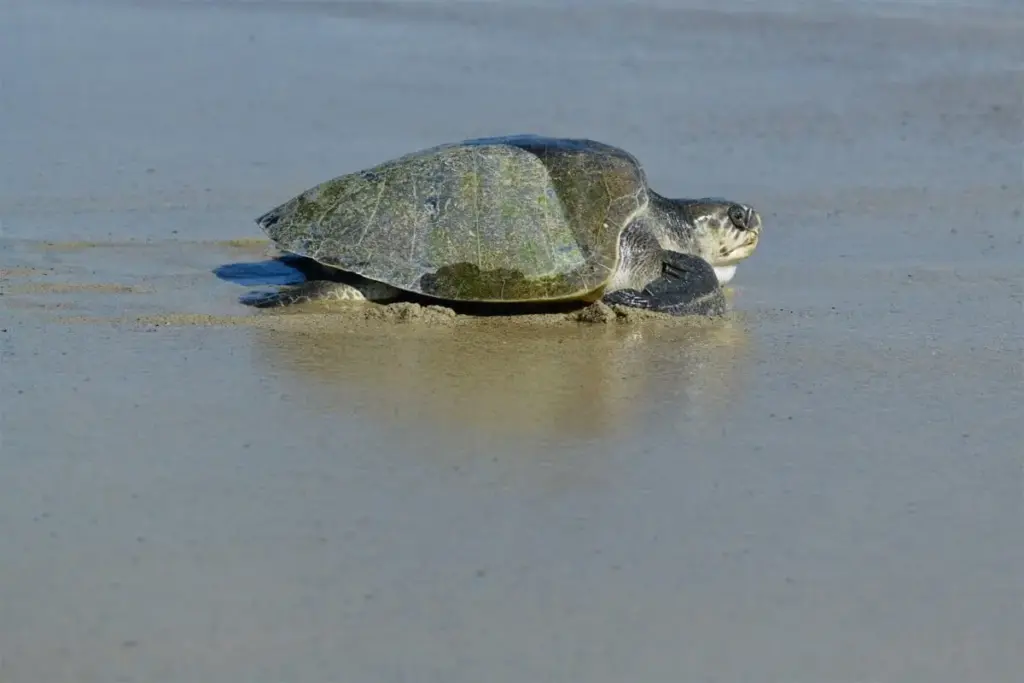
Initially mistaken by local night-shift lifeguards for a distressed or ailing marine creature struggling against the shifting coastal sands, the visitor was actually performing an ancient, instinctual ritual. She was laying eggs. Not once, but twice within the span of three days, an olive ridley sea turtle—or potentially the very same resilient reptile—surprised onlookers by crawling ashore in Orange County to establish clandestine subterranean nurseries.
The National Oceanic and Atmospheric Administration (NOAA) Fisheries West Coast division formally confirmed the momentous nature of the discoveries, verifying that no prior instance of natural sea turtle nesting has ever been documented along the continental western seaboard of the United States. This extraordinary happening has shifted the paradigms of marine biology, prompting urgent conversations regarding shifting ocean temperatures, climate adaptation, and the expanding geographic ranges of pelagic species. As municipal authorities race to protect the fragile subterranean clutches from human interference and environmental hazards, the community rallies around a shared hope: witnessing the safe emergence of a new generation of West Coast marine life.
Detailed Chronology: The Unfolding of a Marine Miracle
September 16: The Seal Beach Discovery
The extraordinary sequence of events began under the cover of darkness on September 16, near the community of Seal Beach in Orange County, California. Night patrols and beach safety personnel noticed an unusual dark shape hauling its heavy bulk across the sand. Given the rarity of such marine reptiles appearing on California beaches outside of cold-stunned stranding events, initial responders feared the animal was in acute distress.
Instead of struggling against the surf, the turtle was methodically excavating a deep egg chamber using its powerful rear flippers—a classic maternal nesting behavior. After depositing her clutch, the creature successfully returned to the Pacific Ocean, leaving behind a heavily guarded patch of sand that would soon command the attention of federal scientists. Officials later cordoned off the area, recognizing that they were dealing with an unprecedented ecological phenomenon.
September 19: Lightning Strikes Twice in Huntington Beach
Just as the local marine science community was attempting to comprehend the Seal Beach event, history repeated itself a mere three days later. On September 19, authorities received reports of another sea turtle sighting, this time a few miles away near the iconic Huntington Beach Pier.
Lifeguards patrolling the shoreline observed a reptile digging into the dunes. Trevor McDonald, marine safety chief at the Huntington Beach Fire Department, recalled the initial confusion of his crew.
"Lifeguards patrolling at night saw a turtle digging in the sand and thought, ‘Maybe this turtle is sick. We just don’t see this very often,’" McDonald explained. "Then they observed the turtle starting to lay eggs."
Realizing the profound significance of the sighting, the lifeguards immediately established a perimeter to protect the nesting mother from curious onlookers, stray dogs, and artificial lights that could disorient her. By morning, NOAA biologists were on the scene to inspect, document, and secure the second nest.
Supporting Context & Metrics: Understanding the Olive Ridley
To fully appreciate the gravity of these events, one must examine the biology and typical distribution of the species involved. The turtles responsible for these Southern California nests have been identified as olive ridleys (Lepidochelys olivacea).
Physical Characteristics and Global Distribution
Olive ridleys are recognized as the smallest and most abundant of all sea turtle species found globally. Fully grown adult specimens typically weigh up to 100 pounds (45.3 kilograms) and measure roughly two feet in shell length.
While they possess a cosmopolitan distribution, they are fundamentally creatures of warmth. NOAA notes that olive ridleys are primarily found inhabiting the tropical and subtropical waters of the Pacific, Indian, and Atlantic oceans. Historically, their primary nesting grounds in the Eastern Pacific are located far to the south, stretching from Mexico down through Central America, with occasional sporadic nesting events reported in the southernmost reaches of Baja California, Mexico.
The appearance of nesting olive ridleys in Southern California—hundreds of miles north of their established breeding range—represents a dramatic northward shift. Marine ecologists are now analyzing whether this is an isolated anomaly or an early indicator of shifting species distributions driven by persistent ocean warming trends, changing marine currents, and El Niño Southern Oscillation (ENSO) phases that push warm-water pelagic species far beyond their historical boundaries.
Incubation Dynamics and Environmental Vulnerability
Both nesting sites—near Seal Beach and the Huntington Beach Pier—were rapidly cordoned off by wildlife agencies to create a protective buffer zone. According to NOAA guidelines, the typical incubation period for olive ridley eggs spans between 45 and 60 days, heavily dependent on ambient sand temperatures. Warmer sand tends to accelerate embryonic development and typically yields a higher ratio of female hatchlings, whereas cooler temperatures prolong incubation and favor males.
However, the geographic location introduces immense vulnerability. Unlike the tropical beaches of Central America or the protected shores of major rookeries, Southern California beaches experience dramatic tidal shifts, heavy autumn storm swells, and intense human recreational activity. Furthermore, Southern California sand temperatures during late autumn can fluctuate wildly compared to equatorial zones, potentially impacting hatchling viability and development times.
Official Statements and Community Reaction
The revelation has sent ripples of excitement and wonder throughout the Southern California coastal community, transforming quiet beaches into hubs of educational fascination and conservation vigilance.
Federal and Municipal Responses
The official confirmation from NOAA via their West Coast Fisheries division social media channels galvanized the scientific community:
"This is the first-ever recorded natural nesting for any sea turtle species on the West Coast."
For local emergency and municipal services unaccustomed to managing wildlife nurseries on urbanized beaches, the discovery required immediate logistical adaptation. Trevor McDonald and his team at the Huntington Beach Fire Department expressed immense pride in their frontline staff, who recognized the behavior and safeguarded the site before professional biologists arrived.
"We’re excited about it," McDonald stated, emphasizing the department’s dedication to assisting state and federal wildlife agencies in protecting the precious cargo buried beneath the sand.
The Voice of the Public: Magic on the Shoreline
The discovery has also captured the collective imagination of residents, turning the anonymized expanse of the Southern California coast into a place of natural wonder.
Heidi Stephen, a local resident, shared how the news affected her family. She recounted how her 9-year-old son, Jude, urgently begged her to drive down to Huntington Beach just to catch a glimpse of the fenced-off nest site. Standing near the perimeter tape, Stephen encapsulated the prevailing sentiment of awe:
"It’s so magical."
For many residents, the nesting event serves as a poignant reminder of the resilience and adaptability of the natural world, even within heavily populated coastal zones. George Zamora, another local beachgoer, voiced a protective philosophy shared by many community members regarding the delicate weeks ahead:
"Let them do their thing. Let them be born."
Future Outlook: Conservation Challenges and Scientific Implications
As the countdown begins toward the anticipated 45-to-60-day incubation window, marine scientists, conservationists, and local authorities are bracing for an intense period of monitoring and management.
The Stakes for Marine Conservation
The successful incubation and emergence of these hatchlings would mark a watershed moment for West Coast marine ecology. However, numerous hurdles remain. Wildlife agencies face the delicate task of balancing public curiosity with absolute biological protection. Unauthorized human interference, artificial lighting that disorients emerging hatchlings (leading them toward parking lots and streets rather than the ocean), and predatory wildlife all pose severe threats to the nests.
A Harbinger of Climate Shift?
Beyond the immediate fate of the two Orange County clutches, researchers are looking at the broader ecological picture. As global sea surface temperatures continue to rise, marine species are increasingly forced to seek out cooler or novel habitats to complete their life cycles. If Southern California waters are becoming sufficiently warm to cue nesting instincts in tropical sea turtles, wildlife managers must prepare for the possibility that these occurrences may become more frequent in the years ahead.
For now, all eyes remain fixed on the quiet, fenced enclosures embedded within the bustling sands of Orange County. Beneath the surface, invisible to the millions of urban residents who call the coast home, a fragile and historic biological process is quietly unfolding—one that may redefine our understanding of West Coast marine wildlife forever.



