By Scott Meyer | Photographs by Rob Cardillo
(Originally published in the 2025 Rodale Institute Journal)
Executive Overview
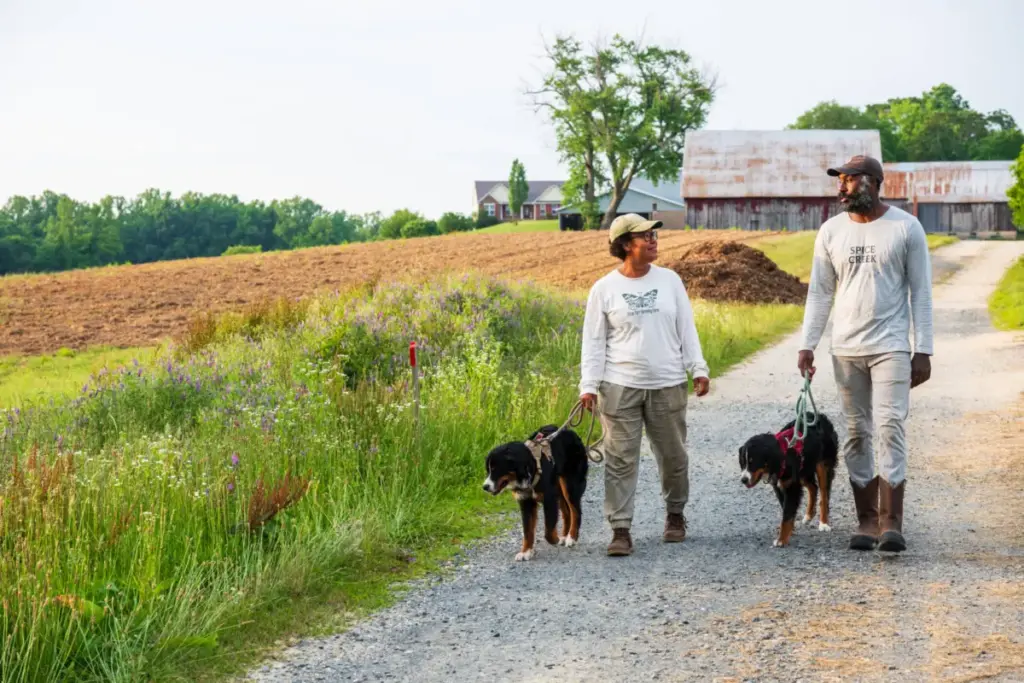
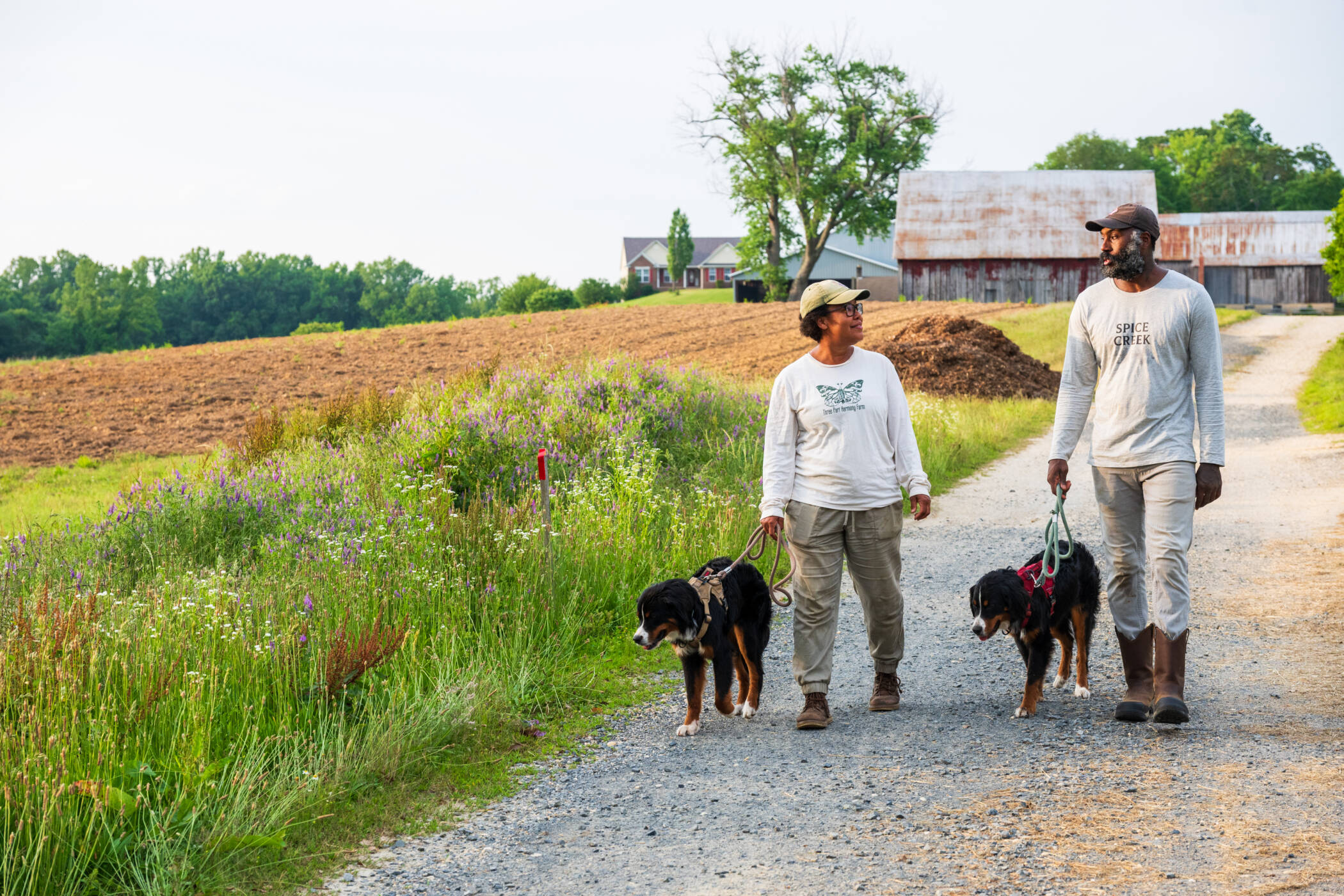
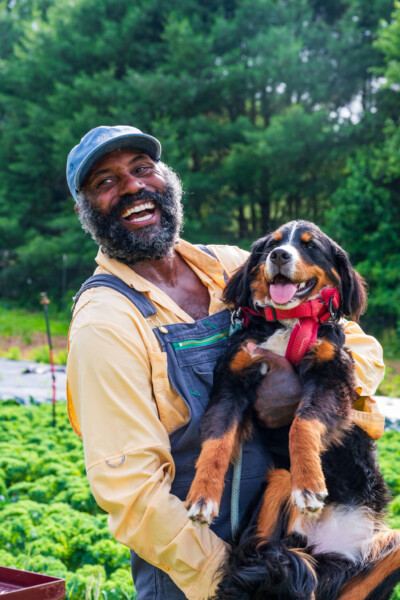
On a steamy, early summer day in Brandywine, Maryland, tomato plants stretch aggressively toward the sky, signaling an urgent need for support. D’Real Graham, tending the land alongside his life partner and agricultural collaborator Gail Taylor, calmly drives posts and sets up a wire trellis to train the heavy vines, ensuring the maturing fruit stays safely off the damp ground. Nearby, peppers and squash bulk up under the humid mid-Atlantic sun, while pristine rows of kale and chard reach their absolute productive peak. Darting between the rows are Ruby and Ivy, the couple’s loyal Bernese Mountain dogs, occasionally pausing to nibble on the nutrient-dense leafy greens.
This scene on the sprawling acreage of Spice Creek Farm represents far more than routine seasonal maintenance. It is the physical manifestation of an ambitious, deeply intentional mission: to build a healthy, equitable, and cooperative regional food system.
While Taylor spent more than a decade successfully raising food on a compact two-acre urban farm in Washington, D.C., the 2025 growing season marks the couple’s first full year on this expansive, 24-acre rural property located roughly 25 miles southeast of the District. Once a conventional tobacco farm, Spice Creek Farm is undergoing a radical, regenerative transformation.
Through a blend of ancestral land stewardship, modern organic practices, and community-centric economics, Taylor and Graham are laying the groundwork for what they call the "Black Agrarian Corridor" in southern Maryland. Their remarkable progress and visionary approach have rightfully earned them status as finalists for the inaugural U.S. Good Farmer Award—a prestigious joint initiative by the Rodale Institute and the Davines Group designed to honor exceptional agriculturalists driving positive environmental and social change.
Detailed Chronology: From Policy Desks to Rural Acreage
The path that brought Gail Taylor and D’Real Graham to the rolling fields of Brandywine is as unconventional as it is inspiring. Both came to agriculture not through generational family farms, but through professional pivots driven by a desire to create tangible, positive impacts in their communities.
Setting Down Roots in Maryland
Taylor spent her teenage years near Albany, New York, before earning a degree in U.S. foreign policy and Latin America from Syracuse University. Following stints working and studying in Guatemala and Chile, she relocated to Washington, D.C. Seeking an alternative to desk-bound policy work, she began volunteering in 2005 at Deep Roots Farm, a sprawling 200-acre regenerative organic farm in Upper Marlboro, Maryland.
Recognizing her dedication, proprietor Gale Livingstone hired Taylor for the following season. "I was looking for a change from policy work, and farming felt to me like I was having a positive impact for people," Taylor reflects. As her responsibilities expanded, so did her vision for food sovereignty.
Tired of the exhausting daily commute from the city to the rural farm, Taylor drafted a blueprint in 2011 for a backyard Community Supported Agriculture (CSA) subscription service. Operating out of her Washington home, she convinced three neighbors to lend their yards for cultivation while turning her own property into a seedling nursery. Every Thursday, she loaded a bicycle with harvests gathered from across the neighborhoods, dropping off shares on her porch for an initial group of six CSA members.
Legislative Advocacy and Urban Farming
Ambition soon outpaced backyard boundaries. Taylor identified an unused two-acre plot near Catholic University to scale up into a commercial urban farm, but local tax structures posed a severe hurdle. "D.C. had no policy for levying property taxes with agriculture exemptions like you find in so many places," Taylor explains.
Refusing to be deterred, she enlisted pro bono legal assistance from American University law students and spearheaded the legislative push that successfully passed the District’s 2014 DC Urban Farming and Food Security Act. This landmark legislation altered city tax laws and enabled municipalities to lease vacant land to urban growers. In 2015, Taylor launched Three Part Harmony Farm on the site. By 2024, its intensive 64-bed layout (each measuring 3 by 100 feet) yielded an astounding 7,000 pounds of fresh, organic produce annually.
A Shared Vision Takes Shape
Meanwhile, D’Real Graham was charting his own course away from traditional career tracks. Raised in Michigan, Graham pursued a career in education before relocating to Washington to work for an educational nonprofit. Like Taylor, he found his way to Deep Roots Farm as a volunteer.
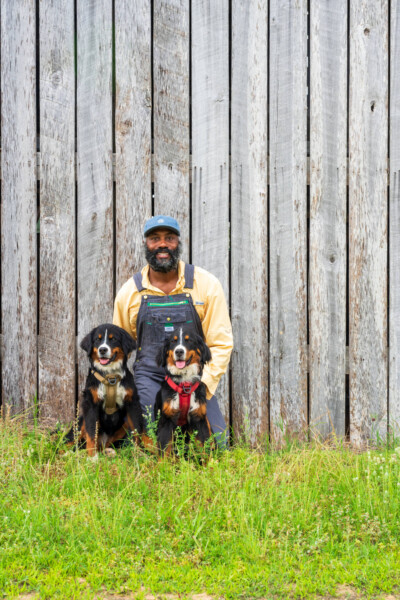
"I was ready to pivot from office culture to agriculture, but it was hard," Graham admits. "At first, Farmer Gale only trusted me to weed, but I came to it humbly and was willing to learn." His humility and work ethic paid off rapidly; by the end of his first season, he was piloting the delivery van and managing the farm’s stands at three weekly farmers markets.
After meeting at Deep Roots, Taylor and Graham formed both a life partnership and an operational alliance. In 2019, Graham joined Three Part Harmony Farm full-time. Together, the couple began searching for a larger canvas—a place where they could scale up production, escape the strict spatial limitations of city lots, and realize their long-held dream of establishing a regional food hub.
In 2022, they secured an initial lease on the Brandywine property, supplementing their urban output with rural harvests. By December 2023, backed by Dirt Capital Partners—a prominent investor in regenerative organic agriculture—the couple transitioned to a lease-to-purchase agreement, securing a permanent home for their expanding vision.
Supporting Context & Metrics: Rebuilding the Land
The 24-acre property in Brandywine carries deep historical weight and considerable ecological baggage. Originally owned for generations by the locally prominent Baden family, the land was historically exploited for intensive tobacco cultivation, and later for conventional corn and soybean production.
"I researched the history of this land, and I learned that 110 people had been enslaved here at one time," Graham notes, underscoring the profound spiritual and historical significance of Black farmers reclaiming and healing this soil today.
Bordered on one side by Spice Creek—which flows directly into the Patuxent River and ultimately feeds the Chesapeake Bay watershed—the farm occupies a sensitive ecological zone. When Taylor and Graham took over, the fields were severely degraded. Decades of heavy machinery used in conventional farming had heavily compacted the soil, while chemical weed control had stripped the earth of biological life.
+-------------------------------------------------------------+
|                     SPICE CREEK FARM METRICS                |
+-------------------------------------------------------------+
| Location:           Brandywine, Prince George's County, MD  |
| Total Acreage:      24 Acres                                |
| Vegetable Cultivation: 3 Acres (and rapidly expanding)      |
| CSA Membership:     150 Active Members                      |
| Production Cycle:   48 Weeks of Food Production Annually    |
+-------------------------------------------------------------+
Remediation and Infrastructure Development
Transforming the compacted clay into a thriving organic ecosystem required brute force and strategic investment.
- Soil Restoration: In the summer of 2022, the couple imported seven massive truckloads of compost. Renting a skid steer, Graham spent three grueling days meticulously spreading organic matter across the sloping fields.
- Physical Protections: They installed heavy-duty deer fencing to protect vulnerable crops and hand-dug initial beds for sweet potatoes, white potatoes, watermelons, eggplants, and tomatillos.
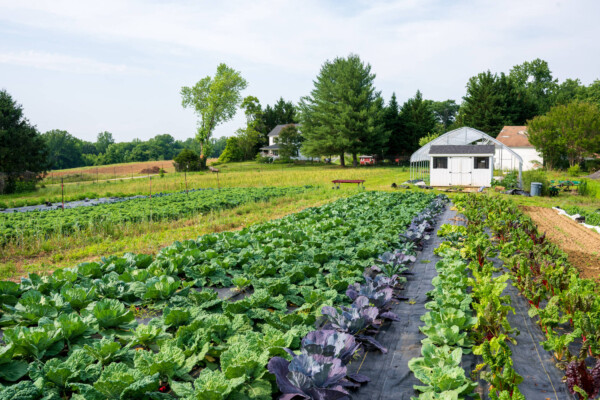
- Mechanization & Irrigation: Operations have since graduated to walk-behind tractors, comprehensive drip-irrigation water lines, an efficient post-harvest wash station, and a functional greenhouse used to propagate seedlings both for the farm and for neighboring growers.
- Diversification: Future projects include integrating cotton and cowpeas into the rotation. "We are growing cotton because we want to learn how to grow it and to restore our community’s relationship to the plant," Graham explains.
- Agroforestry & Livestock: A dedicated field near the roadside brick home has been planted with native species to attract pollinators. The couple is actively preparing to introduce pasture-raised chickens—guarded by their newly trained Bernese Mountain dogs, Ruby and Ivy—alongside goats designated for land clearing and brush management.
Official Statements & Expert Guidance
Scaling an agricultural enterprise from a few urban lots to 24 rural acres is fraught with logistical and financial obstacles. To navigate this critical growth phase, Taylor and Graham partnered with the Rodale Institute consulting team, accessing invaluable technical expertise.
The Value of Organic Consulting
Kegan Hilaire, Rodale Institute’s small farms and diversified vegetable consultant, has worked closely with the couple. Hilaire emphasizes that the hurdles facing Spice Creek Farm are common among transitioning operators.
"When farmers begin to scale up, they need to balance their short-term needs for infrastructure and equipment to keep up with their growth, while staying focused on their long-term plans," Hilaire explains. "A walk-behind tractor can get you started, for example, but it’s not going to be enough when you’寧 working 20 acres. You also need simple infrastructure for post-harvest preparation and storage that can handle the volume you’re harvesting now, while you save for a bigger cooler and processing space."
Rodale Institute consultants assist beginning and transitioning farmers with virtually every facet of enterprise management:
- Soil building, weed management, and sophisticated crop rotations.
- Navigating organic certification, meticulous recordkeeping, and inspection preparation.
- Identifying lucrative buyer markets, securing capital resources, and networking with peer agriculturalists.
To date, Rodale’s consulting network has partnered with over 1,000 farmers across the contiguous United States, successfully transitioning more than 45,000 acres to certified organic production as part of a larger institutional goal to convert 1 million acres.

Economic Realities and Labor Pressures
Despite institutional backing, external headwinds have complicated the journey. Federal funding and grant allocations for small-scale, organic operations experienced dramatic reductions heading into 2025.
"We didn’t bring a lot of capital to this," Graham notes candidly. "We have depended on grants for funding, and those cuts have had a big impact on us."
Labor is another persistent challenge. The historical trauma associated with agricultural labor in the United States continues to cast a long shadow, particularly for Black and brown communities. To combat labor shortages and attract dedicated workers, Taylor and Graham are reconfiguring their residential infrastructure. Currently housing one farmhand in the property’s historic roadside brick home, they are developing a smaller central cabin into their own private residence, freeing up the brick house entirely for employee housing.
Future Outlook: The Black Agrarian Corridor
Spice Creek Farm is designed to be much more than a standalone commercial enterprise; it is the nucleus of a collaborative regional movement. Rather than viewing nearby smallholders as competition, Taylor and Graham are actively forging alliances with half a dozen neighboring farms in southern Maryland.
This network communicates regularly to coordinate crop rotations, ensuring that local markets are supplied efficiently without market saturation. Beyond business logistics, the network provides essential social resilience. "We like to just sit down to meals together and talk with people who understand our lives," Graham says.
The Multi-Farm CSA Model
This cooperative philosophy underpins the couple’s ultimate economic strategy: resurrecting and expanding the multi-farm CSA model Taylor pioneered in Washington, D.C., where a single subscription distributed food sourced from 12 distinct regional producers to 270 households.
"We want to relaunch that idea here, creating important marketing opportunities for other farmers while offering customers the chance to choose to buy from Black farmers, women farmers, and regenerative organic farmers," Taylor explains. "We believe we can all succeed together."
Stewards of the Future
Ultimately, Taylor and Graham view their work through the lens of generational legacy and education. Plans are already underway to host educational workshops that demystify sustainable food production and ecological restoration for consumers.
"We aspire to be land stewards as much as farmers," Graham summarizes.
"We wake up every day with the goals of building the soil and producing food that’s good for people," adds Taylor. "We want to get to the point where we can nurture the next wave of beginning farmers."
Through unyielding grit, ecological restoration, and a steadfast commitment to community equity, Spice Creek Farm is doing far more than sowing a brighter future—it is harvesting a profound transformation across the landscape of southern Maryland.