In an era dominated by digital acceleration, prefabricated standardization, and hyper-optimized mass production, the fundamental relationship between human cognition and manual construction is undergoing a radical reassessment. Based in Saint-Ouen, Paris, the interdisciplinary practice Atelier CRAFT sits at the vanguard of this paradigm shift. Founded in 2016, the studio operates at the intricate intersection of architecture, spatial design, and scenography, bridging cultural, commercial, and social realms. Guided by the manifesto "Transform design through making," Atelier CRAFT rejects the rigid silos that traditionally separate intellectual design from physical execution.
Instead, the practice champions a philosophy of "thinking through the hand," a methodology wherein the workshop and the drawing board are inextricably intertwined. By merging raw timber, reclaimed industrial materials, and repurposed historical objects with contemporary construction logistics, the studio crafts spaces rooted deeply in circularity and reversible architecture. This comprehensive investigation explores Atelier CRAFT’s manifesto, their seminal projects—ranging from diplomatic pavilions to high-end commercial spaces—and their broader vision for a built environment where the artisan’s touch reclaims its rightful place in modern architectural discourse.
Detailed Chronology: The Evolution of Atelier CRAFT
To understand the current design philosophy of Atelier CRAFT, one must trace its evolution through a series of key milestones, material experiments, and landmark interventions.
2016: The Genesis of a Hybrid Practice
Atelier CRAFT was established in Saint-Ouen with a clear, disruptive mandate: to break down the barriers isolating architects from makers. The founding partners recognized that contemporary architectural practice had become overly reliant on two-dimensional digital representations, distancing designers from the tactile reality of physical materials. By embedding a fully functional workshop directly into their creative process, the founders established a working model where spatial solutions are not merely drafted on screen, but discovered through physical experimentation, prototyping, and iterative making.
2024: Bridging Centuries with Palanquin 1804–2024
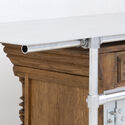
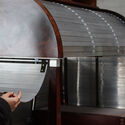
A critical inflection point in the studio’s conceptual trajectory arrived with the realization of Palanquin 1804–2024. Tasked with intervening on a prestigious, exquisitely crafted 19th-century piece of furniture, the studio confronted a masterclass in historical joinery. Prior to its arrival in the Saint-Ouen workshop, the design team had only studied the artifact through photographs. Upon physical inspection, the inherent wisdom of the historical joinery became immediately apparent: the piece had been originally engineered to be completely disassembled.
Despite enduring for over two centuries, the desk remained structurally pristine. Rather than locking the artifact into a static display state, Atelier CRAFT chose to honor the original craftspeople while injecting a contemporary narrative. They engineered a novel, reversible structural support system that gave the desk a fresh architectural purpose without permanently altering or damaging the historic fabric. The project successfully bridged three distinct timeframes—drawing upon the historical past, adapting it for modern utility, and ensuring its longevity into the future.
2025: Redefining Diplomatic Spaces through AMBACTOS
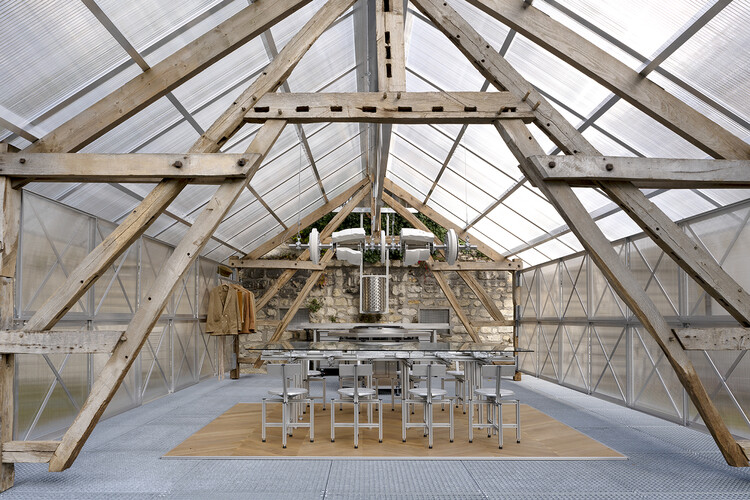
The year 2025 marked the realization of AMBACTOS, Tomorrow’s Embassy Kitchen, a project that encapsulated the studio’s socio-political engagement with labor, culture, and diplomacy. Recognizing that the authentic transmission of cultural heritage relies entirely on honoring the workers who create it, Atelier CRAFT placed culinary artisans and manual laborers at the absolute center of diplomatic representation.
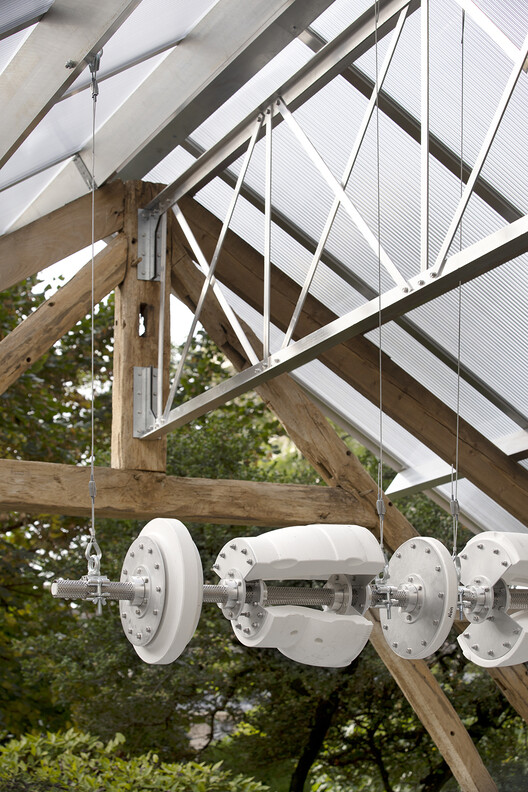
Within this pavilion, the kitchen transcends its utilitarian function to become a stage for French culinary arts and international hospitality. The architecture itself speaks a language of ecological and technical responsibility: the primary pavilion structure is built from reclaimed oak timber salvaged from the dismantling of an aging rural agricultural building. In a brilliant stroke of industrial reinterpretation, an abandoned industrial mold originally used for crafting porcelain vases at the prestigious Manufacture de Sèvres was salvaged and repurposed into a dramatic, suspended light fixture.
Late 2025: Commercial Scenography at L’Atelier Birkenstock
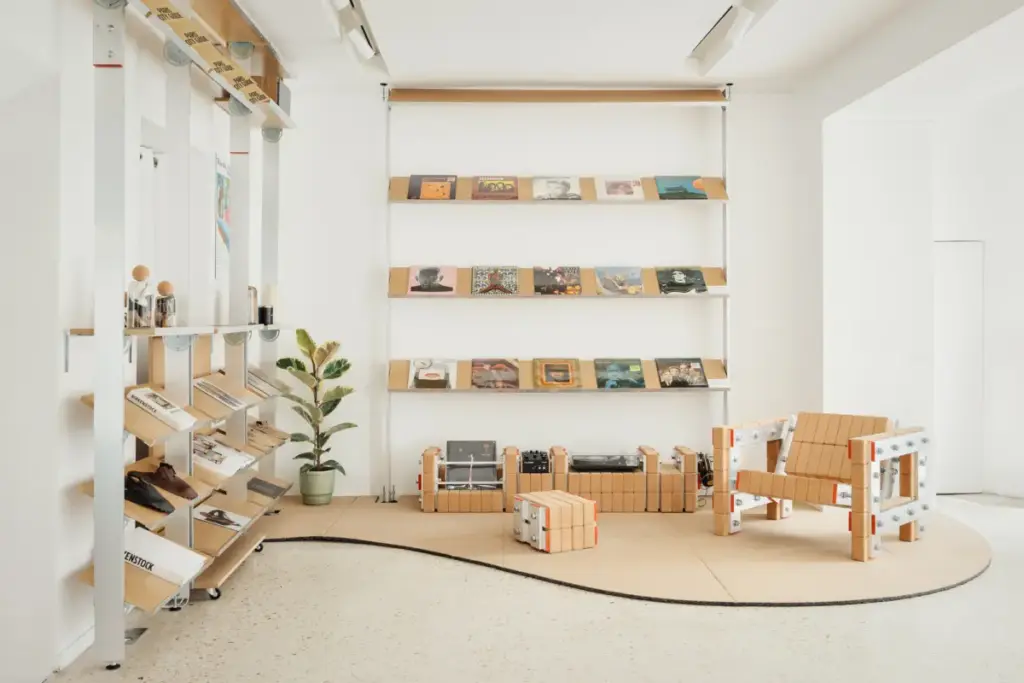
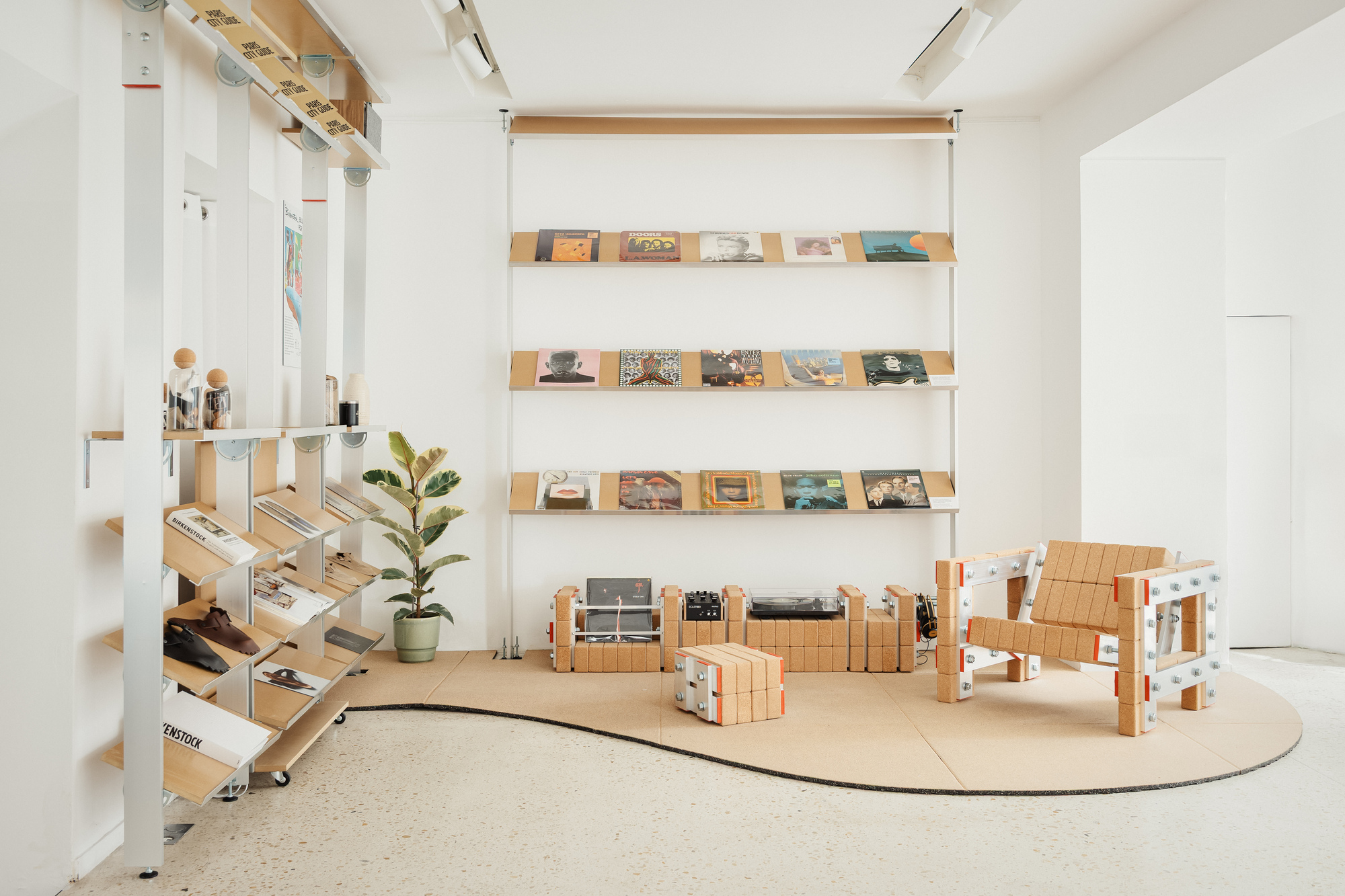
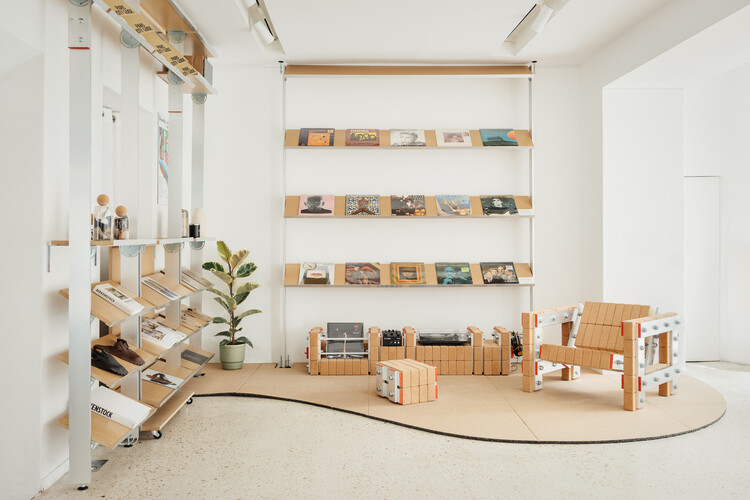
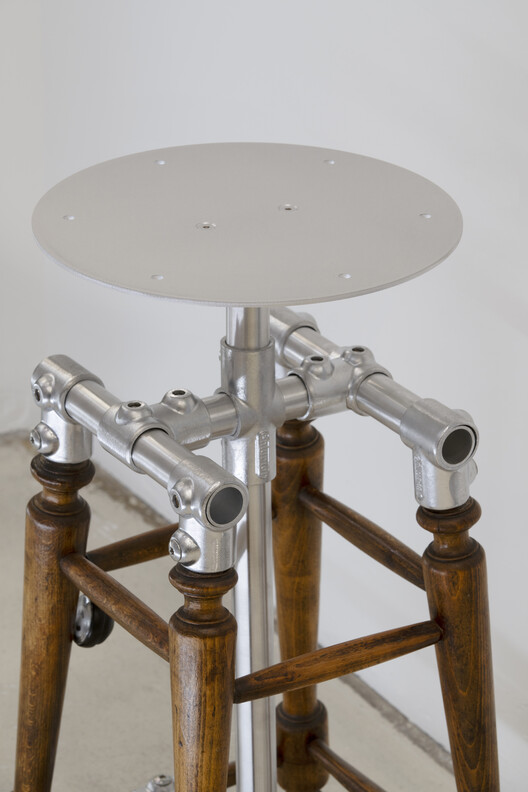
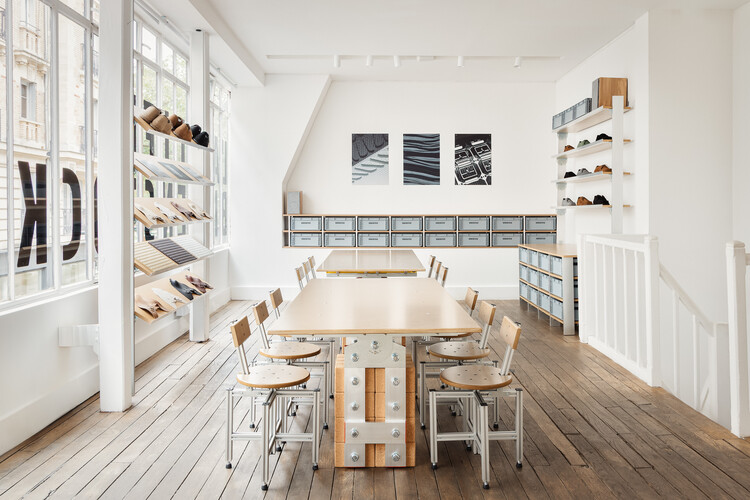
Demonstrating their versatility across sectors, Atelier CRAFT partnered with iconic footwear manufacturer Birkenstock to design L’Atelier Birkenstock. Because the client’s core manufacturing identity is rooted in the production of cork soles, the studio centered the spatial experience around recycled cork. This primary material was thoughtfully juxtaposed with utilitarian industrial components—such as aluminum mason’s rules and medium-density fiberboard (MDF). By maintaining radical transparency in how these elements were assembled, the design allowed visitors to intuitively comprehend the material logic of every surface, shelf, and display unit.
Supporting Context & Metrics: The Mechanics of Circularity
Atelier CRAFT’s operational framework operates on a rigorous matrix of material sourcing, structural reversibility, and the dialectic between mass production and individual craftsmanship.
The Five-Tier Material Sourcing Matrix
In addressing environmental responsibility without sacrificing poetic design, the studio has codified its material acquisition into a strict five-tier hierarchy:
Rental: Utilized primarily for ephemeral, short-term scenography and temporary architectural installations.
Borrowing: Securing elements temporarily from clients, partnering institutions, or specialized material libraries.
Secondhand Acquisition: Sourcing structural and decorative elements from the burgeoning reuse and deconstruction markets.
Workshop Stock: Utilizing accumulated offcuts, trial pieces, and leftover inventories directly from their Saint-Ouen workshop.
New Procurement: Purchasing virgin materials strictly under the strict mandate that the final installation guarantees total reversibility and future disassembly.
Industry versus Craft: The Semi-Industrial Synthesis
The studio’s work occupies a delicate middle ground between manual fabrication and semi-industrial efficiency. Mass industrialization offers undeniable advantages in terms of cost optimization, speed, and structural standardization; however, its fatal flaw lies in its homogenization of space—it tends to de-specify and flatten local character. Conversely, pure "Do-It-Yourself" (DIY) methodologies guarantee uniqueness, but are rarely scalable or reproducible.
Atelier CRAFT navigates this tension by interrogating industrial systems, reclaiming their underlying manufacturing efficiencies, and applying them at smaller, highly contextualized scales. By integrating the speed of industry with the adaptability of the artisan’s hand, they achieve spaces that are simultaneously optimized and hyper-localized.
Official Statements & Design Philosophy
In an exclusive dialogue with ArchDaily curator Agustina Íñiguez, the founding principals of Atelier CRAFT articulated the core tenets that govern their practice:
On the Genesis of Projects: "Our design process always begins with a story: we research historical, social, and cultural narratives. This is why our choices for each project or client are always grounded in the context, either with materials or historical references. After years of making, we’ve also begun to define a constructive language and recognize our obsessions: the repurposing of objects, the beauty of raw material, and craft. We summarize our philosophy in one sentence: Transform design through making."
On the Hybrid Practice of Designer-Maker: "Bringing together the design and the making has always been a guiding principle since the beginning. It is also what brought us together in the first place: the need to challenge our fields of work, to break down boundaries between architecture, design, and craftsmanship. Having our design studio and workshop intertwined allows us to create in a very organic way and with great freedom: we don’t need to draw everything because most design solutions emerge in the workshop while experimenting."
On the Rejection of Pastiche and the Value of Existing Objects: "Existing objects provide historical connections that probably would not have occurred to us if we’d had to design the object from scratch. It’s an endless source of inspiration for the studio. For us, using antique objects or elements is our way of preserving and paying tribute to craft traditions and the artisans who made these pieces. However, we always seek to avoid creating pastiches; the existing material or object remains a starting point that we must transpose into our era for modern uses."
On the Philosophy of Time: "In this way, our purpose is to create timeless objects and spaces that draw on the past, which we try to adapt into present uses so that it can endure into the future. Our work attempts to conciliate these three timeframes."
Future Outlook: Reclaiming the Hand in Architectural Education
Looking toward the horizon, Atelier CRAFT advocates for a fundamental institutional reckoning within the architectural profession. The studio envisions a near future characterized by the reconciliation of the mind and the hand—a reintegration of physical making into academic architecture programs.
Currently, the fast-paced economic models and compressed timelines of modern real estate development force the built environment to rely almost exclusively on automated, highly industrialized construction methods. However, as global cities pivot increasingly toward the rehabilitation, adaptive reuse, and deep retrofitting of existing building stocks, the limitations of rigid industrial standardization become glaringly apparent.
Transforming existing architectural structures demands constant, on-site adaptation—a reality that naturally invites a return to craft-based methodologies and a synthesis between manual dexterity and industrial precision. Crafting, as Atelier CRAFT demonstrates, is not merely a nostalgic aesthetic style or a superficial decorative finish; it is an agile, responsive process focused on how things are made, how they are joined, and how they can eventually be unmade. If the architectural discipline is willing to invest the necessary resources and time, this hands-on ethos can be scaled to transform the entire built environment, ensuring that the spaces of tomorrow remain adaptable, sustainable, and profoundly human.