By Heather Clancy
Executive Overview
For years, the public conversation surrounding the environmental footprint of the booming digital economy has focused squarely on direct consumption: the buzzing evaporative chillers, the vast cooling towers, and the gallons of municipal water pumped directly onto server room floors to keep artificial intelligence (AI) models and cloud infrastructure from overheating. Yet, this visible water usage tells only half the story.
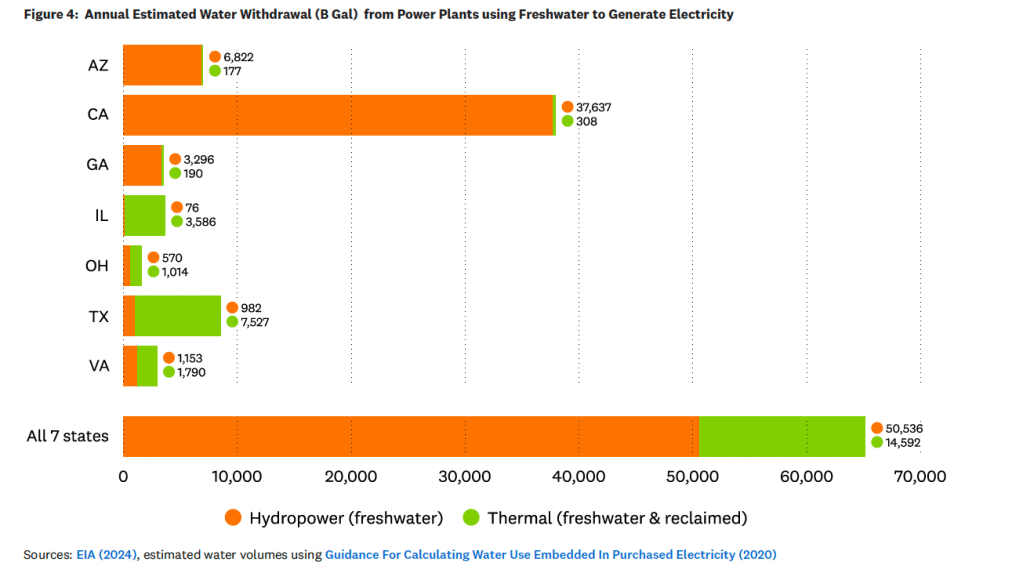
A landmark analysis published on August 25 by the sustainability nonprofit Ceres reveals that the true liquid footprint of the digital age lies far away from the server racks, hidden deep within the thermal power plants that generate the electricity required to keep them running. According to the report, titled Water Behind the Watts: The Hidden Risk of Powering Data Centers, thermal electricity generation—encompassing fossil fuels and nuclear energy—accounts for an astounding 3 to 4 trillion gallons of freshwater withdrawals annually across just seven U.S. states. Together, these seven states host more than half of all data centers in the United States.
This indirect water consumption completely reshapes how tech companies, regulators, and environmentalists must view digital infrastructure. For instance, the annual water withdrawals required simply to generate the electricity powering data centers in Virginia in 2024 are estimated to be a staggering 21 times the amount used by the entire city of Washington, D.C. As tech giants like Amazon, Meta, Microsoft, and OpenAI rush to secure massive new power supplies—frequently turning to natural gas to fuel energy-hungry AI workloads—the strain on regional watersheds is reaching a critical inflection point.
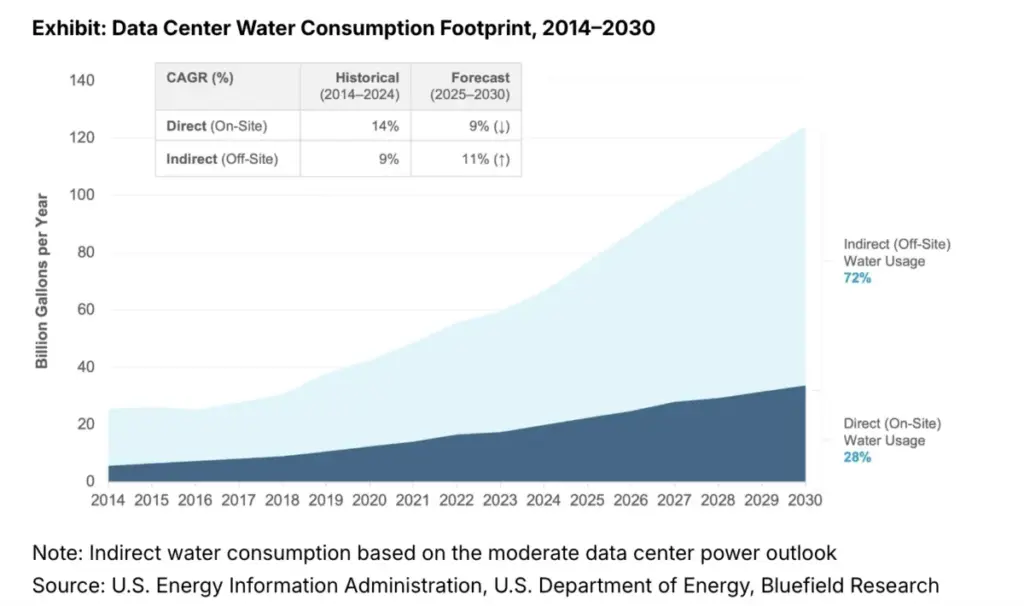
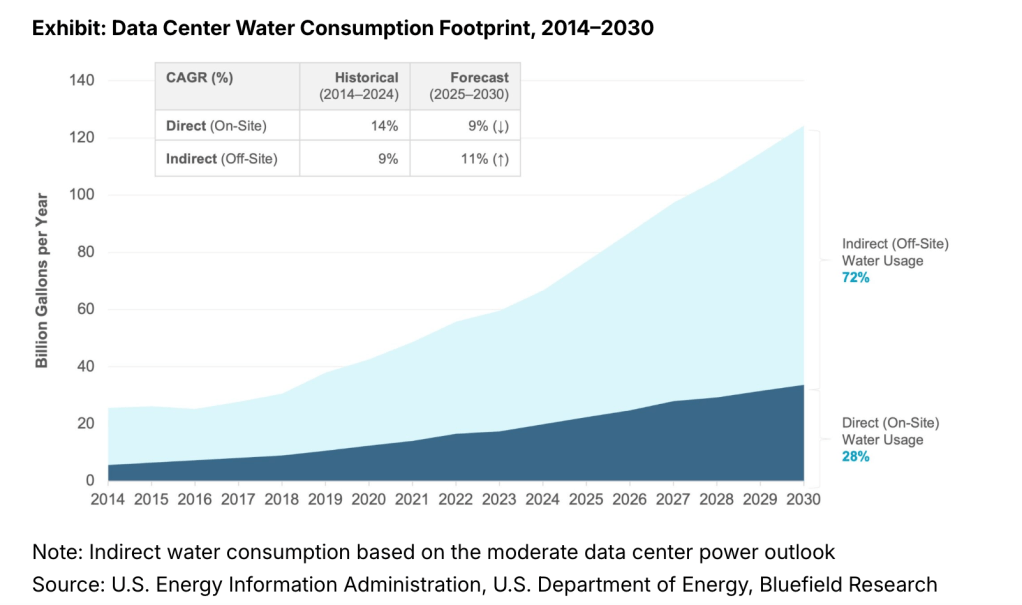
With separate projections from Bluefield Research indicating that the water footprint tied to data center electricity generation is doubling annually and will represent over 70 percent of total data center water consumption by 2030, the industry faces an urgent, invisible crisis. Without standardized metrics, transparent disclosure, and proactive site-selection strategies that account for watershed stress, the digital revolution risks colliding head-on with severe water scarcity.
Detailed Chronology: The Unfolding Crisis of Indirect Water Use
To understand how the tech industry arrived at this invisible water crisis, it is necessary to examine the convergence of the artificial intelligence boom, shifting energy grid dynamics, and the delayed realization of policymakers and environmental auditors.
- The Pre-AI Era (Early 2010s–2020): For the past decade, data center expansion was largely evaluated through a carbon lens. Corporate sustainability reports celebrated targets centered on Power Usage Effectiveness (PUE) and renewable energy procurement through Power Purchase Agreements (PPAs) for wind and solar farms. Direct water usage—chiefly driven by evaporative cooling systems—was scrutinized primarily in hyper-arid regions like Arizona, but the indirect water embedded in grid electricity remained largely unquantified in corporate ESG disclosures.
- The Generative AI Explosion (2023–2024): The launch of advanced generative AI models triggered an unprecedented wave of digital infrastructure construction. Facilities designed to train and run massive language models required densities per rack that far exceeded traditional cloud computing servers. Power demands skyrocketed from megawatt scales to gigawatt scales. To meet this unquenchable thirst for electricity, tech operators scrambled for power, leading to a resurgence in regional grid dependence, including life-extension agreements for nuclear plants and a rapid expansion of natural gas-fueled generation capacity.
- August 25, 2026 – The Ceres Revelation: Publishing its exhaustive analysis, Water Behind the Watts, Ceres brought the hidden water-energy nexus into sharp focus. The report shifted analytical frameworks by quantifying the millions—and trillions—of gallons of freshwater withdrawn by thermoelectric and hydroelectric plants dedicated to servicing digital hubs in seven key states. The findings shattered the assumption that tech companies operating in water-abundant regions were insulated from watershed impacts.
- Late 2026 and Beyond – The Looming 2030 Horizon: Industry analysts, including teams at Bluefield Research, began charting the trajectory of these hidden withdrawals. With data center electricity demand projected to nearly double or triple by the end of the decade, forecasts revealed that indirect water use would soon dwarf direct facility consumption, accounting for more than 70 percent of the industry’s total water footprint by 2030. The push for standardization and unified measurement tools became an urgent priority for corporate boards and environmental regulators alike.
Supporting Context & Metrics: Breaking Down the Numbers
Water consumption and withdrawal rates are heavily dictated by the specific energy mix powering a regional grid. Not all kilowatt-hours are created equal when it comes to liquid impact. Thermoelectric power plants—which use heat to generate steam that spins turbines—require immense volumes of water for cooling purposes.
The Regional Breakdown: Hydro vs. Thermal vs. Renewables
The Ceres analysis evaluated the water impacts across seven states housing more than 50% of the nation’s data center capacity, revealing stark geographic disparities based on regional energy portfolios:
- California (The Hydro Heavyweight): California recorded the highest freshwater withdrawal volume among the analyzed states, pulling nearly 1.4 trillion gallons. This massive footprint was primarily driven by the state’s heavy reliance on hydroelectric generation, which, while low in carbon emissions, exhibits high water withdrawal and evaporative loss characteristics depending on reservoir management.
- Virginia (The Data Center Capital): Northern Virginia’s "Data Center Alley" represents the densest concentration of computing infrastructure on Earth. More than 90 percent of the indirect water use linked to data centers in Virginia, Ohio, and Georgia is tied to their heavy reliance on thermal generation sources, including natural gas, coal, and nuclear energy. The scale is staggering: the water needed for electricity powering Virginia’s data centers in 2024 alone is estimated at 21 times the municipal water consumption of Washington, D.C.
- Ohio and Georgia (The Thermal Corridor): Mirroring Virginia, these states rely heavily on traditional thermal fleets. The coupling of data center load growth with fossil and nuclear generation locks these states into high indirect water withdrawal trajectories.
- Texas (The Renewable Buffer): Texas registered lower average water withdrawals per unit of data center load compared to thermal-heavy states. This relative efficiency is attributable to the Lone Star State’s robust integration of grid-tied wind and solar resources, which require virtually no water during the operational phase of electricity generation.
- Arizona and Illinois (The Vulnerable Frontiers): While Arizona utilizes a mix of resources, its primary vulnerability lies in severe, chronic water stress and regional drought. Illinois, hosting major digital hubs in the Chicago metropolitan area, faces growing aquatic stress linked to Midwestern weather volatility. Ceres highlighted both states as prime examples of locations where future data center site-selection must prioritize watershed health alongside land and fiber availability.
The Natural Gas Dilemma
A troubling paradox is emerging within the tech sector. To meet corporate net-zero carbon goals, tech giants have historically favored wind and solar. However, the 24/7/365 baseload requirements of modern AI training clusters cannot rely solely on intermittent renewables without massive battery storage infrastructure.
Consequently, companies like Amazon, Meta, Microsoft, and OpenAI have increasingly pursued direct arrangements or grid expansions involving natural gas-fueled capacity. From an emissions reduction perspective, natural gas is often viewed as a bridge fuel; however, from a water perspective, natural gas-fired thermoelectric plants add heavily to the indirect freshwater withdrawal ledger, compounding the crisis.
Official Statements and Industry Expert Perspectives
The lack of transparency surrounding indirect water procurement has drawn sharp rebukes from environmental researchers and financial analysts who argue that corporate reporting is dangerously incomplete.
Shama Perveen, director of water research at Ceres and co-author of the Water Behind the Watts report, emphasized that corporate disclosures must evolve to encompass the entire supply chain of energy procurement:
"This is the foundation for better understanding water risk linked to procuring electricity and working with power producers and peers in a precompetitive space on best practices to minimize impacts to local water resources, especially in water-stressed areas," Perveen stated.
She noted that while tech firms routinely report their direct PUE and facility-level water usage effectiveness (WUE), they systematically overlook the trillions of gallons drawn by the power plants lighting up their server farms. Without this baseline transparency, true corporate water stewardship remains impossible.
Echoing these concerns, Jonathan Koomey, a preeminent researcher who has published extensive studies on data center energy and water dynamics, pointed out the chaotic state of measurement standards across the digital infrastructure sector:
"It’s a real problem the industry needs to figure out," Koomey asserted. "They are being confronted with numbers that are all over the general landscape. People don’t have a clear way to measure this, and there aren’t clear standards."
Koomey’s warnings highlight a systemic vulnerability: when tech executives claim their facilities are "water-neutral" or "water-positive," they are typically accounting only for localized, on-site consumption offsets. They ignore the millions of gallons boiling away in cooling loops at upstream power stations hundreds of miles away.
Future Outlook: Navigating the 2030 Water Horizon
As the digital economy barrels toward 2030, the intersection of artificial intelligence, energy demand, and water security will define corporate social responsibility in the tech sector. Projections from Bluefield Research indicate that the water footprint tied directly to data center power generation is doubling annually, set to command over 70 percent of the industry’s total water consumption by the end of the decade.
To avert regulatory crackdowns, community pushback, and severe operational disruptions, a multi-faceted transformation is urgently required:
1. Standardized Scope 3 Water Accounting
Just as greenhouse gas protocols distinguish between direct emissions (Scope 1) and indirect supply chain emissions (Scope 2 and 3), the tech industry must adopt comprehensive water accounting standards. This framework must attribute regional power plant withdrawals directly to the corporate buyers consuming the kilowatt-hours.
2. Watershed-Smart Site Selection
Geographic expansion strategies must move beyond cheap land, tax incentives, and fiber connectivity. Data center developers must evaluate local watershed stress, aquifer depletion rates, and the specific water intensity of the local utility grid before breaking ground on new facilities. Building massive AI training clusters in drought-prone regions tied to thermal-heavy grids is no longer viable.
3. Precompetitive Collaboration and Grid Decarbonization
Tech giants must move past isolated corporate offsetting schemes and engage in precompetitive collaboration with power producers, utilities, and municipal water authorities. By accelerating the deployment of water-free renewable energy (solar and wind) paired with long-duration energy storage—and supporting advanced, closed-loop or dry-cooled nuclear technologies—the industry can simultaneously slash both its carbon emissions and its hidden liquid ledger.
The digital cloud may feel weightless to the billions of users interacting with it daily, but its foundation rests on a very physical, increasingly strained resource. Unless the technology sector confronts the water behind the watts, the thirst of the AI revolution may outpace the capacity of America’s most vital watersheds.