

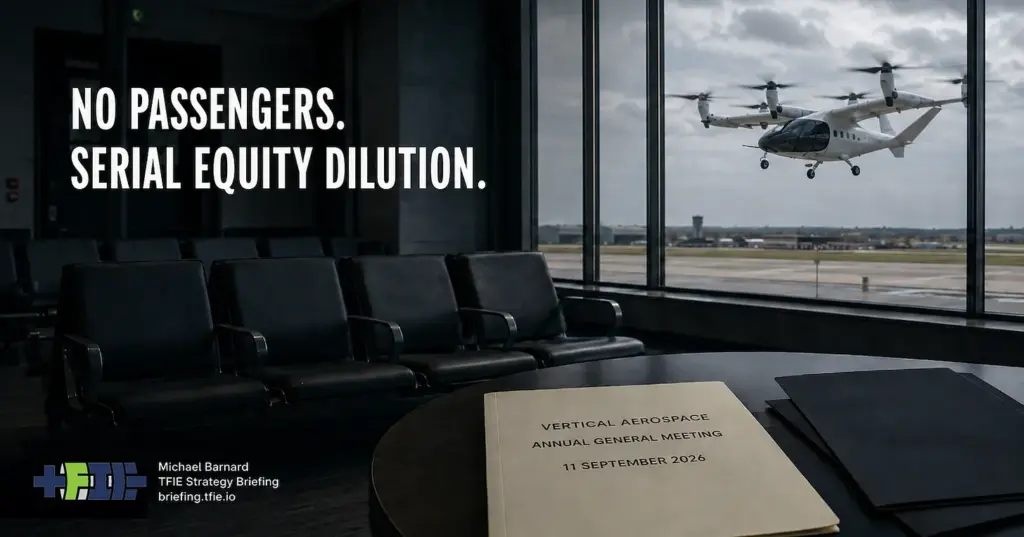
Executive Overview
The evolution of advanced air mobility (AAM) has long been defined by a stark duality: breathtaking engineering milestones set against grueling, capital-intensive commercial realities. No enterprise illustrates this tension more clearly than Vertical Aerospace.
Following its high-profile public listing via a Special Purpose Acquisition Company (SPAC) merger in late 2021, the company has navigated a turbulent five-year landscape marked by shifting development timelines, complex corporate restructuring, and persistent reliance on outside capital. Yet, amidst these financial headwinds, Vertical’s engineering team has delivered tangible progress. The company’s successful public demonstration of piloted transition flights between vertical lift and wingborne flight at the Farnborough International Airshow marked a major technical watershed.
However, as industry observers and financial analysts increasingly point out, engineering success does not automatically translate into commercial viability. While Vertical’s recent flight milestones have successfully narrowed technical uncertainty, they have done little to resolve the profound commercial and infrastructural questions facing the urban electric vertical takeoff and landing (eVTOL) sector. With commercial operations targeted for 2029, a growing capital stack, and lingering pressures regarding its New York Stock Exchange (NYSE) listing compliance, Vertical stands as a prime case study in the high-stakes gamble of trying to invent an entirely new mass passenger market from the ground up.
Detailed Chronology: From Public Listing to Farnborough and Beyond
To understand Vertical Aerospace’s current standing, it is necessary to trace the trajectory of its financial and operational roadmap since it entered the public markets.
2021: The SPAC Debut and Initial Projections
When Vertical Aerospace listed on the NYSE in November 2021 following its merger with Broadstone Acquisition Corp., the market narrative was built on a relatively straightforward financial proposition. The transaction yielded approximately $300 million in gross proceeds, bolstered by convertible senior secured notes. At the time, this capital was projected to comfortably exceed the roughly $250 million the company estimated it would need to spend to achieve type certification and scale production.
The ambition was clear: secure a public listing, leverage the proceeds to finalize aircraft development, and transition smoothly toward commercial manufacturing. However, like many early-stage aerospace ventures, reality quickly outpaced initial projections. Aerospace development cycles are notoriously unforgiving, subject to regulatory delays, supply chain bottlenecks, and escalating testing requirements.
2024: Facing the Compliance Crucible
As development costs mounted and certification timelines shifted to the right, financial pressure began to mount on the company’s equity valuation. By 2024, Vertical’s share price dipped below the NYSE’s $1 minimum continued-listing threshold, triggering regulatory warnings.
To maintain compliance and preserve its access to public capital markets, Vertical implemented a one-for-ten reverse share split in September 2024. While this maneuver successfully adjusted the nominal share price, it underscored the persistent vulnerability of pre-revenue aerospace companies whose operational timelines stretch far beyond initial investor horizons.

2026: The Farnborough Breakthrough and August Financing
The summer of 2026 brought a much-needed injection of positive momentum on the engineering front. At the Farnborough International Airshow in July, Vertical executed public, piloted transitions between vertical and wingborne flight on successive days before a large audience. For an industry where safety and repeatable performance are paramount, this was a vital proof-of-concept.
Shortly after the airshow, Vertical announced approximately $100 million in fresh financing in August 2026. According to the company’s H1 2026 business update, this capital injection—alongside anticipated facility draws and existing cash reserves—provided at least 12 months of operational runway. This funding allowed the company to maintain momentum on certification activities, manufacturing readiness, and hybrid-electric development programs heading into its September 11 Annual General Meeting (AGM).
Supporting Context & Metrics: The Architecture of Capital and Market Uncertainty
The core tension underlying Vertical Aerospace’s journey—and indeed the broader eVTOL sector—lies in the chasm between technical feasibility and commercial viability.
The Capital Stack Evolution
Vertical’s financing history reveals a steady evolution away from the simple equity model promised during its 2021 debut. Over the past five years, the company’s capital structure has grown increasingly complex, incorporating a mix of common equity, convertible securities, preferred capital, and committed financing facilities.
This layered financing structure carries significant implications for common shareholders, introducing dilution risks and complex liquidation preferences. Yet, for an enterprise still years away from generating ticket revenue, the ability to continually tap outside capital markets is not a sign of failure—it is the literal lifeblood of the program. Development-stage aerospace is brutally expensive, and maintaining options to raise capital remains essential as the company targets type certification in 2029.
The Problem of Inventing a Market
The broader strategic dilemma facing Vertical and its peers was highlighted in comparative analyses of advanced air mobility versus regional electric aviation:
- The Regional Model: Traditional regional electric aircraft developments, while still exposed to technical and regulatory hurdles, build upon existing infrastructure. They target established airlines, known routes, and validated passenger demand.
- The eVTOL Model: Urban and premium eVTOL passenger services face a dual burden. They must prove not only that the aircraft can fly safely and efficiently, but also that an entirely new mass passenger market exists—one large enough to support the immense costs of vehicle development, regulatory certification, industrialization, and specialized urban vertiport infrastructure.
Farnborough successfully narrowed technical uncertainty by demonstrating that the aircraft could execute complex flight regimes. However, it did little to resolve commercial uncertainty. Routine passenger service, high daily utilization rates, and operational profitability remain unproven hypotheses.
Official Statements & Industry Perspectives
Reflecting on the milestone achieved at Farnborough and the financial realities underscored by the company’s ongoing disclosures, industry analysts have emphasized the importance of evaluating technical progress and commercial readiness as two entirely separate categories.

Speaking on the nature of advanced air mobility development, market commentators have repeatedly stressed that successive financing rounds should not be automatically dismissed as indicators of corporate distress. In the words of observers tracking the sector’s maturation:
"Development-stage aerospace companies routinely need successive rounds of capital, and a company that can still raise money has options. It does mean the programme has not made the transition from investor financing to customer financing."
Furthermore, as the company faced renewed pressure around the NYSE’s minimum-price threshold leading up to its September AGM, governance experts noted that public market listings serve a dual function for firms like Vertical. Beyond providing liquidity, listed equity acts as an active currency within the complex machinery required to fund long-term certification programs.
While events like the September 11 AGM do not represent immediate delisting cliffs—thanks to the NYSE’s structured cure processes—they serve as focal points for assessing the health of the underlying business. The continued reliance on external funding highlights that, despite strong engineering strides, the market that will eventually repay this capital is still waiting to be built.
Future Outlook: The Road to 2029 and Beyond
As Vertical Aerospace looks past its recent flight demonstrations and navigates the intricacies of its evolving capital structure, the path forward is defined by a series of critical milestones.
- The Certification Horizon: With type certification targeted for 2029, Vertical must maintain its rigorous flight-test campaign, working closely with aviation regulators to validate every aspect of its aircraft’s architecture.
- Commercial Validation: The ultimate test for Vertical—and the broader eVTOL industry—will shift from the drawing board and the airshow circuit to the balance sheet. Transitioning from investor-funded development to customer-funded operations will require establishing robust commercial partnerships, proving operational economics, and securing the necessary urban infrastructure.
- Financial Discipline: Managing the complexities of a multi-layered capital stack while working to maintain exchange compliance will remain a delicate balancing act for executive leadership.
Vertical Aerospace may very well continue to post strong engineering achievements, restore long-term exchange compliance, secure additional capital, and ultimately achieve type certification. Each of these outcomes would represent a monumental milestone for the company and the electric aviation sector as a whole.
However, as five years of post-listing history have demonstrated, technical triumph is only half the battle. While Farnborough successfully moved the engineering case forward, the commercial case—the ultimate test of market demand, operational scalability, and profitability—remains a journey yet to be flown.



