

Executive Overview
In recent months, conservation organizations and ornithologists have raised urgent alarms regarding the health of garden bird populations across the United Kingdom. At the heart of this ecological concern is trichomonosis, a highly contagious and frequently fatal parasitic disease that spreads rapidly among birds congregating at artificial feeding stations. Responding to mounting clinical evidence, the Royal Society for the Protection of Birds (RSPB) issued comprehensive new guidance earlier this year, establishing a critical paradigm shift for backyard conservationists: "Feed Seasonally. Feed Safely."

This authoritative advisory marks a departure from the traditional, year-round feeding habits long embraced by amateur wildlife enthusiasts. While artificial feeding has historically been viewed as an unmitigated good, contemporary research indicates that static, high-density feeding environments inadvertently act as vector transmission hubs. To mitigate the spread of contagious pathogens, conservation strategies must evolve. Rather than relying exclusively on suet balls, fat blocks, and peanuts dispensed from plastic tubes, gardeners are now urged to cultivate living landscapes. By integrating native flora, seed-bearing perennials, and berry-producing trees, homeowners can provide a sustainable, naturally spaced larder that supports native bird populations without inviting disease.

Detailed Chronology & Scientific Background
The growing urgency surrounding garden bird health is rooted in decades of ornithological observation, which reached a critical juncture with the emergence and proliferation of avian trichomonosis.

The Rise of Trichomonosis
Historically a parasite affecting pigeons and doves (caused by the flagellated protozoan Trichomonas gallinae), the disease mutated or spilled over into passerine populations—most notably affecting greenfinches and chaffinches—around the mid-2000s. This cross-species transmission resulted in catastrophic declines in greenfinch populations throughout the UK. The parasite infects the upper digestive tract of birds, causing lesions and swelling that eventually prevent the bird from swallowing, leading to starvation or suffocation.

Clinical studies established that damp, unwashed bird tables and crowded fat-ball feeders serve as primary incubation zones. Saliva and regurgitated food contaminated with the parasite are easily transferred when multiple birds feed in close quarters.

Evolution of RSPB Guidance
Recognizing that traditional supplementary feeding regimes were unintentionally accelerating disease vectors, the RSPB initiated a comprehensive review of its public advisory materials. Earlier this year, this research culminated in the launch of the "Feed Seasonally. Feed Safely" campaign.

- The Seasonal Mandate: The RSPB designated May 1 to October 31 as a period during which supplementary feeding of high-fat items (such as suet, fatballs, and mealworms) should be strictly limited to small amounts. During these warmer months, natural protein sources—such as caterpillars, beetles, and flying insects—are naturally abundant. Peanuts and seeds are advised only for the harsher autumn and winter months.
- The Safety Mandate: Gardeners were instructed to eliminate flat-surface feeders (like traditional wooden bird tables) where food mixes with droppings, to relocate hanging feeders regularly to prevent ground contamination, and to practice rigorous hygiene regimens.
To bridge the nutritional gap left by reduced supplementary feeding during spring and summer, the RSPB began strongly advocating for structural garden changes. Transitioning toward wildlife-friendly planting schemes provides an organic, self-regulating food source that minimizes artificial gathering points.

Supporting Context & Metrics: The 26 Best Plants for Garden Birds
To assist conservation-minded gardeners in transforming their outdoor spaces, botanical experts have cataloged 26 of the finest plants for feeding garden birds naturally. These species have been evaluated across various categories—spanning annuals, perennials, climbers, shrubs, and trees—providing both visual beauty and vital ecological support.

1. Annuals & Grasses for Seed Harvests
- 1. Sunflower (Helianthus annuus): Essential for late summer and autumn. Dwarf varieties like ‘Choco Sun’ require no staking and fit neatly into borders. Crucially, gardeners must select pollen-bearing varieties rather than sterile, pollenless cultivars to ensure seed development.
- Type: Annual | Wildlife Rating: 4/5 | Beauty Rating: 4/5
- 2. Ornamental Millet (Pennisetum glaucum ‘Purple Baron’): Standing at 90cm with deep purple foliage and feathery spikes, this grass creates dramatic borders. Once spent, its dense seedheads attract specialized seed-eaters.
- Type: Annual | Wildlife Rating: 3/5 | Beauty Rating: 3/5
- 3. Cornflower (Centaurea cyanus): Compact options like ‘Polka Dot Mixed’ thrive in pots or meadow borders. While their blossoms draw pollinating insects for insectivorous birds, their mature seeds are heavily targeted by goldfinches.
- Type: Annual | Wildlife Rating: 3/5 | Beauty Rating: 4/5
2. Perennials & Wildflowers
- 4. Teasel (Dipsacus fullonum): A statuesque biennial whose bristly flowerheads offer aesthetic architecture in winter while permitting goldfinches to extract tiny seeds using their specialized, pointed beaks.
- Type: Perennial | Wildlife Rating: 3/5 | Beauty Rating: 3/5
- 5. Knapweed (Centaurea nigra): Boasting thistle-like purple blossoms that act as prime magnets for bees, subsequently drawing in insect-hunting dunnocks and seed-loving finches.
- Type: Perennial | Wildlife Rating: 5/5 | Beauty Rating: 5/5
- 6. Field Scabious (Knautia arvensis): A 1.5m grassland stalwart producing blue flowerheads that feed insect larvae before offering rich seed feasts to sparrows and finches.
- Type: Perennial | Wildlife Rating: 4/5 | Beauty Rating: 4/5
- 7. Michaelmas Daisy (Symphyotrichum novi-belgii): Delivers vital late-season colour and abundant seed crops long after traditional summer flora has faded.
- Type: Perennial | Wildlife Rating: 4/5 | Beauty Rating: 5/5
- 8. Self-heal (Prunella vulgaris): A low-growing, resilient ground cover with violet blooms that supports both pollinating insects and seed-seeking house sparrows.
- Type: Perennial | Wildlife Rating: 4/5 | Beauty Rating: 3/5
- 9. Coneflower (Rudbeckia fulgida): Provides golden blooms from July to October, featuring deep seed cores easily accessible to garden finches and sparrows.
- Type: Perennial | Wildlife Rating: 3/5 | Beauty Rating: 5/5
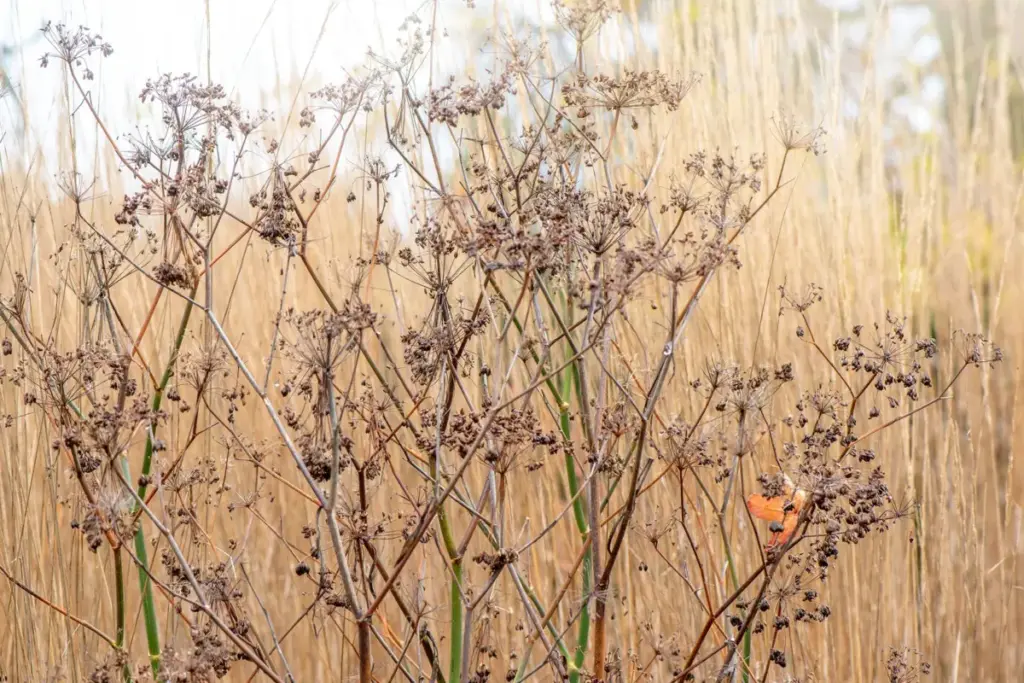
- 10. Fennel (Foeniculum vulgare): Features feathery foliage that attracts aphids—quickly harvested by blue tits—followed by nutrient-dense seed umbels.
- Type: Perennial | Wildlife Rating: 4/5 | Beauty Rating: 4/5
- 11. Verbena (Verbena bonariensis): Tall, elegant stems allow sparrows and finches to balance gracefully while stripping seeds in autumn.
- Type: Perennial | Wildlife Rating: 4/5 | Beauty Rating: 5/5
- 12. Chicory (Cichorium intybus): Drought-resistant with pale blue flowers, offering a reliable late-summer foraging resource for finches.
- Type: Perennial | Wildlife Rating: 4/5 | Beauty Rating: 5/5
3. Climbers & Evergreen Shrubs
- 13. Firethorn (Pyracantha spp.): An exceptional defensive hedge and wall shrub whose white blossoms attract insects, followed by massive orange and red berry crops for thrushes and winter migrants.
- Type: Evergreen Shrub | Wildlife Rating: 4/5 | Beauty Rating: 4/5
- 14. Wild Honeysuckle (Lonicera periclymenum): A host plant for dozens of moth caterpillars, providing high-protein nesting food, complemented by autumn berries consumed by blackcaps and robins.
- Type: Semi-Evergreen Climber | Wildlife Rating: 5/5 | Beauty Rating: 5/5
- 15. Ivy (Hedera helix): A vital keystone species. Its late-season flowers sustain over-wintering insects, while its dense, calorie-rich berries provide crucial winter sustenance for thrushes and wood pigeons.
- Type: Evergreen Climber | Wildlife Rating: 5/5 | Beauty Rating: 3/5
- 16. Mistletoe (Viscum album): Hemiparasitic shrub whose sticky white berries are the namesake favorite of mistle thrushes and overwintering blackcaps.
- Type: Evergreen Shrub | Wildlife Rating: 3/5 | Beauty Rating: 3/5
- 17. Lavender (Lavandula angustifolia): Beyond its summer nectar value, leaving non-sterile varieties unpruned to set seed provides an exceptional food source for local sparrows.
- Type: Evergreen Shrub | Wildlife Rating: 4/5 | Beauty Rating: 5/5
4. Deciduous Shrubs & Trees
- 18. Elder (Sambucus nigra): Fragrant summer blooms give way to dark berries essential for starlings, warblers, and blackcaps fueling up for migration.
- Type: Deciduous Shrub | Wildlife Rating: 4/5 | Beauty Rating: 4/5
- 19. Guelder Rose (Viburnum opulus): Native shrub producing red berries; gardeners must ensure they select fertile cultivars rather than sterile ornamentals like ‘Roseum’.
- Type: Deciduous Shrub | Wildlife Rating: 4/5 | Beauty Rating: 4/5
- 20. Oregon Grape (Mahonia aquifolium): Early yellow nectar fills the "hungry gap" in late winter, while blue-black summer berries feed juvenile blackbirds.
- Type: Evergreen Shrub | Wildlife Rating: 4/5 | Beauty Rating: 3/5
- 21. Hawthorn (Crataegus monogyna): Supporting over 500 invertebrate species and producing abundant haws, this is arguably the single most important native UK plant for wildlife.
- Type: Deciduous Tree | Wildlife Rating: 5/5 | Beauty Rating: 4/5
- 22. Crab Apple (Malus spp.): Sustains birds year-round, from spring aphids and caterpillars to autumn fruits favored by waxwings and thrushes.
- Type: Deciduous Tree | Wildlife Rating: 5/5 | Beauty Rating: 5/5
- 23. Hazel (Corylus avellana): Supports early spring caterpillars for tit species, while jays and nuthatches harvest autumn hazelnuts for caching.
- Type: Deciduous Tree | Wildlife Rating: 5/5 | Beauty Rating: 4/5
- 24. Holly (Ilex aquifolium): Requires careful pairing of female specimens (e.g., ‘Argentea Marginata’) with male pollinators (e.g., ‘Silver Queen’) to secure vital winter thrush rations.
- Type: Evergreen Tree | Wildlife Rating: 4/5 | Beauty Rating: 4/5
- 25. Silver Birch (Betula pendula): Catkins provide vital winter seeds for siskins and goldfinches, while trunks offer nesting hollows for woodpeckers.
- Type: Deciduous Tree | Wildlife Rating: 5/5 | Beauty Rating: 5/5
- 26. Rowan (Sorbus aucuparia): A magnificent focal tree whose protein-rich insect populations and iconic red berries are devoured by waxwings and fieldfares.
- Type: Deciduous Tree | Wildlife Rating: 5/5 | Beauty Rating: 4/5
Official Statements & Hygiene Protocols
While planting wildlife-friendly flora reduces reliance on artificial feeding stations, gardeners who choose to continue supplementary feeding—particularly during the autumn and winter window (November 1 to April 30)—must adhere to strict biosecurity measures.

The RSPB emphasizes that cleaning protocols are non-negotiable when attempting to break the chain of infection for trichomonosis and salmonellosis:

- Protective Personal Equipment: Handlers must wear dedicated rubber gloves and protective outer garments during cleaning operations.
- Location Isolation: Feeders must be washed exclusively outdoors, utilizing dedicated long-handled brushes that never cross-contaminate household utensils or washing areas.
- Sanitation Standards: Feeders should be regularly moved around the garden to prevent toxic accumulations of droppings and spilt seed hulls in the soil below. Flat-surface bird tables must be phased out in favor of hanging tube feeders that minimize contact with waste.
- Thorough Decontamination: Post-cleaning personal hygiene is mandatory; handlers must thoroughly scrub hands and forearms with antibacterial soap immediately upon completion.
Future Outlook
The modernization of garden bird feeding guidance represents a mature phase in grassroots conservation. As urban environments expand and natural habitats become increasingly fragmented, residential gardens serve as vital stepping stones for avian wildlife. However, the lessons of the trichomonosis epidemic prove that well-intentioned human intervention can sometimes generate unforeseen biological hazards.

Looking forward, the integration of wildlife gardening into suburban planning will be paramount. By shifting our focus from passive consumption at artificial feeding tables to active cultivation of natural habitats—such as planting native hedges, leaving seedheads intact through the winter, and establishing diverse floral borders—homeowners can foster resilient, self-sustaining bird populations. The modern gardener is no longer merely a host offering handouts, but an ecosystem steward curating a living, breathing landscape where birds can thrive naturally, safely, and sustainably.



