

Executive Overview
Two centuries after the birth of modern scientific inquiry, the foundational pillars of American ecology and entomology continue to resonate deeply within contemporary research. As the Biodiversity Heritage Library (BHL) celebrates its landmark 20th anniversary through its dedicated BHL at 20: Treasures from the Biodiversity Heritage Library series, a profound spotlight is cast upon two pioneering Midwestern scientists: Stephen A. Forbes and Charles Robertson.
Through rare archival materials and foundational publications contributed by the University of Illinois Urbana-Champaign Library, modern researchers, historians, and nature enthusiasts are granted unprecedented digital access to the birth of ecological science. Forbes, a visionary zoologist and entomologist, revolutionized our understanding of aquatic environments, holistic environmental interactions, and applied ecology. Meanwhile, Robertson, a dedicated botanist and entomologist operating out of Carlinville, Illinois, meticulously documented the intricate, web-like relationships between native flora and insect pollinators over a career spanning decades.
Today, as climate change and habitat loss threaten global ecosystems, the meticulous field logs, specimens, and publications left behind by Forbes and Robertson are no longer viewed merely as historical artifacts. Instead, they serve as irreplaceable baseline data for twenty-first-century conservation biology, shedding light on species decline, ecological degradation, and the historical vitality of North American landscapes.

Detailed Chronology: The Lives and Legacies of Forbes and Robertson
The Path of Stephen A. Forbes (1844–1930)
Born on May 29, 1844, Stephen Alfred Forbes emerged as one of the most towering intellectual figures in American natural history. His academic journey at the University of Illinois Urbana-Champaign established him as a premier professor of zoology and entomology, where he championed an expansive, interconnected view of the natural world. Forbes refused to study organisms in isolation; his investigations spanned insects, crustaceans, fishes, and birds, evaluating how each biological entity interacted dynamically with its physical and biological environment.
- 1886: Recognized internationally for his rigorous empirical contributions, Forbes was awarded the prestigious first-class medal of the Société d’Acclimation de France for his groundbreaking scientific publications.
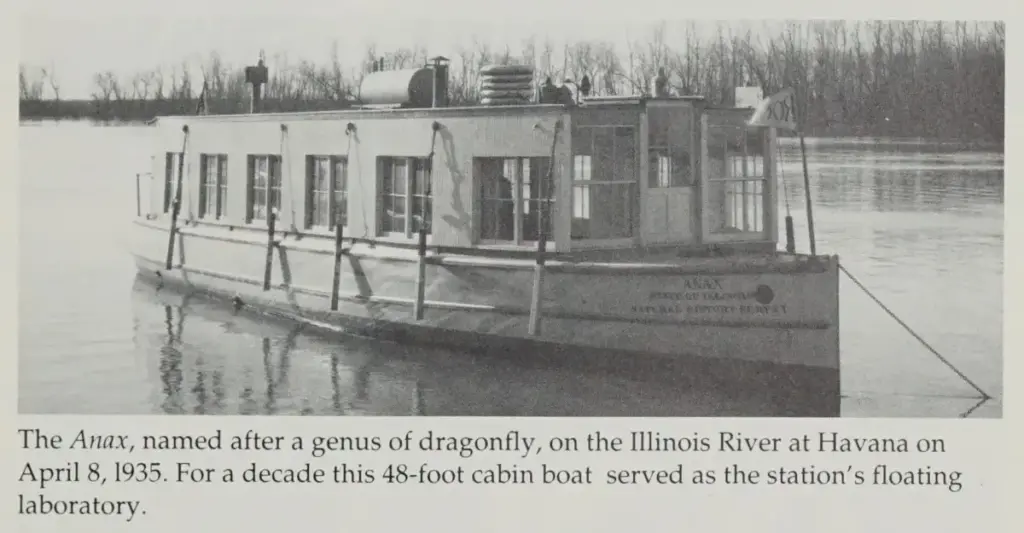
- 1894: Demonstrating a commitment to field-based, continuous ecological research, Forbes established the Forbes Biological Station on the Illinois River in Havana, Illinois. Two years later, in 1896, he directed the construction of a pioneering 48-foot floating biological laboratory to facilitate round-the-clock aquatic observation.
- 1908: Forbes published his monumental work, The Fishes of Illinois, a masterpiece documenting over 150 fish species backed by an astounding catalog of more than 200,000 specimens gathered across all 102 counties of Illinois. The publication featured exquisite color plates by talented illustrators Lydia M. (Hart) Green and Charlotte M. Pinkerton, alongside meticulous distribution maps.
- 1917: Appointed as the director of the Natural History Survey Division, Forbes steered the organization with steadfast leadership until his passing.
- March 13, 1930: Forbes passed away in Urbana, Illinois, leaving an indelible legacy that prompted the University Senate to pass a heartfelt memorial resolution praising his "simplicity, sincerity and broad human interests."
- May 26, 1994: The Illinois Natural History Survey (INHS) celebrated the sesquicentennial (150th anniversary) of Forbes’ birth, honoring a man whose holistic approach birthed modern aquatic ecosystem science.
The Life and Obsessions of Charles Robertson (1858–1935)
Born on June 12, 1858, in Carlinville, Illinois, Charles Robertson led a life of quiet, unhurried dedication that mirrored the methodical rhythm of nature itself. After foundational studies at Blackburn College in his hometown, Robertson pursued advanced education in botany and zoology at Harvard University. He subsequently returned to Blackburn College, imparting knowledge as a professor of biology and Greek while embarking on a monumental, decades-long ecological study in his own backyard.
- Late 19th to Early 20th Century: Over a span of more than twenty years, Robertson conducted exhaustive field observations in Macoupin County, Illinois. He meticulously recorded 1,429 pollinating insect species—encompassing specialized bees, flies, beetles, and butterflies—visiting 456 distinct plant species.
- 1911: Robertson’s life and local prominence were permanently captured in the History of Macoupin County, Illinois: Biographical and Pictorial, cementing his status as a pillar of regional scientific achievement.
- 1928: He published his magnum opus, Flowers and Insects, representing one of the most comprehensive, localized studies of floral-pollinator networks ever conducted in a single municipality. Every recorded insect was explicitly cross-referenced with the exact host plant upon which it was gathered.
- Early 1935: Demonstrating a relentless passion for his field well into his seventies, Robertson was actively collecting insect specimens in Florida only a few months before his death.
- June 1, 1935: Robertson passed away in his lifelong home of Carlinville, leaving behind exhaustive specimen logs, extensive correspondence, ledgers, and data books spanning the years 1877 to 1935—treasures now safely housed within the University Archives at the University of Illinois Urbana-Champaign.
Supporting Context & Metrics: Data, Research, and Modern Applications
The archival contributions housed within the Biodiversity Heritage Library offer far more than historical nostalgia; they represent vital computational and ecological datasets for modern scientific inquiry.

Quantitative Metrics of Scientific Impact
- 200,000+: The staggering number of fish specimens collected across 102 Illinois counties that formed the empirical backbone of Stephen A. Forbes’ The Fishes of Illinois.
- 1,429 & 456: The precise ecological breadth of Charles Robertson’s Carlinville studies, documenting 1,429 pollinating insect species interacting with 456 native plant species.
- 1877–1935: The comprehensive chronological range of Robertson’s surviving personal papers, correspondence, and specimen collection logs preserved at UIUC.
- 6: The number of modern field stations operated today by the Illinois Natural History Survey—including the Great Rivers Field Station, Illinois River Biological Station, Kaskaskia Biological Station, Lake Michigan Biological Station, Ridge Lake Biological Station, and Sam Parr Biological Station—all descending intellectually from Forbes’ initial 1894 field station initiative.
Modern Conservation and Data Science
The historical value of these collections has been dynamically unlocked by modern researchers seeking to measure environmental degradation. A prime example is the landmark study published in Ecology & Society by John Marlin, a research affiliate with the Illinois Sustainable Technology Center and INHS. By retracing Robertson’s nineteenth-century footsteps in Carlinville, Marlin and his contemporaries were able to assess severe species declines and plant-pollinator network collapses over a century of intensive land-use change.
Furthermore, a quantitative analysis published in the Data Science Journal highlighted the immense informational wealth locked inside Robertson’s digitized correspondence and collection logs. These records allow contemporary data scientists and conservation biologists to model baseline biodiversity metrics, tracking how industrialization, agriculture, and urbanization have fundamentally altered Midwestern ecosystems.
Official Statements & Institutional Reflections
The preservation and digitization of these rare materials represent a collaborative triumph between academic libraries, state scientific surveys, and international digital repositories.

Reflecting upon the profound human and professional impact of Stephen A. Forbes, the University Senate formally resolved at his passing:
"The Senate knew him as Professor of Zoology and Entomology and Dean of the College of Science; it admired his sagacity and patience as chairman of its Committee on Educational Policy; its members loved him for his simplicity, sincerity and broad human interests. The University and the State are immeasurably indebted to him as one of their most useful and eminent laborers for the common good."
Highlighting the overarching mission of the Biodiversity Heritage Library during its milestone anniversary, project organizers emphasize the unique bridge these archives construct:

"Archival documents such as these reveal the values, culture, and identity that shaped the Illinois Natural History Survey and science in Illinois. Being able to trace the legacy of scientific research and lives of those behind these discoveries provides richer context and understanding for future scientific research. BHL provides a unique juxtaposition between the human experience of doing science, revealed through archival documents, and the official scientific record preserved in books and journal articles. Together, these materials provide a fuller and more inclusive account of the history of science here in Illinois."
Future Outlook: Connecting Historical Archives to Tomorrow’s Conservation
As the Biodiversity Heritage Library marks two decades of open-access preservation, the imperative to digitize, analyze, and protect historical scientific literature has never been more urgent. The life works of Stephen A. Forbes and Charles Robertson demonstrate that historical natural history collections are active, predictive tools for the future of global ecology.
Moving forward, the integration of nineteenth- and twentieth-century field logs with modern geographic information systems (GIS), machine learning, and ecological modeling will allow researchers to reconstruct lost landscapes with unprecedented accuracy. The Frank C. Bellrose Waterfowl Research Center—housed within the modern iteration of the Forbes Biological Station—continues to leverage these historical foundations to influence wetland conservation and environmental policy across the Illinois River Valley and beyond.

However, the continued accessibility of these irreplaceable digital treasures relies heavily on global community support. Ensuring that foundational texts like The Fishes of Illinois and Flowers and Insects, alongside Robertson’s fragile specimen logs, remain free and open to the public guarantees that the next generation of conservationists can build directly upon the patient, meticulous observations of the past. By honoring the legacies of Forbes and Robertson, the global scientific community reaffirms its commitment to understanding, preserving, and healing the natural world.



