

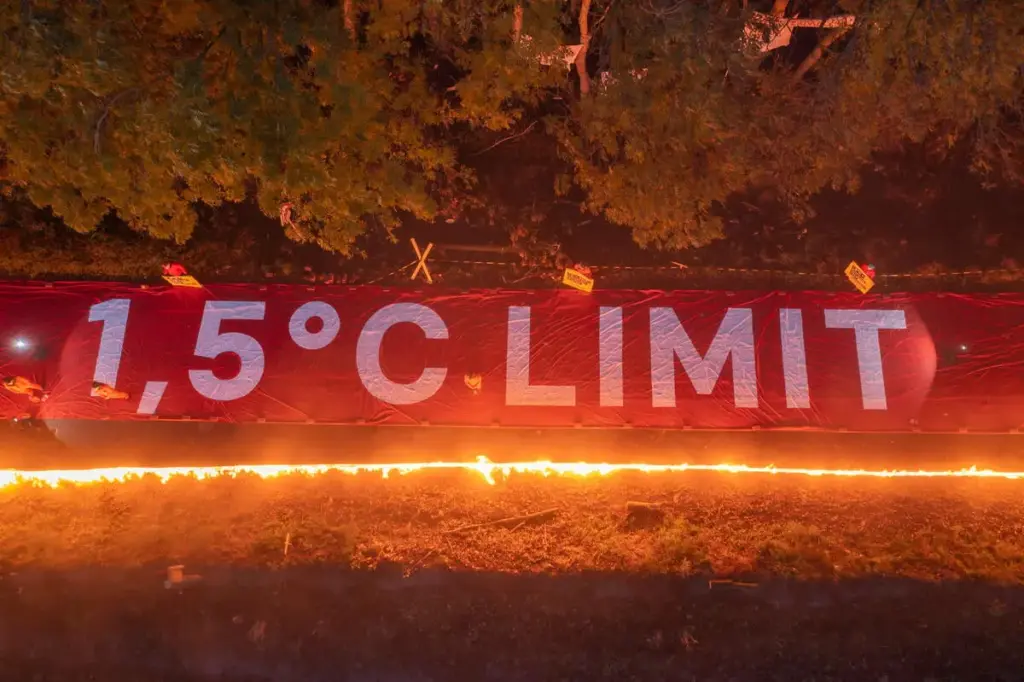
AMSTERDAM — In a sobering reality check that threatens to redraw the boundaries of global environmental policy, the United Nations Environment Programme (UNEP) has released a landmark report warning that the global temperature rise will exceed the critical 1.5°C threshold, likely within the next few years.
This stark projection has triggered an immediate and forceful response from international environmental organizations, led by Greenpeace. Activists, scientists, and indigenous frontline leaders are demanding a wholesale transformation of government policy centered on an accelerated, fully funded transition away from fossil fuels and an absolute halt to forest destruction.
The new UNEP assessment marks a historic pivot for the international body. For the first time, a flagship UN report formally outlines a 1.5°C "overshoot, peak, and decline" pathway. Released against a backdrop of compounding ecological turmoil—including unrelenting global heatwaves, catastrophic wildfires, and a strengthening "super" El Niño—the report underscores a terrifying acceleration in the pace of climate change. It is a definitive confirmation that the international community is barreling past a vital planetary boundary, emphasizing the urgent need for a robust, unyielding multilateral response.
Executive Overview: A Defining Planetary Crossroads
The announcement from UNEP is not merely a statistical milestone; it represents a profound systemic shock to the international climate architecture. For decades, the 1.5°C target established by the Paris Agreement has functioned as the ultimate benchmark for climate safety. Crossing this line, even temporarily, exposes the planet to compounding risks that could cascade into irreversible ecological tipping points.
Yet, environmental advocates stress that an overshoot must not be treated as a death sentence for the planet’s climate goals. Instead, it must serve as an unprecedented, hardline wake-up call for global policymakers. The core challenge facing humanity is twofold: to dramatically flatten the peak of the temperature anomaly and to accelerate the subsequent decline back to safe levels through massive, immediate carbon mitigation and aggressive decarbonization.
As world leaders prepare for upcoming diplomatic milestones—including the United Nations General Assembly (UNGA) and the upcoming COP31 climate talks—pressure is mounting on geopolitical heavyweights to abandon incrementalism. Greenpeace is actively rallying the Santa Marta "coalition of doers" to spearhead ambitious domestic policies, demanding that governments bridge the glaring chasm between political rhetoric and the harsh realities of the climate crisis.
Detailed Chronology and Diagnostic Context: Understanding the 1.5°C Overshoot
To fully grasp the gravity of the UNEP report, it is necessary to examine the mechanics and timeline of the projected temperature anomaly.
The Path to Overshoot
Over the past decade, global greenhouse gas emissions have stubbornly remained near historic highs, despite repeated pledges under the Paris Agreement. This systemic failure to bend the emissions curve downward has made a temporary breach of the 1.5°C ceiling statistically unavoidable. According to UNEP’s best-case modeling scenario—which assumes that nations not only meet but substantially exceed their currently declared Nationally Determined Contributions (NDCs)—global temperatures are projected to peak at approximately 1.8°C above pre-industrial levels before beginning a multi-decade descent.
The Dangers of the Peak
While a decline back to 1.5°C is theoretically possible under optimal emissions-reduction models, scientists emphasize that "decline is not a given." It hinges entirely on unprecedented, aggressive policy interventions enacted immediately. Every fraction of a degree spent above the 1.5°C threshold compounds environmental degradation. A peak of 1.8°C carries severe structural risks:
- Ecosystem Collapse: Widespread coral reef die-offs, irreversible melting of Arctic permafrost, and potential destabilization of major oceanic circulation systems (such as the Atlantic Meridional Overturning Circulation, or AMOC).
- Extreme Weather Amplification: Exponential increases in the frequency, duration, and intensity of meteorological disasters, including multi-year droughts, flash floods, and unprecedented urban heat stress.
- Socioeconomic Disruption: Massive displacement of vulnerable human populations, collapsing agricultural yields in the Global South, and spiraling economic costs associated with climate adaptation and disaster recovery.
Supporting Context & Metrics: Legal Obligations, Science, and Regional Realities
The Legal Imperative: The ICJ and the 1.5°C Threshold
Amid political hesitation and foot-dragging by high-emitting nations, the legal framework governing climate action has undergone a radical transformation. The 1.5°C limit is no longer viewed solely as a diplomatic aspiration or a soft political guideline; it has been codified as a binding legal obligation.
In a landmark Advisory Opinion backed by a formal UN General Assembly resolution, the International Court of Justice (ICJ) confirmed that limiting global warming to 1.5°C is a legal requirement for all sovereign states. Crucially, the ICJ ruled that major historical carbon emitters carry a distinct legal responsibility to act fastest and most aggressively to curb emissions and protect vulnerable populations. This judicial milestone strips away the legal shield of ambiguity that polluters have historically used to delay transition timelines.
The Pacific Frontline: Survival vs. Politics
Nowhere is the human cost of climate inaction felt more acutely than in the Pacific region. Coinciding with the release of the UNEP report, Pacific Island Forum leaders convened in Palau to forge regional solidarity ahead of COP31, reinforcing their unwavering push for a Fossil Fuel Free Pacific.
For Pacific island nations, the concept of an "overshoot" is an existential threat. Rising sea levels, ocean acidification, and intensified tropical cyclones threaten their territorial integrity, cultural heritage, and sovereign survival. To these communities, the 1.5°C limit is not a negotiable policy parameter—it is an absolute line of demarcation between continued existence and oblivion.
Official Statements: Voices from the Frontlines of Advocacy and Science
The gravity of the UNEP warning has elicited fierce, unified condemnation of current climate policies from leadership across Greenpeace’s global network.
Jasper Inventor, Deputy Programme Director at Greenpeace International
Reflecting on the psychological and political weight of the UNEP findings, Inventor issued a resolute call for mobilization:
"This is news none of us wanted to hear, but overshoot is not the reason to give up and surrender 1.5°C. It’s a heartbreaking moment, and we need to reflect on that, but every fraction of a degree still matters and the UNEP report must now serve as a defining call to action.
The 1.5°C goal is not only a legal, political, and moral threshold—it’s our lifeline, and what we do today and tomorrow will determine our fate. Governments must accelerate a fast, fair, and funded just transition into renewable energy, ensure we end and reverse forest destruction by 2030, and hold fossil fuel polluters and forest destroyers to account. To help finance climate action, we must also make polluters pay for climate damages."
Moemoana Schwenke, Pacific Climate Campaigner at Greenpeace Australia Pacific
Speaking directly from the Pacific Island Forum in Palau, Schwenke emphasized the intersection of climate justice, sovereignty, and indigenous stewardship:
"For the Pacific, 1.5°C is not an ambition, it is a survival line. It is a matter of justice, sovereignty, and our right to determine our own futures in our Pacific way. We inherit our lands, oceans, and cultures as an entrusted responsibility, not a commodity to be exhausted.
The International Court of Justice has already been clear that 1.5°C is a legally binding obligation, not just a choice. Pacific communities, for decades, have been clear that our ways of life, homes, and livelihoods are under threat from climate disasters and impacts. An overshoot is not compatible with Pacific wellbeing.
The court and governments must translate responsibility into action: a rapid, just, and legally grounded transition away from fossil fuels with no further expansion of coal, oil, and gas."
Dr. Jerry Jose, Senior Scientist at the Greenpeace International Science Unit
Providing a rigorous scientific breakdown of the intergenerational consequences of an overshoot, Dr. Jose highlighted the cascading risks of delayed mitigation:
"Among the many stark warnings, the UNEP report presents the intergenerational burden climate change will impose on future communities in an overshoot scenario. The risks of permanent change escalate as our climate warms. In addition, the multiple decades needed for a decline in the global temperature back to 1.5°C would exacerbate already uneven impacts, many of which having the potential to continue well beyond stabilisation.
Deep and sustained mitigation in the near-term is essential to limit the peak and duration of the overshoot we are leaving our future generations. Even a decline of temperature is ‘not a given’ and depends on decisions and actions taken today. This raises profound questions about intergenerational responsibility and must compel us to act now."
Future Outlook: The Road to COP31 and Beyond
The publication of the UNEP "Limiting Overshoot" report draws a hard boundary across the history of global climate policy. The era of loose commitments, voluntary offsets, and delayed transition timelines has officially expired.
As the international community looks ahead to the upcoming UN General Assembly and the critical negotiations at COP31, the roadmap for survival is clear, albeit extraordinarily steep:
- Immediate Fossil Fuel Phase-Out: Governments must enact legally binding moratoriums on the exploration and expansion of new coal, oil, and gas reserves, systematically winding down existing fossil fuel infrastructure.
- Ecosystem Restoration and Deforestation Halts: Nations must commit to entirely ending and reversing global forest destruction by 2030, preserving Earth’s vital terrestrial carbon sinks.
- The "Polluter Pays" Principle: Massive financial frameworks must be established to compel fossil fuel corporations and major industrial polluters to finance climate loss and damage, ensuring that adaptation funding is fully secured for the most vulnerable nations.
- Enforcing Intergenerational Justice: Adhering strictly to the legal rulings of the International Court of Justice, developed nations must drastically accelerate their decarbonization schedules to prevent passing an uninhabitable planet down to future generations.
The science is definitive, the legal obligations are clear, and the moral imperative is undeniable. Whether global leaders muster the political courage to alter course before the 1.5°C overshoot becomes an unmitigated catastrophe remains the ultimate test of our time.



