By Environmental Journalism Desk Published in partnership with Conservation & Marine Research Briefs DOI: 10.66709/news-329294
Executive Overview
In a historic milestone for marine biology and regional scientific autonomy, a team of predominantly Caribbean researchers has completed one of the most comprehensive deep-water expeditions in the history of Trinidad and Tobago. Operating between June 29 and July 28, the monthlong mission shattered long-standing paradigms of marine exploration in the southern Caribbean Sea. Utilizing advanced technologies—including the California-based Schmidt Ocean Institute’s research vessel R/V Falkor (too) and its state-of-the-art remotely operated vehicle (ROV) SuBastian—the team successfully mapped approximately 13% of the nation’s marine territory.
For decades, the vast depths of Trinidad and Tobago’s waters—nearly 93% of which sit well beyond the reach of recreational scuba diving—remained a geographic and ecological blind spot. This recent expedition shattered that obscurity. Researchers documented dozens of active cold seeps, captured vivid imagery of rare and bizarre deep-sea fauna, and collected over 700 biological specimens. Preliminary analyses indicate that at least 20 of these specimens represent species entirely new to science, with potential new genera among them.
Crucially, the mission marks a decisive break from historical models of "parachute science"—where foreign researchers extract data from developing nations without meaningful local involvement or leadership. Led by prominent deep-sea ecologist Dr. Diva Amon, a native of Trinidad and Tobago and co-founder of the marine conservation organization SpeSeas, this endeavor establishes a new benchmark for regional empowerment, local capacity-building, and data-driven environmental stewardship in the Caribbean.
Detailed Chronology & Operational Scope
Breaking the Surface: Setting Sail on the R/V Falkor (too)
The expedition commenced on June 29, launching a rigorous, month-long operational window in the deep waters surrounding the dual-island Caribbean republic. The mission was conceptualized to address critical data deficiencies in a maritime territory where deep-sea environments had scarcely been glimpsed, let alone systematically cataloged.
Aboard the R/V Falkor (too), an international cadre of scientists worked alongside a historic majority of Caribbean researchers. The deployment of advanced marine technology allowed the team to systematically survey regions of the seafloor that had previously only been theorized about. By utilizing multibeam echosounders for seafloor mapping and deploying ROV SuBastian for targeted visual surveys and sample collection, the team bypassed the physical limitations that have historically hindered local researchers.
Mapping the Unknown: Metrics of Discovery
Over the course of 28 days, the expedition mapped an astonishing 11,335 square kilometers (approximately 4,376 square miles) of previously uncharted seafloor. To put this into perspective, the mapped area is roughly two-and-a-half times the physical size of Grand Canyon National Park in the United States.
Beyond topography, the expedition targeted anomalous features in the water column. The team identified 219 distinct bubble streams rising from the ocean floor—classic indicators of methane and gas venting. Using ROV SuBastian and low-cost deep-sea camera arrays to track these plumes, the researchers verified the existence of 25 active cold seep ecosystems. One of these newly discovered seeps spanned more than 2,000 square meters (roughly 28,000 square feet), an area equivalent to eight professional tennis courts.
Specimen Collection and Taxonomic Breakthroughs
The biological haul of the expedition was equally staggering. The team successfully gathered more than 700 physical specimens, which will ultimately form the cornerstone of an expanded deep-sea repository at the University of the West Indies (UWI), St. Augustine.
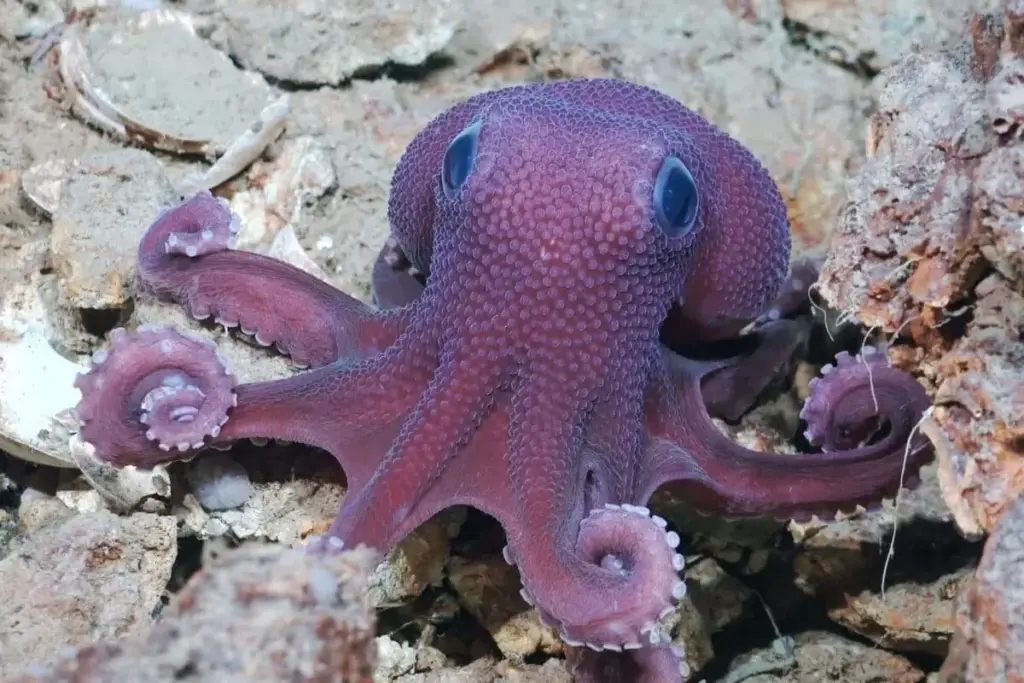
Among the standout discoveries is a suspected new species of octopus belonging to the genus Graneledone. Dr. Amon had first encountered a similar cephalopod during a 2014 expedition aboard the E/V Nautilus, but technological limitations and logistical constraints prevented collection at the time. This summer, armed with ROV SuBastian, the team successfully retrieved a specimen. Immediate onboard molecular and genetic analyses confirmed with high certainty that the octopus represents a species entirely new to science.
Other visual encounters captured by the expedition’s high-definition cameras included:
The Black Swallower Fish (Chiasmodon niger): A legendary deep-sea predator filmed with a massively distended stomach, illustrating its unique physiological capacity to ingest prey significantly larger than itself.
A Mobula Ray Carcass: Lying motionless on the benthic zone, providing a rare glimpse into a deep-sea "whale fall" or nutrient drop, surrounded by specialized scavenging crabs and marine worms.
Ghost Sharks and Eelpouts: Chimaeras gliding silently past methane seeps at depths exceeding 2,355 meters (7,726 feet), alongside eelpouts (Pachycara caribbaeum) resting atop dense colonies of chemosynthetic mussels (Gigantidas childressi), which thrive entirely without sunlight by metabolizing methane and sulfur.
Supporting Context & Scientific Metrics
The Significance of Cold Seeps
Cold seeps are specialized, highly localized ecosystems where hydrocarbons—primarily methane—leak from the Earth’s crust into the deep ocean. Unlike most marine ecosystems that rely on photosynthetic primary production, cold seeps are powered by chemosynthesis. Microbes oxidize the escaping methane, forming the base of a complex food web that supports dense aggregations of specialized fauna, including tubeworms, clams, and mussels.
Marine hydrogeologist and geoscientist Dr. Rachel Lauer of the University of Calgary, who served as a co-principal investigator on the expedition, expressed astonishment at the sheer scale of the ecosystems uncovered.
"We expected to see life, but certainly not at the scale that we did," Dr. Lauer noted. "It was impressive."
Dr. Lauer highlighted the unpredictable nature of deep-sea hydrogeology, noting instances where massive methane plumes in the water column led the team to anticipate vast ecosystems, only to find minor, sporadic bubbling at the seafloor. Conversely, seemingly "anemic" bubble streams occasionally guided them to sprawling biological oases featuring monumental piles of mussels and tubeworms covering nearly a square kilometer.
Redressing Historical Inequities: The Death of "Parachute Science"
For generations, marine research in the Global South—and particularly within Small Island Developing States (SIDS) in the Caribbean—has been dominated by institutions from North America and Europe. Foreign vessels would routinely conduct expeditions in regional waters, collect valuable biological and geological data, and transport specimens back to metropolitan museums, leaving local scientists locked out of the research pipeline.
Dr. Diva Amon’s leadership of this expedition represents a watershed moment for scientific decolonization.
"This is the first time there has ever been a team that was predominantly Caribbean scientists working on the deep ocean in the Caribbean," Dr. Amon emphasized. "Previously, it’s been a lot of—speaking very plainly—parachute science, and so this was really precedent setting."
By ensuring that the primary intellectual leadership, field operations, and post-expedition data analysis were anchored in the Caribbean, the mission has established a sustainable blueprint for regional scientific sovereignty.
Official Statements & Expert Perspectives
The ramifications of the expedition extend far beyond immediate taxonomic discoveries, providing regional academics with unprecedented tools for advocacy and environmental management.
Dr. La Daana Kanhai, Marine Scientist, University of the West Indies, St. Augustine: “How absolutely blessed we all were to have this incredible opportunity to get a glimpse of Trinidad and Tobago’s deep sea in 2026. Every sample from this expedition helps us advance knowledge about this remarkable ecosystem and provides a platform for evidence-based decision-making.”
Dr. Diva Amon, Deep-Sea Ecologist and Co-Founder of SpeSeas: “We know that there are certainly at least 20 new species, and that includes potential new genera as well, which isn’t surprising, given how little is known about deep-sea biodiversity in the Caribbean. Once we actually begin to look into these samples more deeply, we expect there to be many, many more.”
Furthermore, Dr. Amon highlighted the transformative impact of repatriating scientific collections. Once fully cataloged, the 700+ specimens will be housed in the Zoology Museum at UWI St. Augustine, expanding the institution’s deep-sea holdings twelve-fold.
"This will be a chance for Trinis—locals—to come and see these specimens with their own eyes," Dr. Amon said. "Having those biodiversity collections at home is so important because we just haven’t had that until very recently."
Future Outlook: Conservation Challenges Ahead
While the discovery of new species and vibrant cold seeps is a cause for celebration, marine scientists warn that Trinidad and Tobago’s deep-water environments face escalating, systemic threats.
The Fossil Fuel Frontier
Trinidad and Tobago has long maintained a carbon-intensive economy driven by shallow-water oil and gas extraction. However, as legacy shallow reserves experience depletion, government and industry stakeholders have increasingly turned their gaze toward deeper waters, contemplating aggressive deep-sea fossil fuel exploration and drilling.
This economic pivot collides with a stark regulatory reality, according to Dr. Amon:
"We have deep-water oil and gas exploitation on our doorstep, and there are next to no stewardship mechanisms for our waters. We have one marine protected area, which is a shallow water coral reef. Nothing else. There’s no offshore protection of any kind, and there are no management mechanisms of any kind."
Broader Anthropogenic Stressors
Beyond the looming specter of deep-sea hydrocarbon extraction, the nation’s abyssal zones are increasingly vulnerable to global and regional stressors. Plastic pollution—which routinely sinks from surface waters to the deepest trenches—along with the cascading impacts of ocean warming, acidification, and changing current regimes driven by global climate change, threaten these pristine, slow-growing ecosystems before science even has the chance to fully understand them.
The Real Work Begins
As the R/V Falkor (too) expedition concludes its active phase, the scientific community recognizes that the data collected must immediately translate into actionable policy. Conservationists hope that the high-resolution maps, methane seep inventories, and photographic evidence of unique benthic communities will compel policymakers in Port of Spain to establish robust marine spatial planning frameworks and designate offshore Marine Protected Areas (MPAs).
As Dr. Amon succinctly summarized:
"This is not just about doing the science, but it’s about the impact story beyond this expedition. I think the real work starts now."