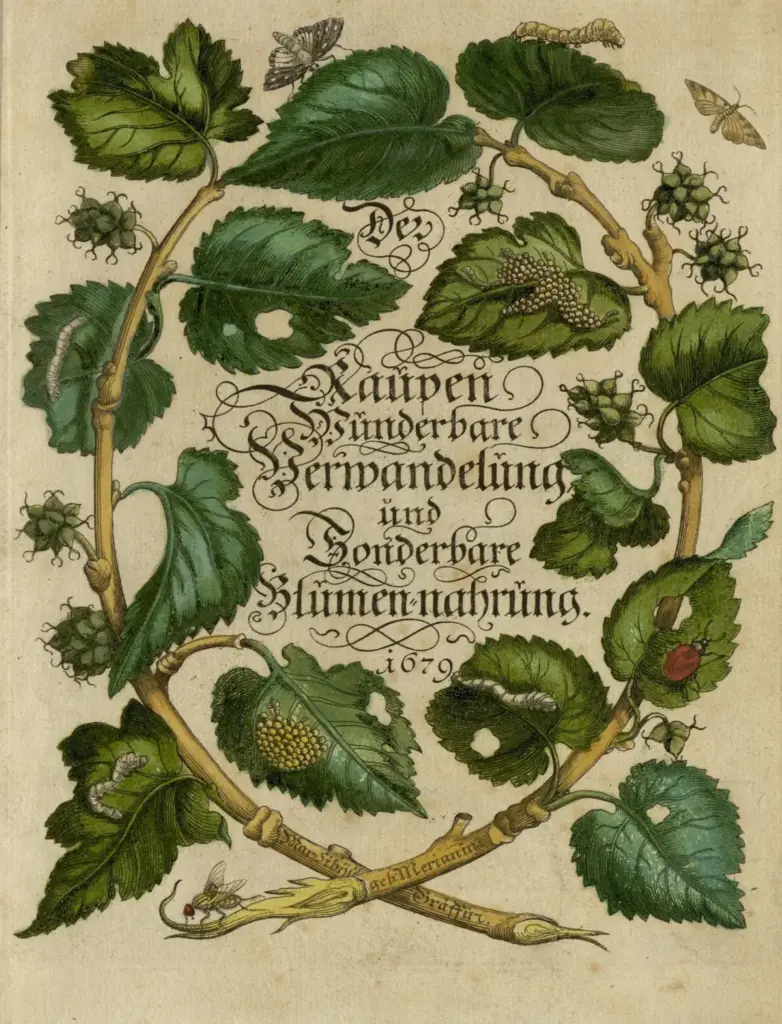
In the winter of 1679, a pioneering naturalist and illustrator named Maria Sibylla Merian published Der Raupen wunderbare Verwandelung, und sonderbare Blumennahrung (The Wonderful Metamorphosis and Special Nourishment of Caterpillars). Combining painstaking empirical observation with breathtaking artistic precision, Merian documented the life cycles of insects alongside their host plants. It was an intellectual tour de force for its time, creating a rigorous baseline for entomology that predated modern systematic nomenclature by decades.
Nearly 350 years later, that very volume—preserved in pristine condition as an original edition in the Library of the Senckenberg German Entomological Institute in Müncheberg—serves as the anchor for a quiet revolution in modern science.
In 2026, the Senckenberg Gesellschaft für Naturforschung officially joined the Biodiversity Heritage Library (BHL), the world’s largest open-access digital repository for literature on biodiversity. This strategic partnership does much more than simply digitize aging texts. By integrating Senckenberg’s distributed, specialized library holdings—ranging from historical zoological treatises to rare botanical and paleontological records—into a global digital infrastructure, the collaboration transforms static historical pages into dynamic, searchable, and interconnected data nodes.
As biodiversity loss and environmental degradation accelerate, contemporary researchers can no longer afford to work in silos. By bridging centuries of natural history literature with modern data infrastructures, artificial intelligence text mining, and Linked Open Data (LOD) initiatives, this partnership ensures that historical knowledge is not merely preserved as a relic of the past, but actively fuels the scientific breakthroughs of tomorrow.
Detailed Chronology: From Merian to Modern Digital Ecosystems
To understand the magnitude of Senckenberg’s integration into the BHL network, one must trace the evolutionary arc of biodiversity documentation over the past three and a half centuries.
The Foundational Era (Late 17th to 19th Century)
The roots of modern taxonomy and ecology lie in the meticulous observation records kept by early naturalists. When Maria Sibylla Merian published her masterpiece in 1679, scientific communication was fragmented. Naturalists relied on hand-copied notes, limited correspondence, and rare printed volumes. Over the subsequent centuries, institutions like Senckenberg—founded in Frankfurt am Main—began centralizing these efforts, gathering specimen collections alongside the literature required to describe and classify them.
As natural history societies proliferated across Europe during the 18th and 19th centuries, specialized research libraries emerged. Institutions in Dresden, Görlitz, Müncheberg, and Weimar began amassing unique regional and disciplinary archives. However, these libraries remained physically isolated. A researcher studying a specific beetle species in South America might possess a specimen but lack access to a rare 18th-century monograph housed in an Eastern German research library, halting taxonomic validation in its tracks.
The Digital Dawn and the Birth of BHL (2006–2009)
Recognizing that physical barriers were actively hindering global conservation and taxonomic research, a consortium of major natural history museums, botanical libraries, and research institutions founded the Biodiversity Heritage Library in 2006. BHL set out to digitize and make freely accessible the legacy literature of biodiversity worldwide.
By 2009, the infrastructure had matured from a pioneering digitization project into an indispensable pillar of the global research ecosystem. It became clear that unlocking the text buried within historical publications was just as critical as collecting physical specimens. During this period, integration models began to shift from simple PDF archiving to deep taxonomic indexing, matching historical species names in texts to modern taxonomic databases.
The Integration of Senckenberg (2026)
The decision by the Senckenberg Gesellschaft für Naturforschung to join BHL in 2026 marks a major milestone in European biodiversity informatics. Senckenberg is one of Germany’s premier natural history research organizations, operating massive research facilities and distributed libraries across multiple federal states.
By contributing curated, rare holdings—such as the Müncheberg institute’s original 1679 Merian edition and specialized entomological series—Senckenberg fills critical gaps in the global bibliographic record. This integration acts as a two-way street: it elevates Senckenberg’s decentralized library assets onto an international stage while anchoring global BHL data queries in deeply authoritative, peer-validated European source material.
Supporting Context & Metrics: The Anatomy of a Knowledge Ecosystem
The scale and impact of Senckenberg’s entry into the BHL network can be fully appreciated by examining the structural components of the institutions involved and the shifting nature of how scientific literature is utilized.
Senckenberg’s Distributed Library Landscape
Senckenberg’s research libraries are not monolithic. They are distributed across several historical centers in Germany, each specializing in distinct scientific domains shaped by regional and institutional histories:
Müncheberg (Senckenberg German Entomological Institute): Home to one of the largest and most comprehensive entomological research libraries in Europe. It houses extensive corpora of historical literature dedicated entirely to the study of insects.
Frankfurt am Main: The administrative headquarters and the birthplace of Senckenberg, intimately linked through historical figures like Maria Sibylla Merian, who was born in the city.
Dresden, Görlitz, and Weimar: Regional nodes maintaining specialized collections spanning zoology, botany, geology, and paleontology.
From Unstructured Text to Structured Linked Data
Historically, natural history literature has been treated as static text—something to be read page-by-page in a quiet reading room. Today, the demands of data-driven science require an entirely different paradigm.
Through semantic enrichment and text-mining pipelines, historical publications are rapidly being converted into structured data. When a natural history text is ingested into an open infrastructure like BHL:
Taxonomic Names Are Extracted: Automated tools recognize historical binomial nomenclature, linking centuries-old species descriptions directly to modern databases such as the Global Biodiversity Information Facility (GBIF) or the Catalogue of Life.
Georeferencing Occurs: Descriptions of collection localities in 19th-century travelogues and survey journals are translated into modern geographic coordinates.
Cross-Disciplinary Synthesis Becomes Possible: Researchers can query how a species’ distribution has shifted over 200 years by pairing historical literary descriptions directly with genomic databases, museum specimen labels, and contemporary ecological monitoring data.
Traditional Library Model
Modern BHL & Senckenberg Ecosystem
Access: Physical visitation or static microfilm/PDF copies.
Access: Global, instantaneous, open-access digital retrieval.
Searchability: Limited to basic library catalog metadata (author, title, year).
Searchability: Full-text semantic indexing, entity extraction, and species-name recognition.
Interoperability: Isolated within individual institutional silos.
Interoperability: Linked Open Data (LOD) integrated with global biodiversity graphs.
Research Utility: Primarily human-read historical reference.
Research Utility: Machine-readable, queryable data feeding AI, text-mining, and predictive modeling.
Official Statements and Institutional Perspectives
The strategic importance of the Senckenberg-BHL partnership is underscored by leaders in the fields of taxonomy, biodiversity informatics, and institutional governance.
Dr. Lutz Kunzmann, Member of the Board of Directors at Senckenberg, emphasizes the institutional and strategic value of the move:
"Our libraries contain numerous specialized and historically developed collections of great relevance to international research. Their digitization and integration into BHL anchor them within a global research infrastructure and increase their visibility. At the same time, membership provides an important impulse for the strategic development of Senckenberg in the areas of digitization, networking, and international collaboration."
Dr. Jana Hoffmann—Vice President of the Consortium of European Taxonomic Facilities (CETAF), head of the Entomology Information Center at Senckenberg Müncheberg, and Co-Editor-in-Chief of Contributions to Entomology—reflects on her long-standing relationship with the network:
"Since 2009, I have worked with BHL’s collections and community, both as a researcher and through my involvement in biodiversity information infrastructures. Over that time, I have seen BHL evolve from a pioneering digitization initiative into an essential component of the biodiversity knowledge ecosystem. Whether supporting integrative taxonomy, biodiversity knowledge systems, or emerging biodiversity and geobiodiversity data infrastructures, literature continues to provide the evidence base on which this work depends."
Hoffmann further highlights how modern workflows are altering the very nature of archival research:
"What once existed primarily as individual publications increasingly becomes part of a broader, interconnected knowledge environment. By connecting library, archive, and collection data and combining Linked Open Data approaches with text mining of legacy literature and archival material, historical resources become easier to discover, interpret, and reuse."
Future Outlook: AI, Global Baselines, and the Next Century of Research
As we look toward the future of biodiversity science, the integration of historical literature into global digital libraries is not merely a preservation exercise—it is an urgent scientific necessity.
Establishing Baselines for Environmental Change
We are currently living through an unprecedented period of global biodiversity loss and rapid climate change. To understand how ecosystems are destabilizing, conservation biologists and ecologists require accurate historical baselines. How abundant was a specific pollinator species in Central Europe in 1850? What host plants did it rely upon before industrial agriculture transformed the landscape?
Answers to these questions are locked away in the pages of rare monographs, expedition journals, and early natural history periodicals. By bringing these texts into the BHL, researchers can rapidly synthesize baseline data across vast temporal scales, identifying population contractions, phenological shifts, and extinction vectors that would be impossible to detect using only modern observational data.
Powering Next-Generation Artificial Intelligence
In the era of artificial intelligence and machine learning, the quality of data going into training models determines the validity of the insights coming out. Emerging AI applications designed to assist in taxonomic identification, automated ecological monitoring, and semantic literature synthesis require curated, citable, and scientifically validated sources.
Projects like the AI-generated network visualizations inspired by historical plates (such as Georg Wolfgang Franz Panzer’s Deutschlands Insecten, processed via modern language models) demonstrate the immense potential of pairing historical illustration with advanced data science. When historical literature is openly accessible, structured, and richly tagged, it provides a gold-standard training corpus for algorithms designed to interpret natural world phenomena.
A Commitment to Tomorrow’s Science
Ultimately, Senckenberg’s incorporation into the Biodiversity Heritage Library represents a philosophical and practical commitment to open science. It ensures that the profound intellectual investments made by naturalists centuries ago continue to pay dividends in an increasingly interconnected research world.
By ensuring that works like Maria Sibylla Merian’s 1679 masterpiece—alongside thousands of other specialized texts—are no longer trapped behind physical library doors, the scientific community is building an unbroken chain of knowledge. This infrastructure guarantees that biodiversity research remains robust, verifiable, and fully equipped to answer the critical environmental questions of tomorrow.