

Executive Overview
Indonesia’s ambitious endeavor to relocate its political heartland from the sinking, congested flood plains of Java to the pristine and ecologically fragile island of Borneo has collided head-on with a familiar and devastating environmental crisis: runaway wildfires. In mid-September, a ferocious wave of forest and land fires breached the outer perimeter of Nusantara, the nation’s multi-billion-dollar future capital city currently under construction in East Kalimantan.
While emergency responders and state fire brigades successfully halted the flames before they reached the core government complex, the proximity of the infernos has exposed deep structural vulnerabilities in the grand relocation plan. Conceived in 2019 by then-President Joko "Jokowi" Widodo as a futuristic, green metropolis designed to alleviate Jakarta’s catastrophic urban burdens, Nusantara is now rising over a landscape scarred by decades of ecological degradation, coal mining, and drained peatlands.
As El Niño-fuelled droughts intensify across the archipelago, the fires are doing more than scorching protected forests like Bukit Soeharto; they are blanketing the region in toxic haze. Across East and Central Kalimantan, fine particulate matter ($PM_2.5$) has soared to hazardous levels, dwarfing World Health Organization safety guidelines by over fortyfold. While government ministers scramble helicopters and ramp up patrols to protect the prestige project, local communities—particularly informal laborers, pregnant women, and families with vulnerable children—are bearing the heavy human toll of an ecological crisis they did not create. The unfolding disaster forces a critical reckoning for Indonesian policymakers: can a futuristic capital be forged in an environmental crucible without first safeguarding the fundamental right of its people to breathe clean air?
Detailed Chronology: The September Crisis at the Gates of Nusantara
The escalation of wildfire activity near the nascent capital zone unfolded rapidly over a two-week period in September, transforming from localized blazes into a high-level national security and environmental concern.
Early September: The Outer Zones Catch Fire
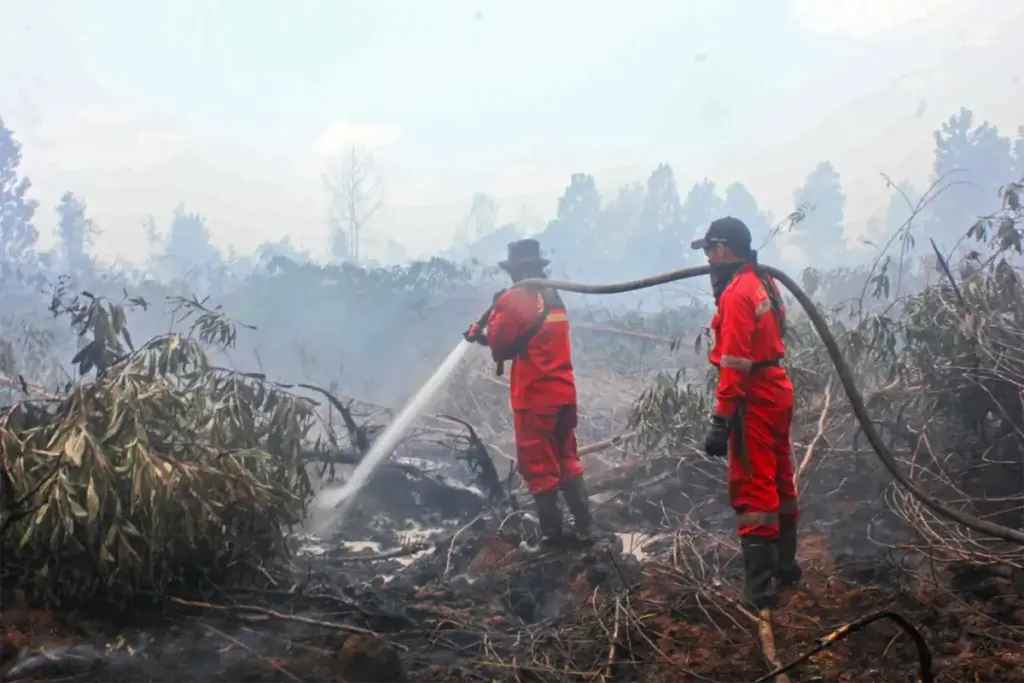
By early September, regional dry-season conditions, supercharged by El Niño-induced heat, created a tinderbox across East Kalimantan. On September 3, fires swept through the Bukit Soeharto protected forest—a critical conservation area that falls directly within the delineations of the Ibu Kota Nusantara (IKN) planning zone. Charred landscapes and smoldering brush replaced lush tropical secondary growth, prompting emergency alerts from local disaster mitigation agencies (BPBD).
By mid-September, the fires had advanced to within 30 to 40 kilometers (19 to 25 miles) of the capital’s central government complex perimeter. Major flare-ups were officially reported in Wonotirto, situated near the newly constructed main toll road, and further intensified around the rugged hills of Bukit Tengkorak.
Danis H. Sumadilaga, spokesperson for the Nusantara Capital Authority, sought to reassure the public in a September 9 statement, emphasizing that the fires had been contained within the outer buffer zones. "Hopefully, it won’t reoccur," Danis stated. "We will have to conduct monitoring and patrols to ensure this fire doesn’t happen again."

September 14: Ministerial Inspection and Aerial Warfare
Despite official assurances, the situation remained volatile. On September 14, high-level federal intervention was triggered when Forestry Minister Raja Juli Antoni flew to East Kalimantan to conduct an emergency aerial and ground inspection of the fire zones. He was accompanied by the head of Indonesia’s National Disaster Management Agency (BNPB) and the chief of the IKN Authority.
From the skies, officials surveyed a fragile landscape blanketed in a dense, grey pall. Helicopters equipped with giant hanging buckets buzzed overhead, scooping water from local reservoirs to drop onto persistent hotspots skirting the city’s development boundaries.
The urgency of the situation was underscored during the minister’s ground checks. Spotting a fresh plume of smoke rising from the hilly interior, Minister Antoni openly rebuked the delayed response on-site. "It’s there again — where’s Manggala Agni?" the minister demanded, referencing the state’s specialized forestry fire brigade. Urging immediate mobilization, he instructed officials: "They need to get there, along with colleagues — there’s smoke again. Please coordinate with the firefighters, army, police. Find the quickest route."
While the multi-agency response managed to avert structural catastrophe at the core construction sites, the incident shattered the illusion that the capital’s expansive boundaries could easily be insulated from the broader, systemic fire crisis plaguing Indonesian Borneo.
Supporting Context & Metrics: A Tale of Two Cities and a Regional Tinderbox
To understand the gravity of the fires threatening Nusantara, one must examine the geopolitical motivations behind the capital’s relocation, alongside the long-term ecological degradation that has turned Borneo into a seasonal firetrap.
The Vision and Reality of Nusantara
Announced by President Joko Widodo in 2019, the Nusantara project carried an initial estimated price tag of 466 trillion rupiah (approximately $32.7 billion USD at the time). Recognizing that Jakarta was buckling under severe traffic congestion, chronic flooding, and rapid land subsidence caused by the excessive extraction of groundwater from its underlying aquifers, the government sought a clean slate.
Beyond practical engineering solutions, the move held profound symbolic weight. By shifting the nation’s political center away from Java—home to over half of Indonesia’s 275 million citizens—to the less-developed eastern side of the archipelago, the government intended to catalyze equitable regional economic growth.

However, the transition has faced immense hurdles. Much of the anticipated private sector investment—slated to cover roughly 80% of the capital’s cost through public-private partnerships—has been slow to materialize. Furthermore, questions regarding the project’s long-term priority have multiplied following the 2024 election of President Prabowo Subianto, whose administration must balance the massive capital expenditures of IKN against broader national welfare commitments.
Ecological Fragility and the Smoke Crisis
The environmental backdrop of East Kalimantan compounds these economic and political challenges. Over the past several decades, vast swathes of Borneo’s pristine rainforests and carbon-rich peatlands have been systematically drained, logged, and converted into industrial oil palm plantations and timber estates. Furthermore, East Kalimantan serves as the beating heart of Indonesia’s coal mining industry, accounting for more than a quarter of the province’s GDP in recent years.
Drained peatlands and abandoned mining concessions create a subterranean hazard; when dry season droughts arrive, these carbon sinks burn continuously underground, making them extraordinarily difficult to extinguish.
The regional air quality metrics reflect this ecological breakdown. On September 14, an air pollution monitoring station operated by the Ministry of Environment in the South Barito district of neighboring Central Kalimantan recorded continuous $PM_2.5$ concentrations exceeding 600 micrograms per cubic meter ($mu g/m^3$) over a 24-hour period. To put this into perspective, this toxic concentration is more than 40 times higher than the World Health Organization’s strict 24-hour safe guideline of just $15 mu g/m^3$.
In nearby Balikpapan—a bustling coastal city of nearly 800,000 residents serving as the primary logistics gateway to Nusantara—the skies turned an ominous, hazy grey. Local residents initially mistook the toxic haze for morning fog, only to be overwhelmed by the acrid smell of burning biomass. Data released by the Balikpapan city health department revealed a staggering 20% spike in respiratory illness diagnoses in August compared to July, logging 1,361 formal cases, though local health authorities have noted that direct causation studies linking the surge explicitly to the wildfires are still underway.
Official Statements and Local Realities
The friction between high-level political aspirations and ground-level socioeconomic realities forms the core tragedy of the current wildfire emergency. While federal officials focus on perimeter defense and water-bombing sorties, citizens inhabiting the shadow of the new capital face immediate health and financial crises.
Perspectives from Academia and Civil Society
Dr. Sri Murlianti, a social development lecturer at Mulawarman University in Samarinda, argued that the fires expose the deep flaws of pushing a hyper-modern urban megaproject onto a landscape crippled by historical environmental degradation.

"The measure of development success should not be just how many buildings are built, or how much investment is made," Sri told Mongabay Indonesia. "Pero whether the people living nearby have the most basic right — to breathe safe air."
This sentiment was echoed by Refinaya Jamiilfitriani, coordinator of the Mahardhika Samarinda Women’s group, who highlighted the disproportionate domestic and psychological burden placed on women and families during prolonged air pollution crises.
"Children cannot play freely outside, vulnerable members of the family require more attention, the house needs to be cleaned more frequently, and health needs monitoring," Refinaya explained. She sharply criticized the systemic expectation that ordinary citizens must perpetually absorb the costs of environmental mismanagement.
"What about daily laborers, small traders, motorcycle taxi drivers, farmers?" she asked pointedly. "So if they’re not able to leave the house, that just means they’ll go hungry tomorrow because they won’t earn any income — why are people continually being asked to adapt to damage they didn’t create?"
Stories from the Ground
In Sepaku Lama—a village nestled directly within the designated grounds of the new capital—local families have felt the immediate physical impacts of the smoke. Deden Wahyudi, a resident whose home was enveloped by dense smoke in late August, watched anxiously as his mother, Jakiyah, suffered severe health complications that culminated in a pneumonia diagnosis exacerbated by the polluted air.
Meanwhile, municipal authorities in North Penajam Paser, the regency that hosts the core of the IKN project, have shifted into defensive emergency mode. Nurlaila, head of the district’s disaster management office, outlined their immediate intervention strategy: "Our focus is on stockpiling masks, distributing these to the public, and providing education and outreach to reduce outdoor activities."
For vulnerable populations, however, safety advice to "stay indoors" remains an economic impossibility. Informal workers, agricultural laborers, and construction crews must choose between exposing their lungs to hazardous fine particulates or facing immediate destitution.

Future Outlook: Navigating Climate Realities in Indonesia’s New Era
As Indonesia looks toward the future with the gradual institutional migration to Nusantara, the September wildfire crisis serves as an unignorable warning flare. Climate projections indicate that extreme weather events, prolonged droughts, and intensified El Niño cycles will continue to threaten the equatorial forests of Borneo in the coming decades.
To ensure the long-term viability of Nusantara, government authorities must move beyond reactive measures—such as scrambling water-bombing helicopters only when fires reach the outer gates. Experts and environmental advocates argue that structural reforms are urgently required:
- Ecosystem Restoration and Peat Protection: The Indonesian government must prioritize the re-wetting and restoration of drained peatlands and degraded forest zones surrounding the IKN perimeter, rather than treating them merely as disposable buffer zones.
- Strict Enforcement Against Land-Clearing Fires: Zero-tolerance policies for slash-and-burn land clearance must be stringently enforced across East and Central Kalimantan, holding both corporate concession holders and local land speculators legally accountable.
- Public Health Infrastructure: As urban populations swell with incoming construction workers, civil servants, and migrants, municipal authorities in Balikpapan, North Penajam Paser, and Nusantara proper must establish robust air-quality monitoring networks and emergency healthcare infrastructure equipped to handle recurring respiratory crises.
- Inclusive Urban Planning: True sustainable development must internalize the welfare of indigenous communities, informal laborers, and marginalized families, ensuring that the pursuit of a futuristic national capital does not come at the direct expense of public health and ecological justice.
Ultimately, Nusantara’s success will not be judged solely by the architectural grandeur of its government palaces or the volume of foreign capital it attracts. As the smoke clears over the hills of Bukit Soeharto, the true test of Indonesia’s new capital will be whether it can foster a harmonious coexistence between human ambition and the fragile, breathing ecosystems of Borneo.



