(This reporting is made possible through a collaborative partnership between Grist and WABE, Atlanta’s NPR station.)
Executive Overview
For years, the state of Georgia aggressively positioned itself as the undisputed capital of America’s clean energy transition. Bolstered by aggressive economic development strategies, specialized workforce training programs, and lucrative state-level tax incentives, Governor Brian Kemp’s administration successfully transformed the Peach State into a magnet for multi-billion-dollar investments. Global automotive titans and renewable technology pioneers—including Hyundai, Rivian, Kia, and Blue Bird—poured capital into the region, turning sprawling acreage into state-of-the-art facilities designed to build electric vehicles (EVs), next-generation lithium-ion batteries, and commercial solar arrays.
However, the rapid ascent of Georgia’s clean energy ecosystem has collided with severe political, economic, and regulatory headwinds over the past eighteen months. The return of a federal administration hostile to climate mandates has destabilized the macroeconomic landscape. The sudden termination of federal EV tax credits, combined with newly enacted tariffs on critical components like battery packs and charging hardware, has disrupted supply chains and cost structures. Simultaneously, relaxed regulatory emissions standards for internal combustion engines and the rollback of federal fleet electrification mandates have altered consumer and corporate demand curves.
Local challenges have further complicated this transition. A high-profile federal immigration raid at an EV battery plant—which resulted in the detention of over 400 foreign workers crucial to facility setup—sent shockwaves through the industry. Across the Southeast, billions in clean energy investments have been paused, scaled back, or canceled, accompanied by localized layoffs.
Yet, despite this tumultuous climate, Georgia’s manufacturing sector is not retreating; it is pivoting. Rather than abandoning clean energy altogether, automakers and component suppliers are deploying flexible manufacturing strategies, diversifying production lines to embrace hybrids, and expanding into energy storage solutions. This deep-dive investigation examines how Georgia’s clean energy sector is weathering a turbulent political storm, transforming its manufacturing floors, and forging a pragmatic path forward amid profound uncertainty.
Detailed Chronology: From Boom Times to Policy Whiplash
To understand Georgia’s current industrial pivot, one must trace the rapid trajectory of its clean energy economy over the past decade—a timeline marked by aggressive state recruitment, historic investments, and abrupt federal policy reversals.
2018–2021: The Foundation of a Green Industrial Base
The groundwork for Georgia’s clean energy surge was laid years before the national EV boom fully materialized.
2018: Georgia-based bus manufacturer Blue Bird achieved a major commercial milestone by successfully launching its zero-emission electric school buses into the commercial market, signaling that heavy-duty commercial electrification was commercially viable.
The Legislative Push: Governor Kemp’s administration recognized an unprecedented economic opportunity in the global shift toward decarbonization. Utilizing the state’s QuickStart workforce training program—long lauded as one of the best in the nation—and tailored tax structures, Georgia systematically outmanoeuvred competing Southern states to secure clean-tech manufacturing facilities.
2022–2024: Historic Investments and Rapid Expansion
The pace of development accelerated exponentially following the passage of federal legislative packages that encouraged domestic manufacturing:
2022: Hyundai Motor Group announced and broke ground on its massive "Metaplant America" near Savannah—a multibillion-dollar project dedicated almost entirely to electric vehicle production and hailed as one of the largest economic development initiatives in Georgia history.
2023: Blue Bird opened a significantly expanded, dedicated electric bus manufacturing facility to meet surging municipal and school district demand.
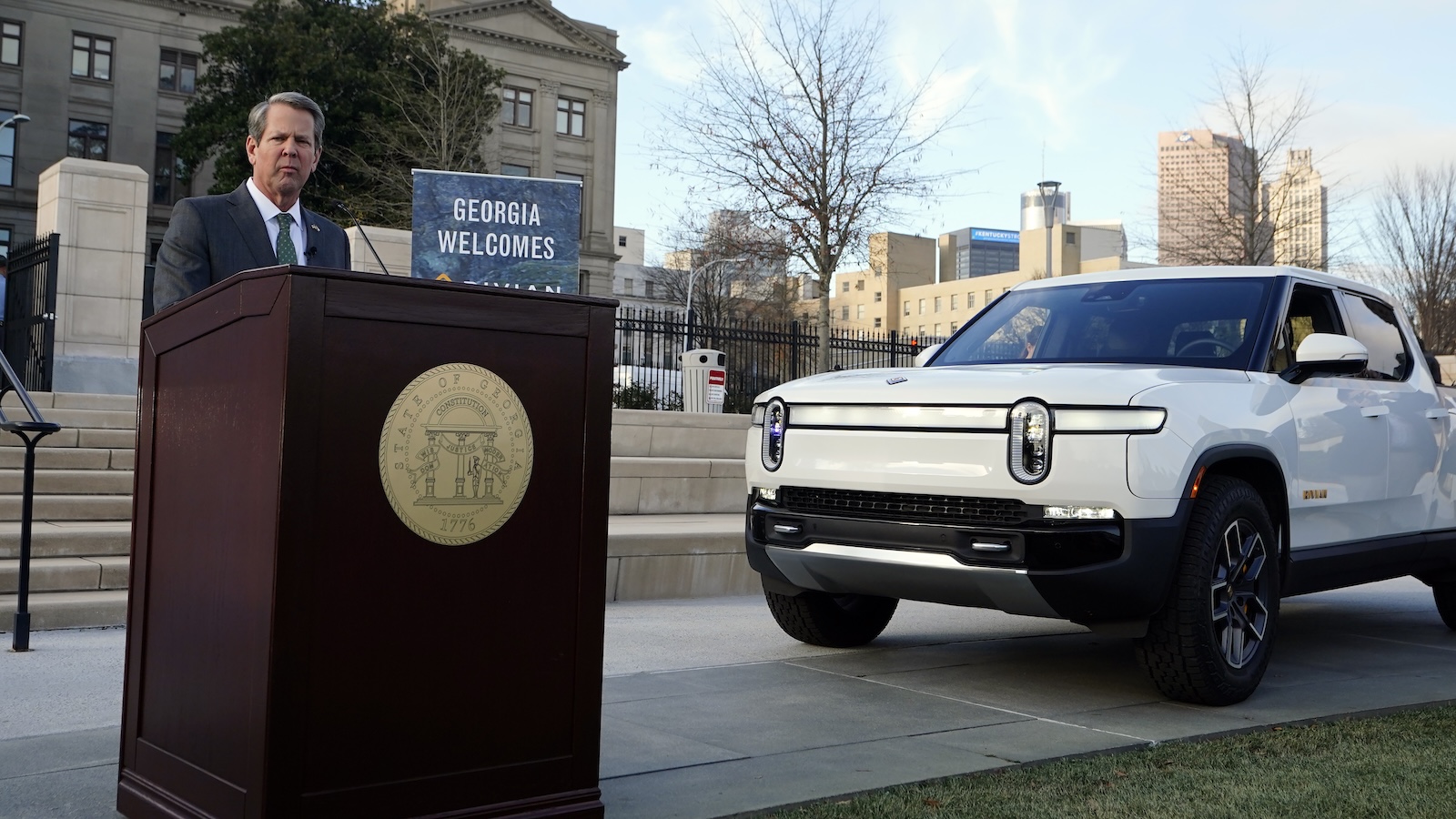
2024: Kia officially integrated EV manufacturing into its existing assembly footprint at its West Point, Georgia plant. Concurrently, electric truck maker Rivian initiated groundwork on its multi-billion-dollar manufacturing plant east of Atlanta, promising thousands of high-tech jobs. The state also attracted a dense web of tier-one suppliers, including battery cell manufacturers, recycling facilities, and solar panel companies.
2025–Present: The Regulatory and Operational Pivot
The momentum hit a sudden wall with the inauguration of the second Trump administration and a shifting macroeconomic environment:
Federal Policy Reversals: The new federal administration systematically dismantled key pillars of the prior administration’s climate agenda. Federal consumer tax credits for EV purchases were abruptly terminated, while steep tariffs were levied on imported battery packs, energy storage hardware, and charging infrastructure components. Furthermore, federal agencies loosened tailpipe emissions rules for gas-powered passenger vehicles and scrapped federal fleet electrification targets.
The Regulatory Crackdown: Amid this policy shift, federal immigration authorities executed a high-profile raid on a major Georgia EV battery facility, detaining more than 400 workers—many of whom were South Korean nationals brought in temporarily to oversee complex equipment installation and factory calibration.
The Market Adjustment: Faced with declining immediate demand for pure EVs—driven by lingering consumer concerns over vehicle sticker prices, charging station accessibility, and the loss of financial incentives—Georgia manufacturers began altering their production models. Plants originally engineered solely for battery-electric vehicles were retrofitted to produce high-demand hybrids, while battery suppliers diversified their output to serve stationary grid-storage markets.
Supporting Context & Metrics: Navigating the Numbers
While the headlines frequently highlight canceled projects and policy setbacks, the underlying financial data reveals a more nuanced reality: while the market has slowed and transformed, the scale of capital investment in the region remains staggering.
Investment Analysis
According to tracking data compiled by the Southern Alliance for Clean Energy (SACE):
The Pullback: In the wake of federal policy shifts and market cooling, more than $4 billion in clean energy investments across the Southeast has been canceled or scaled back over the past year. High-profile adjustments include localized workforce reductions, such as layoffs at SK Battery facilities earlier in the year.
The Resiliency: Despite these contractions, this pullback is dramatically dwarfed by the nearly $74 billion in total manufacturing investments across the region that are continuing to push forward. Georgia maintains its position as the undisputed clean energy and EV manufacturing leader in the American Southeast.
Consumer Adoption and the Infrastructure Gap
A critical challenge facing Georgia’s clean energy sector is the disconnect between state-level manufacturing capacity and local consumer adoption rates.
Lack of State-Level Incentives: Unlike progressive states on the West Coast or in the Northeast that offer direct cash-back incentives or rebates for EV buyers, Georgia provides virtually no state-level financial encouragement for consumers to purchase electric vehicles.
The Penalty Tax: Compounding this barrier, Georgia imposes an additional annual registration fee specifically targeted at alternative-fuel and electric vehicles, ostensibly designed to make up for lost state gas tax revenue. This policy creates a paradoxical economic environment where citizens are trained to build advanced EVs, yet face financial disincentives to own them.
Utility-Led Growth: In the absence of legislative support, private industry and regulated utilities are stepping into the vacuum. SACE data indicates that utility-related investments in EV charging infrastructure across the region increased by 14 percent over the past year. Consortia like IONNA—a joint venture involving automakers such as Kia and Hyundai—are actively deploying high-speed charging networks throughout the state, including key installations directly at manufacturing sites like the West Point Kia facility.
Official Statements and Industry Insights
Industry leaders, economic analysts, and clean energy advocates have been candid about the friction points defining this transitional era, emphasizing both the operational hurdles and the long-term inevitability of electrification.
The Automaker Perspective: Flexibility as a Survival Strategy
At Kia’s advanced manufacturing facility in West Point, the assembly line operates with a high degree of agility. Rather than churning out massive, uniform batches of single-powertrain vehicles, the plant functions similarly to a custom workshop. Every vehicle rolling down the line can feature completely different specifications—ranging from traditional internal combustion engines to hybrids and full electrics—tailored to real-time market demand.
"What we’ve seen is a transition back away from maybe full EV vehicle building to this kind of a middle-of-the-road opportunity," explains Stuart Countess, CEO of the Kia manufacturing plant.
Countess emphasizes that while electric vehicles remain the long-term horizon for the automotive industry, current consumer realities—chiefly vehicle purchase price and the density of the public charging network—have slowed adoption rates. The removal of federal financial supports proved to be an inflection point:
"We had a tax incentive credit that did go away," Countess notes. "Sales were really moving in the right direction, but once it went away, it became a much different environment."
This sentiment is echoed by Kia’s corporate sibling, Hyundai, which swiftly adapted its massive Metaplant near Savannah—originally conceptualized as a pure EV facility—to incorporate hybrid vehicle production into its assembly blueprints.
The Analyst Outlook: A "Messy" But Necessary Transition
Market analysts view these operational pivots not as a death knell for the EV movement, but as a painful, necessary phase of industrial maturation.
"It’s kind of a messy period we’re in right now," says Stephanie Valdez-Streaty, director of industry insights at Cox Automotive. "But I think the manufacturers are adjusting."
Valdez-Streaty points out that proximity to manufacturing heavily influences consumer behavior over generational timelines. As more Georgians find employment within these advanced manufacturing plants, familiarity with the technology breeds broader cultural and commercial acceptance:
"It’s like that familiarity, right? People have jobs at those companies and familiarity with those products."
Despite the turbulence of the past eighteen months, Valdez-Streaty asserts that the broader automotive market is continuing its migration toward electrification; the timeline has simply stretched out.
The Advocacy View: Navigating Political and Regulatory Paradoxes
Stan Cross, electric transportation director at the Southern Alliance for Clean Energy (SACE), highlights the complex political landscape governing Georgia’s green transition.
"The state continues to have a lot riding on the success of both the electric vehicle but also the battery market," Cross observes. However, he warns that state-level political messaging remains fraught with contradiction: "When it comes to electric vehicles, Georgia politics remains utterly confused."
Cross argues that because state lawmakers have been reluctant to enact pro-adoption policies—and have instead implemented punitive measures like extra EV registration fees—advocates must look toward regulatory bodies to sustain momentum.
"Though we’re not seeing a lot of activity on the legislative side, we do see potential on the regulatory side and really are encouraging Georgia Power to step up and help kind of fill the void that policymakers in the state are creating," Cross said.
Future Outlook: The Road Ahead for Georgia’s Green Economy
As Georgia’s clean energy sector moves past the initial shock of federal policy reversals and tariff implementations, its long-term viability hinges on industrial adaptability and market diversification.
The Hybrid Bridge: For the foreseeable future, automakers in West Point and Savannah will lean heavily on hybrid and plug-in hybrid electric vehicles (PHEVs) to smooth out revenue streams. This "middle-of-the-road" strategy buffers companies against shifting federal EV subsidies while keeping production lines active and workforces employed.
Diversification into Grid Storage: Battery manufacturers across the state are increasingly splitting their production capacity between mobility applications (EVs) and stationary energy storage systems (ESS). As demand for grid-scale renewable energy storage surges alongside data center expansion and solar grid integration, these localized battery plants have found a vital secondary revenue stream.
Infrastructure Maturation: With private consortia like IONNA and regional electric utilities increasing infrastructure investments by double-digit margins, the "charging anxiety" that deters everyday consumers is slowly being mitigated. As public chargers become as ubiquitous as traditional gas stations, consumer confidence is projected to rebound.
Georgia’s grand experiment in clean energy manufacturing has undeniably faced a severe reality check. Federal policy whiplash, shifting tax structures, and regulatory friction have forced multi-billion-dollar corporations to rewrite their playbooks on the fly. Yet, through industrial flexibility, technological diversification, and an unwavering commitment to regional infrastructure, the Peach State’s clean energy sector is proving resilient—transforming a period of immense political and economic turbulence into a durable foundation for the future of American transportation.