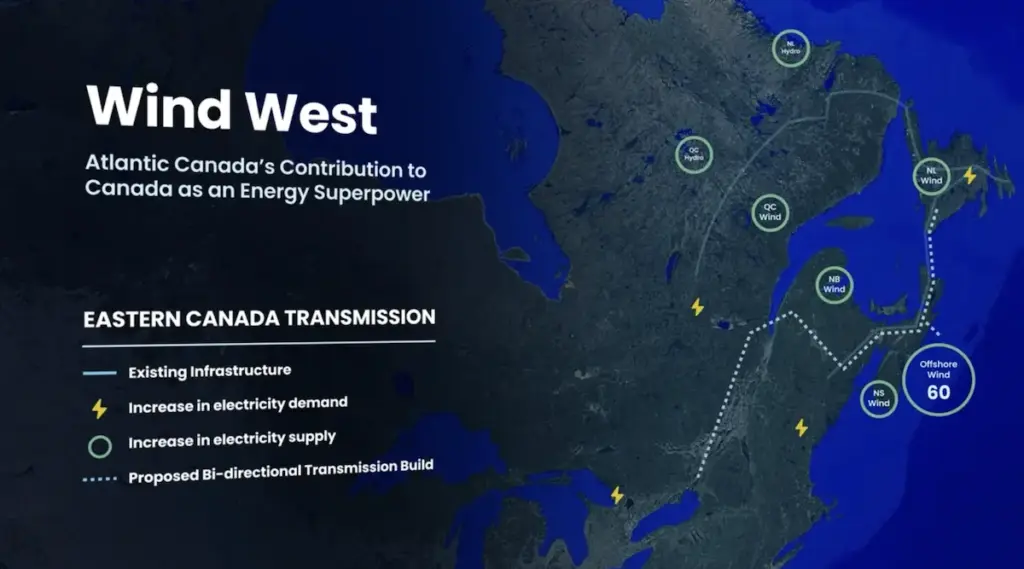
In an era defined by polarized energy policies and cross-border geopolitical maneuvering, the Canadian province of Nova Scotia is quietly laying the groundwork for a massive, multi-gigawatt offshore wind revolution. Titled "Wind West," this ambitious clean energy initiative aims to capture some of the strongest and most consistent wind resources in North America. Designed to far exceed the province’s own internal electricity consumption, the project is poised to generate an immense surplus of renewable power, creating a vital geopolitical and economic lifeline for energy-hungry states in the Northeastern United States.
This Canadian expansion stands in stark contrast to the shifting political landscape south of the border. In the United States, the federal administration under President Donald Trump has waged a sustained, multi-front campaign against offshore and onshore wind development—deploying executive reviews, legal hurdles, and lucrative lease-buyout offers to stall renewable deployment. Yet, as coastal U.S. states face mounting energy demands and soaring conventional fuel costs, regional leaders are looking northward. Through strategic memorandums of understanding, interstate coalitions, and cross-border transmission lines, northeastern states are forging alliances with Canada to secure stable, long-term supplies of zero-emission electricity.
Nova Scotia’s master plan is not merely a regional infrastructure upgrade; it is a profound structural shift in North American energy security. By pairing massive offshore wind capacity with broader regional initiatives like the Eastern Energy Partnership, Atlantic Canada is positioning itself as a clean energy superpower. This comprehensive report explores the mechanics of the Wind West project, the escalating cross-border dynamics with the United States, the creative regulatory workarounds emerging in Washington, and the broader economic implications for both nations.
Detailed Chronology: The Evolution of North American Cross-Border Clean Energy
The convergence of Canadian wind generation and U.S. demand is the culmination of years of escalating energy policy conflicts and strategic infrastructure planning.
Early Phase (Prior Years): Regional energy integration between the U.S. and Canada historically relied on terrestrial hydro and fossil fuels. However, aggressive climate targets in states like Massachusetts, New York, and California prompted early explorations into long-range transmission and offshore wind partnerships.
January – February 2026: Legal battles intensified as U.S. courts ruled against executive actions targeting Atlantic Coast offshore wind projects. Simultaneously, the regulatory friction prompted Northeastern U.S. governors to look toward Canadian partners. On February 5, 2026, Massachusetts Governor Maura Healey and Nova Scotia Premier Tim Houston signed a high-profile Memorandum of Understanding (MOU). This agreement formally established a collaborative framework to co-develop North Atlantic offshore wind projects that would supply clean energy to New England.
March – April 2026: The federal administration in Washington escalated its efforts to curb domestic offshore wind, introducing taxpayer-backed financial incentives for leaseholders to surrender their federal tracts. In response, a coalition of state attorneys general from New York, Connecticut, Maine, Massachusetts, New Jersey, and Rhode Island filed a federal lawsuit challenging the legality of these multi-million-dollar lease buyouts. California soon followed with a parallel legal challenge regarding West Coast developments.
June 2026: Cross-border infrastructure achieved a major milestone with the official opening of the 1.25-gigawatt Champlain Hudson Power Express transmission line. This critical artery began funneling massive quantities of Quebec hydropower directly into New York City, satisfying up to 20% of the metropolis’s electricity demand and proving the viability of large-scale international clean power trade.
Late Summer 2026: The Government of Nova Scotia formally showcased the "Wind West" project at the inaugural Canada Investment Summit in Toronto, presenting it as a centerpiece investment opportunity for regional and international capital.
Fall 2026: To navigate ongoing domestic hostility toward renewable energy terminology, the U.S. Department of Energy (DOE) implemented creative administrative restructuring, renaming wind energy systems "aeromechanical energy systems" and consolidating related offices into a new Integrated Energy Systems Office (IESO).
Supporting Context & Metrics: The Scale of Wind West
The technical parameters of Nova Scotia’s offshore wind initiative underscore its transformative potential for North American power markets.
Exceptional Natural Resources
Nova Scotia’s offshore geography benefits from extraordinary meteorological conditions. Annual average wind speeds in the designated development zones routinely top 9 to 11 meters per second. These metrics place the region among the most robust wind regimes on the North American continent.
Capacity Factors and Reliability
Wind West is projected to achieve exceptional capacity factors—a measure of actual electricity generation relative to a facility’s maximum potential output—reaching up to 60%. To contextualize this performance, traditional fossil-fueled assets in the United States, such as coal-fired plants and high-efficiency combined-cycle natural gas turbines, frequently record capacity factors ranging from the mid-30s to the low-60s depending on seasonal demand fluctuations. The high capacity factor of Nova Scotia’s offshore winds promises a level of generation consistency rarely matched by onshore wind installations.
Phased Deployment and Generation Targets
Phase I Target: The initial phase of Wind West calls for a massive 5-gigawatt tranche of offshore turbines.
Annual Output: This initial phase is expected to yield approximately 24 terawatt-hours (TWh) of electricity annually.
Domestic Impact: To illustrate the sheer scale of the project, 24 TWh per year is roughly twice the current peak electricity demand of Nova Scotia itself.
Long-Term Potential: The provincial government has identified broader offshore zones capable of hosting an estimated 62 gigawatts of total capacity. Fully realized, these resources possess the technical potential to satisfy approximately 25% of Canada’s total national electricity needs.
Official Statements and Strategic Vision
The leadership driving these cross-border initiatives has emphasized both the economic upside and the strategic necessity of regional energy integration.
Upon signing the historic bilateral agreement in February, Nova Scotia Premier Tim Houston highlighted the mutual benefits of the partnership:
"I look forward to sharing this clean energy with Massachusetts, powering economic opportunities for the New England region, and creating thousands of jobs and billions in investment in Nova Scotia."
This sentiment is echoed in the strategic framework of the newly formed Eastern Energy Partnership. This multi-province coalition—spanning Quebec, New Brunswick, Newfoundland and Labrador, Nova Scotia, and Prince Edward Island—aims to build robust east-west electrical transmission backbones. According to the official Wind West strategic blueprint:
"Offshore wind from Nova Scotia can provide enormous quantities of clean energy, at stable prices, while diversifying supply, and boosting reliability for customers. And, in addition to Nova Scotia’s offshore wind, the Atlantic Provinces have other enormous resources to offer—in new and expanded hydro, in new nuclear, in onshore wind, geothermal, tidal and others."
Conversely, the domestic regulatory environment in the United States has necessitated unusual bureaucratic maneuvers. Facing federal hostility toward renewable energy programs, the U.S. Department of Energy pivoted its nomenclature to safeguard technical research. The newly formed Integrated Energy Systems Office (IESO) released mission guidelines focusing on what it terms "aeromechanical energy systems":
"IESO addresses challenges to the long-term reliability and performance of wind energy systems and promotes the recycling of end-of-life wind energy components."
Despite these semantic adjustments, federal funding for physical construction remains constrained, leaving coastal state governments to spearhead legal and international countermeasures independently.
Future Outlook: Geopolitical Realities and Cross-Border Interdependence
As North America navigates an increasingly complex energy transition, the dichotomy between Canadian ambition and U.S. federal obstructionism will likely define the market for years to come.
For the Northeastern United States, the appetite for clean, predictable electricity is insatiable. Cities like Boston and New York require massive decarbonization to meet statutory climate mandates, yet domestic headwinds threaten to choke off local infrastructure development. By turning to Atlantic Canada—and specifically tapping into Nova Scotia’s Wind West development—these states can bypass local permitting deadlocks. The operational success of the Champlain Hudson Power Express demonstrates that cross-border transmission corridors are not only feasible but essential for metropolitan grid stability.
Meanwhile, Nova Scotia and its Atlantic provincial partners are positioning themselves as global exporters of green electrons. By developing energy systems that vastly outstrip local consumption, Canada is creating a resilient economic engine built on manufacturing, marine engineering, and long-term power purchase agreements with U.S. utilities.
Ultimately, federal political resistance in Washington may delay, but cannot permanently halt, the economic gravitational pull of cheap, abundant renewable energy. Whether categorized as traditional wind farms or rebranded "aeromechanical energy systems," the physics of the energy transition favor high-capacity, utility-scale generation. As Nova Scotia moves forward with Phase I of Wind West, the province is not only securing its own energy future but also serving as a vital clean power reserve for its neighbors to the south.