

Executive Overview
The intersection of global geopolitical ambition and local vulnerability turned volatile in Manila on September 10, as Philippine President Ferdinand Marcos Jr. arrived at the Grand Hyatt Manila to address hundreds of foreign business executives. The gathering was the Luzon Economic Corridor (LEC) Investors’ Forum—a high-stakes showcase of the Philippines’ aggressive push to position itself as a central node in the global artificial intelligence (AI) and semiconductor supply chains.
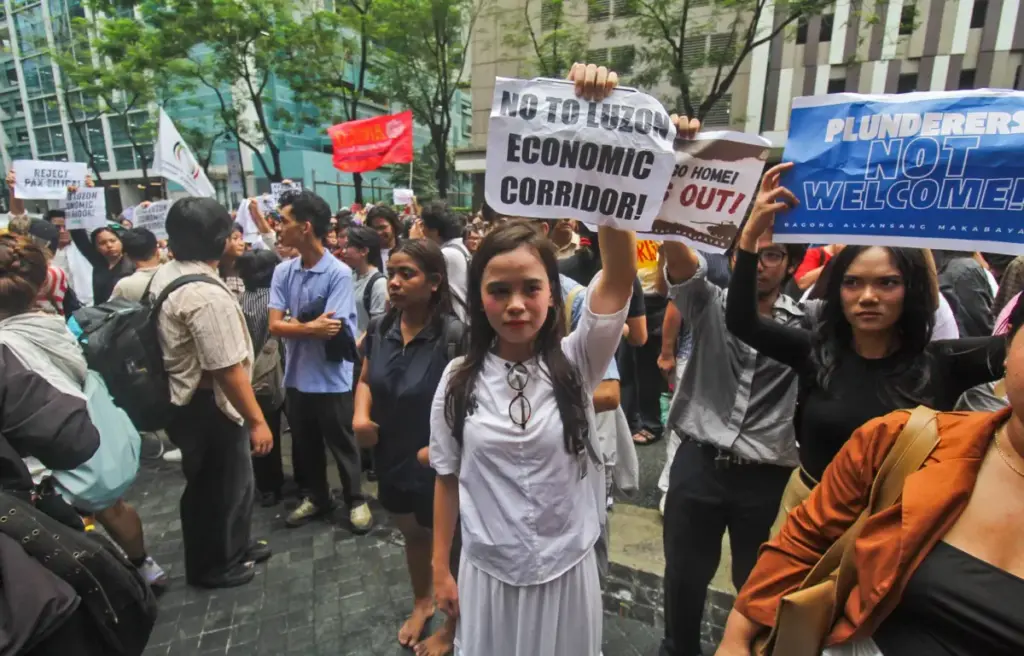
Just outside the luxury hotel doors, however, a starkly different reality unfolded. Hundreds of demonstrators, trade unionists, scientists, and Indigenous community members converged to protest the event. Brandishing placards reading “No to Pax Silica!”, the crowd met with a heavy police presence. What began as a demonstration quickly devolved into violent clashes, with law enforcement utilizing riot shields and batons to break up the lines.
Activists reported that at least 27 protesters were injured and five arrested, while police officials countered that 16 personnel sustained minor cuts and contusions. Among those detained was Jona Yang of the activist-scientist coalition AGHAM, who was apprehended while attempting to mediate tensions between the crowd and police lines.
At the heart of the unrest is Pax Silica—a U.S.-led, multi-nation pact designed to forge semiconductor and AI supply chains independent of China. Central to this pact is a massive, 1,620-hectare (4,000-acre) high-tech manufacturing hub slated for Central Luzon. While the Marcos administration and Washington frame the project as an economic windfall that will integrate the Philippines into cutting-edge global technology, civil society groups, environmentalists, and Indigenous leaders warn of an unprecedented resource grab. They argue the project threatens local ecologies, prioritizes foreign industrial power over domestic energy needs, and displaces the ancestral domains of the Indigenous Aeta people.
Detailed Chronology: From Pact to Protest
The road to the September 10 clashes at the Grand Hyatt Manila has been paved by a rapid series of geopolitical developments, legislative maneuvers, and escalating local resistance since the LEC’s inception.
- 2024: The Luzon Economic Corridor (LEC) initiative is formally launched, designed to spur infrastructure and industrial development across the Philippines’ largest island.
- September 2025: President Ferdinand Marcos Jr. signs the Investor’s Lease Act, a critical piece of legislation enabling foreign corporations to lease commercial and industrial lands for up to 99 years, clearing the regulatory runway for massive foreign-backed industrial parks.
- April 2026: Washington and Manila officially announce joint plans to establish a 1,620-hectare economic security zone in Central Luzon, positioning it as the premier AI-native industrial acceleration hub under the Pax Silica initiative.
- July 2026: U.S. Secretary of State Marco Rubio travels to Manila to solidify bilateral commitments to the project, setting the stage for a final binding agreement projected for November 2026.
- September 10, 2026 (Day 1): President Marcos Jr. arrives at the Grand Hyatt Manila for the LEC Investors’ Forum. Outside, hundreds of protesters gather. Clashes erupt between demonstrators and riot police, leading to 27 reported injuries among activists, five arrests, and 16 injured police personnel.
- September 11, 2026 (Day 2): The LEC forum moves its proceedings to New Clark City. Prospective investors participate in a guided field visit, closely shadowed by persistent protesters and local Aeta community members vowing to defend their lands.
Supporting Context & Metrics: The Scale of Pax Silica
To understand why Pax Silica has galvanized such intense domestic resistance, one must look closely at the sheer scale of the resources the project demands.
The manufacturing hub is planned within New Clark City, a government-designated "smart city" spanning 9,450 hectares (23,350-acre) within the broader 32,000-hectare (79,000-acre) Clark zone—a former U.S. military base. Managed by the Bases Conversion and Development Authority (BCDA), an agency directly supervised by the Office of the President, the facility is designed to be an energy and water-intensive industrial behemoth.

Energy Demands vs. National Consumption
According to BCDA Chief Joshua Bingcang, conservative estimates indicate the facility will require a baseline capacity of approximately 3 gigawatts of continuous power to operate its semiconductor fabrication and high-tech infrastructure.
Operating consistently throughout the year, this single facility would consume roughly 26.3 terawatt-hours (TWh) annually. To put this into perspective, the entire service sector of the Philippines consumed approximately 28 TWh in total during 2024, according to Department of Energy (DOE) statistics. A single industrial zone under Pax Silica threatens to match the power consumption of the country’s entire commercial service industry.
The BCDA maintains that the facility will be "green," running primarily on solar energy drawn from the region’s abundant sunshine. However, critics like Giovanni Tapang, former dean of the University of the Philippines College of Science and a convenor of the Network Opposed (NO) to Pax Silica, raise critical questions regarding land use and energy equity:
"How many thousands of hectares will they be taking from farmers to build solar panels? And if we’re generating all this clean energy, why let the U.S. use it instead of local households?"
Water and Mineral Pressures
In addition to its gargantuan power footprint, the BCDA projects that the Pax Silica facility will consume between 60 million and 90 million liters (16 million to 24 million gallons) of water per day, sourced primarily from rainwater collected via an impounding dam. Officials note this capacity could theoretically be scaled up to 300 million liters (79 million gallons) daily using advanced technology.
Environmentalists and agricultural advocates warn that this massive extraction poses an existential threat to local farming communities. The Philippines experiences a distinct dry season from December to May—precisely the period when local farmers are most dependent on regional water sources for irrigation. Diverting tens of millions of liters daily toward semiconductor manufacturing risks drying out local agricultural livelihoods.
Furthermore, plans to house mineral processing technology within the hub have raised environmental alarms. Thony Dizon of the advocacy group BAN Toxics pointed out that the government has yet to release clear, binding frameworks for managing industrial waste.

"How will the government ensure that after 30 years, we are not left with a contaminated environment and depleted natural resources?" Dizon asked.
Official Statements and Government Stance
Throughout the forum, government officials and foreign representatives defended the initiative as a historic leap forward for the Philippine economy, while carefully deflecting specifics regarding environmental and social footprints.
- Angela Ignacio (Undersecretary, Philippine Department of Finance): Speaking to reporters at the LEC forum, Ignacio argued that it was premature to disclose detailed plans regarding Pax Silica prior to formal finalization in November. However, she championed the initiative as an unmissable opportunity for the nation:
"This is a chance for the Philippines to become a global player when it comes to technologies that will shape the future."
- Heather Variava (Senior Advisor, U.S. State Department Bureau of Economic, Energy, and Business Affairs): Emphasizing the bilateral partnership, Variava stated:
"The goal of the U.S. is always to be an additive, to bring more power, to bring water, to bring more benefits to the Philippines."
- Joshua Bingcang (Chief, Bases Conversion and Development Authority): Addressing reporters regarding infrastructure requirements, Bingcang stressed the green credentials of the project, highlighting that the region benefits from "300 days of sunshine." Addressing concerns over data centers versus semiconductor plants, Bingcang and Palace officials clarified that the primary focus remains semiconductor manufacturing. Regarding local displacement fears, Bingcang maintained that no formal ancestral domain titles exist in the targeted construction zones, asserting that the project would not displace residents.
Land Disputes and the Aeta Struggle
The deepest fractures surrounding Pax Silica lie in historical grievances regarding land ownership and indigenous rights.
The Clark area has a deeply contested history. Established as a U.S. military base in 1903 during the American colonial period, it remained under U.S. control long after the Philippines gained formal independence, finally reverting to the Philippine government in 1991. However, historians and anthropologists emphasize that long before foreign flags flew over the base, the region was the ancestral territory of the Aetas—widely recognized as among the earliest Indigenous inhabitants of the Philippine archipelago.
The planned footprint of the Pax Silica hub within New Clark City directly overlaps with the ancestral claims of thousands of Aetas. Field surveys conducted by Arnisson Andre Ortega, a professor at Syracuse University and member of the geography collective Countermapping PH, revealed that construction blueprints infringe upon the lands of at least three established Aeta villages.

The Bureaucratic Maze of Ancestral Domain
While BCDA leadership insists that no official titles exist in the area, Indigenous rights advocates argue this is a symptom of systemic administrative neglect rather than a lack of legitimate ownership.
To secure legal recognition of their lands, Indigenous groups must acquire a Certificate of Ancestral Domain Title (CADT) through the National Commission on Indigenous Peoples (NCIP). Aetas in Clark have lobbied for a CADT since 1994, but their applications have stalled for over three decades. Impoverished communities face prohibitive bureaucratic hurdles, including the compilation of detailed area maps, population censuses, multi-generational genealogies covering at least five clans across three generations, and formal elder testimonies.
Ortega criticized the process as an example of "Indigenous-unfriendly" red tape orchestrated by state agencies.
"The absence of a formal title does not invalidate their claim to their ancestral lands; rather, it highlights a critical lack of government support," Ortega noted.
For elders like 76-year-old Gloria Capiz-Estabillo of the Aeta Hungey tribe, the threat is immediate and existential. Capiz-Estabillo stated that BCDA representatives have already begun warning community members that they must vacate their ancestral homelands.
"They’re setting up right in the middle of our land," Estabillo told reporters, fighting back tears. "Where are we going to live? How about our crops? Where will they take us, just drop us in the ocean?"
Future Outlook
As the Marcos administration prepares to sign the final Pax Silica agreement with the United States in November 2026, the nation stands at a critical crossroads.

On one hand, the government is betting its economic future on global integration, leveraging foreign direct investment, the Investor’s Lease Act, and Washington’s strategic decoupling from Chinese supply chains to position Manila as an indispensable high-tech player.
On the other hand, the events at the Grand Hyatt Manila and the defiant rallies in New Clark City signal that this integration comes with immense domestic friction. Civil society coalitions, environmental scientists, and Indigenous communities have made it clear they will not quietly cede their lands, water tables, and energy grids to foreign industrial ambitions. As Aeta elder Gloria Capiz-Estabillo bluntly warned investors touring the contested fields:
"They’ll have to kill us to take us off this land."
With billions of dollars in foreign capital, critical environmental resources, and fundamental human rights hanging in the balance, the Pax Silica initiative has transformed from a technocratic trade agreement into the definitive flashpoint for the future of sovereignty and development in the Philippines.



