

Executive Overview
Texas-based private equity firm Blue Sage Capital is making a high-stakes, strategic return to the municipal solid waste (MSW) sector. Identifying a vital market gap and a fertile landscape for regional consolidation, the firm has officially launched Blue Castle Waste Solutions, a brand-new regional waste-hauling platform explicitly targeting the American Midwest and Plains regions.
Announced on September 10, Blue Castle Waste Solutions is engineered to capture market share across Iowa and Minnesota. The newly formed enterprise is designed to establish an integrated network of residential and commercial waste-hauling assets in underserved or less densely consolidated markets. Rather than starting entirely from scratch, Blue Sage Capital has aggressively hit the ground running, simultaneously closing three strategic acquisitions right out of the gate: Carter-Miller Trash Service and Bridge City and Commercial Sanitation, both based in Iowa, alongside Lee’s Sanitation in northern Minnesota.
This calculated market entry marks Blue Sage’s latest endeavor in the waste management sector, building on a legacy of transformative growth and lucrative exits. The firm’s historical playbook includes building Frontier Waste Solutions—a Texas-based powerhouse that ultimately commanded a staggering $900 million valuation when it was acquired by GFL Environmental—as well as the 2012 sale of R360 Environmental Solutions to Waste Connections.
Now, Blue Sage is applying its proven private equity framework to a new terrain. By pairing freshly injected capital with advanced automation, route-optimization software, and a tactical mix of organic contract bidding and strategic acquisitions, Blue Castle Waste Solutions is positioned to disrupt the mid-tier waste landscape. However, executives emphasize that the goal is not to challenge industry monoliths like Waste Management or GFL Environmental for nationwide supremacy. Instead, Blue Castle aims to cement its status as an elite, highly reliable regional leader that controls its own destiny by remaining laser-focused on core solid waste operations.
Detailed Chronology: The Genesis and Early Acquisitions of Blue Castle
The groundwork for Blue Castle Waste Solutions was laid months prior to its public unveiling, driven by Blue Sage Capital’s thesis that the Midwest and Plains regions offered prime conditions for a well-capitalized regional operator.
Launch and Initial Footprint
On September 10, Blue Sage formally pulled back the curtain on Blue Castle Waste Solutions. The launch was accompanied by the immediate announcement that the platform had successfully completed three distinct regional acquisitions. This simultaneous closing strategy signals a departure from slow, organic market penetration; instead, Blue Castle has established an immediate operational footprint spanning two states:
- Carter-Miller Trash Service (Moravia, Iowa): A trusted local residential and commercial hauler providing foundational routes in southern Iowa.
- Bridge City and Commercial Sanitation (Ottumwa, Iowa): A strategic addition in Wapello County, expanding the platform’s density and commercial service capabilities within the state.
- Lee’s Sanitation (Thief River Falls, Minnesota): A northern Minnesota provider extending Blue Castle’s operational reach into rural and regional markets characterized by high barriers to entry for national players and limited localized competition.
Operational Upgrades and Fleet Modernization
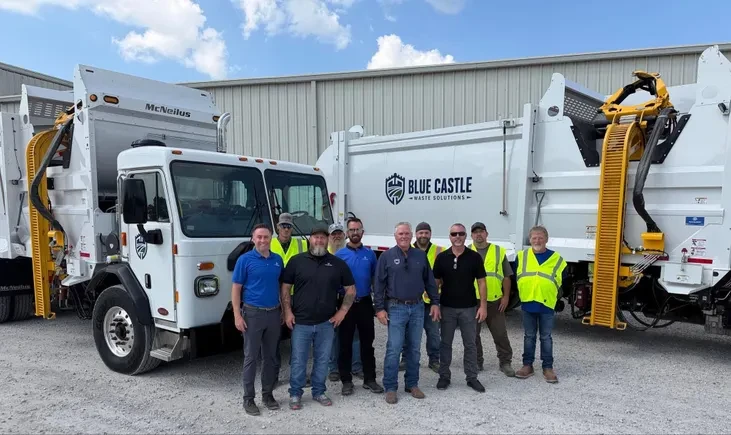
Securing these regional properties was only the first phase of Blue Sage’s strategy. According to Peter Huff, founder and managing partner at Blue Sage Capital, the private equity firm plans to inject substantial capital into its newly acquired assets immediately. This upgrade cycle includes rolling out a modernized fleet of automated side-loading (ASL) collection vehicles—a critical asset for enhancing labor efficiency, driver safety, and route completion times.
In tandem with hardware upgrades, Blue Castle is integrating industry-leading operational software from Routeware. This technology suite is intended to streamline customer service ticketing, digital routing, and asset tracking across disparate Midwestern jurisdictions.
"We have a little bit more scale and a little bit more capital to reinvest back into serving the communities there," Huff noted, emphasizing that legacy local operators often lack the balance sheet strength required to upgrade technology and fleet assets on their own accord.
Supporting Context & Metrics: The Blue Sage Waste Playbook
To fully understand the trajectory of Blue Castle Waste Solutions, industry observers must look to Blue Sage’s history in the sector. The firm’s playbook is built on specific metrics, disciplined capital allocation, and strategic partnerships that have repeatedly yielded high multiples for investors.
The Frontier Waste Solutions Blueprint
Blue Sage’s most prominent precursor in the waste space is Frontier Waste Solutions, a Texas-based MSW hauler that became a textbook private equity success story. Blue Sage was among the earliest institutional backers of Frontier, partnering with founder John Gustafson to scale a localized operation into a formidable regional player.
Under Blue Sage’s direction, Frontier achieved blistering growth. Huff notes that the company experienced a revenue growth rate exceeding 100% during its initial years of operation. This growth was driven by a balanced dual strategy:
- Organic Wins: Approximately 75% of Frontier’s early growth was achieved by aggressively out-bidding competitors and winning municipal hauling contracts.
- Inorganic Growth: The remaining 25% of growth was secured through targeted bolt-on acquisitions.
Furthermore, Blue Sage utilized creative operational maneuvering to protect profit margins. When managing Frontier in Texas, the firm occasionally engaged in high-level negotiations with some of the country’s largest waste haulers. By strategically swapping specific routes or regional operating markets, Blue Sage was able to secure highly favorable disposal fees and lower contracted landfill disposal rates for its customers.
The Lucrative Exit History
Blue Sage eventually exited its stake in Frontier Waste Solutions in 2022 through a transaction with Summer Street Capital Partners and Concentric Equity Partners. According to Huff, that exit netted Blue Sage more than six times its initial investment.
The Frontier saga ultimately culminated in early 2026, when GFL Environmental acquired Frontier Waste Solutions in a massive deal valued at approximately $900 million. Prior to Frontier, Blue Sage executed a similar success story with R360 Environmental Solutions, an oilfield waste management firm that was successfully sold to Waste Connections in 2012.
Divergent Markets: Texas vs. The Midwest
While Blue Sage plans to run a fundamentally similar playbook with Blue Castle in Iowa and Minnesota, Huff acknowledges that the macroeconomic and geographic realities of the Midwest differ significantly from the hyper-growth corridors of Texas.
"It’s a much smaller and less dense geography, but a geography that has less competition and more opportunity to do things that we just didn’t have the time or capital to do at Frontier," Huff explained.
Whereas Texas presented a booming, high-density market characterized by rapid suburban development and intense competition among major haulers, the Midwest offers a steadier, more insulated operating environment. The lower population density is offset by reduced competitive pressures, allowing a disciplined regional operator to build deep, long-lasting municipal relationships and capture stable, recurring cash flows.
Official Statements and Industry Insights
The leadership structure of Blue Castle Waste Solutions bridges past successes with future ambitions. Notably, Blue Sage has maintained deep ties with John Gustafson, the founder of Frontier Waste Solutions. Demonstrating a collaborative ethos unusual in aggressive corporate consolidation, Gustafson will serve directly on the board of directors for Blue Castle.
"I was happy when they got their next partner and wanted them to keep growing," Huff said regarding his ongoing relationship with Gustafson. "We like to sell with some gas left in the tank." This philosophy underscores Blue Sage’s desire to build sustainable enterprises that continue compounding value long after the private equity firm’s initial thesis is proven.
Strategic Focus on Solid Waste Over Recycling Volatility
One of the most revealing strategic decisions guiding Blue Castle Waste Solutions is its deliberate avoidance of Material Recovery Facilities (MRFs) and commodity-exposed recycling operations.
Currently, Blue Castle owns a single waste transfer station and operates two additional transfer stations under contractual agreements. The company does not own or operate a MRF. While Huff concedes that Blue Castle could theoretically acquire a MRF if a client municipality specifically demanded it, the platform is intentionally steering clear of the complexities and market volatility associated with post-consumer commodities.
"We want to be rewarded for doing a good job of what we can control," Huff stated emphatically. "We don’t want to be at risk for things we don’t control, like the price of aluminum."
By concentrating strictly on municipal solid waste collection and transfer—where revenues are secured by stable, long-term municipal contracts and subscription-based residential fees—Blue Castle is insulating its balance sheet from the unpredictable swings of global commodity markets.
Future Outlook: Growth Projections and Strategic Roadmap
As Blue Castle Waste Solutions settles into its inaugural year of operations, leadership has outlined a clear, measured roadmap for expansion across the Midwest and Plains regions.
Acquisition Pipeline and Infrastructure Development
Huff projects that Blue Castle will successfully close at least two additional acquisitions before completing its first full year of operations. The immediate pipeline focuses on acquiring independent, family-owned or regional haulers that can be seamlessly integrated into the company’s routing and administrative software architecture.
Beyond acquiring existing hauling assets, Blue Castle is prepared to invest heavily in the physical infrastructure of waste disposal. The company’s future growth pillars include:
- Greenfield Development: Evaluating opportunities to build proprietary, state-of-the-art regional landfills.
- Strategic Buyouts: Acquiring existing landfills from private owners seeking an exit.
- Municipal Takeovers: Assuming direct operations of municipal waste management systems for local governments looking to trim operational budgets and cut internal costs.
Setting Realistic Boundaries
Despite the aggressive backing of a seasoned private equity firm and a leadership team with a billion-dollar track record, Blue Castle’s ambitions remain grounded in operational discipline rather than unchecked empire-building.
"We’re not trying to take on the Waste Managements and Waste Connections of the world, and we don’t have aspirations to be that big," Huff concluded. "We just want to be a very good, solid regional leader."
This calculated restraint may well be Blue Castle’s greatest asset. By targeting the white space left open by industry giants in the Midwest, deploying cutting-edge fleet technology, and refusing to overextend into volatile recycling commodities, Blue Sage Capital has positioned Blue Castle Waste Solutions to become a formidable, highly profitable fixture of the Midwestern waste management landscape for years to come.



