

Executive Overview
As global markets increasingly pivot toward sustainable textiles, biobased manufacturing materials, and hyper-localized supply chains, American agriculture is forced to look beyond conventional commodity crops. In the Commonwealth of Pennsylvania, this shift has sparked a profound agricultural renaissance. Farmers across the state are turning their attention to industrial hemp—specifically fiber hemp—as a high-potential specialty crop capable of revitalizing local agricultural economies while meeting surging industrial demands.
However, transitioning to a profitable specialty crop is rarely straightforward. Producing consistently high-quality fiber hemp, particularly within the unpredictable microclimates of cooler, higher-elevation regions, hinges on two hyper-critical operational choices that are frequently overlooked or poorly understood: exact planting schedules and strategic soil preparation.
To bridge this critical knowledge gap, the renowned Rodale Institute has launched a comprehensive, multi-year research initiative funded by the Commonwealth Specialty Crop Block Grant Program through the Pennsylvania Department of Agriculture. Operating out of the institute’s Main Campus in Kutztown, this targeted study investigates the precise interplay between winter cover crop selection—comparing cereal rye, cereal rye-hairy vetch binary mixtures, and traditional tilled fallow systems—and optimal planting dates (ranging from mid-May to early June).
The ultimate objective of this project is clear, ambitious, and urgently needed: to provide Pennsylvania’s agricultural community with science-based, field-tested, and regenerative management strategies. By fine-tuning these early-season variables, the initiative aims to help roughly 400 growers and agricultural stakeholders establish robust crop stands, enhance long-term soil health, and maximize fiber quality and profitability without falling back on expensive, environmentally taxing synthetic chemical inputs.
Detailed Chronology & Project Evolution
The launch of the 2026 fiber hemp optimization trials does not happen in a vacuum. It represents the logical, highly anticipated culmination of years of meticulous foundational research conducted by the Rodale Institute across the Northeast. Tracing the chronology of this research reveals a steady, scientific march toward refining regenerative fiber production.
Laying the Groundwork: Early Trials in the Northeast
For several years, Rodale Institute researchers have dedicated significant resources to demystifying industrial hemp production in the Mid-Atlantic and Northeastern United States. Early investigative efforts focused heavily on baseline agronomic variables: nitrogen management strategies, optimal row spacing configurations, variety performance trials across differing soil types, and rigorous mechanical fiber quality testing.
As published in a prominent 2025 feature by CSA News, these initial studies yielded a paradigm-shifting realization: early-season soil conditions exert a far more profound influence on final hemp outcomes than nutrient inputs alone. Traditional farming intuition often assumes that a struggling crop can be rescued mid-season with synthetic fertilizers. However, Rodale’s data proved that if a hemp crop suffers from poor soil physical structure, sub-optimal moisture, or inadequate temperature during germination and emergence, no amount of late-stage nitrogen can fully compensate at harvest.
The 2026 Breakthrough: No-Till and Cover Crop Synergies
Building directly upon those foundational insights, a breakthrough 2026 study published in Crops & Soils pushed the envelope further. Researchers evaluated how no-till systems integrated with living cover crops and minimal nitrogen inputs compared to conventionally tilled, heavily fertilized plots.
The findings were striking: the no-till, cover-cropped systems consistently produced stronger, structurally superior, and higher-quality fiber than their conventionally managed counterparts. This proved that regenerative practices were not merely environmentally friendly alternatives—they were commercially superior strategies for fiber production.
The 2026–2027 Field Trials at Kutztown
Beginning in 2026, the current iteration of this research officially took root at Rodale Institute’s Kutztown headquarters. Designed as a rigorous, controlled on-farm trial, the project pits three distinct soil preparation strategies against one another:
- Cereal Rye Monoculture: Known for aggressive winter cover and unmatched early-season weed suppression.
- Cereal Rye and Hairy Vetch Mixture: A carefully proportioned binary mix combining the structural biomass of rye with the biological nitrogen fixation of a legume.
- No-Cover/Tilled Fallow Control: Representing traditional baseline preparation methods.
To account for seasonal weather variability and regional temperature fluctuations, these cover crop treatments are crossed with two distinct planting windows: an early planting window in mid-May and a late-summer window in early June. Over two complete field seasons, an interdisciplinary team of researchers is monitoring the plots with microscopic precision, tracking seedling emergence rates, canopy closure velocities, plant height milestones, overall biomass accumulation, weed pressure dynamics, and foliar nitrogen levels.
Furthermore, comprehensive soil health assessments are being conducted concurrently. Researchers are evaluating biological, chemical, and physical soil indicators—including active microbial biomass, soil organic matter percentages, water-stable aggregate formation, and water infiltration rates—to paint a holistic picture of how fiber hemp interacts with its subterranean environment.
Supporting Context & Metrics: The Science of Hemp Establishment
To understand why Rodale Institute’s current research is so critical to the future of Pennsylvania agriculture, one must examine the physiological sensitivities of the hemp plant (Cannabis sativa L.) during its vulnerable early life stages.
The Vulnerability of Early-Season Growth
How well a hemp crop establishes in the spring dictates its entire agronomic trajectory. Soil temperature, moisture availability, and physical resistance at planting directly govern seedling emergence speed, early seedling vigor, and the plant’s ability to outcompete early-season weeds.
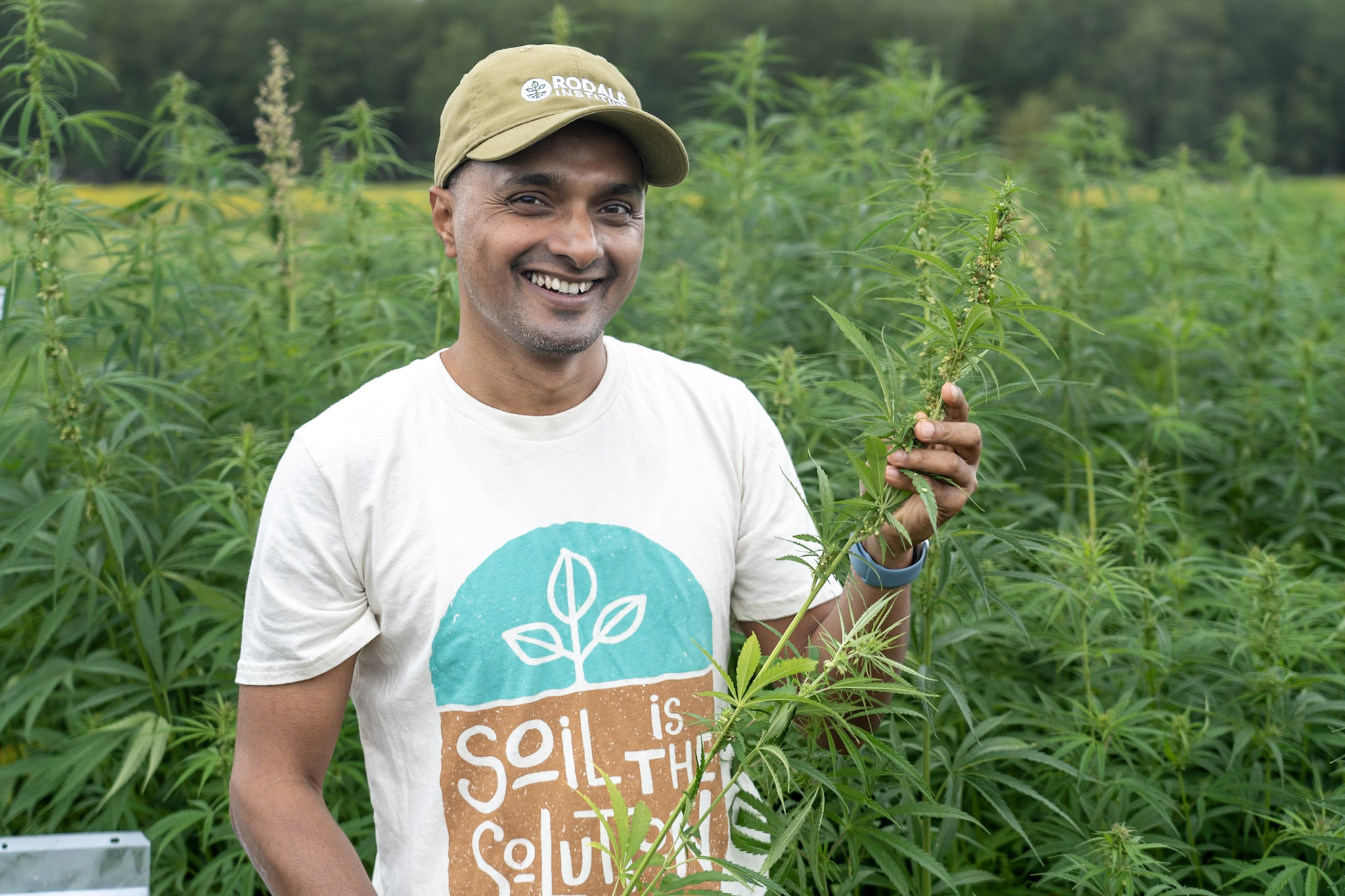
When these early-season factors are miscalculated, the negative consequences cascade through the growing season and manifest harshly at harvest. Farmers frequently face:
- Poor Plant Stands: Patchy germination resulting in low plant density, which ironically encourages branching rather than the tall, straight, unbranched vertical growth required for premium textile-grade fiber.
- Weak Fiber Structure: Stressed seedlings often develop rigid, coarse, or uneven vascular bundles, rendering the harvested bast fiber less desirable for high-end textile spinning.
- Diminished Economic Returns: Lower-yielding, low-quality fiber commands drastically reduced market prices, squeezing farm gate margins.
The Cover Crop Balancing Act
Cover crops offer an incredible biological toolkit to mitigate these risks, but they introduce management complexities that require scientific calibration.
- Cereal Rye (Secale cereale): A powerhouse winter cover crop. It provides reliable, lush winter cover and offers exceptional natural weed suppression through physical smothering and allelopathic root exudates. However, cereal rye produces a tremendous volume of dense, carbon-rich residue by spring. If termination and incorporation (or rolling-crimping) are not timed with absolute precision, this heavy residue mat can physically smother emerging hemp seedlings. This challenge is magnified exponentially in Pennsylvania’s cooler, higher-elevation soils, which warm up more slowly in the spring.
- Hairy Vetch (Vicia villosa): A winter-hardy legume capable of fixing substantial quantities of atmospheric nitrogen, thereby supporting soil biology and reducing the need for synthetic fertilizers. Yet, hairy vetch can behave inconsistently when planted in isolation, struggling in cold, heavy, poorly drained clay soils typical of certain Pennsylvania valleys.
- The Binary Solution: By combining cereal rye and hairy vetch into a strategic multi-species mixture, researchers hope to capture the best of both worlds: the structural weed control and soil-holding power of rye, balanced by the fertility-boosting nitrogen fixation of vetch. Finding the exact management threshold for this mix in Pennsylvania is a primary goal of the Kutztown trials.
The Timing Puzzle: May vs. June
Planting date introduces another layer of operational complexity for growers who operate on razor-thin margins. Even minor shifts in planting schedules—shifting a week earlier or later—drastically alter how rapidly the hemp canopy closes, how much total biomass is accumulated, and the ultimate tensile strength of the fiber at harvest. Because regional climate change has introduced erratic spring weather patterns to the Northeast, historical planting calendars are increasingly unreliable. Growers urgently require data-driven windows that account for local soil thermal profiles.
Official Statements & Industry Perspectives
The urgency and promise of the Rodale Institute fiber hemp project have drawn enthusiastic support from agricultural leaders, researchers, and grant administrators across the Commonwealth.
While industrial hemp was legally reintegrated into American agriculture via the 2018 Farm Bill, agricultural extension services and research institutions are still playing catch-up regarding specialized end-uses like textile-grade fiber. Grain and CBD hemp production dominated the early years of legalization, but fiber requires an entirely different agronomic mindset—shifting the focus from floral compounds or oilseeds to uniform stalks, cellulose content, and decortication efficiency.
Agricultural economists note that establishing robust local supply chains is the single greatest hurdle for the emerging Pennsylvania biobased economy. Mills, textile manufacturers, and biocomposite processors cannot commit to regional sourcing unless they are guaranteed a consistent volume of high-grade fiber year after year. By optimizing the foundational agricultural practices—cover cropping and planting dates—Rodale Institute is effectively shoring up the very first link in the value chain.
Furthermore, state agriculture officials emphasize the dual benefit of projects funded through the Specialty Crop Block Grant Program. By promoting regenerative techniques that safeguard soil health while boosting specialty crop yields, the Commonwealth is simultaneously protecting its long-term natural resources and bolstering rural economies. Healthy soils capture more water, resist erosion during extreme weather events, and sequester carbon—turning the humble fiber hemp field into an active participant in climate resilience.
Future Outlook: Translating Science into Field-Ready Action
As the trials at Rodale Institute’s Kutztown campus progress through their scheduled field seasons, the ultimate measure of success will not rest solely in academic publications, but in the hands of working farmers.
Bridging the Knowledge Gap
Translating complex agroecological data into practical, field-ready recommendations is a core mission of the institute. The insights gained from comparing cereal rye, rye-vetch mixtures, and fallow systems—coupled with precise May versus June planting windows—are designed to be immediately actionable.
To ensure this knowledge reaches the widest possible audience, Rodale Institute is rolling out an extensive outreach and education campaign aimed at engaging approximately 400 growers, processors, and agricultural stakeholders across Pennsylvania. Key dissemination channels will include:
- On-Farm Field Days: Hosting immersive, hands-on demonstrations at the Kutztown campus where farmers can physically walk the trial plots, observe canopy development, and inspect soil structure firsthand.
- Grower-Focused Fact Sheets: Distilling dense research data into clear, concise, step-by-step guides for farm implementation.
- Digital Outreach: Hosting interactive online webinars and presenting findings at regional and national agricultural conferences.
- Peer-Reviewed Literature: Contributing rigorous scientific findings to academic journals to advance the broader global understanding of industrial hemp agronomy.
The Bottom Line for Pennsylvania Farmers
For the average Pennsylvania farmer considering fiber hemp as a specialty diversification crop, the implications of this research are profoundly practical. Implementing better cover crop management and nailing the optimal planting window delivers four distinct, measurable benefits:
- Stronger Crop Stands: Achieving uniform, dense, and vigorous seedling emergence that resists weed pressure naturally.
- Resilient Soils: Building biological activity, improving water-stable aggregation, and increasing organic matter through living root systems and diverse cover crops.
- Superior Fiber Quality: Harvesting straight, tall, structurally consistent stalks that meet stringent textile and industrial manufacturing standards.
- Maximized Profitability: Securing reliable, high-grade yields without sinking capital into costly, high-input chemical management regimes.
As consumer demand for sustainable, domestically produced textiles and biobased materials accelerates, Pennsylvania stands uniquely positioned to become a national leader in fiber hemp production. Through rigorous scientific inquiry, hands-on farmer education, and an unwavering commitment to regenerative agriculture, Rodale Institute is providing the blueprint to help the Commonwealth’s farmers turn a promising green crop into a durable, profitable reality.
This project is proudly funded by the Commonwealth Specialty Crop Block Grant Program through the Pennsylvania Department of Agriculture.



