Executive Overview
Nearly nine decades after vanishing into the vast expanse of the Pacific Ocean, aviation pioneer Amelia Earhart and her navigator, Fred Noonan, remain the subjects of one of the 20th century’s most enduring and heavily scrutinized mysteries. Now, a joint team of researchers from the Archaeological Legacy Institute (ALI) and Purdue University has arrived at the remote, uninhabited shores of Nikumaroro Island to investigate a long-standing lead that could finally solve the enigma.
The expedition centers on a mysterious formation known as the "Taraia Object," first identified via satellite imagery in 2020 along the edge of a lagoon in the Republic of Kiribati. While optimistic researchers theorize that the anomaly is a remnant of Earhart’s twin-engine Lockheed 10-E Electra, skeptics remain cautious, suggesting it could be little more than a fallen tree or geological debris.
Marking the first authorized expedition to Nikumaroro Island in seven years and the inaugural visit to the specific Taraia Peninsula in over a decade and a half, the stakes could not be higher. However, the path to discovery is fraught with peril. The five-day on-site operation is complicated by severe environmental and biological hazards, ranging from the historically intense El Niño climate phenomenon to dense tropical overgrowth and swarms of aggressive, massive coconut crabs.
This comprehensive report examines the logistical hurdles, historical background, and scientific methodologies defining this high-stakes archaeological mission, exploring whether modern technology can finally lay to rest a mystery that has captivated the global imagination since 1937.
Detailed Chronology
The Disappearance: July 1937
To understand the significance of the Nikumaroro mission, one must look back to the summer of 1937. Amelia Earhart, already a global icon for her aviation feats, and navigator Fred Noonan embarked on an ambitious attempt to circumnavigate the globe along an equatorial route. On July 2, 1937, the pair departed Lae, New Guinea, bound for Howland Island—a tiny, remote coral sliver in the central Pacific.
Despite radio communications indicating they were in the vicinity, the Lockheed Electra never arrived. A massive U.S. Navy search and rescue operation yielded no wreckage, no trace of the aircraft, and no definitive sign of the aviators. The official determination declared that the plane had run out of fuel and crashed into the ocean, plunging into the deep waters of the Pacific. Yet, fringe theories, eyewitness accounts, and circumstantial evidence quickly surfaced, suggesting an alternative fate: that Earhart and Noonan had successfully landed on a remote, uninhabited reef.
The Satellite Discovery: 2020
Decades of amateur and professional searches followed, yielding various artifacts—including bone fragments found in the late 1930s (which were subsequently lost) and pieces of aluminum sheeting. However, the modern quest took a definitive leap forward in 2020 when high-resolution satellite imagery captured an anomalous shape resting on the edge of a lagoon off Nikumaroro Island. Dubbed the Taraia Object, this anomaly reignited intense debate within the historical and archaeological communities.
The Voyage to Nikumaroro: November to December
Fast forward to the present day. Following years of bureaucratic navigation and logistical planning, the research vessel Marin Mainiku set sail from a regional port, embarking on a grueling 830-nautical-mile voyage across the South Pacific. After five days at sea, the vessel arrived at the western shores of Nikumaroro Island on a Monday morning.
Expedition leader Rick Pettigrew, writing in the team’s official mission log, expressed both cautious optimism and the gravity of the moment:
"It is incredibly rewarding to be this close to completing our inspection of the Taraia Object and potentially solving, at long last, the outstanding mystery of the disappearance of Amelia Earhart and Fred Noonan more than 89 years ago."
On-Site Operations and Execution Plan
The schedule for the team is rigorously timed, balancing daylight hours, shifting tides, and unpredictable weather patterns:
- Monday: Arrival of the Marin Mainiku at the western side of the island. Initial briefings and preparation for entry through the atoll’s barrier reef.
- Tuesday: The crew plans to navigate through a narrow, historic gap blasted into the coral reef by British colonial authorities in 1963—the last time the island was permanently inhabited. Teams will land ashore to begin "transporting equipment, clearing vegetation, and establishing staging operations," with a dedicated crew cutting a trail through the dense jungle.
- Wednesday: Operations shift decisively toward the Taraia Peninsula. Researchers will deploy magnetometers and metal-detecting technology to scan for ferrous metals characteristic of aircraft construction.
- Thursday through Friday: The final phase involves deploying specialized dredging equipment to shift sediment, permitting a direct visual and physical inspection of the Taraia Object. Observers note that the object rests a mere 10 feet from the shoreline in approximately five feet of water, though accessibility remains heavily dictated by the shifting tides.
Supporting Context & Metrics
Geographic and Environmental Profile
Nikumaroro Island, formerly known as Gardner Island, is part of the Phoenix Islands within the Republic of Kiribati. It is a classic coral atoll: a ring of land surrounding a shallow central lagoon. Measuring roughly four miles long and one mile wide, the island features dense brush, coconut palms, and a harsh, remote climate lacking natural freshwater sources.
The logistical challenges of mounting an expedition to such an isolated location are immense:
- Distance Traveled: 830 nautical miles across open ocean from the departure point to the western shores of the island.
- Timeline of Access: The first authorized expedition in seven years to the island as a whole, and the first visit specifically to the Taraia Peninsula in more than 15 years.
- Object Proximity: Located approximately 10 feet from the shore in as little as 5 feet of water, depending entirely on oceanic tidal variations.
The El Niño Factor
Compounding the remote geography is an extreme meteorological obstacle: the El Niño climate phenomenon. Meteorological agencies have categorized the current El Niño cycle as the strongest ever recorded. For the marine archaeologists on site, this translates to unpredictable wave dynamics, heavy swell action, and shifting weather patterns traveling from east to west.
Michael Krivor, a marine archaeologist participating in the voyage, highlighted the constant operational risk: weather and ocean currents threaten to disrupt "safe transit in and out of the blasted channels," potentially stranding crews or halting daily shore access entirely.
The Menace of the Coconut Crabs
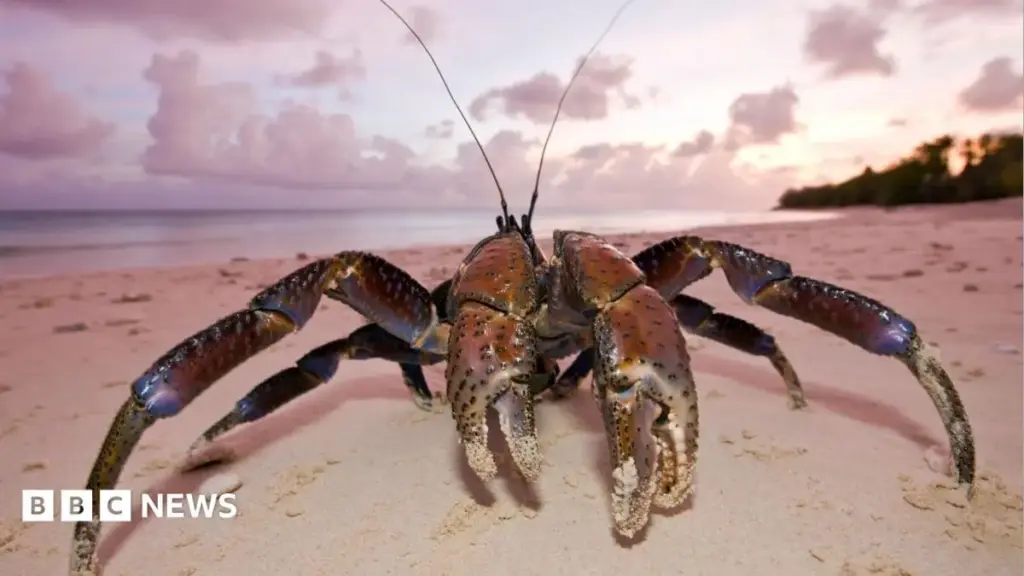
Perhaps the most unusual and widely discussed challenge facing the Purdue-ALI expedition is the local fauna. Nikumaroro Island is heavily populated by Birgus latro, commonly known as coconut crabs or robber crabs. These are the largest land-dwelling invertebrates on Earth, possessing formidable physical characteristics:
- Lifting Capacity: An adult coconut crab can lift weights of up to 28 kilograms (62 pounds).
- Strength: They are among the few species capable of cracking open hard coconut shells using their massive, specialized claws.
- Behavioral Patterns: Primarily nocturnal, these giant crustaceans emerge after dark to hunt for food sources, which range from fallen fruit and coconuts to small mammals, seabirds, and carrion.
The presence of these meat-eating invertebrates is more than a biological curiosity; it poses a direct safety hazard to the researchers. As noted in the expedition’s official dispatches, the crew must retreat to the safety of the Marin Mainiku every evening.
This behavioral reality also intersects with one of the most macabre theories surrounding Amelia Earhart’s fate. Several historical researchers have long theorized that Earhart and Noonan survived a crash landing on the reef, only to succumb to the elements and be partially consumed by the island’s giant crabs, which may have carried away their skeletal remains into the dense jungle underbrush.
Official Statements & Expert Perspectives
The expedition represents a convergence of modern archaeological technology and historic preservation. Speaking on behalf of the collaborative team, expedition leader Rick Pettigrew emphasized the meticulous nature of the work. While the prospect of solving an 89-year-old aviation mystery is intoxicating, the researchers have maintained a strictly empirical approach.
"We are not here to chase myths; we are here to gather hard data," noted one team member during transit. "Whether the Taraia Object proves to be aluminum from an aircraft, iron plating from a shipwreck, or simply a weathered piece of driftwood, our objective is to apply rigorous scientific standards to uncover the truth."
Marine archaeologist Michael Krivor underscored the operational realities of working under severe environmental stress.
"The ocean does not care about historical legacies," Krivor stated regarding the severe El Niño conditions. "Our primary focus must remain on the safety of the personnel and the integrity of the data we collect. Navigating the channel requires precise timing with the tides, and any meteorological shift could force a complete suspension of our underwater dredging operations."
Historians and aviation enthusiasts worldwide are watching closely. The International Group for Historic Aircraft Recovery (TIGHAR), which has spent decades investigating the "Nikumaroro Hypothesis," views this current expedition as a critical litmus test for theories that have long divided the aviation history community.
Future Outlook
As the research vessel Marin Mainiku anchors off the coast of Nikumaroro and teams prepare to breach the coral reef, the immediate future of the expedition depends entirely on Mother Nature. If the El Niño swells remain manageable and the coconut crabs stay clear of daytime operations, the next five days will yield definitive answers regarding the Taraia Object.
Scenario Analysis: What Happens Next?
- If the Object is Verified as Aviation Scrap:
Should the magnetometers and visual dredging confirm the presence of aircraft aluminum matching the specifications of a Lockheed 10-E Electra, it would definitively validate the Nikumaroro Hypothesis. This discovery would rewrite the final chapter of Amelia Earhart and Fred Noonan’s journey, transforming a tragic ocean-crash narrative into a tale of survival against insurmountable odds on an uninhabited atoll. - If the Object is Proven Inconclusive or Natural:
Should the anomaly turn out to be a collapsed tree, geological shelf, or unrelated shipwreck debris, the mystery of Earhart’s final moments will endure. Researchers will be forced to pivot back to alternative theories, leaving the deep-sea search parameters or other suspected crash sites as the remaining frontiers for discovery.
Regardless of the outcome, this Purdue-ALI expedition stands as a masterclass in modern exploration, blending historical detective work with advanced marine archaeology. As the team cuts its path through the jungle brush of the Taraia Peninsula, the world waits to see whether the secrets buried beneath the sand and surf of Nikumaroro will finally be brought to light.