

Executive Overview
The sprawling, vibrant metropolis of Bangkok has ground to a near-complete standstill following a relentless 48-hour deluge that has completely overwhelmed the Thai capital’s drainage infrastructure. Authorities have formally declared a city-wide flood emergency, extending the designation to all 50 districts as torrential rains continue to batter the region. Major thoroughfares have been transformed into stagnant waterways, forcing commuters to abandon vehicles, prompting severe traffic paralysis, and leaving thousands of residents stranded in their homes or navigating waist-deep water.
While seasonal thunderstorms are a standard feature of Thailand’s tropical climate cycle at this time of year, the sheer volume and persistence of the recent precipitation have vastly exceeded historical averages for this period. City officials and emergency response units are locked in a desperate race against time to pump billions of gallons of water out of residential neighborhoods and into a completely saturated network of canals. However, with waterways breaching their banks and low-pressure systems continuing to stall over central Thailand, the immediate outlook remains perilous.
Residents living along the capital’s historic canal networks—locally known as khlongs—have been urgently advised to elevate valuable belongings to upper floors, secure critical infrastructure, and heed evacuation notices where issued. Though no fatalities have been officially reported within Bangkok proper thus far, the severe economic disruption, psychological toll, and memory of the catastrophic 2011 nationwide floods have reignited national anxieties regarding urban climate resilience, infrastructure capacity, and the escalating threats posed by extreme weather events.
Detailed Chronology of the Crisis
The First 24 Hours: A City Overwhelmed
The crisis began unfolding in the early hours of Friday morning, as a stationary low-pressure weather cell collided with regional monsoonal air masses, unleashing localized cloudbursts across central Thailand. By dawn, citizens waking up in downtown Bangkok and its sprawling outer suburbs were greeted by torrential downpours that reduced visibility to mere meters and instantly choked the city’s notoriously congested roadways.
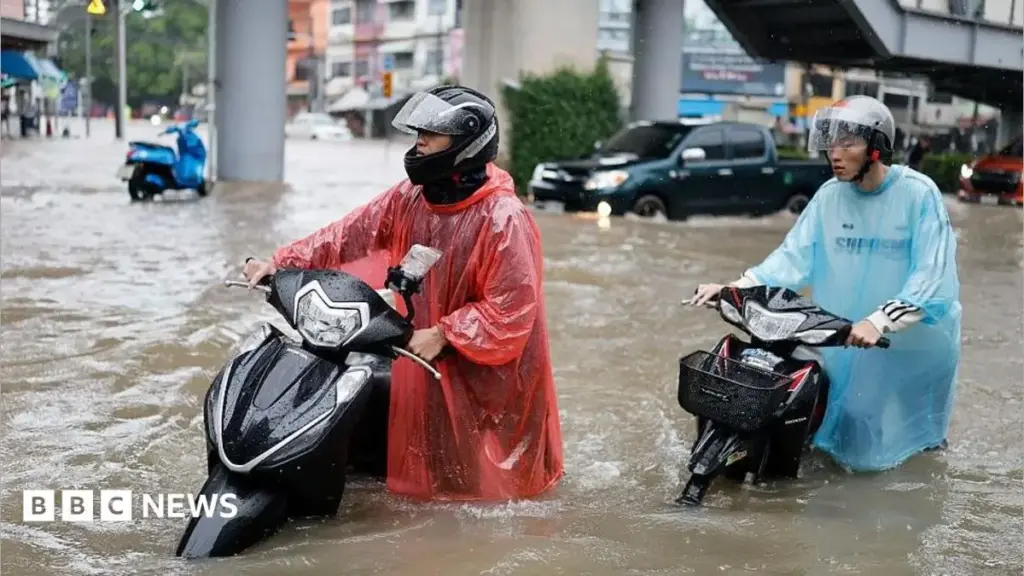
Within hours, storm drains—already taxed by decades of urban expansion, concrete-heavy development, and restricted natural drainage paths—reached maximum capacity. Manholes began overflowing, turning low-lying intersections and residential alleys into rushing rivers. Commuters attempting to navigate the morning rush hour found themselves stranded as public transportation systems experienced massive delays and roads became entirely impassable for standard motor vehicles. Images captured across the capital showed desperate residents pushing stalled motorbikes through murky, debris-laden water that rose past the wheels.
Escalation: Canals Breach and Emergency Declared
As the rain persisted unabated into Saturday, the situation deteriorated rapidly. Bangkok’s intricate network of canals, historically engineered to drain floodwaters safely into the Chao Phraya River and out to the Gulf of Thailand, began reaching critical capacity. By Saturday afternoon, several primary and secondary canals officially breached their banks, spilling millions of gallons of turbid floodwater into densely populated residential and commercial zones.
Recognizing the escalating scale of the threat, the Bangkok Metropolitan Administration (BMA) took the extraordinary step of declaring an emergency disaster zone across all 50 districts of the capital. The universal declaration signaled that the crisis was no longer confined to low-lying outer peripheries or flood-prone riverside communities, but represented an existential threat to the entire metropolitan area. Citizens were formally urged to stay off the roads, remain inside, and prepare for potential disruptions to electrical grids and municipal water supplies.
Supporting Context & Metrics: Infrastructure, Geography, and Climate History
The Geography of Vulnerability
Bangkok’s acute susceptibility to flooding is rooted in its unique and challenging geography. Built largely on a low-lying delta plain just 1.5 meters above mean sea level, the city sits atop soft, clay-rich soil that naturally retains moisture and is prone to steady, cumulative land subsidence—a process accelerated by decades of intensive groundwater extraction and heavy urban construction.

Compounding these geographical challenges is Bangkok’s historical identity as the "Venice of the East." The city was originally designed around an expansive network of waterways used for transportation, commerce, and natural drainage. However, rapid, largely unregulated urbanization over the past half-century has seen many of these vital natural waterways paved over, narrowed, or blocked by real estate developments, drastically reducing the city’s natural water-carrying capacity and leaving it heavily reliant on mechanical drainage systems.
The Specter of 2011: A Lingering Psychological Shadow
For millions of Thais, any mention of major flooding in Bangkok immediately evokes memories of the catastrophic monsoon season of 2011. That historic event stands as one of the costliest natural disasters in Thai history, paralyzing the nation’s industrial heartland, submerging large portions of Bangkok for nearly three months, and resulting in hundreds of fatalities nationwide.
While the current weather event, in its initial stages, has not approached the volumetric scale or duration of the 2011 disaster—and critically, has recorded zero fatalities thus far within the capital—the psychological impact remains profound. Long-term residents watching muddy waters rise toward their doorsteps are acutely aware of how quickly localized heavy rainfall can transform into a protracted regional humanitarian crisis.
Economic and Logistical Fallout
The immediate economic toll of the current flood emergency is substantial. Bangkok accounts for a disproportionate share of Thailand’s gross domestic product (GDP), serving as the nation’s primary hub for finance, corporate headquarters, tourism, and retail commerce.
- Retail Paralysis: Countless small businesses, street-level vendors, and neighborhood shops—such as those operated by residents along the northern canals—have been forced to shutter their doors for consecutive days, resulting in immediate losses of daily income.
- Logistical Nightmares: Supply chains moving through and out of the capital have suffered severe delays. Commercial trucking has been rerouted or halted entirely due to impassable roadways, raising concerns over potential shortages of fresh food and essential goods if the inundation persists.
- Tourism Disruption: International visitors arriving in the "City of Angels" have encountered canceled excursions, disrupted airport transfers, and flooded historical districts, delivering a sharp temporary blow to the recovering post-pandemic tourism sector.
Official Statements and Emergency Responses
Directives from the Bangkok Metropolitan Administration
Bangkok Governor Chadchart Sittipunt has been at the forefront of the city’s crisis management efforts, providing transparent, real-time updates to the public while inspecting flooded districts across the capital. Speaking to reporters regarding the uneven impact of the storms, Governor Sittipunt highlighted that the eastern sectors of the city had suffered the most severe inundation.
"The rain keeps falling and we are doing our best," Governor Sittipunt stated during an emergency briefing. "We are trying our absolute best to pump the water out, but the water levels in the canals are completely full. The highest-risk areas right now are those living immediately adjacent to the canals. Every single canal across the metropolitan area is now filled to maximum capacity."
The BMA has deployed hundreds of heavy-duty industrial water pumps across critical chokepoints, subterranean drainage tunnels, and canal sluice gates. Emergency response teams, including military engineering units and civil defense volunteers, have been mobilized to distribute sandbags, deliver bottled water and dry rations to stranded families, and assist with localized evacuations.
Testimonies from the Ground
The human dimension of the crisis is vividly illustrated by those living on the front lines of the urban flood zone. Somkid Pheuk-ngam, a 67-year-old resident living near a swollen canal in northern Bangkok, shared her harrowing experience with international news agencies as floodwaters continued to breach her property.

"The water just keeps coming in wave after wave," Somkid said, noting that water levels inside her ground-floor living space had reached her waist. "It is virtually impossible to go outside now. I cannot go anywhere, and I have had to keep my shop completely shuttered for two straight days."
Reflecting on the psychological weight of the disaster, Somkid added that the rapid rise and murky quality of the water felt remarkably similar to, and in some areas worse than, the initial phases of the legendary 2011 floods—a sentiment echoed by several of her neighbors who spent the weekend desperately stacking sandbags and moving electrical appliances to second-story balconies.
Future Outlook: What Lies Ahead for Bangkok
Meteorological Projections
According to the Thai Meteorological Department (TMD), the atmospheric instability driving the current crisis is unlikely to dissipate immediately. While the primary low-pressure cell responsible for the heaviest downpours is anticipated to gradually drift inland toward central Thailand over the coming days, secondary monsoonal troughs are expected to sustain intermittent heavy rain and thunderstorms throughout the week.
Meteorologists have warned that soil saturation across Bangkok and its surrounding provinces has reached 100%, meaning that even moderate rainfall will immediately generate surface runoff and exacerbate existing flooding. Consequently, high-alert status remains in effect across all 50 districts, with particular vigilance maintained for riverside communities along the Chao Phraya River, where high tides could clash with inland runoff to push water levels even higher.
Long-Term Resilience and Urban Planning Imperatives
As Bangkok struggles to dry out over the coming days and weeks, the crisis has once again placed the spotlight squarely on the city’s long-term climate adaptation strategies. Urban planners and environmental scientists have long argued that conventional engineering solutions—such as deeper concrete canals and higher flood walls—are no longer sufficient to protect a sinking megacity facing the compounding pressures of rapid urbanization and global climate change.
Experts emphasize that future resilience will require a paradigm shift toward "sponge city" concepts. This includes the restoration of permeable green spaces, the creation of urban retention ponds and wetlands capable of absorbing massive volumes of stormwater, the modernization of subterranean drainage infrastructure using smart, automated sensor networks, and stricter enforcement of zoning laws to protect natural drainage basins from commercial encroachment.
For now, however, the immediate priority for millions of Bangkok residents remains intensely practical: monitoring local weather alerts, securing essential supplies, supporting vulnerable neighbors, and waiting anxiously for the rains to cease and the waters to recede.



