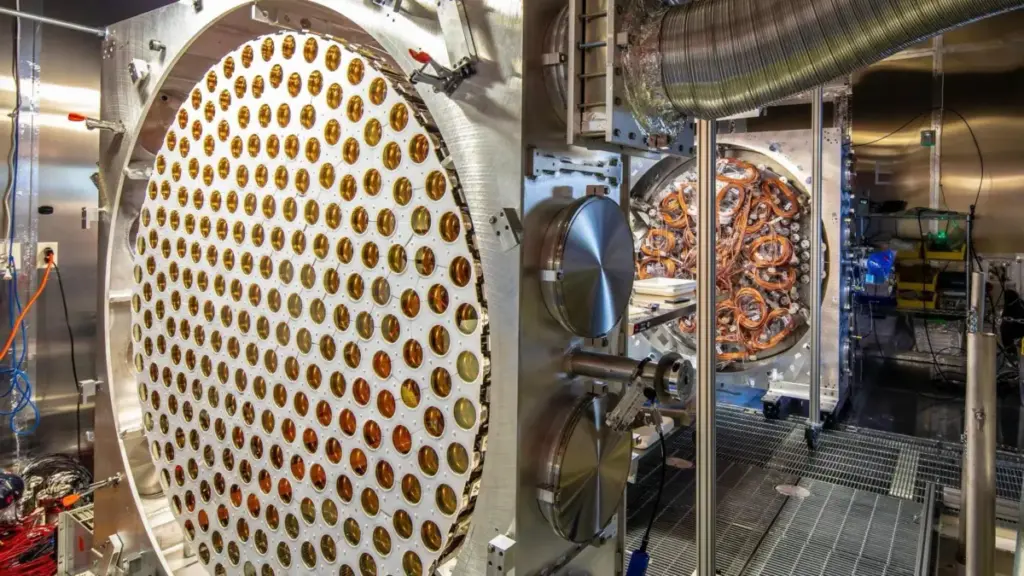
In what could prove to be a watershed moment for modern astrophysics, an international consortium of scientists has unveiled tantalizing preliminary data pointing toward the potential detection of dark matter. Operating nearly a mile beneath the surface of the earth in a repurposed gold mine in South Dakota, researchers utilizing the state-of-the-art LUX-ZEPLIN (LZ) dark matter detector have recorded a mysterious, high-precision particle interaction. This elusive event, observed during an intensive two-year analytical campaign, carries the theoretical hallmark of a Weakly Interacting Massive Particle (WIMP)—the leading candidate for the mysterious, invisible mass that is widely believed to constitute over 85 percent of the universe.
While the scientific community has reacted with cautious optimism, lead researchers emphasize that the finding has not yet undergone rigorous independent peer review. Measured at a statistical significance of 2.6 sigma, the observation falls well short of the gold-standard threshold of 5 sigma traditionally required to claim an official scientific discovery. Nevertheless, the announcement—made public at a physics conference in Japan—has electrified the astro-particle physics community, injecting fresh momentum into decades of tireless research aimed at solving one of the greatest enduring puzzles in physical science.
Detailed Chronology and Experimental Setup
The journey toward this landmark anomaly began years ago with the design and deployment of the LUX-ZEPLIN detector, situated within the Sanford Underground Research Facility (SURF) in Lead, South Dakota. Housed nearly a mile underground to shield the ultra-sensitive instruments from the relentless barrage of cosmic rays that continuously bombard the Earth’s surface, SURF provides an ideal, pristine environment for capturing extremely faint subatomic interactions.
For the past two years, a formidable global collective comprising roughly 250 scientists, engineers, and researchers spanning 39 institutions across six nations—including prominent academic contingents from the United Kingdom, such as the University of Bristol—has meticulously scrutinized the data streamed from the LZ apparatus.
The core of the LZ detector relies on a massive tank filled with liquefied xenon, outfitted with remarkably sensitive light sensors capable of detecting minuscule flashes produced when passing particles collide with xenon atoms. During the extensive data-collection cycle, the system registered a single, highly unusual atomic collision. This isolated event immediately drew the intense scrutiny of the collaboration. Physicists spent countless hours exhaustively testing and cross-referencing known sources of background radiation, instrumental noise, and environmental interference to see if any conventional physical phenomenon could account for the reaction. To date, no standard explanation has emerged as a convincing fit, leaving open the tantalizing possibility that the detector recorded the signature of dark matter itself.
Supporting Context and Metrics: Understanding the WIMP and Statistical Significance
To fully appreciate the gravity of the LZ collaboration’s recent announcement, one must examine the fundamental paradox of dark matter. Although astrophysicists have possessed definitive gravitational evidence of its existence for nearly a century—noting its profound influence on the rotational velocities of galaxies and the large-scale structure of the cosmos—dark matter remains entirely invisible to conventional observation because it neither emits, absorbs, nor reflects electromagnetic radiation. It interacts almost exclusively through gravity and, theoretically, the weak nuclear force.
Enter the WIMP (Weakly Interacting Massive Particle). For decades, theoretical physicists have posited that WIMPs are elementary particles possessing mass roughly akin to atomic nuclei, yet they pass through ordinary matter virtually unimpeded, making direct observation extraordinarily difficult. The LUX-ZEPLIN detector was specifically engineered to capture the fleeting, ghost-like interactions of these hypothetical particles.
However, in the rigorous realm of experimental physics, claims cannot be established on intuition or solitary anomalies alone. Discoveries are governed by statistical metrics known as "sigma" deviations:
The 1-Sigma to 2-Sigma Range: Frequently captures random statistical fluctuations or unverified anomalies. The current LZ finding sits at 2.6 sigma, indicating that while the event is statistically unusual and deeply intriguing, there remains a notable probability that it could be a random background fluctuation rather than a true discovery.
The 3-Sigma Threshold: Generally categorized as "evidence" or an indication of an interesting phenomenon worthy of aggressive follow-up research.
The 5-Sigma Threshold: The undisputed gold standard of particle physics. Achieving 5 sigma implies that the probability of the result occurring purely by chance is roughly one in 3.5 million, providing the mathematical certainty required to declare a definitive scientific discovery.
Consequently, while the 2.6 sigma reading is enough to command global attention, seasoned researchers are careful to frame the data not as a definitive sighting, but as a compelling signpost guiding future inquiry.
Official Statements and Perspectives from the Frontier
The release of these preliminary findings has sparked vibrant discussions across academic and research institutions worldwide. Researchers driving the project have balanced their enthusiasm with a profound commitment to scientific rigor.
Dr. Sam Eriksen, a senior research associate at the University of Bristol and lead author connected to the study, underscored the emotional and intellectual magnitude of the moment. Speaking on the collaborative effort, Dr. Eriksen noted:
"Following a huge amount of scientific effort, this is incredibly exciting. It could be the first step in understanding dark matter as a particle, though further research could also reveal that the particle is ultimately unrelated to dark matter."
Echoing this measured enthusiasm, Professor Rick Gaitskell of Brown University cautioned against premature declarations:
"With only one event, we don’t want to get ahead of ourselves. We are not claiming to have seen dark matter. But we have seen something interesting that we want to share with the scientific community for their input."
Meanwhile, Professor Henning Flaecher, an experimental particle physicist at the University of Bristol who helped lead the exhaustive background-exclusion analysis, highlighted the sheer dedication poured into vetting the anomaly:
"A huge amount of work has been carried out over countless hours to investigate every previously known reason researchers might have observed this unusual reaction. To date, none provide a convincing explanation. It’s an incredibly exciting time—the kind of event every astro-particle physicist dreams of—and we can’t wait to analyse more data to see if additional candidate events appear."
Future Outlook: The Road Ahead for Astro-Particle Physics
The presentation of the LZ data at the physics conference in Japan marks the end of an initial chapter rather than the conclusion of the story. The immediate future of dark matter detection rests on gathering a larger statistical dataset. Because the current anomaly is based on a single isolated event, the international research team plans to continue operating and upgrading the LUX-ZEPLIN detector, allowing it to collect data over extended operational periods.
In the coming months and years, as the collaboration accumulates more exposure time, two distinct scenarios will likely unfold:
The Signal Fades: Additional data collection may reveal that the initial anomaly was simply an exceptionally rare background noise event or a statistical fluke, causing the statistical significance to wash out.
The Signal Strengthens: If subsequent particle collisions mirror the characteristics of the initial event, the statistical sigma rating will steadily climb toward the elusive 3-sigma and eventual 5-sigma thresholds. Such an outcome would transform modern physics, validating decades of theoretical models and providing humanity with its very first tangible grip on the invisible scaffolding of the universe.
For now, the scientific community watches and waits. The deep shafts of the Sanford Underground Research Facility remain quiet, while deep beneath the surface, liquid xenon sensors quietly wait in the dark—listening for the faintest whispers of the cosmos.