By Scott Meyer | Photographs by Rob Cardillo Originally published in the 2025 Rodale Institute Journal
Executive Overview
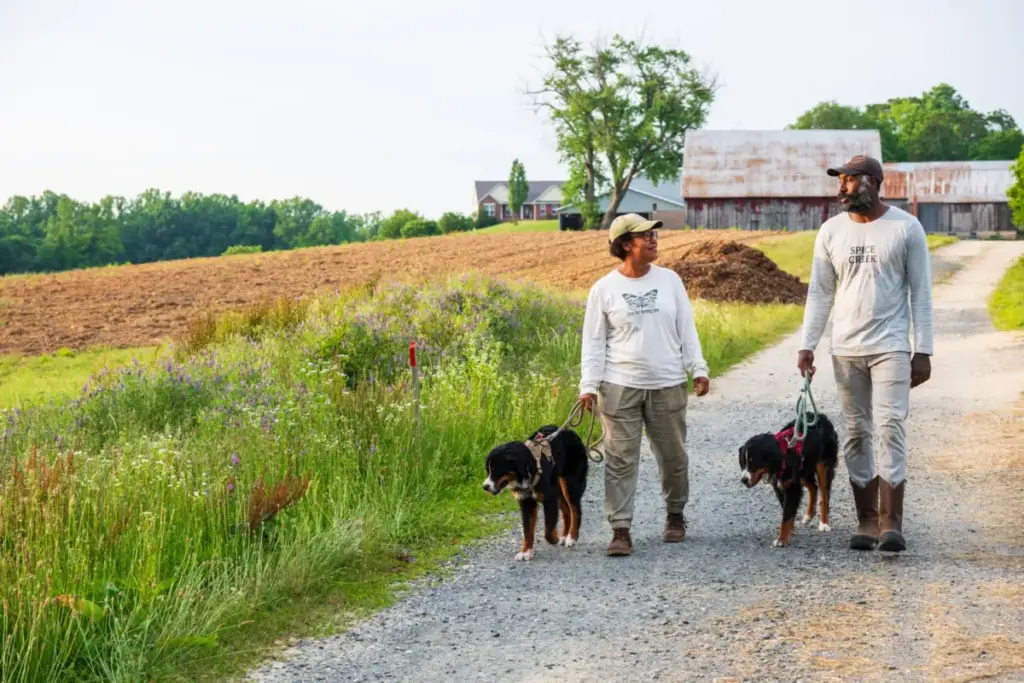
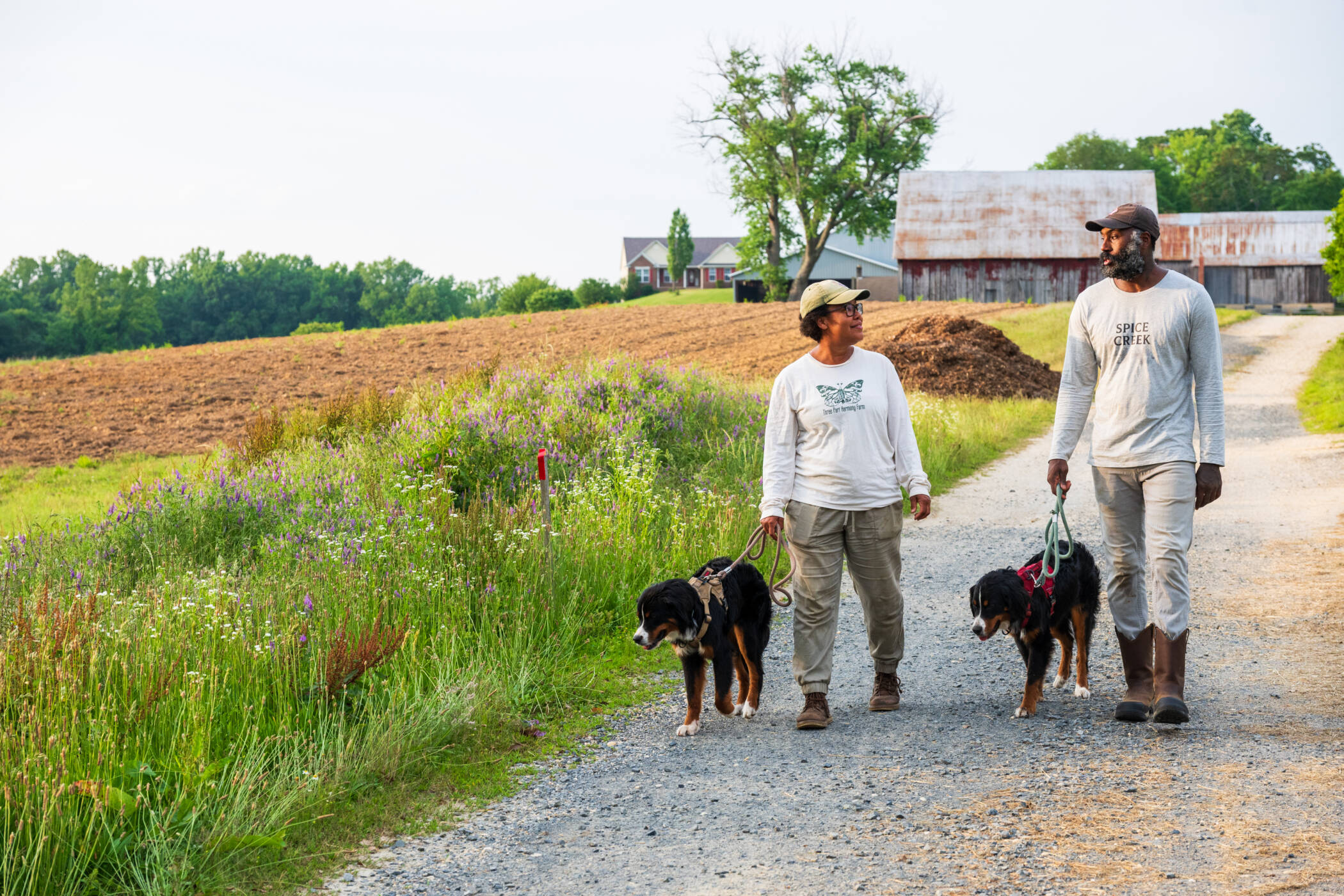
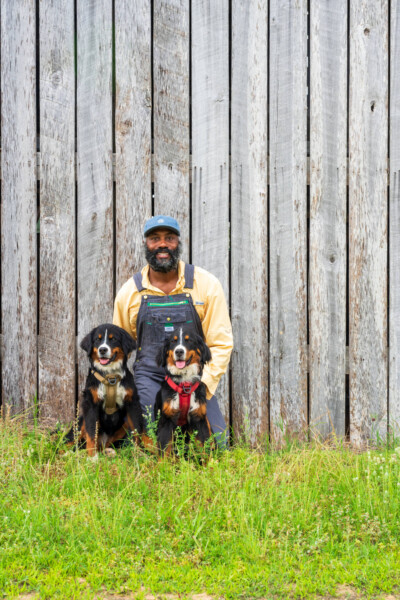
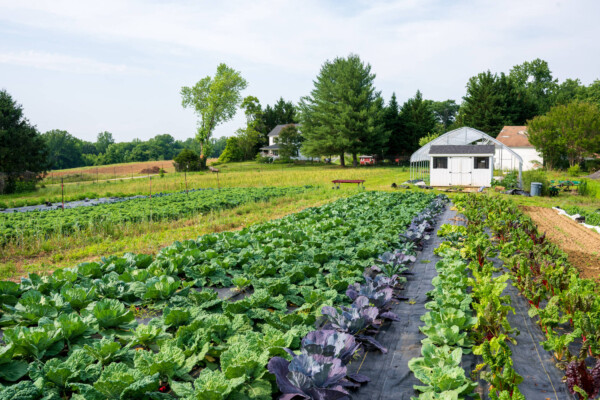
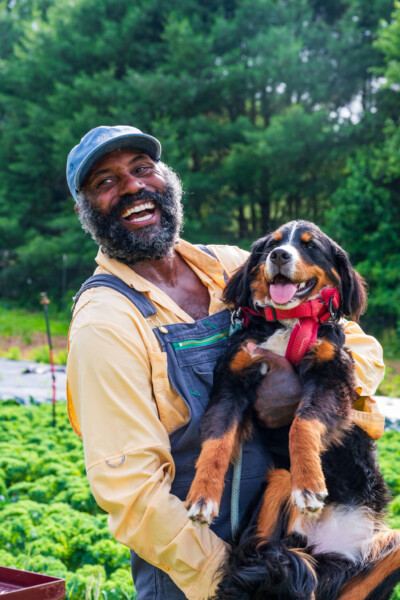
On a steamy, early summer afternoon at Spice Creek Farm in Brandywine, Maryland, the tomato plants stretch skyward, crying out for vertical support. D’Real Graham, who tends the 24-acre property alongside his life partner, Gail Taylor, methodically sets up a wire trellis to train the heavy vines, keeping the fruit pristine and off the damp ground. Nearby, peppers and squash are bulking up, while dense rows of kale and swiss chard reach their absolute productive peak. As Graham drives the final support posts into the soil, Ruby and Ivy—their energetic Bernese Mountain dogs—happily trot between the rows, occasionally nibbling on the crisp, leafy greens.
This tranquil snapshot of daily agricultural labor belies a revolutionary vision. While Taylor spent more than a decade successfully raising food on a compact, 2-acre urban farm in Washington, D.C., 2025 marks the couple’s first full, uninterrupted growing season on this expansive rural site in Brandywine, located roughly 25 miles southeast of the nation’s capital. Spanning 24 acres of former tobacco land, Spice Creek Farm is the canvas upon which Taylor and Graham are executing an ambitious, multi-layered blueprint: establishing an equitable, community-based food system rooted in regenerative organic agriculture.
Their relentless progress, deep-seated environmental stewardship, and unwavering social justice commitments have earned them status as finalists for the inaugural U.S. Good Farmer Award. A collaborative initiative by the Rodale Institute and the Davines Group, the award honors "outstanding farmers making positive environmental and social contributions to agriculture through regenerative organic practices." To scale up their operations sustainably, the couple is actively collaborating with the Rodale Institute’s expert consulting team, bridging grassroots community activism with institutional agricultural science.
Detailed Chronology: From Policy Desks to Rural Acreage
The path that led Gail Taylor and D’Real Graham to the rolling fields of Prince George’s County was neither linear nor traditional. Both founders arrived at agriculture via winding professional roads, bringing distinct skill sets and a shared disillusionment with corporate or bureaucratic desk jobs.
Gail Taylor: Tracing the Roots of Urban Ag Policy
Taylor spent her formative teenage years near Albany, New York, before earning a degree in U.S. foreign policy and Latin America from Syracuse University. Extended periods living and working in Guatemala and Chile shaped her early worldview regarding global equity, labor, and food access. Seeking a tangible way to enact local change, she pivoted away from policy work in 2005.
She began volunteering at Deep Roots Farm, a sprawling 200-acre regenerative organic farm in Upper Marlboro, Maryland, managed by Gale Livingstone.
“I was looking for a change from policy work, and farming felt to me like I was having a positive impact for people,” Taylor reflects.
As her responsibilities at Deep Roots expanded, so too did her vision for localized food systems. Tired of the grueling daily commute from downtown Washington, D.C., out to rural Maryland, Taylor drafted a radical business plan in 2011 for a backyard Community Supported Agriculture (CSA) subscription service based right at her D.C. home. Three local neighbors offered their backyards for crop production, and Taylor constructed a modest greenhouse in her own yard to raise vegetable seedlings. Every Thursday, she loaded a bicycle with fresh harvests collected from urban yards, setting them out on her front porch for her six foundational CSA members.
Looking to scale up, Taylor identified an unused two-acre parcel near Catholic University, only to run into a debilitating regulatory hurdle: D.C. property tax laws contained no agricultural exemptions, making commercial urban farming financially prohibitive. Refusing to accept the status quo, Taylor enlisted pro bono legal assistance from American University law students. She spearheaded the legislative campaign that ultimately birthed the District’s 2014 DC Urban Farming and Food Security Act. This landmark legislation overhauled local tax policy, allowing the city to lease vacant parcels to urban growers.
Buoyed by this legislative victory, Taylor launched Three Part Harmony Farm on the site in 2015. By 2024, its intensive 64-bed footprint (each bed measuring 3 by 100 feet) yielded an astounding 7,000 pounds of fresh, organically grown produce annually.
D’Real Graham: Transitioning from Education to Land Stewardship
D’Real Graham grew up in Michigan with a career focus on education, eventually moving to Washington, D.C., to work for an educational nonprofit. Like Taylor, Graham gravitated toward Deep Roots Farm as a volunteer seeking an antidote to indoor, sedentary office culture.
“I was ready to pivot from office culture to agriculture, but it was hard,” Graham admits. “At first, Farmer Gale only trusted me to weed, but I came to it humbly and was willing to learn.”
Graham’s dedication paid off quickly. By the end of his first agricultural season, he was trusted with driving the farm’s delivery van and managing its high-volume vendor stands at three distinct weekly farmers markets.
After crossing paths at Deep Roots, Taylor and Graham forged both a personal partnership and a professional alliance. In 2019, Graham officially joined the team at Three Part Harmony Farm. Together, the pair began dreaming of a larger canvas—a place where they could exponentially increase production, process larger harvests, and construct a physical and logistical food hub.
In 2022, they leased the initial acreage in Brandywine to supplement their urban crop yields. Recognizing the potential for long-term permanence, the couple finalized a lease-to-purchase agreement for the full 24-acre Brandywine property in December 2023, with critical financial backing from Dirt Capital Partners, an investment firm dedicated to funding regenerative organic agriculture.
Supporting Context & Metrics
Healing Degraded Soil: History and Remediation
The Brandywine property is steeped in complex American history. The land was owned across generations by the locally prominent Baden family, whose fields were historically exploited for intensive tobacco cultivation, followed by decades of industrial-scale corn and soybean farming.
“I researched the history of this land,” Graham notes somber gravity, “and I learned that 110 people had been enslaved here at one time.”
Bordered on one edge by Spice Creek—which feeds directly into the Patuxent River and the wider Chesapeake Bay watershed—the property features a roadside brick house, various legacy outbuildings, and a modest cabin nestled near the center of the acreage.
However, before the soil could yield nourishing organic vegetables, it required extensive medical intervention. Decades of heavy tractor traffic by conventional grain farmers had severely compacted the earth, while chemical herbicide applications had depleted the microbiome.
Soil Rehabilitation: In the summer of 2022, the couple imported seven massive truckloads of organic compost. Renting a skid steer, Graham spent three intensive days spreading the organic matter across the sloping fields.
Infrastructure Investment: Following compost application, they erected heavy-duty deer fencing, hand-dug initial crop beds, and planted inaugural yields of sweet potatoes, white potatoes, watermelons, eggplant, and tomatillos.
Scaling Up: They subsequently integrated a walk-behind tractor, installed comprehensive drip-irrigation lines, constructed a professional harvest-wash station, and built a nursery greenhouse to cultivate high-value seedlings.
The Rodale Institute Partnership
Navigating the transition from small urban plots to a sprawling 24-acre rural farm presented complex operational bottlenecks. To overcome these hurdles, Taylor and Graham partnered with the Rodale Institute, leveraging technical expertise from consultants like Kegan Hilaire, the institute’s small farms and diversified vegetable specialist.
Rodale’s consulting arm assists transitioning and beginning farmers with foundational agronomy—including soil-building protocols, weed management strategies, crop rotations, organic certification paperwork, and inspection preparation. Furthermore, consultants help growers connect with viable markets, secure capital resources, and network within regional farming communities.
To date, Rodale consultants have partnered with more than 1,000 farmers across nearly every contiguous U.S. state, transitioning over 45,000 acres to certified organic production as part of an ambitious initiative to convert 1 million American agricultural acres to regenerative organic methods.
Official Statements and Industry Insights
The evolution of Spice Creek Farm occurs against a challenging macroeconomic backdrop for small-scale, sustainable agriculture.
“When farmers begin to scale up, they need to balance their short-term needs for infrastructure and equipment to keep up with their growth, while staying focused on their long-term plans,” explains Kegan Hilaire. “A walk-behind tractor can get you started, but it’s not going to be enough when you’re working 20 acres. You also need simple infrastructure for post-harvest preparation and storage that can handle the volume you’re harvesting now, while you save for a bigger cooler and processing space.”
While Hilaire has guided Taylor and Graham through securing grants for livestock fencing and stream conservation, 2025 has brought significant headwinds, including unexpected reductions in federal funding for small-scale and organic farming operations.
“We didn’t bring a lot of capital to this,” Graham states candidly. “We have depended on grants for funding, and those federal cuts have had a big impact on us.”
Labor acquisition presents another major roadblock. Agriculture in the United States carries painful historical connotations for many Black and brown communities, making recruitment exceptionally difficult. To combat this, Spice Creek Farm is strategically redesigning its residential layout. While the historic roadside brick house currently shelters an on-site farm worker, future plans involve converting the central white cabin into the couple’s permanent residence, transforming the brick house entirely into dedicated employee housing to attract passionate agrarian workers.
Future Outlook: Building the Black Agrarian Corridor
Rather than operating in isolation, Taylor and Graham view Spice Creek Farm as a vital node in an emerging regional network. They regularly convene with half a dozen neighboring farmers in southern Maryland to share resources, debate agronomic techniques, and coordinate crop rotations.
“We think it makes sense to rotate in coordination with each other, so we are serving customers without competing to sell the same products,” Graham explains. Beyond logistics, this peer network provides vital emotional and social sustenance: “We like to just sit down to meals together and talk with people who understand our lives.”
This cooperative philosophy underpins their master plan: establishing a multi-farm cooperative and food hub reminiscent of Taylor’s earlier urban work, which supplied 270 households with fresh produce sourced from 12 distinct local growers. By uniting Black farmers, women farmers, and regenerative organic practitioners under a single distribution umbrella, Spice Creek aims to prove that equitable food systems can thrive economically.
Looking ahead, the farm’s scope continues to broaden. Plans include introducing pastured chickens—protected by guardian dogs Ruby and Ivy—alongside herds of goats deployed for targeted land clearing and brush management. They are even experimenting with cultivating cotton and cowpeas.
“We are growing cotton because we want to learn how to grow it and to restore our community’s relationship to the plant,” Graham notes.
Ultimately, Taylor and Graham measure success not merely in crop yields or profit margins, but in cultural transformation and ecological restoration.
“We aspire to be land stewards as much as farmers,” Graham concludes.
“We wake up every day with the goals of building the soil and producing food that’s good for people,” adds Taylor. “We want to get to the point where we can nurture the next wave of beginning farmers.”
Farm Facts: Spice Creek Farm
Location: Brandywine, Prince George’s County, Maryland
Land Area: 24 total acres (with over 3 acres currently under active vegetable cultivation and expanding)
Current Membership: 150 dedicated CSA subscribers
Production Cycle: 48 weeks of continuous food production annually