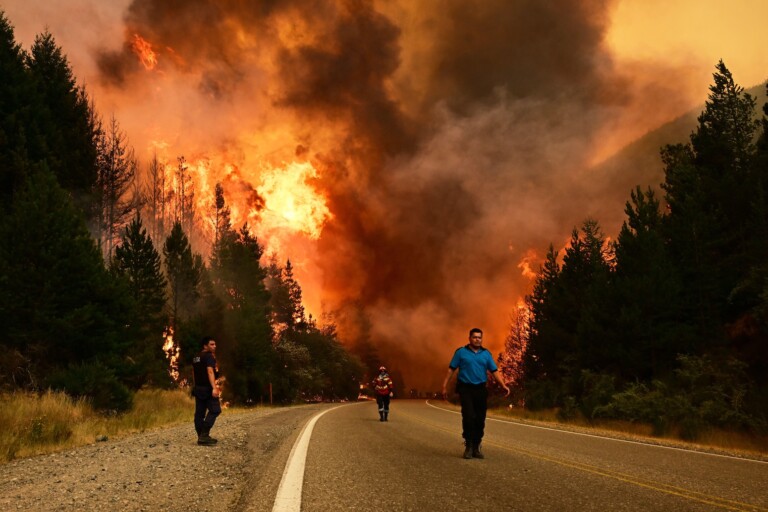
In the summer of 2026, as raging wildfires forced hundreds of thousands of citizens from their homes across France and Spain, a starkly contrasting narrative took root across social media and right-leaning media outlets. Prominent climate sceptics, political commentators, and high-profile figures published charts claiming that 2026 was experiencing the "quietest" European wildfire season in over a decade.
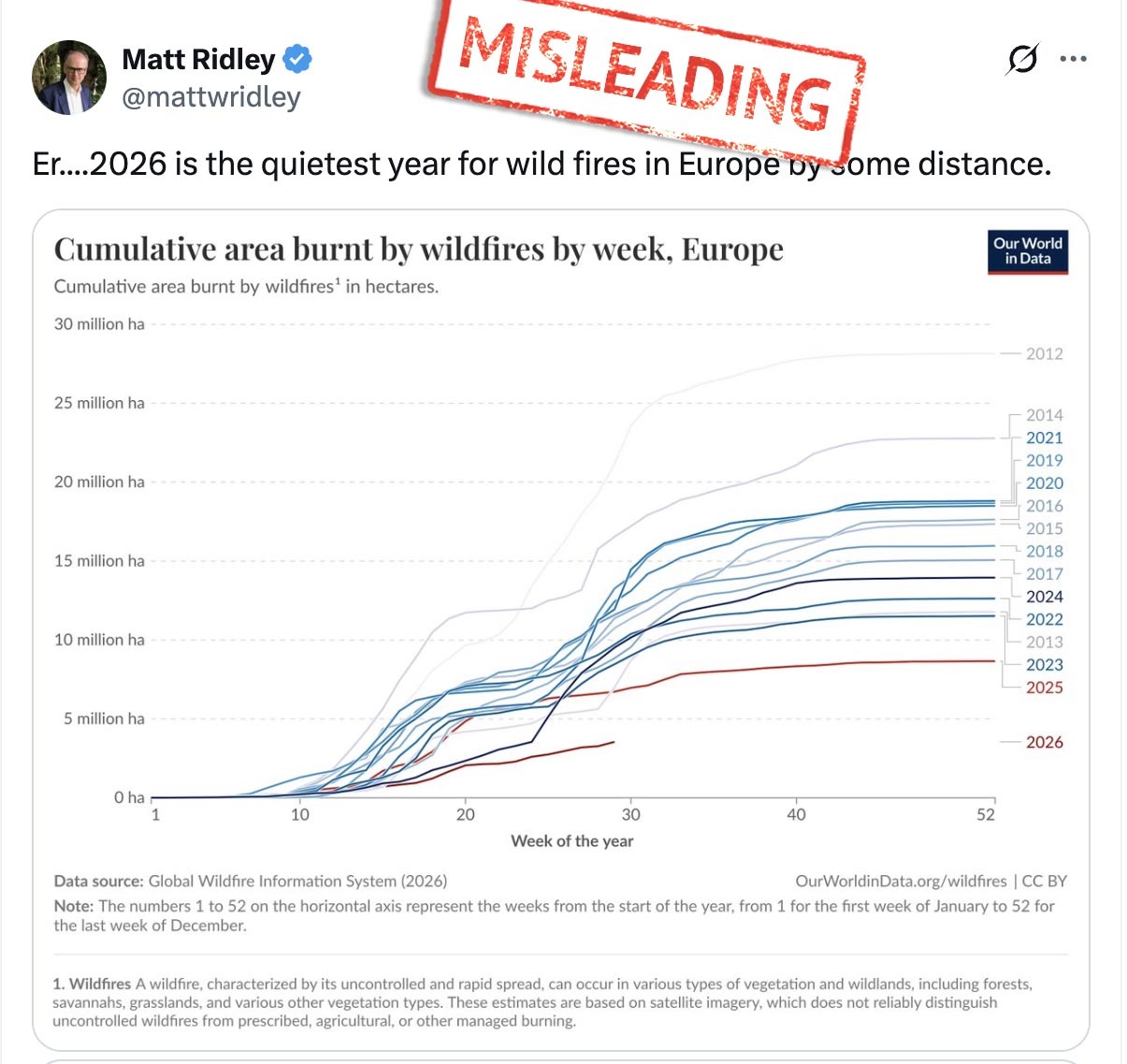
This narrative rested on statistical manipulation and methodological conflation. The visual representations circulated by commentators—including high-ranking climate policy appointees and political figures—relied on regional datasets that aggregated the entire Russian landmass, including Siberia, into the definition of "Europe." Because Russia comprises roughly 74% of the geographic area covered in these specific global datasets and typically accounts for 80% to 90% of its total burned area, a subdued fire season in eastern Siberia effectively masked unprecedented, catastrophic fire activity across Western and Southern Europe.
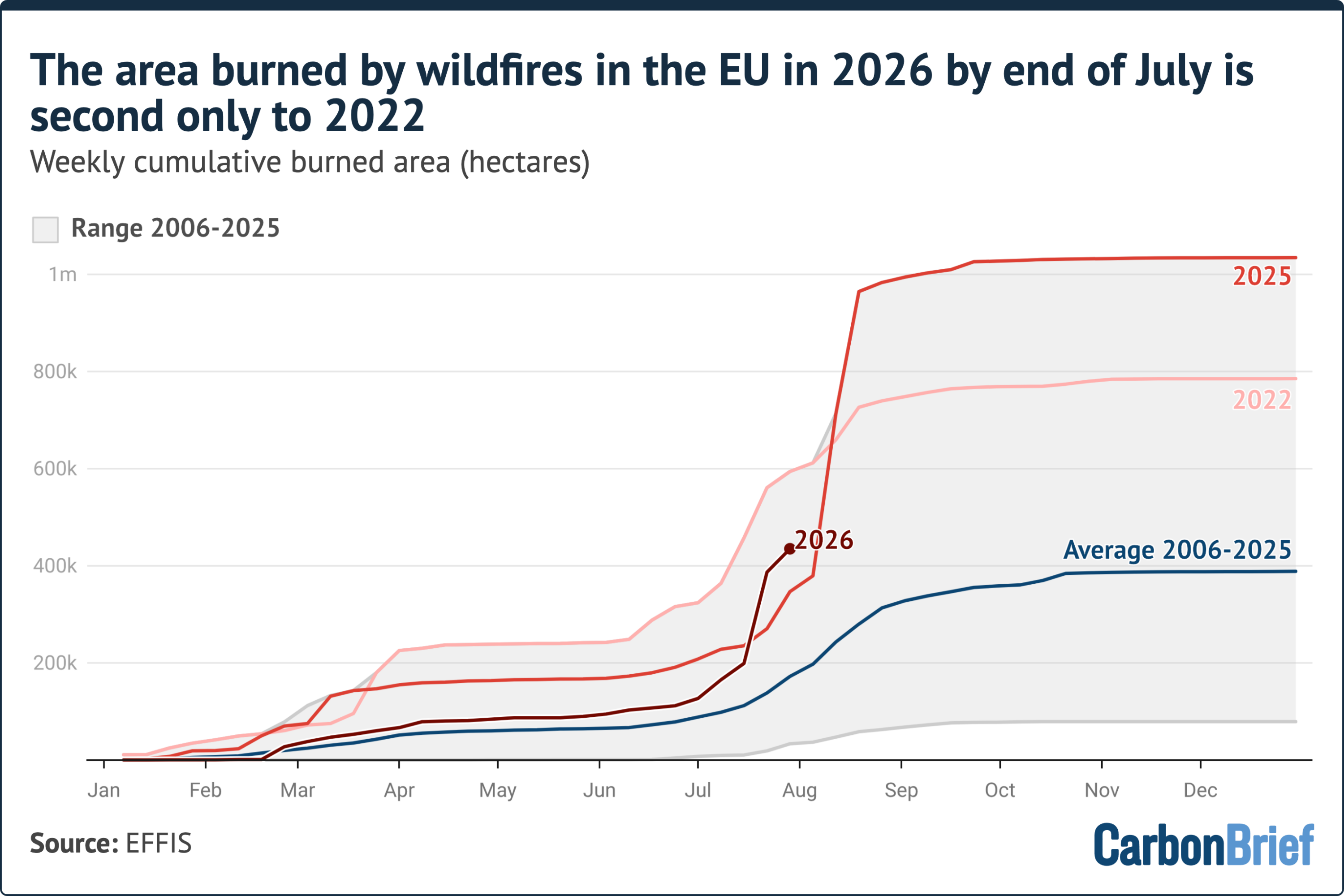
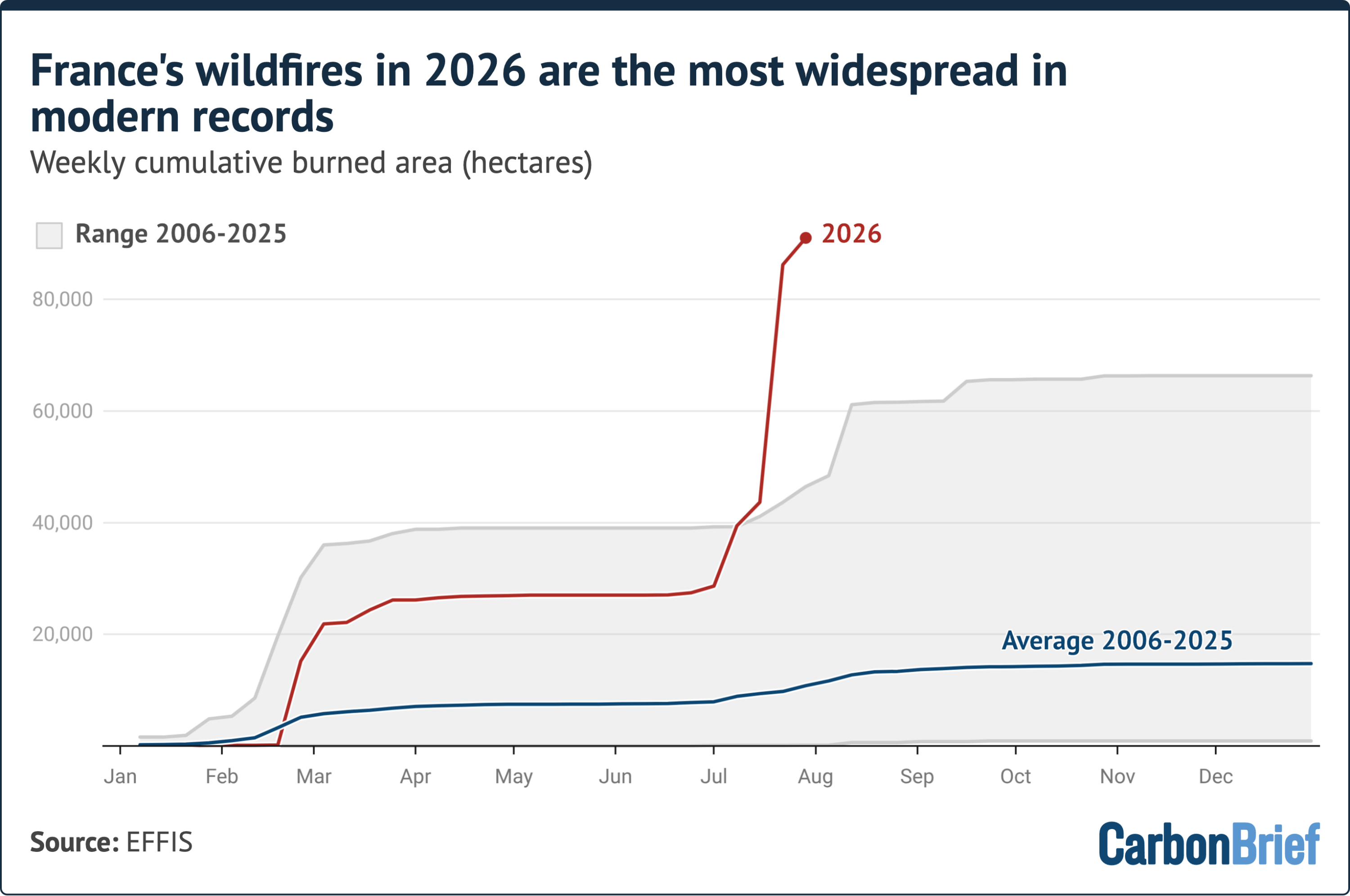
Furthermore, the flawed figures failed to distinguish between uncontained forest fires and intentional agricultural cropland burning—a practice that is rapidly declining across the European Union but remains prevalent elsewhere. Fact-checking by independent researchers and climate analysts using data from the European Forest Fire Information System (EFFIS) reveals the stark reality: by late July 2026, the area burned across the European Union had reached nearly 435,000 hectares. Far from being a "quiet" year, 2026 represents the second-most destructive fire season for the EU on record, behind only 2022. In France, cumulative burned area shattered all modern historical records, while Spain endured one of its most severe fire crises in decades, triggering the largest peacetime evacuations in modern French history.
+-----------------------------------------------------------------------------------+
|                        MISLEADING VS. ACTUAL DATA METRICS                         |
+-----------------------------------+-----------------------------------------------+
| Misleading Narrative (GWIS Agg.)  | Actual EU Reality (EFFIS Data)                |
+-----------------------------------+-----------------------------------------------+
| - Aggregates Russia & Siberia     | - Filters for EU-27 Member States             |
| - Includes Agricultural Burning   | - Isolate True Forest/Wildland Fires          |
| - Shows 2026 as "Record Low"      | - 2026 is 2nd Worst Season on Record          |
| - Masks Regional Crises           | - France: Modern Record (>90,000 ha)          |
|                                   | - Spain: Nearly 5x Seasonal Average           |
+-----------------------------------+-----------------------------------------------+
Detailed Chronology
Mid-June to Early July 2026: The Meteorological Powder Keg
The crisis originated during an extraordinary mid-June heatwave that swept across Southwestern Europe. Temperatures repeatedly breached historical thresholds, drawing moisture out of vegetation and soil across the Iberian Peninsula and southern France. By early July, vast swathes of forest and shrubland had been converted into highly combustible tinder.
Mid-July 2026: Outbreaks in France and Spain
By the second week of July, active fire fronts began multiplying rapidly.
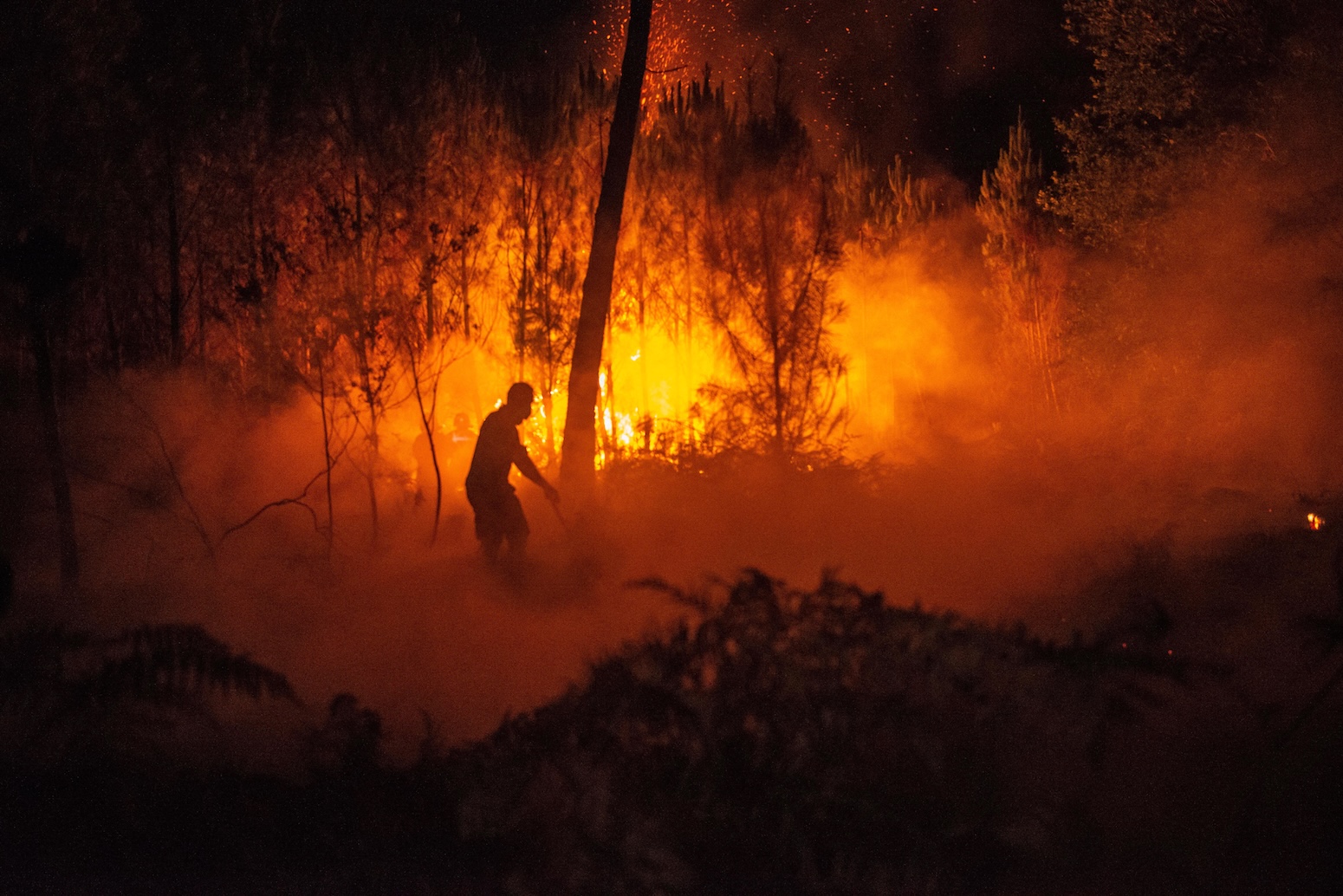
France: While the first half of the year recorded fire activity near historical averages, a dramatic spike occurred during the second week of July. In the Gironde department west of Bordeaux, ignition points coalesced into massive, uncontrollable blazes.
Spain: Simultaneously, multiple fire clusters ignited across central Spain, particularly in the arid terrain surrounding the Madrid autonomous region, rapidly burning through thousands of hectares of forest daily.
July 26–27, 2026: The Political Discourse and Digital Campaign
On July 26, Daily Telegraph columnist Tim Stanley published an op-ed urging political conservatives to take climate change seriously, writing: "This is no longer a matter of speculation: the wildfires of Europe, pitiless and persistent, are the way we live now."
The following day, July 27, former Conservative peer and climate-sceptic commentator Matt Ridley countered Stanley’s argument on X (formerly Twitter). Ridley declared that "2026 is the quietest year for wildfires in Europe by some distance," attaching a chart from Our World in Data based on the Global Wildfire Information System (GWIS).
Timeline of Events (July 2026)
-----------------------------------------------------------------------------------------
[July 10-20]   Extreme heatwave dries out vegetation across France and Spain.
[July 26]      Tim Stanley publishes column highlighting persistent European fires.
[July 27]      Matt Ridley posts misleading "quietest year" chart on social media.
[July 27-28]   Disinformation amplifies; shared by political figures and influencers.
[July 27]      French President Emmanuel Macron convenes emergency crisis cabinet.
[July 29]      EFFIS data confirms France breaks all-time annual burned area record.
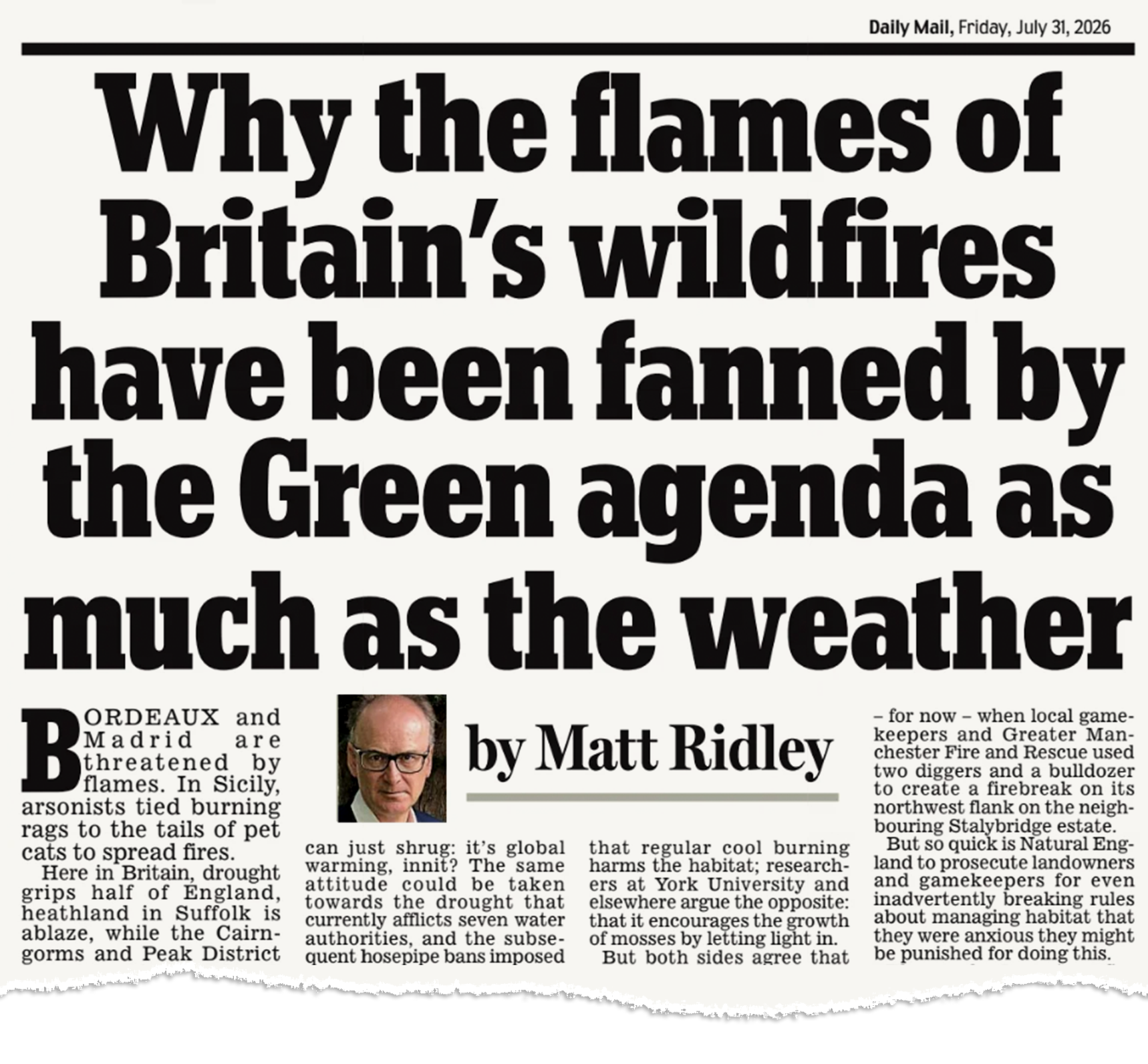
[July 31]      Ridley repeats claims in Spectator/Daily Mail; scientific pushback escalates.
-----------------------------------------------------------------------------------------
Ridley’s post triggered rapid amplification across right-wing political networks. The narrative was reshared by:
Richard Tice, Deputy Leader of Reform UK.
Jacob Rees-Mogg, former British Conservative cabinet minister.
Dr. Matthew Wielicki, a former University of Alabama geochemist recently appointed by the Trump administration to lead the U.S. Global Change Research Program (USGCRP).
Bjorn Lomborg, author and head of the Copenhagen Consensus Center.
Ridley subsequently doubled down on the claim in an article for The Spectator, which was later syndicated by the Daily Mail.
Late July 2026: The Operational Reality
As the digital narrative gathered momentum, emergency services on the ground faced unprecedented operational strains:
July 27: French President Emmanuel Macron convened an emergency crisis cabinet meeting in Paris to deploy national reserves and request international aerial firefighting support.
July 28–29: Mass evacuations peaked. Over 220,000 residents and tourists were evacuated from the paths of the Gironde fires in France. In central Spain, more than 90,000 people were displaced as fires encroached on populated areas near Madrid.
July 31: Comparative satellite data analysis published by scientific platforms confirmed that France had officially surpassed its previous modern annual record for burned area by more than 24,700 hectares.
Supporting Context & Metrics
The Mechanics of Data Misinterpretation
The fundamental error—or intentional obfuscation—within the "quiet year" claim lies in the data architecture of the Global Wildfire Information System (GWIS) compared to the European Forest Fire Information System (EFFIS).
+---------------------------------------------------------------------------------+
|                       COMPARATIVE DATASET ARCHITECTURE                          |
+----------------------------------+----------------------------------------------+
| Feature                          | Global Wildfire Information System (GWIS)    |
+----------------------------------+----------------------------------------------+
| Geographic Boundary              | Entire European Continent + All of Russia    |
| Dominant Landmass                | Russia (~74% of total land area)             |
| Fire Types Included              | Forest, Shrubland, Wildland + Cropland Stubble|
| Primary Data Distortion          | Siberian fire quietness hides European peak  |
+----------------------------------+----------------------------------------------+
| Feature                          | European Forest Fire Information System (EFFIS)|
+----------------------------------+----------------------------------------------+
| Geographic Boundary              | 27 EU Member States (Excludes Russia)        |
| Dominant Landmass                | Western, Central, and Southern Europe        |
| Fire Types Included              | Filtered for Forest and Wildland Vegetation  |
| Primary Data Focus               | Accurately isolates European forest crises   |
+----------------------------------+----------------------------------------------+
1. The Geographic Aggregation Trap
The GWIS classification for "Europe" encompasses the entirety of the Russian Federation, extending all the way to its eastern Pacific coastline. Because Russia’s vast geographic footprint represents nearly three-quarters of the total area in this dataset, Russian fire dynamics statistically dominate the regional total.
In a typical year, Siberian wildfires account for 80% to 90% of all burned acreage in the GWIS "Europe" category. In 2026, Siberian fire activity was significantly below its long-term average. Consequently, when Russian data was combined with European data, the subdued Siberian season mathematically overwhelmed the severe fire activity occurring in France, Spain, and Portugal.
2. Conflation of Agricultural Stubble Burning with Wildfires
GWIS satellite detection algorithms register all thermal anomalies and burned land surfaces, including agricultural stubble burning—the practice of burning crop residues post-harvest. Stubble burning has been heavily restricted across the EU due to environmental regulations, leading to a steady multi-decade decline in agricultural fire events across Western Europe.
Conversely, EFFIS utilizes high-resolution land-cover mapping overlaying active thermal detections to filter out agricultural management fires, isolating true forest, heath, and shrubland wildfires.
Quantitative Breakdown: EU, France, and Spain
European Union Aggregate
Data extracted from EFFIS up to July 29, 2026, paints an alarming picture for the 27 EU member states:
Total Cumulative Area Burned: ~435,000 hectares.
Historical Ranking: Second-highest burn area recorded by late July since satellite monitoring began, surpassed only by the extreme fire season of 2022.
Deviation from Baseline: Exceeded the 2006–2025 multi-year seasonal average by more than 180%.
Cumulative EU Area Burned by End of July (Selected Peak Years)
------------------------------------------------------------------
2022:  [=========================================] ~510,000 ha
2026:  [===================================] ~435,000 ha
AVG*:  [=================] ~155,000 ha (2006-2025 Average)
------------------------------------------------------------------
France: Record-Breaking Destruction
Burned Area (as of July 29): Exceeded 90,000 hectares.
Previous Record Gap: Surpassed the prior modern annual record by nearly 24,700 hectares.
Trajectory: Early-season activity was modest, but a sharp upward trajectory began in early July. In the third week of July alone, France recorded over 19,000 hectares burned above the historical range maximum.
France Cumulative Burned Area Trend (2026 vs. Baseline)
Hectares
 100,000 |                                                 /--- 2026 (Modern Record)
  80,000 |                                                /
  60,000 |                                    /----------+  Historical Max Range
  40,000 |                                   /
  20,000 |--------/-------------------------/               2006-2025 Average
       0 +--------------------------------------------------
         Jan     Mar      May      Jul      Sep      Nov
Spain: Central Region Devastation
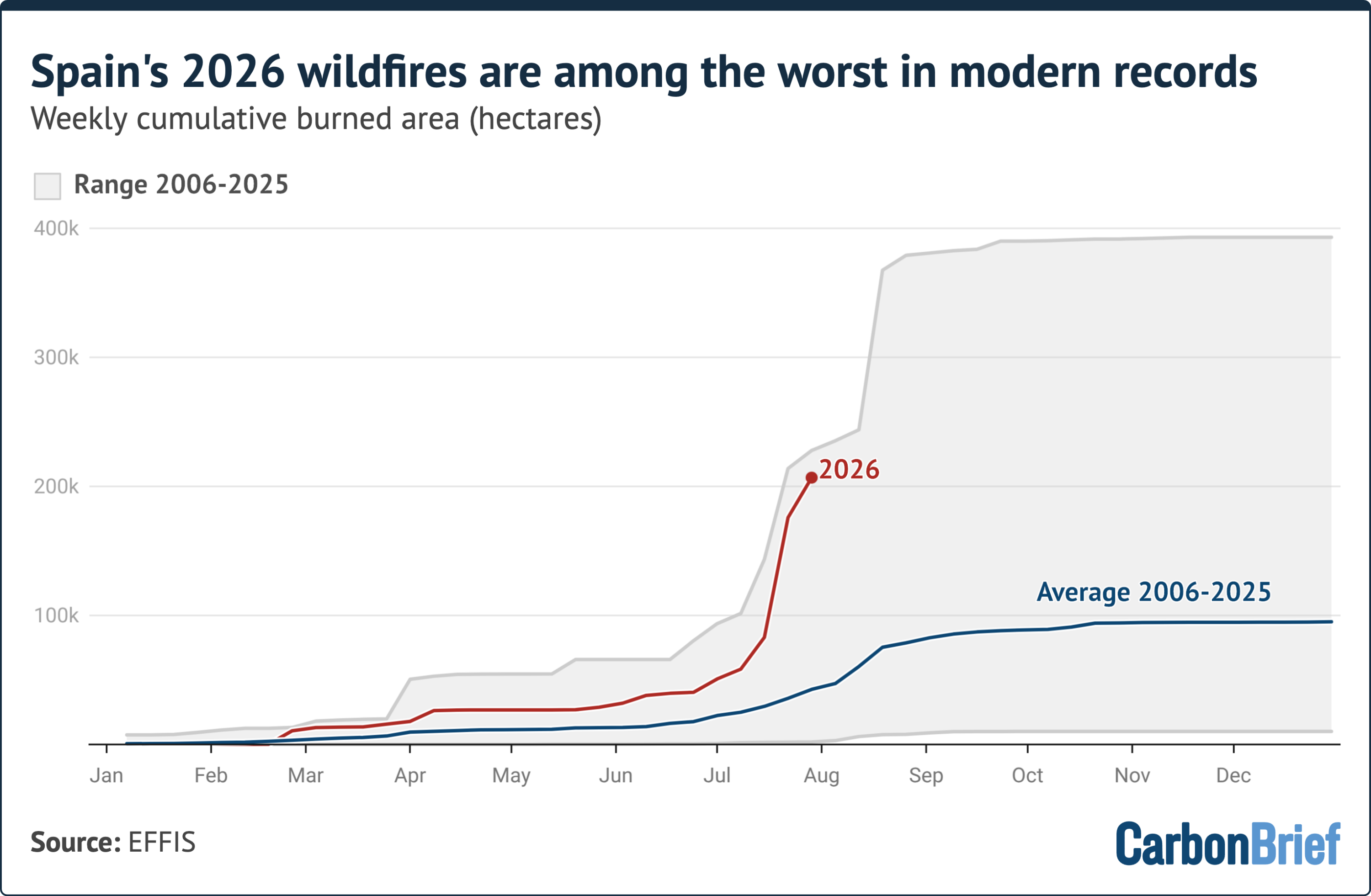
Burned Area (as of July 29): Approached 200,000 hectares.
Multiyear Comparison: Nearly five times the historical 2006–2025 average for late July.
Geographic Focus: Concentrated heavily in the autonomous region of Madrid and surrounding central provinces, where fires burned an area twice the geographic footprint of Madrid proper.
Official Statements & Expert Commentary
Scientific Analysis
Experts in fire ecology and climate risk noted the flaw in aggregating climatically distinct continental zones to evaluate localized climate impacts.
Dr. Calum Cunningham, Research Fellow at the University of Tasmania’s Fire Centre, highlighted how broad spatial aggregation distorts public perception:
"These claims are highly misleading because they rely on aggregating fire activity across an enormous and climatically diverse region. A relatively quiet season in Russia can easily mask an exceptionally active season in France or Spain. If the analysis is focused on the regions actually experiencing the current fires, the picture is very different.
The reality is that Western Europe has experienced an extraordinary sequence of climate conditions this year… There is little doubt climate change has made France and Spain’s wildfires worse. They represent yet another reason to redouble our efforts to tackle climate change and stabilise our climate."
Addressing the tactical challenges created by large-scale evacuations, Dr. Cunningham added:
"Mass evacuation orders protect human lives, which is paramount, but it makes it more likely houses and other structures will burn if there is no one left to defend them."
Political and Ministerial Responses
The severity of the crisis prompted direct statements from European heads of state and joint diplomatic action.
Emmanuel Macron, President of France, addressing a crisis cabinet meeting convened to manage the Gironde emergency:
"The fires ravaging several areas of south-west France demand unprecedented national solidarity and the full mobilization of state resources to protect our citizens and ecosystems."
Pedro Sánchez, Prime Minister of Spain, speaking from an emergency command center near Madrid:
"What we are witnessing in central Spain is not merely a seasonal emergency; it is the raw, painful expression of a changing climate that directly threatens our communities."
Joint Diplomatic Declaration:
In an unusual step reflecting the perceived level of threat, the Foreign Ministers of the United Kingdom, France, and Spain issued a joint security communique:
"This summer’s wildfires demonstrate that climate change is now a national security emergency facing Europe and threatening our way of life."
+-----------------------------------------------------------------------------------+
|                        KEY STATEMENTS FROM KEY LEADERS                            |
+-------------------+---------------------------------------------------------------+
| Speaker           | Central Message                                               |
+-------------------+---------------------------------------------------------------+
| Dr. C. Cunningham | Aggregated continental data masks acute local climate crises.  |
| Emmanuel Macron   | Gironde blazes require unprecedented state crisis intervention.|
| Pedro Sánchez     | Wildfires represent a "painful expression" of climate reality. |
| UK/FR/ES Ministers| European wildfires are a vital "national security emergency." |
+-------------------+---------------------------------------------------------------+
Disinformation Dynamics & Public Policy Implications
The rapid propagation of the "quiet wildfire year" narrative highlights an evolving challenge in climate communications: the weaponization of genuine, open-access scientific data taken out of context.
The Role of Misleading Data Architecture
The posts shared by Matt Ridley, Dr. Matthew Wielicki, and Bjorn Lomborg utilized authentic charts generated from open data platforms (Our World in Data and GWIS). However, by presenting an aggregated continental index without explaining its geographical composition, these commentators created a false sense of security.
Even after climate scientists publicly pointed out that the inclusion of Siberia invalidated the chart as a metric for Western Europe, key figures continued to share the data. Dr. Matthew Wielicki, recently appointed to head the US Global Change Research Program, acknowledged on social media that including all of Russia "isn’t a good proxy for Europe," yet continued to post GWIS-based charts to support assertions that wildfire trends were declining.
  [Open-Access Data (GWIS)]
            │
            ▼
  [Aggregated "Europe" Metric (Inc. Russia/Siberia)]
            │
            ▼
  [Weaponized Headline: "Quietest Year on Record"]
            │
            ▼
  [Amplification via Political Networks & Media Outlets]
            │
            ▼
  [Erosion of Public Awareness & Policy Resistance]
Institutional Links and Policy Impact
This dynamic underscores the strategic network through which climate scepticism is amplified:
Lobbying and Advisory Networks: Commentators involved in organizations like the UK-based Global Warming Policy Foundation (GWPF) leverage platform visibility to challenge the climate consensus.
Institutional Governance: The appointment of vocal climate critics like Wielicki to federal research leadership positions in the US administration demonstrates how misapplied data metrics can directly influence policy governance.
Media Amplification: Op-eds published in high-circulation outlets (The Spectator, Daily Mail) quickly translate social media narratives into mainstream political commentary, distorting the public’s understanding of extreme weather events.
Future Outlook
As temperature anomalies persist across Southwestern Europe, emergency services face an extended, high-intensity fire season driven by acute heatwaves and underlying dry conditions.
+-----------------------------------------------------------------------------------+
|                           FUTURE RISK & POLICY OUTLOOK                            |
+----------------------+------------------------------------------------------------+
| Domain               | Key Anticipated Challenges & Developments                  |
+----------------------+------------------------------------------------------------+
| Operational Pressure | Escalating threat of recurrent late-summer heatwaves.     |
| Civil Defense        | Re-evaluating mass evacuation protocols & property defense. |
| International Aid    | Expanding shared EU aerial firefighting assets (rescEU).   |
| Policy Reform        | Integrating fire prevention with broader climate targets.  |
| Information Integrity| Developing real-time data verification against misinfo.    |
+----------------------+------------------------------------------------------------+
Operational Challenges for late 2026
Persistent Heatwaves: Forecasts indicate lingering high-temperature anomalies across the Mediterranean basin, raising fears that active fire perimeters could expand further before autumn rainfall arrives.
Resource Exhaustion: Modern record burn areas in France and near-record levels in Spain have severely stretched local and national emergency response capabilities, necessitating increased reliance on shared European Union resources like the rescEU firefighting fleet.
Policy and Institutional Adaptation
Rethinking Civil Defense: The displacement of over 330,000 citizens across Southern Europe highlights the growing burden on regional infrastructure. Fire safety experts are calling for updated land-management strategies, including strategic controlled burns and defensive buffer zones around urban-wildland interfaces.
Combating Climate Disinformation: The mismatch between online narratives and on-the-ground realities highlights the need for clearer data presentation. Public institutions are moving toward granular, region-specific reporting (such as EFFIS) to prevent broad spatial statistics from masking localized climate risks.
Ultimately, the 2026 European wildfire season provides a clear case study in modern climate communication: while regional data aggregation can obscure localized fire trends, it cannot alter the real-world impacts felt by communities on the ground.