High-voltage direct current (HVDC) transmission is shedding its historical reputation as a niche, high-cost specialty technology reserved exclusively for record-breaking subsea links, extreme-distance terrestrial runs, or thorny, isolated grid emergencies. For decades, HVDC projects were treated as bespoke engineering marvels—individually tailored, immensely complex, and financially daunting endeavors that required custom manufacturing and one-off control systems.
Today, that paradigm is fracturing. According to insights shared by Cornelis Plet, Chief Technology Officer of Grid Systems Integration at GE Vernova, during a recent Redefining Energy conversation, HVDC is rapidly transitioning into a standard tool in the transmission planner’s primary kit. This shift is driven fundamentally by physical standardization: the market is converging around repeatable 2 GW, 525 kV modular building blocks featuring common converter configurations and bipolar designs in Europe, alongside 3 GW benchmarks emerging in fast-growing markets like the United States and India.
Yet, this hardware maturation exposes a glaring structural mismatch. While factories are finally finding their rhythm and producing reliable, standardized converter units at scale, the wider electrical ecosystem is failing to keep pace. As legacy fossil-fuel generators retire en masse and are replaced by inverter-based renewable energy sources, power systems require far more than simple bulk energy transport. Transmission networks demand complex stability services, interoperability between multi-vendor systems, and coherent inter-regional planning frameworks.
The primary bottlenecks facing the global energy transition are no longer confined to factory floors or cable supply chains. Instead, they have migrated upward into system architecture, regulatory alignment, cross-border institutional cooperation, and a severe shortage of specialized power system engineers. As the physical hardware of the energy transition standardizes, the grid’s administrative and control layers risk becoming the ultimate chokepoint.
Detailed Chronology: From Bespoke Engineering to Standardized Modular Blocks
To understand how HVDC reached this inflection point, it is helpful to trace the evolution of high-voltage transmission over the past generation.
Phase 1: The Era of the Custom Project (Pre-2020s)
Historically, HVDC was deployed strictly on an exception basis. Because power electronics were expensive, proprietary, and highly sensitive, every HVDC link was a custom-engineered masterpiece. Engineers designed converter stations from scratch, tailoring filters, transformers, and control software to the exact electrical parameters of the local AC grid it tied into.
This approach created massive administrative overhead, long lead times, and extreme vulnerability to supply chain shocks. If a component failed or required replacement, sourcing identical parts years down the line was often impossible. Interoperability between different manufacturers was virtually non-existent; mixing a Siemens converter with an ABB control system on the same bipole was a recipe for catastrophic system instability.
Phase 2: The European Modular Push and the PROMOTioN Initiative
Recognizing that Europe’s offshore wind ambitions could never be realized under a bespoke project model, researchers and industry leaders initiated collaborative frameworks to harmonize technology. A major milestone in this evolution was the PROMOTioN (Progress on Meshed HVDC Offshore Transmission Networks) research and demonstration program, previously led by Cornelis Plet.
PROMOTioN was designed to tackle the technological hurdles required to transition Europe from isolated, point-to-point HVDC links toward a fully integrated, multi-terminal, and eventually multi-vendor meshed HVDC grid. The initiative laid the groundwork for proving that separately developed hardware could safely coexist on a shared network.
Phase 3: The 2 GW / 525 kV Convergence (Present Day)
Building on decades of collaborative research and iterative deployment, the European market has reached a critical hardware consensus. The industry is rapidly standardizing around 2 GW, 525 kV HVDC building blocks.
By establishing a repeatable product family, manufacturers of cables, converter stations, and transformers can shift from custom engineering to serial production. Similar market gravity is pulling other geographies toward predictable configurations, notably 3 GW project blueprints taking shape in the United States and India.
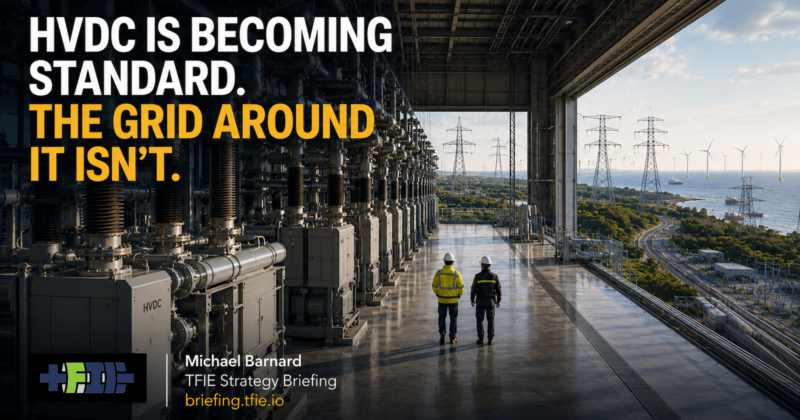
However, this hardware consolidation has unmasked a secondary, thornier set of problems: the software, control codes, and administrative frameworks governing the grid have not harmonized at the same velocity.
Supporting Context & Metrics: The Anatomy of Modern Transmission Bottlenecks
The Hardware Triumph vs. The Software Vacuum
The convergence around 2 GW and 3 GW blocks has undeniably eased some historical manufacturing pressures. Factories are expanding, and supply chain bottlenecks for transformers and high-voltage cables are slowly beginning to unclench. However, the nature of the electrical grid is changing underneath these new installations.
As synchronous generation—coal, gas, and nuclear plants with heavy spinning turbines—retires, the grid loses crucial inertia and short-circuit power. Power electronics, such as the inverters used in wind, solar, and battery storage systems, dominate modern additions. Consequently, HVDC converter stations can no longer act merely as passive tollbooths moving electricity from point A to point B. They must actively participate in stabilizing the surrounding alternating current (AC) grid.
This has created an urgent demand for grid-forming (GFM) controls integrated directly into HVDC systems. Grid-forming converters can establish their own voltage and frequency references, effectively acting as virtual synchronous machines to support weak grids.
The Interoperability Impasse
While grid-forming functionality is increasingly requested by transmission system operators (TSOs), there is currently no single, globally coherent definition of how these controls should behave.
- Fragmented Grid Codes: Requirements vary wildly by country, region, and even individual utility territory.
- Vendor Implementations: Because standards are fluid, equipment vendors maintain distinct, proprietary control logic.
- Multi-Vendor Risk: When Europe attempts to transition from point-to-point links to meshed multi-vendor grids, getting a converter station from Supplier A to seamlessly communicate, share protection duties, and coordinate control modes with Supplier B’s equipment remains a formidable challenge. It is no longer just about voltage and current ratings; it involves deep alignment on intellectual property, interface protocols, and fault-clearing behavior.
The North American Planning Gap
Hardware and software challenges are compounded by systemic institutional failures in spatial and regulatory planning. HVDC lines are uniquely valuable because they can efficiently shunt massive blocks of renewable energy across thousands of kilometers. By definition, this requires crossing state lines, provincial boundaries, international borders, and conflicting utility jurisdictions.
While Europe has gradually constructed imperfect but functional multinational grid-planning institutions—such as ENTSO-E (European Network of Transmission System Operators for Electricity)—North America lags significantly behind. The U.S. and Canada struggle with:
- Inter-regional planning coordination.
- Equitable cost-allocation frameworks.
- Agreeing on standardized metrics for what constitutes a quantifiable "system benefit."
Without regulatory mechanisms that can fairly distribute the costs and rewards of inter-regional transmission lines, multi-state HVDC projects often stall indefinitely in a quagmire of local opposition and regulatory disputes.
The Human Capital Deficit
Perhaps the most overlooked constraint in the modern energy transition is not physical or financial, but demographic. The power sector is facing a severe shortage of experienced power system engineers.
While standardizing HVDC hardware reduces the engineering hours required per individual project, and artificial intelligence increasingly automates routine design tasks, an inverter-dominated grid operating at ultra-high voltages requires specialized human expertise. Professionals who deeply understand electromagnetic transients, complex control loops, system protection, and multi-vendor interactions are in exceedingly short supply. According to industry leaders, workforce constraints are rapidly becoming one of the most practical and stubborn limits on the speed of the global grid buildout.
Official Statements & Expert Insights
Analyzing the dialogue from industry veterans provides a clear window into where the transmission sector stands today.

-
On the Normalization of HVDC:
"HVDC is moving into the normal transmission planner’s toolbox rather than sitting off to the side as an exotic developer proposal." — Cornelis Plet, CTO of Grid Systems Integration, GE Vernova
-
On Physical Standardization vs. Institutional Lags:
Plet emphasizes that the industry has successfully proved that HVDC hardware works at massive scales. The unresolved work is no longer about whether the physical cables and converters can handle the load—they can. The bottleneck has shifted entirely toward "making many such systems work together inside grids whose technical rules and planning institutions were built for a different era."
-
On Interoperability and Meshed Networks:
Reflecting on his leadership with Europe’s PROMOTioN program, Plet notes that future research is increasingly dedicated to proving that separately developed systems can operate symbiotically. True interoperability means moving past the point where every multi-vendor grid expansion requires an enormous, custom-built integration exercise that drains engineering resources and inflates project timelines. -
On the Engineering Workforce:
Addressing the hidden operational bottlenecks, industry experts repeatedly flag human capital. Standard designs and automation tools help bridge the gap, but they cannot replace seasoned electrical engineers capable of diagnosing complex, inverter-driven instability issues across multi-jurisdictional networks.
Future Outlook: Navigating the Next Era of Grid Integration
The global buildout of high-voltage direct current transmission has crossed a crucial Rubicon. The foundational question of whether modern power electronics and 525 kV DC lines can reliably move gigawatts of power over vast distances has been decisively answered in the affirmative. The manufacturing base is adapting, factory capacity is scaling up, and standardized modular building blocks are becoming the global norm.
However, the path forward requires a fundamental evolution in how power grids are regulated, planned, and operated. To unlock the full potential of HVDC in a decarbonized energy economy, three critical transformations must occur over the coming decade:
- Harmonization of Grid Codes and Controls: International standards bodies and regional TSOs must coalesce around unified definitions for grid-forming functionalities. Moving away from fractured, regional-specific control requirements will allow manufacturers to produce universally interoperable software packages, radically reducing integration friction.
- Institutional and Regulatory Reform: Particularly in North America, policymakers must empower federal and regional authorities to mandate inter-regional planning, establish transparent cost-allocation models, and streamline permitting for cross-border transmission corridors. Without these reforms, even the most advanced 3 GW HVDC lines will remain trapped in regulatory limbo.
- Investment in Human Capital: Engineering education and workforce development must be prioritized to replenish the aging ranks of power systems specialists. Training the next generation of engineers in digital controls, electromagnetic transients, and multi-vendor system integration is just as vital as building factories for transformers and subsea cables.
Ultimately, the HVDC revolution proves that engineering hardware is the easy part. The true test of the 21st-century energy transition will be whether our institutions, software standards, and human workforces can evolve quickly enough to manage the complex, interconnected supergrids we are building.