Executive Overview
For over a century and a half, the scientific and cultural landscape of Australia’s southernmost state has been meticulously documented through the pages of one extraordinary publication. Established in 1843, the Royal Society of Van Diemen’s Land—now known as the Royal Society of Tasmania—is Australia’s oldest institution of its kind. In 1849, the Society published the inaugural volume of its Papers and Proceedings, setting in motion a continuous tradition of academic rigor, exploration, and environmental observation that persists to this day.
Now, as part of the worldwide celebration of the Biodiversity Heritage Library’s (BHL) 20th anniversary, this foundational text and its decades-long successor volumes are gaining renewed visibility. Through the collaborative preservation efforts of the BHL open-access repository, researchers, historians, and the general public can now navigate more than 175 years of digitized scientific history.
This comprehensive archival treasure trove offers an unfiltered lens into the complex realities of colonial enterprise, the relentless pursuit of natural science, and the profound ecological changes that reshaped an island. Yet, read through a modern lens, these historical pages also serve as a poignant reminder of the erasures of Indigenous voices, the unintended consequences of introduced species, and the ongoing journey toward historical accountability.
Detailed Chronology: Unlocking Volume One (1849–1851)
The publication of Volume One of the Papers and Proceedings of the Royal Society of Van Diemen’s Land, released in three distinct parts between 1849 and 1851, marked a critical turning point for intellectual life in the British colony. No longer content to operate merely as a penal outpost at the edge of the known world, the settlers sought to quantify, categorize, and exploit their new environment.

The Landscape of Early Data
Volume One opens with an exhaustive, nearly fifty-page analysis of the colony’s demographics and meteorology. Complete with intricate charts, tables, and raw data, these early pages provided foundational metrics for a burgeoning society. Side-by-side with demographic tracking were dispatches on coal exploration, agricultural experimentation, new building techniques, and nascent manufacturing industries. These reports painted an unvarnished picture of a settlement actively carving out a new economic paradigm.
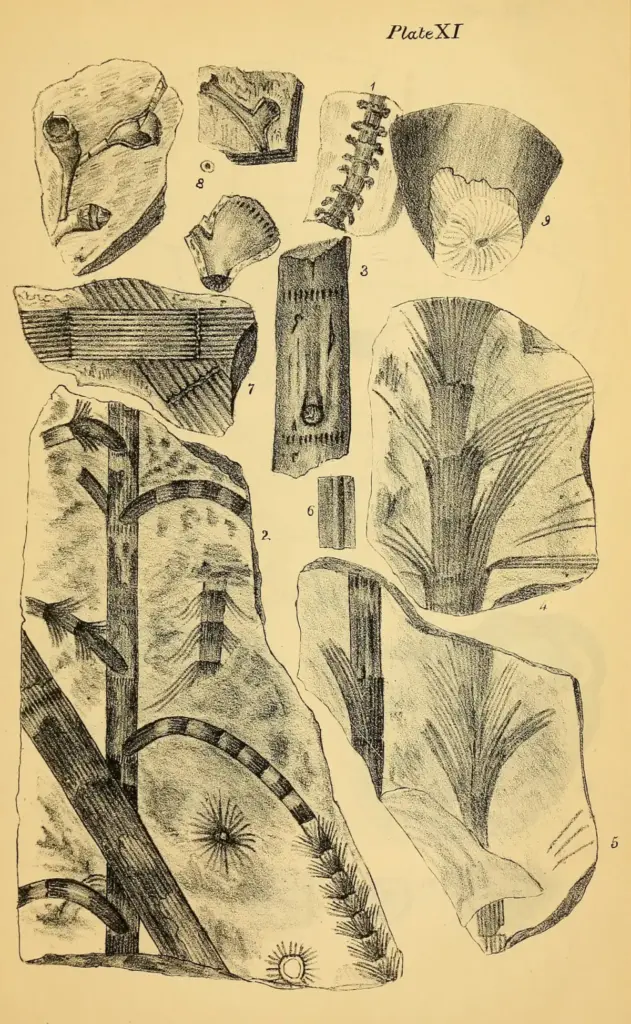
Concurrently, the natural sciences section read like a Victorian Who’s Who of global science. Luminaries such as John Edward Gray, John Gould, and Frederick M’Coy contributed seminal papers that sought to decode the mysteries of ancient Australian fossils and unique living endemic species, such as the enigmatic platypus.
Anecdotal Natural History and Colonial Curiosities
While formal papers drove the structural sections of the journal, it is often the seemingly incidental meeting notes and anecdotal observations recorded by colonial administrators and naturalists that offer the most vivid historical snapshots.
- 1849: A report submitted by Mr. Hull described a gargantuan blue gum tree located roughly six miles from Hobart Town. Standing an estimated 100.5 meters (330 feet) high with a staggering circumference of 25.6 yards (nearly 26 meters), the tree underscored the sheer scale of Tasmania’s original old-growth forests.
- Preserved Oddities: Mr. Champ presented the Society with a small spotted fish preserved in spirits, notable for possessing four legs tipped with finger-like appendages—a marvel of local aquatic biodiversity that captivated the meeting’s attendees.
- The Thylacine Record: In another entry, Mr. Milligan confirmed the safe arrival in London of two live thylacines (Tasmanian tigers) shipped the previous year, highlighting the early, active extraction of iconic endemic fauna for European menageries and scientific institutions.
- Indigenous Knowledge and Botanical Discoveries: Members examined specimens of "native bread" (Mylitta species), a subterranean fungus historically utilized as a food source by Tasmanian Aboriginal people. Meeting notes remarked that when grated and prepared into a milk pudding, the fungus was "very palatable." Additionally, researchers cataloged a rare white resin sourced from the Oyster Bay pine—a tree with an exceptionally restricted distribution that proved invaluable for early colonial carpentry.
The Cascading Impacts of Introduction
Among the most critical entries preserved in these archives are warnings regarding introduced species—actions whose long-term ecological tolls could scarcely be fathomed by nineteenth-century naturalists.

Renowned naturalist Ronald Campbell Gunn authored a vital paper documenting how the "flying squirrel" (the sugar glider) transitioned from an imported 1830s household pet into a fully naturalized, wild Tasmanian species after escaping captivity. Today, this pocket-sized marsupial stands as a severe ecological threat, known to prey upon the nesting females, eggs, and chicks of Tasmania’s critically endangered swift parrot.
Equally consequential was a paper penned by Captain Charles Stanley, which detailed the logistics and practicalities of introducing brown and rainbow trout into local river systems. The subsequent introduction of live fish ova to the Salmon Ponds at New Norfolk permanently altered Tasmania’s aquatic ecosystems, establishing an apex predatory fish presence that disrupted native freshwater fauna forever.
Supporting Context & Metrics
The survival and growth of the Royal Society of Tasmania’s journal were intrinsically linked to the institutional growth of the colony itself. Beyond pure scientific inquiry, the early volumes religiously documented the administrative heartbeat of the Society: office-bearer appointments, financial ledgers, acquisition logs, and lists of donors.
While these logistical pages are often skipped by casual readers, they reveal the powerful social networks that steered nineteenth-century Tasmania. Meetings regularly attracted contributions of rare books, fine art, geological strata samples, and anthropological artifacts from the colony’s elite.

These donations laid the structural and physical foundation for institutions that remain globally recognized today, including:
- The Royal Tasmanian Botanical Gardens
- The Tasmanian Museum and Art Gallery (TMAG)
- The Royal Society of Tasmania’s Art and Library Collections
+-------------------------------------------------------------------------+
|                  EVOLUTION OF TASMANIAN SCIENTIFIC LITERACY             |
+--------------------------+----------------------------------------------+
| Era                      | Primary Focus & Archival Legacy              |
+--------------------------+----------------------------------------------+
| Mid-19th Century         | Colonial resource mapping, meteorology,      |
| (1843–1900)              | natural history collection, acclimatization. |
+--------------------------+----------------------------------------------+
| 20th Century             | Formalization of academic peer-review,       |
|                          | expansion into regional geology & ecology.   |
+--------------------------+----------------------------------------------+
| 21st Century             | Antarctic sciences, cultural truth-telling,  |
| (Present Day)            | open-access digital repatriation via BHL.    |
+--------------------------+----------------------------------------------+
The Shadow of Colonialism
A rigorous contemporary reading of these historical texts necessitates acknowledging their inherent biases. Produced exclusively by and for European administrators, naturalists, and settlers, the early Papers and Proceedings reflect a worldview shaped entirely by colonial privilege.
Indigenous voices, cultural burning practices, and the devastating human costs of dispossession and frontier violence are systematically omitted or viewed through a paternalistic lens. As modern historians and scientists navigate these pages, these conspicuous absences and culturally jarring viewpoints serve as a compelling, if occasionally uncomfortable, reminder of how written history is forged.
Official Statements & Expert Perspectives
Reflecting on the modern relevance of these historical texts, Dr. Sally Bryant AM, a leading Tasmanian wildlife scientist, threatened species conservationist, and Honorary Editor of the journal, emphasizes the evolution of the publication’s mission:

"Today’s Papers and Proceedings continue to focus on Tasmanian and Antarctic natural science, but they also actively encourage broader social and cultural themes. Recent volumes have contributed significantly to truth-telling and historical accountability, including the publication of the Royal Society of Tasmania’s joint Apology to Tasmanian Aboriginal people in 2021 and papers arising from our annual Tasmanian Aboriginal Lecture series."
Dr. Bryant, who was awarded Honorary Life Membership of the Society in 2026, highlights how the journal has transitioned from an instrument of colonial resource extraction into a vehicle for reconciliation, modern ecological stewardship, and cross-cultural dialogue.
Future Outlook: The Digital Frontier
As the Biodiversity Heritage Library marks its 20th milestone, platforms like BHL are fundamentally transforming how historical literature is analyzed. Through the integration of open-access digital repositories, researchers are no longer bound by geography or the physical fragility of rare, yellowed paper.
Advanced computational tools—including optical character recognition (OCR) and machine learning text analysis—can now be applied to over 175 years of continuous publication data. Researchers can track historical shifts in species distribution, climate anomalies, and linguistic patterns across centuries of entries in seconds, uncovering connections that manual reading might easily overlook.

In an age increasingly dominated by transient digital media and artificial intelligence, the enduring survival of the Papers and Proceedings of the Royal Society of Tasmania stands as a testament to the power of structured, long-form observation. It remains one of the Society’s greatest legacies: not merely a collection of historical words on a decaying page, but a dynamic, evolving window into the natural environments, human cultures, and political struggles that continue to define Tasmania’s unique place in the world.
To explore the complete, freely accessible digital collection of the Papers and Proceedings of the Royal Society of Tasmania, visit the Biodiversity Heritage Library.