

Executive Overview
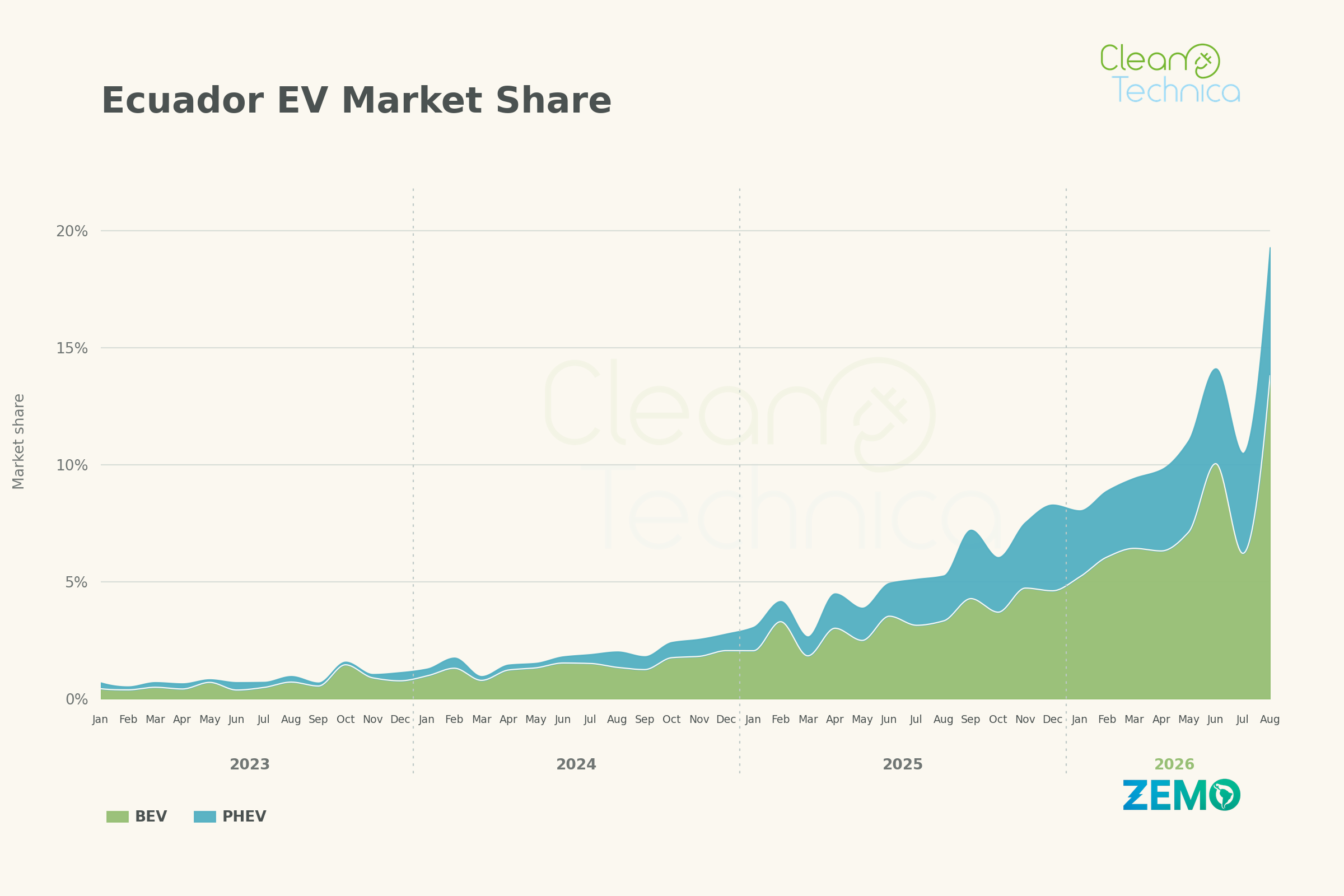
In the fast-evolving landscape of global e-mobility, few nations capture the sheer velocity of change quite like Ecuador. Historically grouped alongside Peru and Argentina at the stagnant bottom of South American electric vehicle (EV) adoption tables, Ecuador has orchestrated a dramatic turnaround. What was once a fledgling market idling at a modest 2% market share just a year and a half ago has transformed into a high-octane growth story.
By the close of the first quarter of 2026, battery electric vehicle (BEV) adoption had already scaled to 6%. By August 2026, that figure shattered expectations, with BEVs capturing a formidable 13.8% of total monthly vehicle sales. When plug-in hybrid electric vehicles (PHEVs)—painstakingly tracked via recent market interventions by ZEMO and the Ecuadorian Association of Automotive Enterprises (AEADE)—are factored into the tally, Ecuador’s electrified market share flirts close to the 20% threshold at 19.3%.
This phenomenal momentum positions Ecuador not merely as a domestic success story, but as a regional disruptor. If current trajectories hold, Ecuador is poised to surpass Colombia, challenging for the bronze medal as the third most advanced EV market in Latin America. This comprehensive analysis explores the catalysts, vehicle segments, brand dynamics, and economic pressures driving Ecuador’s unexpected ascension into the e-mobility elite.
Detailed Chronology: The Accelerated Path to Electrification
To truly appreciate Ecuador’s current standing, one must examine the compressed timeline of its automotive transformation. As recently as late 2023, surpassing 100 monthly EV sales was viewed as a major operational milestone for local distributors. The market was characterized by high import barriers, scarce charging infrastructure, and consumer hesitancy typical of nascent technology adoption.
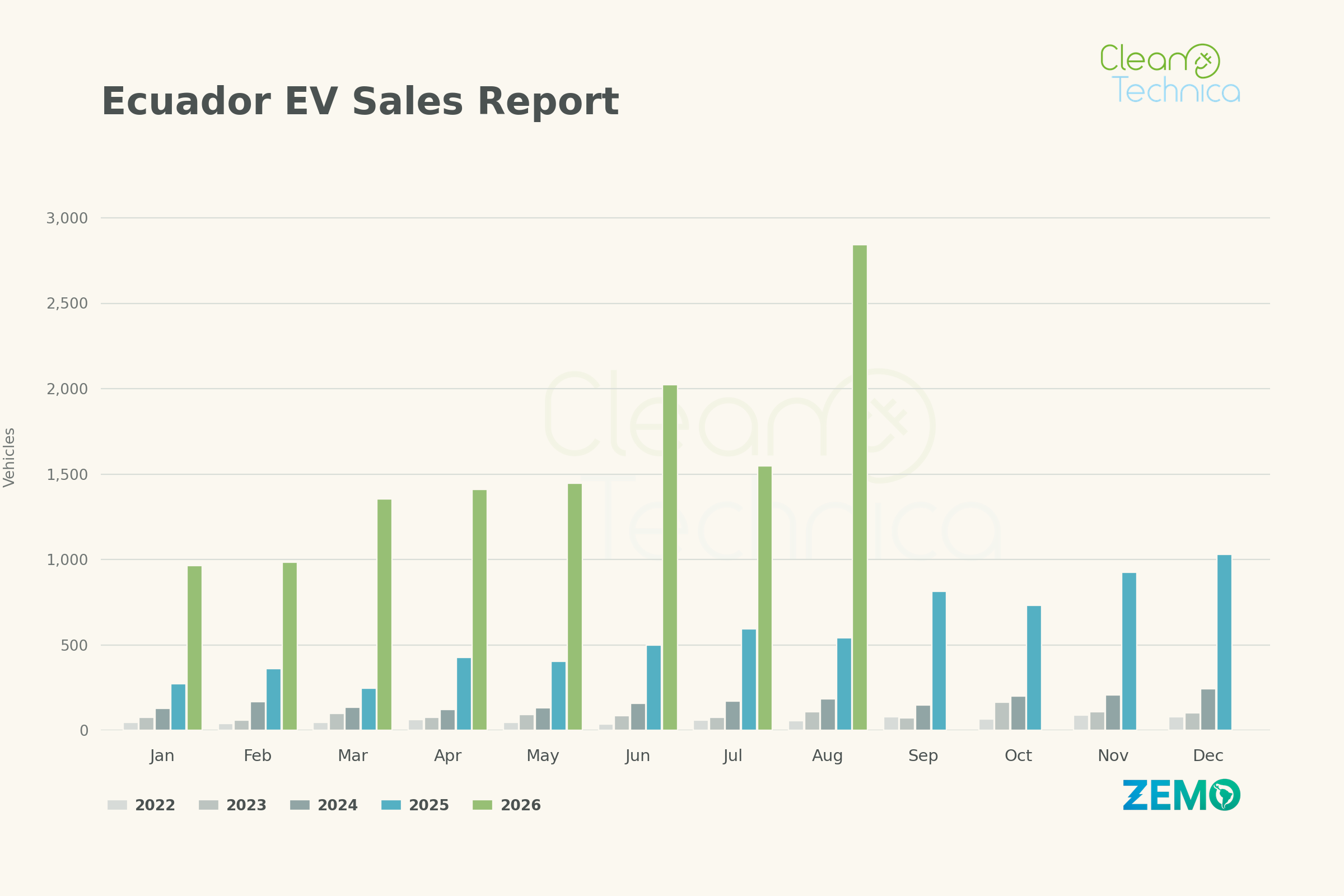
- October 2023: Ecuador officially crosses the psychological milestone of 100 cumulative monthly EV sales.
- 2024–2025: Market share hovers sluggishly between 2% and 3%. Despite a backdrop characterized by acute domestic challenges—including a severe national electricity crisis—early adopters begin showing resilience, matching parallel booms seen in neighboring nations like Bolivia, where gasoline supply volatility forced drivers to seek alternatives.
- December 2025: Cumulative sales milestones break past the 1,000-unit threshold.
- Q1 2026: BEV penetration accelerates sharply, hitting 6% and signaling that structural barriers are rapidly dissolving.
- August 2026: The market witnesses a staggering inflection point. Monthly sales skyrocket by 426% year-over-year, propelling total EV sales dangerously close to the 3,000-unit mark for a single month. BEVs cross 2,000 units for the first time in history, while PHEVs add an impressive 800-plus units.
This hyper-growth phase has coincided with a broader post-pandemic economic recovery and automotive boom. While internal combustion engine vehicles (ICEVs) have also enjoyed a record-breaking 2026—eclipsing sales figures seen anytime since 2018 and doubling 2020 lows—the sheer volume of incoming electric alternatives suggests a systemic shift. Unlike Uruguay, where electric vehicles are actively cannibalizing and reversing combustion vehicle growth, Ecuador is experiencing a dual-track market expansion. However, industry analysts predict that structural economic pressures will tilt the scales entirely in favor of electrification by next year.
Supporting Context & Metrics: Decoding the Numbers
A granular look at the data reveals structural shifts in how Ecuadorians consume and utilize electrified transport. For years, public reporting focused exclusively on BEVs due to fragmented data collection. Recent methodological updates by ZEMO and AEADE have retroactively integrated PHEV metrics all the way back to 2017, providing a seamless, distortion-free historical lens.
Powertrain Breakdown: BEVs vs. PHEVs
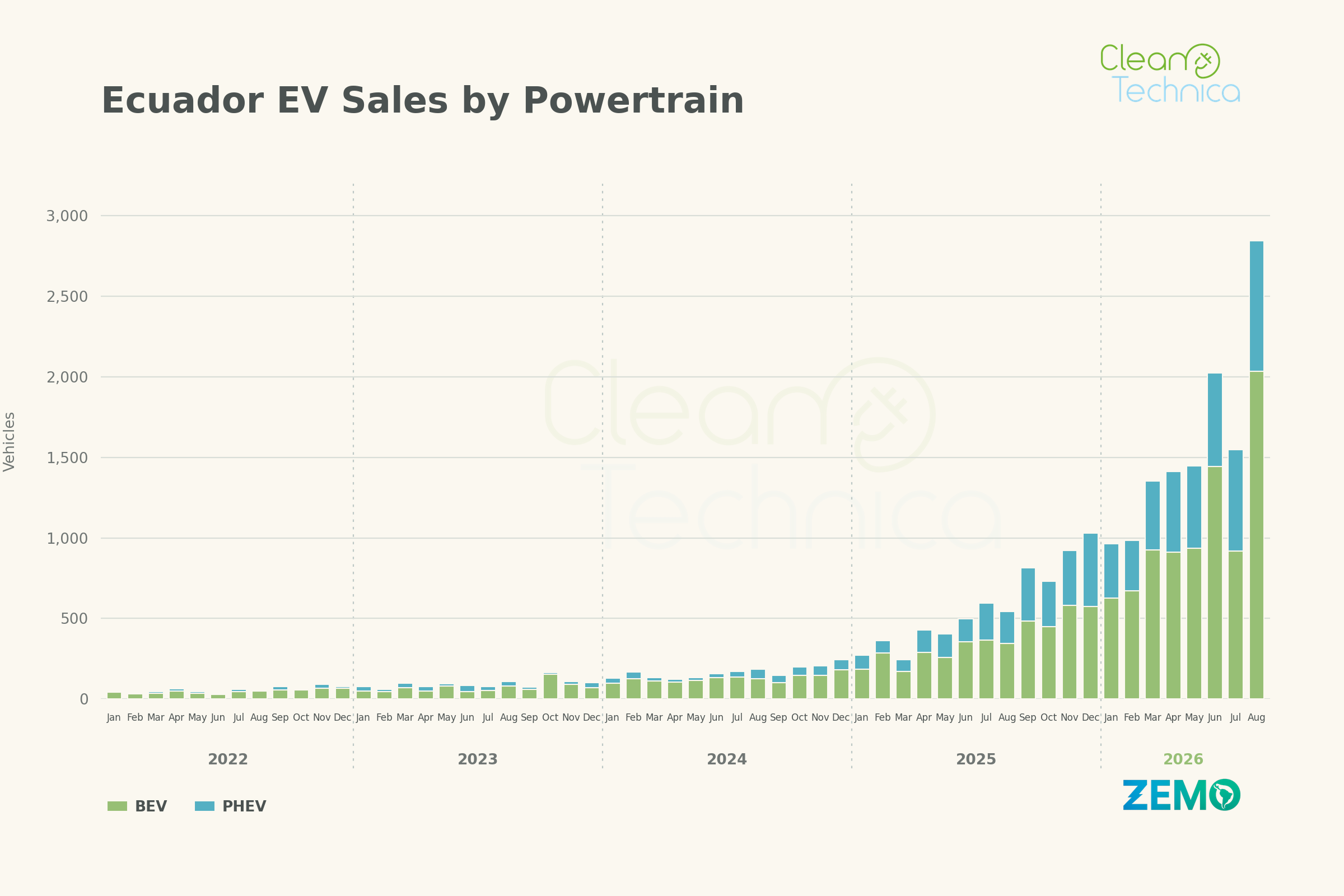
Ecuador’s electrified mix demonstrates a healthy balance, leaning heavily toward pure electric platforms while maintaining robust hybrid participation.
- BEVs: Command roughly 70% of the electrified market share. In August 2026, BEV sales alone captured 13.8% of the total national vehicle market.
- PHEVs: Comprise the remaining 30%, securing a substantial 5.5% slice of the August market share. This high participation rate distinguishes Ecuador from smaller regional peers like Uruguay, Costa Rica, and Colombia, where PHEVs often play a more marginal role.
Total Vehicle Sales and Economic Tailwinds
The broader automotive market is experiencing an unprecedented post-pandemic surge. Yet, the acceleration of EVs cannot be viewed in isolation from macroeconomic policy. The Ecuadorian government has progressively phased out blanket subsidies for gasoline and diesel, fundamentally altering the total cost of ownership (TCO) calculation for everyday motorists.
While targeted financial aid has been introduced for diesel bus and truck operators to mitigate inflationary shocks stemming from international conflicts and rising fuel import costs, passenger vehicle owners face the unshielded reality of fossil fuel pricing. Combined with existing government-backed tariff and tax exemptions designed to spur clean technology adoption, the economic incentive to transition to plug-in vehicles has never been more compelling.
Brand Landscape: The Erosion of Monopolies
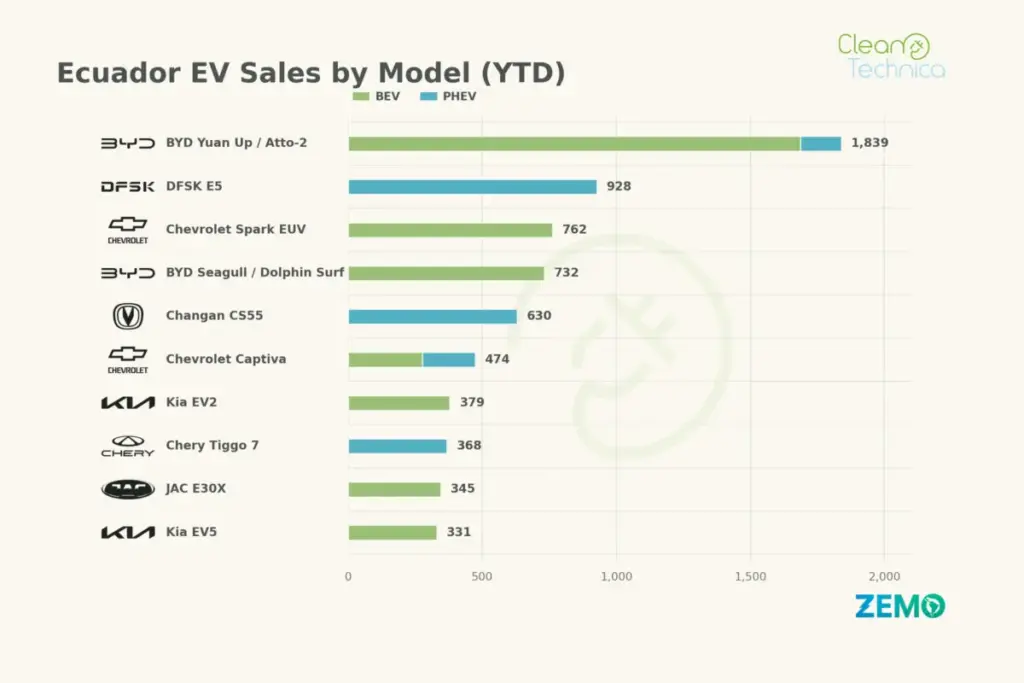
The competitive dynamics within Ecuador’s EV market are maturing rapidly. In the early stages of the transition, Chinese manufacturing giant BYD held a commanding, near-monopolistic market share, exceeding 70% in 2024. By 2026, increased market maturity and aggressive competition have diluted this dominance, pushing BYD’s market share below the 30% mark.

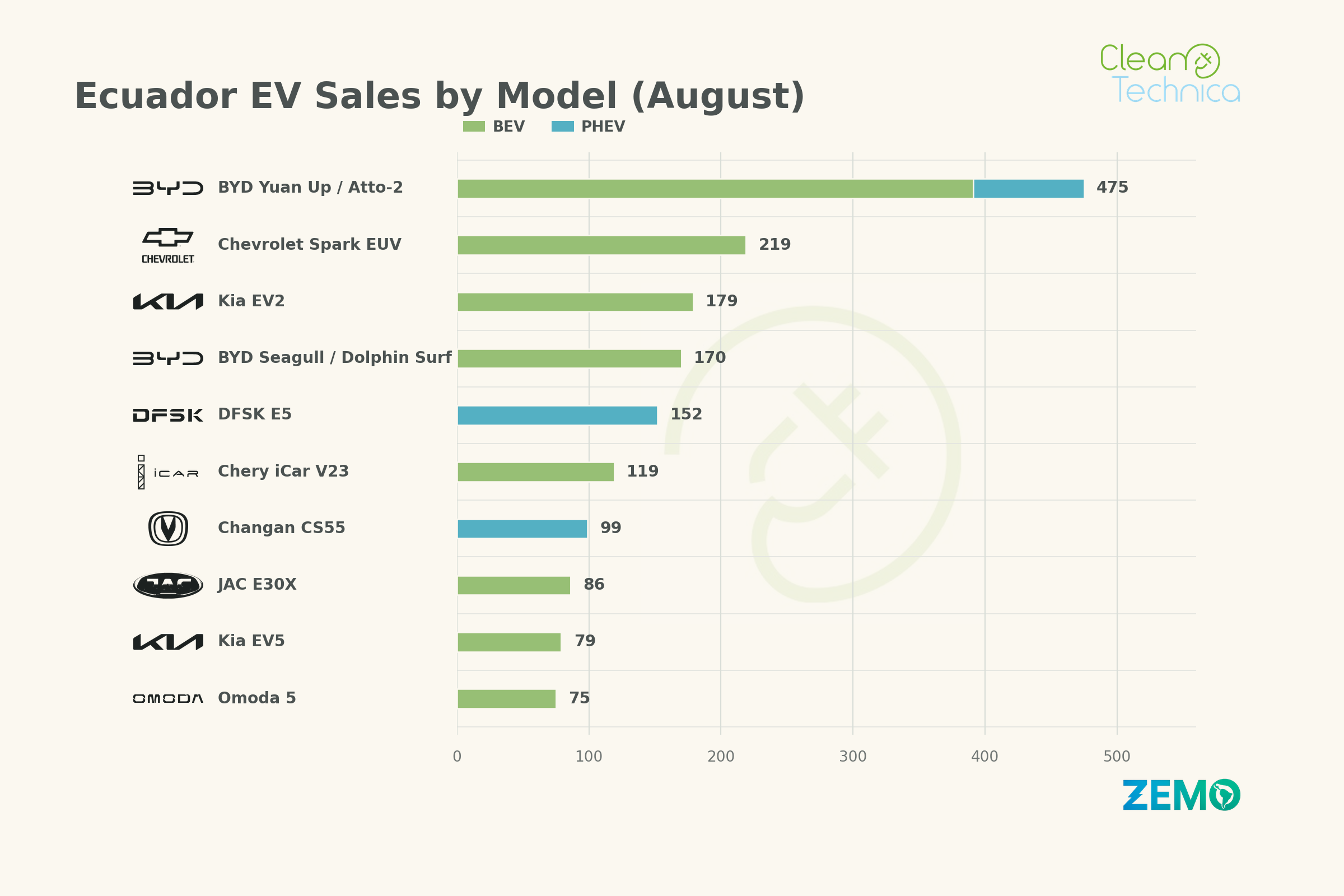
- BYD: Retains the overall volume leadership crown (hovering around 30% YTD), anchored by high-volume hits like the Yuan Up and Seagull.
- Chevrolet: Secures a surprising second-place position among legacy automakers, leveraging rebranded Chinese EV platforms (such as the Spark EUV) to capture local market share.
- Kia: Claims a prominent spot driven by the unexpected commercial success of the European-built Kia EV2.
- DFSK & Dongfeng: Round out the top tier, demonstrating the deep entrenchment of versatile plug-in SUVs and affordable utility vehicles.
+-------------------------------------------------------------+
|              2026 Ecuador EV Market Share Leaders           |
+-------------------+-----------------------------------------+
| Brand             | Market Position / Performance           |
+-------------------+-----------------------------------------+
| BYD               | Leader (~30% YTD share; Yuan Up, Seagull|
| Chevrolet         | Strong #2 (Rebranded Chinese platforms) |
| Kia               | Rapid Rise (Spurred by European-built   |
|                   | Kia EV2)                                |
| DFSK / Dongfeng   | Solid Mid-Tier (PHEV SUVs and utility)  |
+-------------------+-----------------------------------------+
Official Statements and Industry Insights
Industry stakeholders and market analysts point to a confluence of regulatory foresight, shifting consumer economics, and aggressive international manufacturing strategies as the primary drivers of Ecuador’s success.
"The transition we are witnessing in Ecuador is a textbook case of policy alignment meeting market readiness," notes market intelligence aggregated by ZEMO. "When you remove fiscal penalties on clean tech, end regressive fossil fuel subsidies, and simultaneously flood the market with affordable form-factors tailored to local geography, adoption curves shift from linear to exponential."

Automotive association representatives emphasize that the diversification of available body styles has broken down psychological barriers among conservative buyers. No longer restricted to fragile, high-priced urban hatchbacks, Ecuadorian consumers are being offered a robust portfolio of crossovers, rugged utility vehicles, and family-oriented plug-in hybrids.
Future Outlook: Emerging Segments and Regional Implications
As Ecuador consolidates its position as a mature e-mobility market, two specific vehicle introductions deserve intense scrutiny as bellwethers for the future of Latin American transportation:
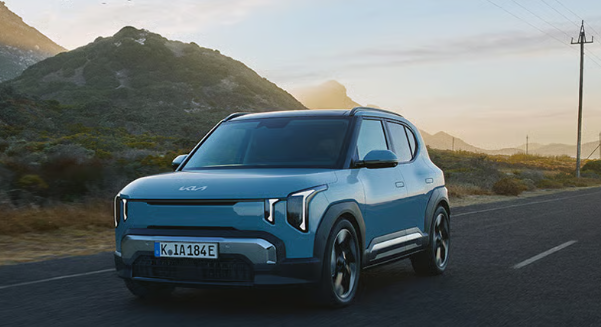
1. The Kia EV2: Europe’s Entry into Affordable Competitiveness
Manufactured in Slovakia, the Kia EV2 represents a watershed moment: the first European-produced electric vehicle to hit Latin American shores at a genuinely reasonable price point. Retailing at approximately $23,000, the mini-SUV is price-competitive with local internal combustion engine crossovers and undercuts or matches top Chinese competitors like the BYD Yuan Up.
Although its battery architecture relies on imported cells, the EV2 proves that traditional automotive strongholds can leverage globalized supply chains to engineer vehicles capable of competing toe-to-toe with Chinese manufacturing juggernauts. Its rapid ascent into the top sales tier—despite being on sale for only a fraction of the year—signals robust consumer appetite for diversified geographical branding.

2. The Chery iCar V23: Conquering the Andes
Perhaps the most intriguing disruptor is the Chery iCar V23 (alternatively marketed as iCaur V23), an affordable, fully electric off-roader designed specifically to pry market share away from traditional combustion-engine 4x4s. Priced around $28,000 for its dual-motor 4×4 variant—matching the entry point of legendary ICE off-roaders like the Suzuki Jimny—the V23 is tailor-made for rural topography.
While purists may debate its extreme off-road capabilities compared to ultra-light mechanical 4x4s, the V23 delivers the interior volume, ground clearance, and rugged utility demanded by drivers navigating unpaved Andean mountain passes and poorly connected rural provinces.

A Note on Efficiency: Official specifications for the V23 indicate an 81 kWh battery delivering a modest 420 km range under the optimistic NEDC cycle—raising questions regarding heavy-vehicle aerodynamic drag and raw energy efficiency. Whether real-world WLTP figures validate these metrics remains a subject of ongoing testing, but the vehicle’s utility proposition remains uncontested.
The Broader Horizon
Ecuador’s evolution from an isolated regional laggard to a thriving, competitive EV market is complete. With fuel prices remaining elevated due to structural subsidy reforms and international geopolitical pressures, the financial case for internal combustion is evaporating.
As automakers flood the country with rugged off-roaders, European-designed compacts, and affordable urban runabouts, Ecuador is cementing its status as an e-mobility powerhouse. Neighboring Colombia—long considered the Andean benchmark for clean transport—must monitor its rear-view mirror closely. If current momentum holds, the bronze standard of South American EV adoption may soon find a new home in Quito.



