

Executive Overview
The global climate crisis is no longer an impending future threat; it is an active economic and human rights catastrophe unfolding across the Global South. For decades, international climate discourse has framed catastrophic weather events as unpreventable natural disasters—acts of God that trigger philanthropic disaster relief. However, an emerging consensus among climate strategists, legal scholars, and frontline advocates rejects this framing. They argue that the accelerating destruction of communities from the high-altitude valleys of the Himalayas to the low-lying atolls of the Pacific represents a corporate crime with a clear financial balance sheet.
In this economic system, the hyper-polluting fossil fuel industry generates hundreds of billions of dollars in net profits by extracting and burning carbon. Meanwhile, vulnerable communities that contributed virtually nothing to global greenhouse gas emissions are forced to absorb the catastrophic financial and human costs.
Recent operational data reveals the sheer scale of this asymmetry:
- A single high-altitude glacier collapse in Nepal recently wiped out more than 1,000 lives and inflicted US$5 billion in damages—equivalent to 10% of the nation’s total Gross Domestic Product (GDP).
- In the Pacific, data compiled by Oxfam Australia demonstrates that average annual GDP losses from climate-induced disasters have quadrupled over the past decade, now reaching a staggering 14.3% of national GDP across the region.
- Concurrently, the number of Pacific residents directly impacted by climate disasters has surged by 700% over the same ten-year period, forcing the permanent relocation of entire ancestral villages.
This investigative analysis examines the structural mechanisms underlying this wealth transfer, documents the human and economic toll on frontline communities, and evaluates the growing international campaign to hold historic polluters financially accountable for climate loss and damage.
Detailed Chronology
[2014–2019] Initial Climate Escalation
├── Pacific GDP disaster losses average ~3.5% annually
└── Himalayan glacial melt accelerates; early GLOF warnings issued

[2020–2022] Systemic Crisis Point
├── Severe cyclone sequences hit Pacific; internal displacements rise rapidly
└── COP27 (Sharm el-Sheikh) agrees in principle to establish a Loss and Damage Fund

[2023] Policy & Operational Milestones
├── COP28 (Dubai) operationalizes Loss and Damage Fund; initial pledges remain under $700M
└── Top 5 fossil fuel majors post combined annual profits exceeding $100 billion

[Recent Event / Present] Himalayan & Pacific Crises
├── Massive glacier collapse in Nepal leaves >1,000 dead, causing $5B in damage (10% of GDP)
└── Oxfam Australia report reveals Pacific disaster losses have climbed to 14.3% of regional GDP
The Himalayan Disaster Cycle
The Hindu Kush Himalaya (HKH) region, often referred to as the Earth’s "Third Pole," contains the largest reserve of continental ice outside the polar regions. Over the past two decades, rising global temperatures have destabilized these frozen reserves, leading to the rapid formation of precarious, high-altitude glacial lakes.
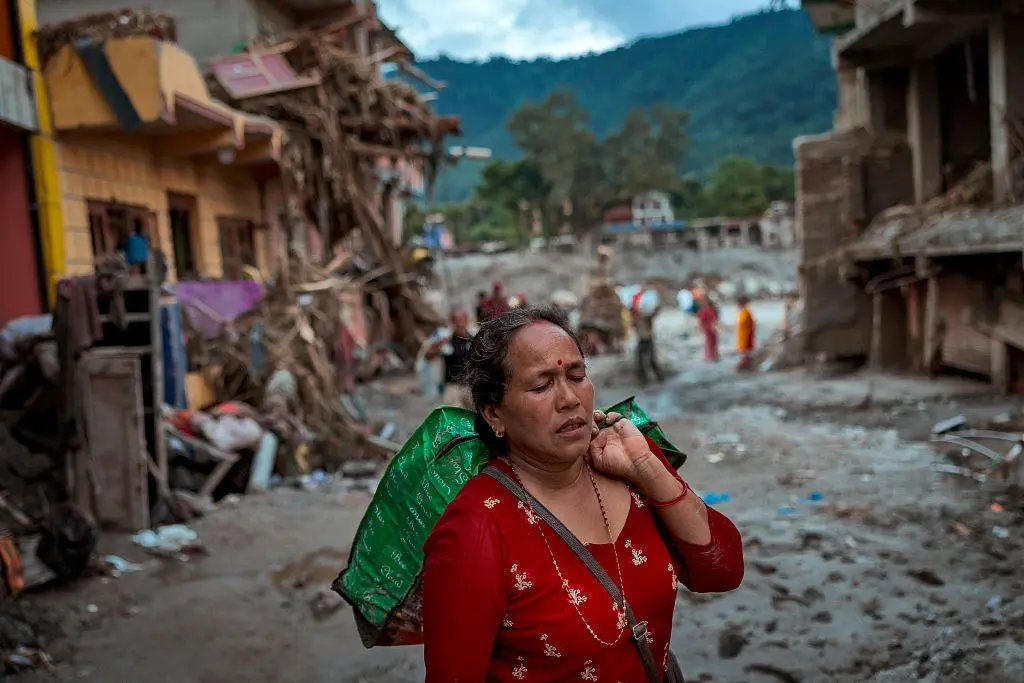
The recent glacier collapse in Nepal’s Himalayan valleys marks a watershed moment in mountain hazards. A massive ice sheet, weakened by sustained thermal warming, severed from a high-altitude peak and plummeted into a glacial lake below. The resulting Glacial Lake Outburst Flood (GLOF) unleashed millions of cubic meters of water, silt, and debris into narrow downstream channels.
The torrent demolished hydroelectric infrastructure, swept away bridges, destroyed agricultural terraces, and leveled entire mountain settlements. Beyond the immediate loss of over 1,000 lives, the event erased critical national infrastructure, leaving Nepal with an estimated recovery bill of US$5 billion. For a developing economy with a GDP of roughly US$40 billion, losing a tenth of its economic engine in a matter of hours creates an immediate national debt trap.
The Decadal Erosion of the Pacific
Simultaneously, across the Pacific Basin, a slower, unrelenting structural collapse has unfolded over the past ten years. Pacific Island Nations (PINs) have long faced seasonal cyclones, but the intensity, frequency, and thermal energy driving these storms have escalated dramatically.
Throughout the 2010s, category 5 tropical storms—such as Cyclone Pam in Vanuatu and Cyclone Winston in Fiji—shattered regional economies, routinely wiping out between 30% and 60% of national output in single 24-hour windows. Over the decade leading to 2024, routine sea-level rise combined with thermal expansion has transformed ordinary high tides into destructive "king tides." Coastal erosion, saltwater intrusion into fresh groundwater lenses, and total loss of arable land have shifted from seasonal inconveniences to existential threats, triggering forced internal relocations across Tuvalu, Kiribati, and the Solomon Islands.
Supporting Context & Metrics
To comprehend the scale of injustice documented by climate campaigns like Fill the Fund and Make Big Polluters Pay, the financial and human metrics must be analyzed alongside corporate revenues.
+-----------------------------------------------------------------------------------+
|                            THE UNBALANCED BALANCE SHEET                           |
+-----------------------------------------------------------------------------------+
| FRONTLINE LOSSES                                CORPORATE PROFITS                 |
|                                                                                   |
| Nepal Disaster Loss (1 Event)                   Combined Oil Major Profits (Annual)|
| [$5.0 Billion]                                  [$100.0+ Billion]                 |
|                                                                                   |
| Pacific Annual GDP Loss                         Global Loss & Damage Fund Pledges |
| [14.3% of Regional GDP]                         [~$0.7 Billion]                   |
+-----------------------------------------------------------------------------------+
Nepal’s Fiscal Shockwave
The financial toll of Nepal’s glacier collapse illustrates how climate impacts strip fiscal sovereignty from developing nations:
- Direct Economic Damage: US$5.0 billion.
- Proportional Economic Weight: ~10% of total national GDP.
- Fiscal Opportunity Cost: To fund rebuilding without external grant assistance, the Nepalese government must reallocate state funds away from primary healthcare, public education, and rural electrification programs, or incur high-interest sovereign debt from international financial institutions.
Pacific Regional Disintegration (Oxfam Australia Data)
A comprehensive longitudinal analysis released by Oxfam Australia underscores the compounding nature of climate impacts across Pacific Island states:
| Metric | Historical Baseline (Pre-2014) | Current Decadal Figure (2024) | Net Escalation |
|---|---|---|---|
| Average Annual GDP Loss | ~3.5% of regional GDP | 14.3% of regional GDP | +308% (4-Fold Increase) |
| Population Affected by Disasters | Baseline regional index | 700% increase in affected individuals | 8-Fold Total Multiplier |
| Displacement Dynamics | Localized temporary shelters | Permanent village relocation | Irreversible cultural loss |
The 14.3% average annual GDP contraction means Pacific nations operate in a state of permanent economic recovery. Capital that should fund sustainable development, digital infrastructure, and education is continually funneled into repairing sea walls, restoring destroyed power grids, and relocating citizens displaced by rising waters.
The Corporate Profit Asymmetry
While frontline nations experience catastrophic financial hemorrhaging, the primary drivers of climate destabilization continue to record historically unprecedented financial returns.
                          FINANCIAL INEQUALITY GAP

  Fossil Fuel Industry Annual Net Income
  ██████████████████████████████████████████████████  ~$400+ Billion (Global sector)

  Nepal Glacier Disaster Damage (Single Event)
  ███  $5.0 Billion

  Total Initial Commitments to UN Loss & Damage Fund
  █  ~$0.7 Billion
The top global fossil fuel entities generate hundreds of billions of dollars in annual net profits. The total capital pledged to the United Nations Loss and Damage Fund—established after decades of negotiation—remains below $700 million. This initial commitment represents less than 15% of the cost of a single disaster in Nepal, highlighting a deep disparity in international climate finance.
Official Statements & Commentary
Civil society leaders and climate strategists argue that the international community’s reliance on voluntary aid must be replaced with legally binding liability frameworks and polluter levies.
The Campaign Strategy: Fill the Fund
Harjeet Singh, Global Convenor of the Fill the Fund campaign and Founding Director of the Satat Sampada Climate Foundation, emphasizes that the global climate finance architecture remains fundamentally broken:
"What happened in Nepal’s Himalayan valleys is not a natural tragedy; it is an unpunished crime written directly onto the balance sheets of fossil fuel corporations. When a nation loses ten percent of its national output overnight because of a glacier collapse, telling that government to apply for high-interest loans or wait for meager charitable donations is ethically untenable.
Developing nations are being driven into deep debt spirals to pay for a crisis they did not create. The UN Loss and Damage Fund cannot function as a charity bin funded by spare change from wealthy nations. It must be filled through direct, mandatory levies extracted from the balance sheets of the oil, gas, and coal majors whose core business model continues to destroy human lives."
The Australian & Pacific Perspective: Make Big Polluters Pay
Julie-Anne Richards, Strategic Campaign Lead for the Make Big Polluters Pay campaign in Australia, highlights the immediate political and financial responsibilities of high-emitting, fossil-fuel-exporting nations:
"The data emerging from our Pacific neighbors is a devastating condemnation of international inaction. When nations lose over 14 percent of their GDP year after year to climate disasters, and when seven times as many people are being battered by storms and coastal erosion compared to a decade ago, we are witnessing the systemic unravelling of entire societies.
Australia, as a major fossil fuel exporter, sits right on the doorstep of this injustice. Pacific leaders are not asking for handouts; they are demanding justice. The polluters who have extracted trillions in wealth by using our atmosphere as an open dump must be made to pay for the loss and damage they cause. A dedicated tax on fossil fuel extraction and fossil fuel windfalls could easily cover the cost of relocating affected communities and restoring fragile coastal ecosystems."
Calls from Small Island Developing States (SIDS)
Diplomats representing the Alliance of Small Island States (AOSIS) have echoed these calls during high-level UNFCCC proceedings, arguing that conventional climate finance mechanisms fail to address the realities on the ground.
- On Economic Sovereignty: Representatives note that high debt burdens prevent vulnerable nations from building long-term climate resilience.
- On Human Mobility: Pacific diplomats emphasize that forced climate migration strips indigenous communities of non-economic assets, including ancestral lands, cultural heritage, and traditional knowledge—losses that cannot be quantified solely through financial metrics.
Future Outlook
Addressing the growing crisis of climate loss and damage requires moving beyond voluntary diplomatic commitments toward institutional policy reforms, global legal accountability, and innovative tax structures.
                    PATHWAYS TO CLIMATE JUSTICE

 ┌──────────────────────────────────────────────────────────────┐
 | 1. POLLUTER-PAYS LEVIES                                      |
 |    Implement extraction taxes on fossil fuel corporations    |
 └──────────────────────────────┬───────────────────────────────┘
                                │
                                ▼
 ┌──────────────────────────────────────────────────────────────┐
 | 2. LEGAL REPARATIONS & LITIGATION                            |
 |    Secure ICJ Advisory Opinions & advance tort claims in court|
 └──────────────────────────────┬───────────────────────────────┘
                                │
                                ▼
 ┌──────────────────────────────────────────────────────────────┐
 | 3. DEBT-FREE LOSS & DAMAGE FINANCE                           |
 |    Channel grants directly to frontline communities          |
 └──────────────────────────────────────────────────────────────┘
Taxing the Polluters: Financial Mechanisms for Reparations
To close the multi-trillion-dollar climate finance gap, international coalition partners are advocating for targeted financial instruments designed to redirect profits from carbon-intensive industries to frontline communities:
- Carbon Extraction Levies (Climate Damage Tax): Establishing a standardized tax per ton of carbon dioxide equivalent extracted at the wellhead or mine mouth. Economists estimate that a modest levy on fossil fuel majors operating within OECD jurisdictions could generate over US$100 billion annually for the Loss and Damage Fund.
- Fossil Fuel Windfall Profits Taxes: Redirecting a percentage of extraordinary corporate energy profits—earned during global energy crises—directly toward disaster-stricken nations.
- Maritime and Aviation Fuel Surcharges: Implementing international levies on unregulated bunker fuels used in global shipping and aviation, with proceeds earmarked for climate adaptation in Small Island Developing States.
Legal Avenues and Advisory Opinions
The fight for climate reparations is increasingly shifting into courtrooms and international judicial bodies:
- International Court of Justice (ICJ): Led by the nation of Vanuatu, the UN General Assembly successfully requested an ICJ Advisory Opinion regarding the obligations of states under international law to protect the climate system from anthropogenic emissions. A strong ruling could establish legal liability for historic emitters, opening pathways for formal state-to-state reparations.
- Domestic Corporate Litigation: Municipalities and civil society organizations in both the Global North and Global South are filing tort actions against major oil companies. These lawsuits seek financial compensation for municipal infrastructure damages caused by rising sea levels and extreme weather events.
Reimagining the Climate Finance Architecture
If the international community fails to transform how Loss and Damage is funded, vulnerable economies face worsening debt crises and social instability. Leaving nations like Nepal to absorb $5 billion shocks unilaterally, or forcing Pacific populations to abandon ancestral territories without financial compensation, threatens global equity and international security.
Transitioning from voluntary aid to enforceable polluter-pays mechanisms offers a viable pathway forward. By compelling the corporations that profit from fossil fuels to cover the damages caused by their products, the international community can ensure that those who cause environmental harm bear the cost of repair.



