In the shadowy, climate-controlled sanctuaries of the world’s most prestigious natural history libraries, acquisitions are rarely made on whim. Every rare volume brought into a collection undergoes a rigorous calculus of provenance, historical weight, and scientific utility. For the Marie Louise Rosenthal Library at The Field Museum, an unexpected opportunity arose in March with the discovery of a rare three-volume zoological masterpiece: Eberhard August Wilhelm von Zimmermann’s Geographische Geschichte des Menschen, und der allgemein verbreiteten vierfüßigen Thiere, nebst einer hieher gehörigen Zoologischen Weltcharte.
Published between 1778 and 1783, this monumental work by the German geographer, zoologist, and mathematician is much more than a dusty antique. Anchored by a groundbreaking fold-out map titled Tabula Mundi Geographico Zoologica sistens Quadrupedes hucusque notos sedibus suis adscriptos edidit, the treatise is widely celebrated as the first true world map of zoological geography. It offers a pristine window into late-eighteenth-century cartographic and biological thought.
Yet, the acquisition of this rare text did not merely plug a gap in The Field Museum’s shelves. It unlocked a fascinating, centuries-spanning administrative drama involving the International Commission on Zoological Nomenclature (ICZN), historical institutional advocacy by Field Museum luminaries, and the evolution of biological taxonomy itself. Today, thanks to the collaborative preservation efforts of the Biodiversity Heritage Library (BHL)—which is celebrating its 20th anniversary through the commemorative series BHL at 20: Treasures from the Biodiversity Heritage Library—both Zimmermann’s heavily revised German edition and its controversial Latin predecessor are globally accessible to researchers, historians, and the curious public.
Detailed Chronology: From Enlightenment Cartography to Modern Nomenclature
To understand the weight of Zimmermann’s Geographische Geschichte, one must retrace the shifting paradigms of late-eighteenth-century science. The intellectual landscape of the Enlightenment was consumed by a desire to categorize, map, and rationalize the natural world. Zimmermann, situated at the intersection of geography and zoology, sought to explain not just what animals existed, but where they lived and how they arrived there.
1777: The Latin Prototype and Taxonomic Missteps
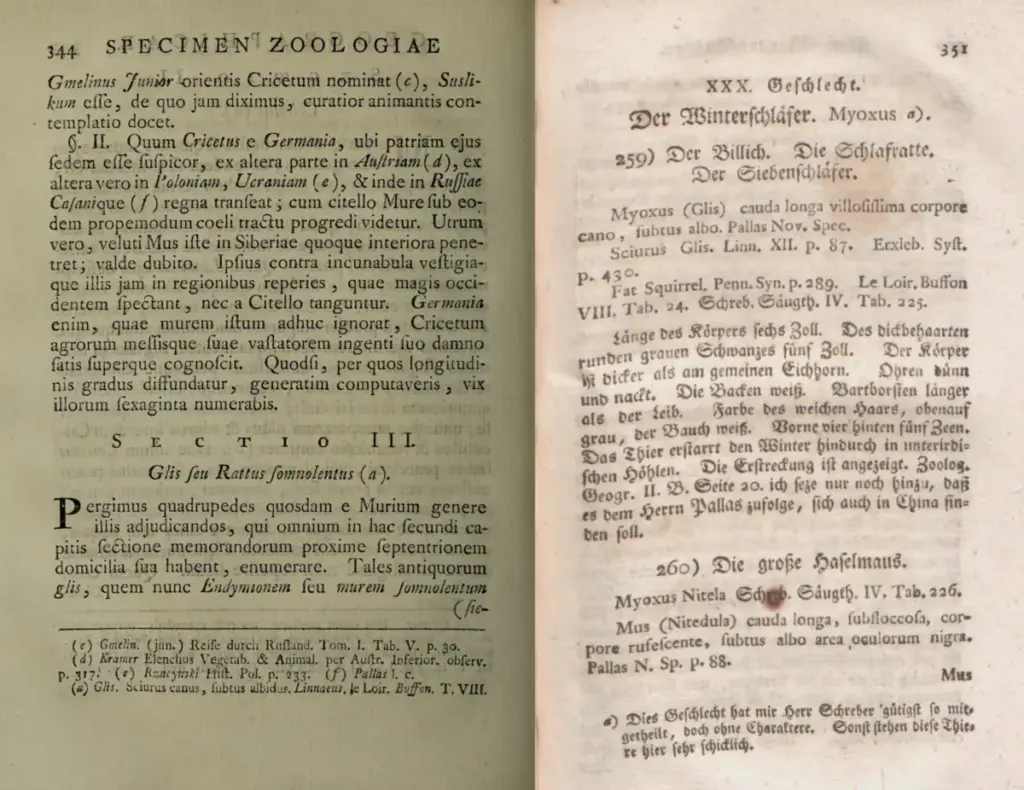
Zimmermann’s intellectual journey into biogeography began in earnest with the 1777 publication of his Latin work, Specimen zoologiae geographicae, quadrupedum domicilia et migrationes sistens. While conceptually ambitious, the volume suffered from a critical flaw under modern taxonomic standards: Zimmermann failed to consistently apply Linnaean binomial nomenclature. Instead, he relied on a chaotic mix of generic descriptions, common names, and polynomial phrases.
For instance, in the 1777 text, a species of dormouse was designated not by a strict binomial, but by the descriptive moniker Glis seu Rattus somnolentus. While innovative for its time regarding geographic distribution, its inconsistent taxonomy would later render it a bureaucratic nightmare for twentieth-century zoologists.

1778–1783: The German Masterpiece and Binomial Breakthroughs
Recognizing the limitations of his earlier work, Zimmermann heavily revised, expanded, and translated his treatise into German, resulting in the three-volume Geographische Geschichte des Menschen, und der allgemein verbreiteten vierfüßigen Thiere. Published incrementally between 1778 and 1783, this new edition embraced true binomial nomenclature for numerous species, cementing several scientific names that remain in use today.
Prominent examples debuted in this German edition include:
- Cervus muntjak (the muntjac deer)
- Lutra minima (subsequently reclassified, now known as Chironectes minimus, the water opossum)
- Canis zerda (now recognized as Vulpes zerda, the fennec fox)
Furthermore, the transition from Glis seu Rattus somnolentus in 1777 to the clean binomial Myoxus glis in Volume 2 (1780) of the Geographische Geschichte—a species now designated as Glis glis, the European fat dormouse—exemplifies Zimmermann’s maturation as a taxonomist.
The Cartographic Evolution: Capturing Cook’s Voyages
Accompanying the 1778–1783 volumes was an updated, radically refined version of the Tabula mundi geographico zoologica. Zimmermann integrated the latest geographical discoveries brought back by global explorers, most notably Captain James Cook and the crews of his historic Pacific voyages.
The 1783 map reflects profound shifts in global awareness:
- The Pacific: It documents the European "discovery" of the Sandwich Islands (modern-day Hawaii).
- North America: It presents a significantly more accurate and complete rendering of the continent’s volatile western coastline.
- Africa and the Indian Ocean: It explicitly marks the Seychelles east of mainland Africa, following a French colonial settlement established just thirteen years prior.
On this fold-out masterwork, quadrupeds are plotted directly over their native ecological ranges using a mix of genera, specific epithets, binomens, and vernacular names. Castor (beaver) and Bison stretch across northern North America; Tigris prowls Asia; and Kanguro appears boldly across New Holland (Australia), marking one of the earliest entries of the kangaroo into European scientific consciousness following its recording by botanist Daniel Solander aboard HMS Endeavour.

Supporting Context & Metrics: Evaluating Rare Books in the Digital Age
The decision by The Field Museum’s Marie Louise Rosenthal Library to acquire the Geographische Geschichte was governed by a strict institutional evaluation framework. Library curators do not merely collect old books for the sake of antiquity; they measure potential acquisitions against four distinct pillars:
- Collection Scope: Does the title fall strictly within the library’s natural history mandate?
- Scientific & Historical Value: Does the work introduce breakthrough concepts, rare plates, or pivotal taxonomic shifts?
- Institutional Scarcity: How many other global research libraries hold physical copies of the work?
- Digital Availability: Is the work already fully digitized and freely accessible within the Biodiversity Heritage Library ecosystem?
When the Rosenthal Library evaluated Zimmermann’s three-volume German set, it checked every box. It was historically momentous, remarkably scarce in institutional holdings, and absent from digital repositories in its complete, three-volume German iteration—though BHL did host its rejected 1777 Latin precursor.
The Metrics of Impact
- 3 Volumes: The comprehensive scope of Zimmermann’s 1778–1783 German edition.
- 1954: The decisive year the ICZN formally settled the taxonomic fate of Zimmermann’s competing editions.
- 20 Years: Two decades of open-access digital preservation spearheaded by the Biodiversity Heritage Library, transforming rare book collections into globally distributed research engines.
Official Statements & Institutional Advocacy: The ICZN Drama
One of the most compelling revelations surrounding the acquisition is its direct administrative link to The Field Museum itself. The story of how Zimmermann’s works were judged by history unfolded in the pages of the Opinions and Declarations Rendered by the International Commission on Zoological Nomenclature (1954).
Opinion 257 and the Rejection of 1777
Under the rigorous oversight of the ICZN, historical scientific literature is continually audited to maintain taxonomic stability. In Opinion 257, the Commission evaluated Zimmermann’s 1777 Specimen zoologiae geographicae. Because the work failed to meet the strict prerequisites of Article 25 of the Règles internationales de la nomenclature zoologique (the predecessor to today’s International Code of Zoological Nomenclature—specifically its failure to consistently enforce binomial nomenclature), the Commission officially rejected the 1777 Latin edition for nomenclatural purposes. It was summarily cast onto the Official Index of Rejected and Invalid Works in Zoological Nomenclature.
The Field Museum’s Intervention
Crucially, this 1954 ruling did not happen in a vacuum; it was catalyzed by direct intervention from Field Museum scientists. The Commission’s final determination stemmed heavily from formal correspondence between Francis Hemming, Secretary to the ICZN, and Wilfred H. Osgood of The Field Museum. Osgood aggressively championed the official recognition and validation of Zimmermann’s later German work, Geographische Geschichte.
To bolster the case, Hemming also consulted Philip Hershkovitz, then Curator of Mammals at The Field Museum, who firmly backed Osgood’s stance. Their collective advocacy convinced the Commission that Zimmermann’s 1778–1783 German volumes had successfully applied binomial nomenclature. Consequently, the ICZN placed Geographische Geschichte on the coveted Official List of Works Approved as Available for Zoological Nomenclature.

Future Outlook: The Living Scientific Record
The integration of Zimmermann’s Geographische Geschichte into both The Field Museum’s rare book vault and the global digital architecture of the Biodiversity Heritage Library serves as a profound reminder that eighteenth-century literature is not dead history. Rather, it is a living, breathing component of modern biological nomenclature.
By having simultaneous digital access to the rejected 1777 Latin text, the validated 1778–1783 German masterpiece, and the 1954 ICZN administrative rulings via BHL, contemporary researchers possess an unparalleled case study in the evolution of scientific standards. They can observe, page by page, how early naturalists struggled to map the planet’s biodiversity, how taxonomic codes evolved to bring order to chaos, and how twentieth-century museum curators fought to preserve the historical integrity of zoological naming conventions.
As the Biodiversity Heritage Library marks its 20th anniversary through initiatives like BHL at 20: Treasures from the Biodiversity Heritage Library, stories like this underscore the vital importance of open-access digital preservation. By rescuing foundational texts from obscurity and placing them directly into the hands of global researchers, BHL ensures that the historical roots of modern science remain visible, verifiable, and endlessly fascinating for centuries to come.