

For over a decade, international climate policy and market-driven environmentalism have tried to quantify the monetary value of a living planet. Forests have been converted into carbon sinks, wetlands designated as natural infrastructure, and biodiversity packaged into green bonds and complex financial instruments. A multi-billion-dollar global conservation economy has arisen on the premise that intact ecosystems can generate sufficient economic value to secure their own preservation.
Yet, running parallel to this nascent green finance architecture is a far older, vastly more lucrative, and ruthlessly efficient economy that places a price on nature by destroying it. Land grabbing, illegal logging, illicit gold mining, and wildlife trafficking are traditionally classified as mere environmental offenses. Consequently, responsibility for combating these crises is relegated to park rangers, local customs officials, and specialized forestry police.
According to a landmark research paper published by the Brookings Institution—co-authored by Igarapé Institute leaders Robert Muggah and Ilona Szabó de Carvalho—this traditional view fundamentally misdiagnoses the nature of modern environmental crime. Far from being localized infractions, ecological crimes represent a systemic drag on sustainable development, governance, and global climate action. They actively drain public coffers, undermine legitimate commercial competitors, and erode the institutional integrity of states.
More importantly, enforcement models focused solely on frontline interdiction are bound to fail. Environmental crime is deeply embedded in transnational trade, global finance, and local political economies. To meaningfully disrupt these networks, governments, regulators, and international coalitions must stop treating environmental destruction as an isolated ecological issue and instead target the illicit financial flows and complex supply chains that render the illicitly harvested bounty indistinguishable from legal commerce.
Detailed Chronology: The Evolution and Modern Enforcement of Environmental Crime
To understand how environmental crime operates today, one must trace its historical evolution from isolated, small-scale infractions into a globally integrated shadow economy.
From Local Infraction to Transnational Enterprise
Historically, environmental law enforcement operated on a localized scale. A logger felling a protected tree or an artisanal miner panning for gold was viewed as an isolated actor working at the periphery of the law. However, over the past twenty years, these localized acts have been systematically co-opted by sophisticated transnational organized crime syndicates.
As traditional illicit markets—such as drug trafficking and arms smuggling—faced heightened international scrutiny, criminal organizations discovered that environmental crime offered lower risks, higher profit margins, and exceptional integration potential into the legal economy. In the Amazon Basin, drug cartels have successfully diversified their portfolios, utilizing the same riverine transport networks, logistical hubs, and corrupt channels to traffic cocaine alongside illegal timber, mercury-laced gold, and wildlife.
The Anatomy of Laundering Commodities
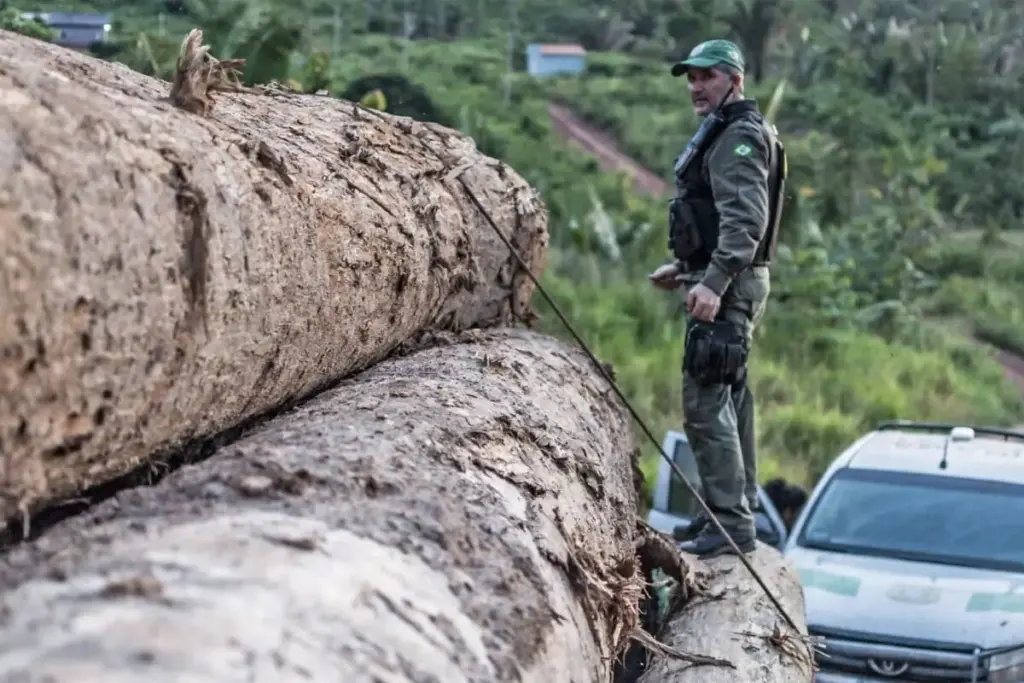
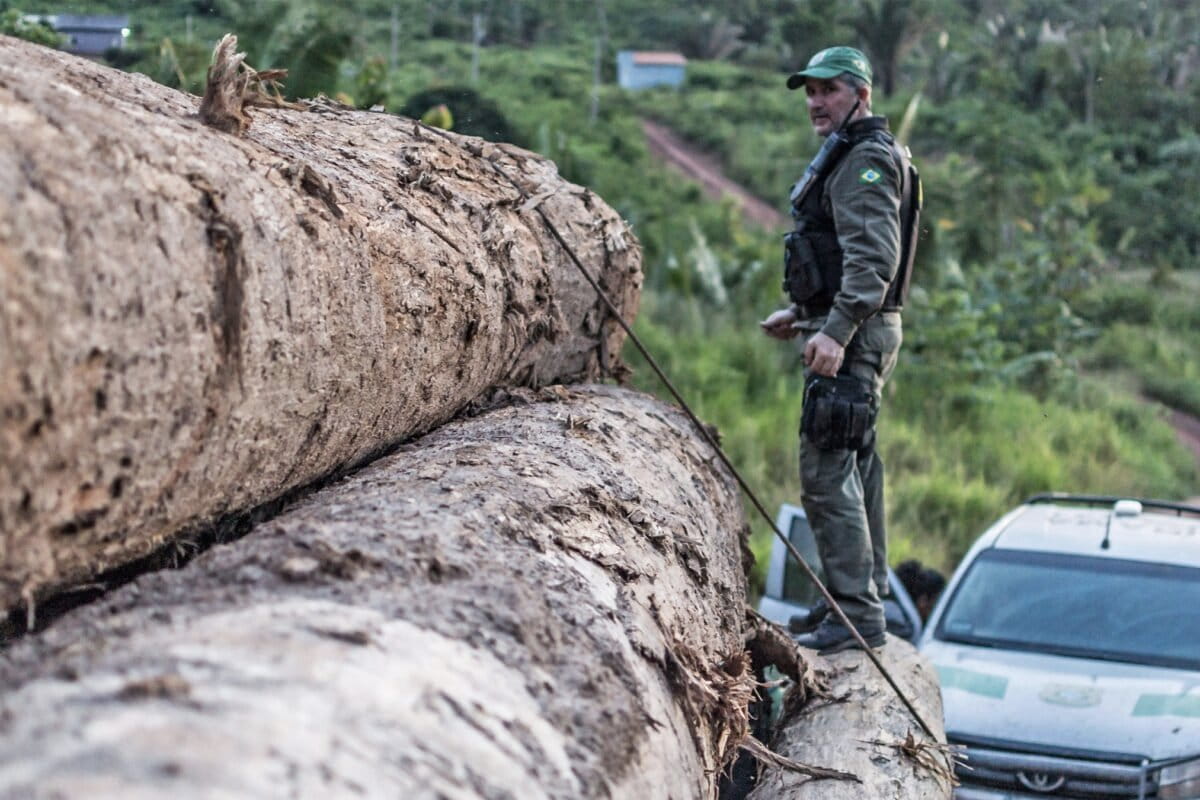
The brilliance of modern environmental crime lies in its ability to erase provenance. A tree illegally felled in the Brazilian Amazon rarely stays isolated. It is trucked to a sawmill, blended with legally harvested timber, and issued fraudulent paperwork (grilagem). By the time the timber reaches an exporter, its illegal origins have been thoroughly laundered.

Recent investigations underscore the scale of this deception. A prominent case tracked more than 25,000 cubic meters (nearly 883,000 cubic feet) of illegally harvested timber from Pará, Brazil, straight through laundering pipelines to corporate buyers in the United States, France, Germany, and Portugal.
Gold undergoes an even more complete transformation. Extracted using toxic mercury in informal operations known as garimpo, illegal gold changes hands multiple times, crossing porous borders before being melted down in regional refineries. Once refined, its molecular history is effectively erased, allowing criminal syndicates to mix it seamlessly with legally mined gold and inject it into formal global markets.
Cross-Border Collaboration: Operation Green Shield 2026
Recognizing that domestic enforcement is routinely outmatched by border-spanning syndicates, South American nations have begun forging unprecedented regional alliances. A watershed moment arrived in August, when authorities from Bolivia, Brazil, Colombia, Ecuador, and Peru released the results of Operation Green Shield 2026.
Deploying more than 3,600 law enforcement officers, the multi-national coalition executed 1,045 field actions targeting illegal mining, logging, wildlife trafficking, and fuel smuggling. The operation yielded 839 arrests and asset seizures valued at over $280 million—a staggering leap from the 94 arrests and $64 million in seizures recorded the previous year.

Crucially, the success of Operation Green Shield 2026 lay not just in its quantitative yield, but in its methodological shift. By leveraging shared geospatial intelligence, cross-border satellite tracking, and real-time data-sharing protocols, investigators demonstrated that regional syndicates can only be effectively dismantled through synchronized, transnational cooperation.
Supporting Context & Metrics: The Scale of the Shadow Economy
The true economic footprint of environmental crime remains difficult to pin down precisely, precisely because it is designed to blend seamlessly into the legal global economy.
Financial Magnitudes and Market Penetration
While a widely cited estimate by the Financial Action Task Force (FATF) places the annual proceeds of environmental crime between $110 billion and $281 billion, economists and security analysts suggest the true figure likely scales into the trillions of dollars when accounting for lost tax revenues, environmental restoration costs, and systemic market distortions.
- The Labor Imbalance: At the very bottom of the illicit supply chain are impoverished extractors—smallholder farmers clearing protected plots after a failed harvest, or artisanal miners relying on toxic mercury because cleaner technologies are financially inaccessible. While these individuals bear the brunt of local ecological damage and hazardous working conditions, they capture only a fraction of the economic value.
- Downstream Windfalls: The vast majority of profits are amassed downstream by financiers, logistics brokers, corrupt permit officials, and transnational brokers who orchestrate the movement of illicit goods into formal markets.
- Market Distortions: Legitimate companies operating within the bounds of tax and environmental regulations are forced to compete against unscrupulous actors who externalize their operational costs onto the environment. Consequently, governments lose critical royalties while shouldering escalating expenditures for healthcare, policing, and ecological repair.
Official Statements and Institutional Perspectives
International experts, institutional researchers, and global regulators have increasingly sounded the alarm, emphasizing that traditional conservation strategies are inadequate against financialized environmental crime.

"The world has spent a decade trying to put a price on nature… Around them, a financial system is emerging on the assumption that intact ecosystems can generate enough economic value to protect them. A more destructive economy has been putting a price on nature for much longer. It makes money by extracting and selling it."
— Robert Muggah and Ilona Szabó de Carvalho, Co-Founders of the Igarapé Institute, writing for the Brookings Institution.
Muggah and Szabó de Carvalho argue that environmental crimes function as an anchor holding back both sustainable development and global climate goals:
"Enforcement alone will not solve a problem that runs through trade, finance and local political economies… Putting a price on nature will achieve little while those markets continue absorbing commodities and money generated by its destruction. The task is to make those transactions visible and costly enough to change behavior."
From a regulatory standpoint, international bodies are increasingly recognizing that environmental security is inextricably linked to financial integrity. The FATF has repeatedly stressed that environmental crimes are fundamentally profit-driven enterprises that rely heavily on trade-based money laundering, front companies, and complicit financial institutions. Without integrating anti-money laundering (AML) frameworks into conservation efforts, state interventions will continue to capture low-level operatives while leaving the structural architecture of organized crime entirely untouched.

Future Outlook: Interventions, Regulations, and the Road Ahead
As environmental degradation threatens global supply chains and destabilizes regional governance, a profound shift in strategy is underway. Meeting the challenge requires a multi-pronged approach that moves far beyond local policing.
1. Following the Commodity and the Money
Governments and international agencies must pivot from reactive, localized interdictions—such as burning illegal mining equipment or arresting low-level loggers—to proactive financial and supply chain investigations. By utilizing modern satellite tracking, trade analytics, and financial intelligence units, investigators can map the corporate webs, shell companies, and banking channels that wash dirty money.
2. Regulatory Pressures from Consumer Markets
Major consumer markets are beginning to impose strict legal liabilities on downstream buyers. The European Union’s landmark Deforestation Regulation (EUDR), alongside emerging regulatory frameworks in the United Kingdom, requires companies dealing in high-risk commodities (such as timber, cattle, soy, and palm oil) to prove definitively that their supply chains are legal and deforestation-free. Though implementation timelines have faced political friction and delays, these regulatory shifts permanently alter market incentives, forcing corporate boardrooms to reckon with the provenance of their raw materials.
3. Creating Livelihood Alternatives at the Source
Illicit economies thrive in regions where the state is absent and formal economic alternatives are nonexistent. To sustainably dismantle environmental crime, governments and development banks must invest heavily in local governance, clear and enforceable land tenure rights, and financial inclusion programs. Formalizing artisanal mining through the provision of cleaner technologies, fair credit access, and reliable legal buyers can break the dependency of local communities on criminal syndicates.

Conclusion
The global community remains deeply absorbed in calculating the monetary value of standing forests, carbon credits, and protected watersheds. Yet, criminal syndicates settled the economic debate long ago, extracting trillions of dollars from the systematic liquidation of the natural world.
To turn the tide, global authorities must recognize that environmental crime is not merely an ecological crisis, but a sophisticated financial and commercial enterprise. Only by making illicit transactions transparent, raising the costs of laundering nature’s destruction, and systematically targeting the capital that fuels these networks can the international community hope to preserve what remains of the planet’s vital ecosystems.



