


Executive Overview
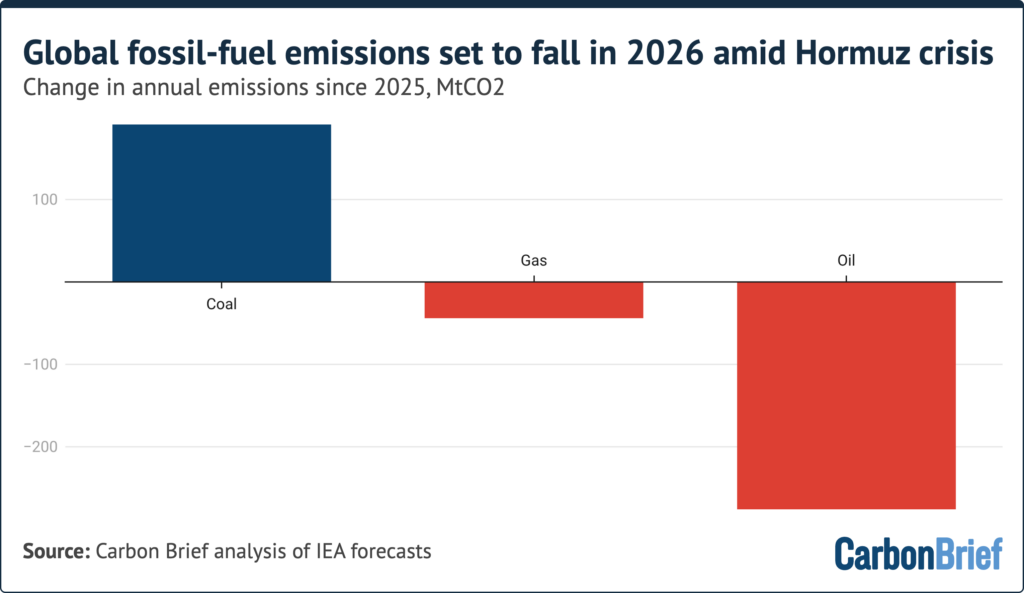
In an unexpected convergence of geopolitical turmoil and global macroeconomics, carbon dioxide ($textCO_2$) emissions from global fossil fuels are projected to decline by approximately 0.5% in 2026. According to a landmark analysis by Carbon Brief, using updated dataset projections from the International Energy Agency (IEA), the primary catalyst behind this contraction is the fallout from the ongoing conflict in the Strait of Hormuz between the United States and Iran.
While military conflicts traditionally disrupt energy security and prompt immediate shifts back to carbon-heavy fallback fuels, the systemic economic shock radiating from the Middle East has triggered deep "demand destruction" across the global energy architecture. Soaring international oil and natural gas prices have imposed severe financial headwinds on industrial, commercial, and retail consumers worldwide. Consequently, sharp demand reductions for refined petroleum products and liquefied natural gas (LNG) are more than offsetting a temporary, weather- and market-driven uptick in global coal consumption.
Fossil fuels historically account for approximately two-thirds of total global greenhouse gas emissions. Therefore, a 0.5% net decline in fossil-fuel combustion represents a significant macroeconomic shift. Rather than temporarily delaying the clean energy transition, the high price environment and supply insecurity generated by the Hormuz crisis appear to be accelerating structural shifts away from fossil fuels. Driven by record adoption rates for electric vehicles (EVs) and policy pivots among developing nations away from volatile imported gas, the current crisis may fundamentally alter the trajectory of global peak emissions.
Detailed Chronology: Escalation in the Strait of Hormuz and Global Market Turbulence
From Chokepoint Disruption to Global Shockwaves
The origin of the 2026 global energy contraction traces back to the outbreak of direct military hostilities between the United States and Iran. The conflict quickly concentrated around the Strait of Hormuz—the world’s critical maritime energy chokepoint through which roughly a fifth of global petroleum and a vast portion of sea-borne LNG typically pass.
               [ US-Iran Military Hostilities ]
                              │
                              ▼
               [ Strait of Hormuz Disruption ]
                              │
               ┌──────────────┴──────────────┐
               ▼                             ▼
   [ Severe Oil & Gas Spikes ]    [ Geopolitical Flashpoints ]
               │                          (e.g., Yemen)
               ▼                             │
    ┌──────────┴──────────┐                  │
    ▼                     ▼                  │
[Demand Destruction]  [Accelerated Switch] ◄─┘
 (Oil -2.4%, Gas -0.6%) (EVs, Clean Energy)
    │                     │
    └──────────┬──────────┘
               ▼
   [ Net Emissions Decline ]
      (~0.5% Drop in 2026)
Initial strikes and naval blockades in early 2026 immediately constrained transit throughput, sending crude oil and natural gas spot prices soaring. As insurance premiums for maritime tankers skyrocketed and shipping routes were diverted around Africa, global supply chains absorbed massive cost inflation. Within weeks, the price shock spread from primary commodity exchanges to regional utility grids and consumer fuel stations.

Spillover Conflicts and Energy Market Volatility
As the conflict lengthened throughout 2026, secondary geopolitical flashpoints exacerbated market uncertainty. Renewed violence in Yemen and peripheral clashes across the Red Sea corridor transformed a localized military crisis into a long-term supply threat.
Each month of sustained disruption has compounded the economic incentive for fuel-importing nations to insulate their economies from Middle Eastern supply lines. The persistent risk of sudden supply cutoffs transformed short-term market hedging into long-term strategic reallocation of energy capital. While governments initially scrambled to secure emergency fossil fuel reserves, the prolonged nature of the crisis forced structural adjustments, dampening aggregate fossil fuel consumption globally.
Fuel-by-Fuel Breakdown: Assessing the 2026 Carbon Trajectory
To understand the mechanics of the 0.5% net drop in global emissions, Carbon Brief evaluated the individual trajectories of the three primary fossil fuels: oil, natural gas, and coal. The analysis demonstrates that deep contractions in liquid transportation fuels and gas-fired power generation are overpowering a temporary resurgence in coal usage.
       2026 Forecasted Shifts in Demand & Impact on CO2 Emissions
┌──────────────┬─────────────────────────┬──────────────────────────────┐
│ Fuel Source  │ Demand Shift (2026 YoY) │ Key Structural & Market Drivers │
├──────────────┼─────────────────────────┼──────────────────────────────┤
│ Oil          │  -2.4% (-2.5m bpd)      │ Hormuz shock, price-driven   │
│              │                         │ demand destruction, record   │
│              │                         │ EV adoption worldwide.       │
├──────────────┼─────────────────────────┼──────────────────────────────┤
│ Natural Gas  │  -0.6%                  │ Unprecedented price spikes,  │
│              │                         │ Asian LNG import cutbacks,   │
│              │                         │ industrial fuel-switching.   │
├──────────────┼─────────────────────────┼──────────────────────────────┤
│ Coal         │  +1.2%                  │ Gas-to-coal switching,       │
│              │                         │ El Niño cooling demands,     │
│              │                         │ China grid renewable waste.  │
└──────────────┴─────────────────────────┴──────────────────────────────┘
Oil: Dramatic Demand Destruction and the EV Surge
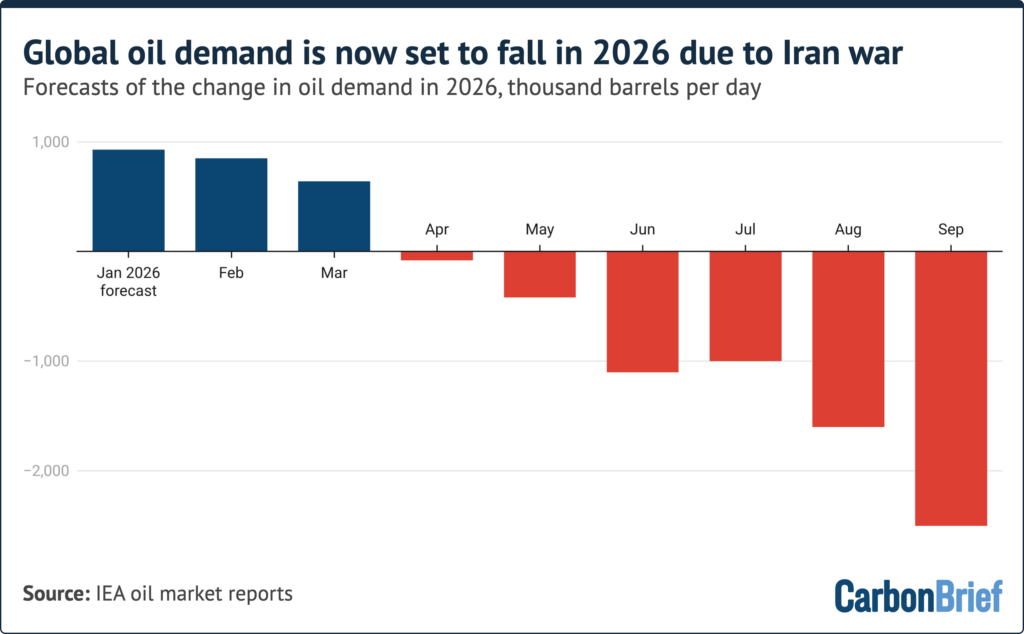
The most significant driver of the total emissions decline is an unprecedented downward revision in global oil demand. At the start of 2026, standard market projections anticipated continued expansion in oil consumption. However, sustained fuel price spikes triggered rapid consumer behavioral shifts and accelerated technology substitution.
In major economic blocs, automotive fleets transitioned toward electrification at an accelerated pace. Higher pump prices dramatically shortened the payback period for electric vehicles, driving record EV market shares across both mature and emerging auto markets:
- Established Markets: Electric vehicle sales reached unprecedented penetration levels across Western Europe, China, and Australia.
- Developing Markets: In non-traditional markets—including Indonesia, Thailand, and several South American nations—EV sales nearly doubled year-on-year by mid-2026.
This structural shift away from internal combustion engines, coupled with broader macroeconomic sluggishness caused by high energy costs, severely depressed refined fuel demand.
Natural Gas: Price Volatility Triggers Demand Contraction
Natural gas markets experienced severe disruptions due to the loss of key LNG export volumes normally routed through the Persian Gulf. Prior to the conflict, global gas demand was expected to expand steadily as nations substituted gas for coal in power generation.
Instead, extreme price volatility forced energy-intensive industries—such as fertilizer manufacturing, steel production, and chemical processing—to curtail output, particularly across Europe and non-operating regions of Asia. Utilities that possessed dual-fuel capacity actively switched away from gas to avoid unprecedented spot-market prices. Consequently, worldwide gas demand pivoted from expected growth into a clear annual contraction.
Coal: Temporary Rebound Driven by Weather and Gas Substitution
In contrast to oil and gas, global coal demand is projected to rise by 1.2% in 2026. This uptick generated widespread commentary suggesting a broad "return to coal" in response to the security crisis. However, granular data reveals that this rise is constrained and driven largely by factors independent of the Strait of Hormuz conflict:
- Gas-to-Coal Switching Limits: While elevated gas prices incentivized power generators to maximize coal-fired generation where available, structural power plant retirements over the previous decade mean few industrial economies retain the spare capacity to execute large-scale fuel switching.
- El Niño Weather Impacts: A powerful El Niño pattern throughout 2026 raised global temperatures, driving record demand for air conditioning and space cooling. Concurrently, severe droughts reduced hydroelectric power output in critical markets like South America and parts of Asia, forcing power grids to rely more heavily on coal reserves.
- Renewable Integration Challenges in China: Short-term operational bottlenecks within regional distribution grids in China led to temporary curtailments ("wasted" energy) of wind and solar output, requiring coal-fired baseline units to balance local generation loads.
Crucially, the carbon footprint of this 1.2% increase in coal consumption is fully offset by the combined drop in global oil and gas usage, resulting in a net overall reduction in global energy emissions.
Forecast Revisions and Macroeconomic Metrics
The International Energy Agency’s Shifting Baseline
The changing trajectory of 2026 global emissions is best illustrated by the sequential baseline revisions executed by the International Energy Agency over the course of eight months.
       IEA 2026 Global Oil Demand Revisions (Jan vs. Sept 2026)

   +1.0m bpd ──┐ [Jan Forecast: +930,000 bpd]
               │
    0.0m bpd ──┼────────────────────────────────────────────────────
               │
   -1.0m bpd ──┤
               │
   -2.0m bpd ──┤
               │
-3.0m bpd ──┘ [Sept Update: -2,500,000 bpd]- Oil Expectations: In January 2026, the IEA predicted a modest global demand increase of 930,000 barrels per day (bpd). As the Hormuz blockade dragged on, the agency systematically lowered its projections. By September 2026, the update projected a demand drop of 2,500,000 bpd—a net year-on-year decline of 2.4%, representing one of the sharpest non-pandemic demand contractions in modern history.
- Natural Gas Forecasts: In January, the IEA anticipated a 2.0% expansion in global gas demand for 2026. By July, this figure was revised down to a 0.6% contraction, with subsequent quarterly reports indicating even further price-induced suppression.
- Coal Forecasts: In late 2025, the IEA anticipated that declining coal usage in China would outpace pro-coal policy initiatives in the United States, producing a global net drop in coal consumption. By September 2026, unexpected weather anomalies and gas price substitution prompted a revision upward to a 1.2% increase.
Financial Sector Consensus and Market Modeling
Major Wall Street institutions corroborated these shifts. An internal research report from Morgan Stanley published in mid-September identified an institutional consensus forecasting a 2,415,000 bpd decline in global oil demand for 2026.
Analytic consensus across major institutions confirms that the oil demand contraction is not simply an inventory adjustment, but reflects genuine end-user demand destruction driven by high fuel prices and swift technological adaptation.
Official Statements and Expert Analysis
DNV and Market Analysts on Permanent Demand Destruction
Energy sector analysts emphasize that the current crisis is altering long-term behavioral and capital allocation strategies rather than merely inducing a temporary market pause.
Sverre Alvik, Vice President for Energy Transition at global engineering consultancy DNV, noted in an analytical paper:

"For every month the conflict lasts, the probability of permanent oil demand destruction increases. High prices accelerate the threshold at which clean technology substitution becomes the default economic choice, rather than merely an environmental preference."
Alvik highlighted that the rapid market penetration of zero-emission vehicles in emerging economies represents an irreversible structural transformation. Once a commercial fleet or consumer transitions to an electric vehicle, that transportation segment is permanently removed from the liquid fossil fuel customer base.
Developing Nations Pivot Away from Imported Liquefied Natural Gas
Developing nations across South and Southeast Asia have been particularly affected by high energy import costs. Countries that previously structured their long-term power development plans around imported LNG have faced immense financial stress, accumulating an aggregate $9.4 billion regional gas import bill.
Governments in nations such as Bangladesh, Thailand, and Vietnam are responding to these price shocks by re-evaluating their energy exposure:
- Diversification Strategies: Official policy statements signal a move away from volatile, dollar-denominated imported spot-market gas.
- Acceleration of Renewables: Developing economies are increasingly channeling capital into domestic solar, wind, and regional grid interconnections to ensure energy sovereignty.
- Extended Asset Lifespans: In some instances, legacy domestic coal infrastructure is being retained for longer operational windows to prevent complete reliance on imported LNG, altering the near-term fuel mix while prioritizing energy security.
Future Outlook: Permanent Structural Realignments Beyond 2026
Redefining Peak Oil and the Post-Crisis Energy Landscape
The long-term consequence of the 2026 Middle East crisis may be the formal advancement of the timeline for peak global fossil fuel demand.

Prior to the outbreak of hostities, standard energy transition baselines—including those published by the IEA in late 2025—projected that global oil demand would continue modest growth before reaching a plateau around 2030. Initial IEA modeling assumed that post-2026 markets would see a rapid rebound in oil consumption above 2025 levels.
                  Global Oil Demand Trajectory Realignment

  Demand
    │
    │                      / [Previous Baseline: Peak ~2030]
    │                     /
    │   Actual           /
    │   Trend          /-- [Revised Realignment: Flatlining 2026–2027]
    │     │          /
    │     ▼        /
    │    ───┐    /
    │       └───┘
    └───────────────────────────────────────────────────────── Time
       2025    2026    2027                   2030
However, updated projections indicate that global oil consumption will likely remaining effectively flat across 2027, challenging the assumption of a post-crisis rebound. With global clean-tech manufacturing expanding and alternative energy deployment reaching record scale, the current energy shock may have effectively brought global oil demand to its structural peak years ahead of schedule.
Interdependent Horizons for Coal and Gas
The ongoing evolution of the global fuel mix beyond 2026 remains highly sensitive to commodity pricing dynamics:
- Gas Price Normalization: If gas prices stabilize as global supply chains reroute, gas-to-coal switching is expected to reverse quickly, allowing global coal consumption to resume its structural decline.
- Sustained Market Volatility: If geopolitical tensions continue to restrict Middle Eastern energy exports, elevated gas prices could entrench temporary reliance on domestic coal reserves in select regions, even as accelerated renewable deployments suppress aggregate fossil-fuel reliance.
Ultimately, the 2026 energy crisis demonstrates that severe supply disruptions and price volatility within fossil fuel markets can act as a powerful accelerator for decarbonization. By forcing commercial markets and national governments to fast-track clean technology adoption, the fallout from the Hormuz conflict may mark a pivotal turning point in the long-term path toward a lower-carbon global economy.



