

Executive Overview
The automotive landscape in the People’s Republic of China is undergoing a profound structural transformation. While the domestic electric vehicle (EV) market has experienced a cooling period characterized by fierce price wars, market saturation, and softer consumer demand throughout 2026, Chinese automakers are finding unprecedented success beyond their borders. A striking manifestation of this macro-trend is visible in the latest sales report from Zhejiang Geely Holding Group (Geely), one of the world’s largest automotive conglomerates.
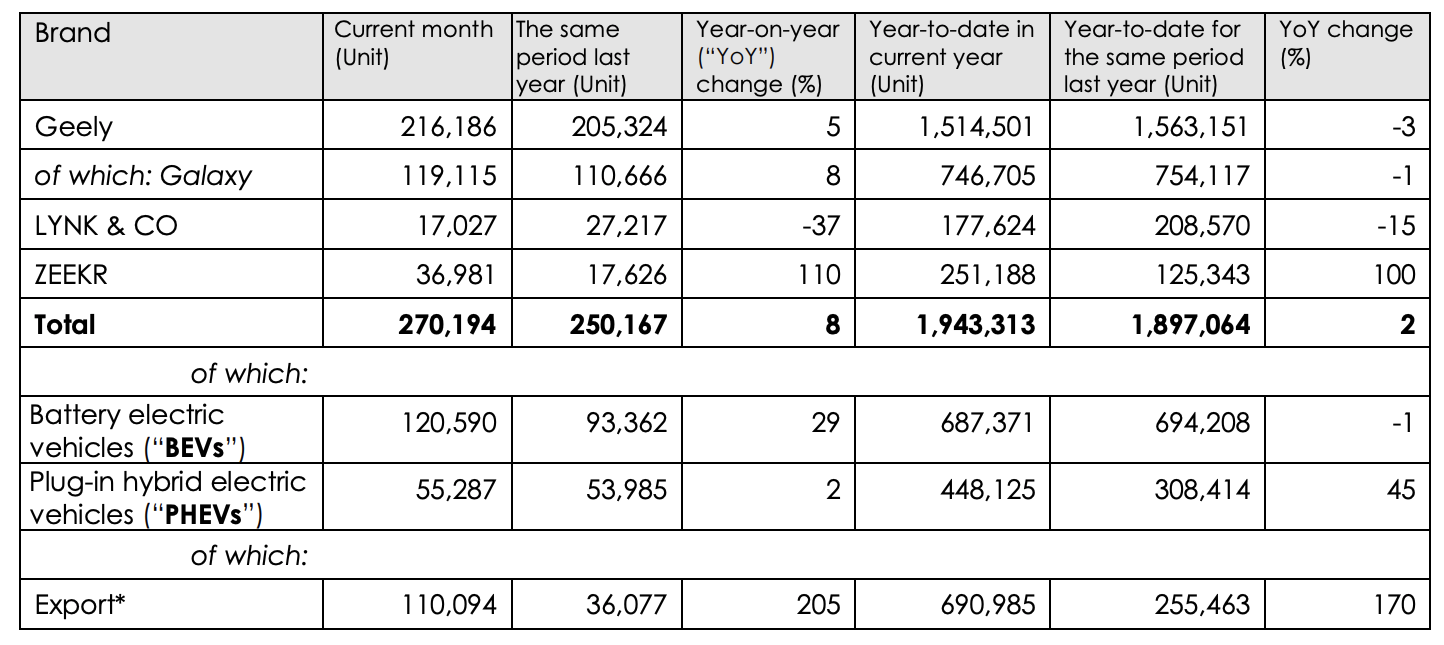
In August 2026, Geely posted modest overall year-over-year growth, but a closer examination of its underlying metrics reveals a dramatic narrative of geographical pivot. While domestic sales faced notable headwinds—contracting by an estimated 54,000 units compared to the same period in 2025—the company’s international export division exploded. Geely’s overseas shipments surged by an astonishing 205%, acting as a powerful financial and volume shock absorber.
Concurrently, the company’s powertrain strategy continues to lean heavily into pure battery-electric vehicles (BEVs), which saw robust double-digit growth, led by standout performances from its premium EV subsidiary, Zeekr. Conversely, plug-in hybrid electric vehicles (PHEVs) experienced a plateau, and sub-brands like Lynk & Co suffered sharp declines. This report provides an in-depth, investigative analysis of Geely’s August 2026 sales figures, unpacking the brand divergence, the astronomical rise of Chinese automotive exports, and the broader geopolitical and economic implications for the global clean transportation transition.
Detailed Chronology and Brand-Level Breakdown
The August 2026 reporting period highlights a tale of stark contrasts across Geely’s multi-brand portfolio. As the automotive industry shifts rapidly toward electrification, managing a diverse stable of traditional, hybrid, and battery-electric brands has become a high-stakes balancing act.
The Core Geely Brand: Steadying the Ship
The baseline Geely brand—which traditionally anchors the company’s mass-market appeal—experienced mild year-over-year growth of 5% in August 2026. While positive, this growth rate underscores the mature and hyper-competitive nature of China’s internal combustion engine (ICE) and entry-level electrified segments. To maintain its footing domestically, the core brand has had to aggressively discount vehicles, squeezing profit margins while fighting off aggressive domestic rivals like BYD, Changan, and a myriad of tech-backed EV startups.
Lynk & Co: Navigating a Severe Slump
Perhaps the most alarming figure in Geely’s August release was the performance of Lynk & Co, its joint-venture premium brand positioned between mainstream Geely offerings and luxury European marques. Lynk & Co sales plummeted by a staggering 37% year over year.
Industry analysts point to several compounding factors for this downturn. The brand is currently navigating a delicate and often disruptive transition phase as it pivots its product lineup toward a higher concentration of new energy vehicles (NEVs). Furthermore, consumer preferences in China’s urban centers have shifted rapidly toward direct-to-consumer digital ecosystems and hyper-advanced smart-cockpit features popularized by competitors like Huawei-backed partnerships and Xiaomi. Lynk & Co’s traditional dealership model and identity crisis in a rapidly evolving market appear to have cost it significant consumer mindshare.

Zeekr: The Electric Crown Jewel
In stark contrast to Lynk & Co’s struggles, Geely’s luxury battery-electric vehicle arm, Zeekr, continued its meteoric rise. Zeekr reported an extraordinary 110% year-over-year sales increase in August 2026.
Zeekr’s success can be attributed to several key product and strategic advantages:
- Advanced Architecture: Utilizing Geely’s Sustainable Experience Architecture (SEA), Zeekr vehicles offer class-leading charging speeds, structural rigidity, and interior packaging.
- Rapid Product Refresh: The brand has consistently updated its portfolio—ranging from the 001 shooting brake to its crossover and MPV offerings—ensuring it remains at the cutting edge of consumer demand.
- Global Aspirations: Unlike brands strictly tethered to the domestic Chinese market, Zeekr was built from the ground up with international safety and homologation standards in mind, allowing it to absorb foreign demand seamlessly.
The net result of these divergent brand trajectories—a 5% rise for the core brand, a 37% plunge for Lynk & Co, and a 110% surge for Zeekr—was a net global increase of over 9,000 unit sales for the group’s passenger vehicle segments, proving that high-performing electric assets can successfully offset legacy or underperforming divisions.
Supporting Context and Metrics: The Export Phenomenon
To fully grasp the magnitude of Geely’s August 2026 report, one must analyze the raw quantitative data and place it within the framework of global trade dynamics.
BEVs vs. PHEVs: The Pure Electric Push
Geely’s powertrain data for August 2026 illustrates a clear corporate preference and consumer pull toward pure battery-electric technology:
- BEV Sales: Rose from 93,362 units in August 2025 to 120,590 units in August 2026, marking a robust 29% year-over-year increase.
- PHEV Sales: Increased only modestly by 2%, moving from 53,985 units to 55,287 units.
This data suggests that while plug-in hybrids served as an important bridge technology for Chinese consumers over the last several years, the market is decisively settling into a bifurcation: short-to-medium range drivers are embracing pure BEVs with ultra-fast charging capabilities, while long-distance commercial and rural applications increasingly look to advanced range-extenders and BEVs with solid-state roadmap promises.
The Export Tsunami: 205% Growth
The undisputed headline of Geely’s August performance is its international export surge. Geely’s overseas shipments skyrocketed by 205%, jumping from 36,077 units in August 2025 to a massive 110,094 units in August 2026.
To contextualize what this means for the company’s geographic footprint, consider the macro-arithmetic:
- Overall company sales grew by 8% year-over-year (from 250,167 units to 270,194 units—a total volume increase of roughly 20,000 units).
- International exports grew by approximately 74,000 units.
- Simple subtraction reveals that Geely’s domestic sales in China actually contracted by roughly 54,000 units in August 2026 compared to the previous year.
This metric provides undeniable proof of a sweeping structural pivot. Faced with a saturated, hyper-price-war-ridden domestic market where margins are razor-thin, Geely—alongside peers like Chery, SAIC, and Great Wall—is aggressively deploying its manufacturing excess into international markets across Southeast Asia, the Middle East, Latin America, and Europe.
Official Statements and Industry Observations
While corporate press releases from Geely emphasize the resilience of their multi-brand strategy and the global appeal of their technological platforms, industry analysts are viewing the numbers through a more cautious, analytical lens.
In commentary surrounding the release, market observers noted that the dramatic contraction in the domestic Chinese market is a natural consequence of the "race to the bottom" pricing strategies that have dominated the region since 2023. Automakers have exhausted traditional margin buffers, forcing a strategic imperative: export or perish.
Furthermore, the absence of comparative export data from rival giant BYD during the same reporting week has raised eyebrows across the financial sector. While BYD’s temporary withholding of granular export metrics requires further investigation, it underscores a broader sensitivity among Chinese original equipment manufacturers (OEMs) as they face increasing regulatory scrutiny, potential tariff barriers in the European Union and North America, and mounting geopolitical friction.
Despite these headwinds, Geely’s ability to pivot more than 110,000 vehicles abroad in a single month demonstrates a sophisticated, resilient supply chain and robust logistics network—including dedicated roll-on/roll-off (RoRo) shipping fleets commissioned by Chinese automakers to bypass traditional maritime bottlenecks.
Future Outlook: Navigating the Road Ahead
As the automotive industry looks past the horizon of late 2026, Geely’s strategic trajectory offers a clear window into the future of global mobility. Several key themes will dictate the company’s success—and the success of Chinese automotive globalization—in the years to come:

1. The Geopolitical and Regulatory Battlefield
The staggering 205% growth in Geely’s exports is bound to accelerate protectionist reflexes in Western markets. The European Union’s implementation of countervailing duties on Chinese-built BEVs, alongside ongoing trade discussions in North America, means that shipping vehicles directly from Chinese assembly plants may face diminishing returns over the long term. Consequently, Geely and its peers must accelerate plans for localized manufacturing, joint ventures, and assembly hubs in target overseas regions (such as Europe and Southeast Asia) to bypass trade walls.
2. The Domestic Battleground: Consolidation and Margin Recovery
The drop in domestic sales experienced by Geely in August is unlikely to be an isolated incident. China’s automotive sector is undergoing a painful Darwinian consolidation. Weaker brands will likely be squeezed out or forced into mergers, while survivors will have to rely on software-defined vehicle (SDV) monetization, autonomous driving capabilities (such as advanced ADAS and Navigation on Autopilot), and brand prestige to restore domestic profitability.
3. Brand Differentiation and Synergy
The polarized performance of Zeekr (+110%) versus Lynk & Co (-37%) signals that consumers are increasingly unforgiving of ambiguous brand positioning. Geely management will face intense pressure to restructure its portfolio, ensuring that every sub-brand has a distinct, defensible value proposition in both domestic and international arenas.
Conclusion
Geely’s August 2026 sales report is a watershed moment. It illustrates that the destiny of major Chinese automakers is no longer solely tied to the fortunes of the domestic Chinese economy. By leveraging world-class EV manufacturing capabilities, aggressive pricing, and an unprecedented export offensive, Geely has successfully transformed a domestic slump into a global triumph. However, as international markets react with heightened trade scrutiny and regulatory hurdles, the next phase of Geely’s global journey will require just as much diplomatic and localized agility as it has demonstrated in manufacturing and engineering excellence.



