Executive Overview
For more than 400 million years, sharks have glided through the world’s oceans, wielding their iconic dorsal fins and powerful tails with unmatched grace. Older than trees, flowers, and even the dinosaurs, these apex predators have survived multiple mass extinction events, evolving into a diverse lineage that spans more than 500 species globally. From the massive, speckled whale shark to the flattened angel shark, the pink goblin shark, and the diminutive dwarf lanternshark—which maxes out at a mere eight inches (20 centimeters)—sharks are an evolutionary marvel.
Beyond their fascinating history, sharks represent the lifeblood of marine ecosystems. Renowned oceanographer Dr. Sylvia Earle, founder and CEO of Mission Blue, famously stated, "Sharks are beautiful animals, and if you’re lucky enough to see lots of them, that means that you’re in a healthy ocean. You should be afraid if you are in the ocean and don’t see sharks."
Yet, these ancient architects of the deep are facing an unprecedented crisis. Driven to the brink by human activity—chiefly overfishing, habitat degradation, climate change, and lethal coastal management practices such as shark nets and drumlines—sharks are disappearing faster than ever. According to a landmark global status report by the International Union for Conservation of Nature (IUCN), more than 300 species of sharks, rays, and chimaeras are now threatened with extinction.
This in-depth report explores the ecological significance of sharks, traces the historical and modern threats driving their decline, details the devastating collateral damage of outdated coastal "protection" programs, and highlights the innovative, non-lethal solutions and grassroots conservation efforts championed by global organizations like Mission Blue to secure a future of peaceful coexistence between humans and sharks.
Detailed Chronology: 400 Million Years of Evolution Meets the Anthropocene
To understand the severity of the modern shark crisis, one must look at the immense evolutionary timeline of the animals and the rapid, devastating acceleration of human-induced threats over the past century.
The Paleozoic Era: Ancient Origins (Over 400 Million Years Ago)
Sharks first appeared in the fossil record during the Devonian period, roughly 400 to 450 million years ago. Long before terrestrial flora colonized the land and long before vertebrate predators walked the earth, primitive cartilaginous fish were already patrolling ancient oceans. Their capacity to adapt allowed them to survive Earth’s worst mass extinctions, including the Permian-Triassic extinction ("The Great Dying"), which wiped out over 95% of marine species.
The Rise of Industrial Fisheries (Mid-to-Late 20th Century)
For millennia, human interactions with sharks were largely limited to coastal artisanal fishing, indigenous whaling or netting, and mythic folklore. However, the mid-20th century marked a catastrophic turning point. The advent of industrial-scale commercial fishing, mechanized longlines, and refrigerated factory trawlers transformed the open ocean into a harvesting zone. Driven by surging global demand for shark fins, meat, liver oil, and gill plates, shark mortality rates skyrocketed exponentially.
The Expansion of Lethal Coastal Control (1930s–Present)
In response to rising public anxieties surrounding beach safety, governments in South Africa and Australia introduced lethal shark-control programs in the 1930s. KwaZulu-Natal, South Africa, deployed its first shark nets in 1952, followed by New South Wales and Queensland in Australia implementing extensive net and drumline arrays along popular tourist beaches. For decades, these measures operated largely unchecked, despite warnings from marine biologists regarding their ecological toll.
The Turning Point: Modern IUCN Assessments and Policy Shifts (2010s–Present)
In recent years, mounting scientific data and shifting public sentiment have triggered a global reassessment of shark management. The 2024 IUCN global status report served as an urgent wake-up call, confirming that nearly a third of all chondrichthyan species (sharks, rays, and chimaeras) face extinction. Concurrently, regional governments, Indigenous communities, and conservation groups have intensified legal challenges and freedom-of-information (FOI) requests, exposing the devastating bycatch rates of lethal control programs and accelerating the transition toward smart, non-lethal alternatives.
Supporting Context & Metrics: The Ecological Role and Vulnerability of Sharks
Architects of Aquatic Biodiversity
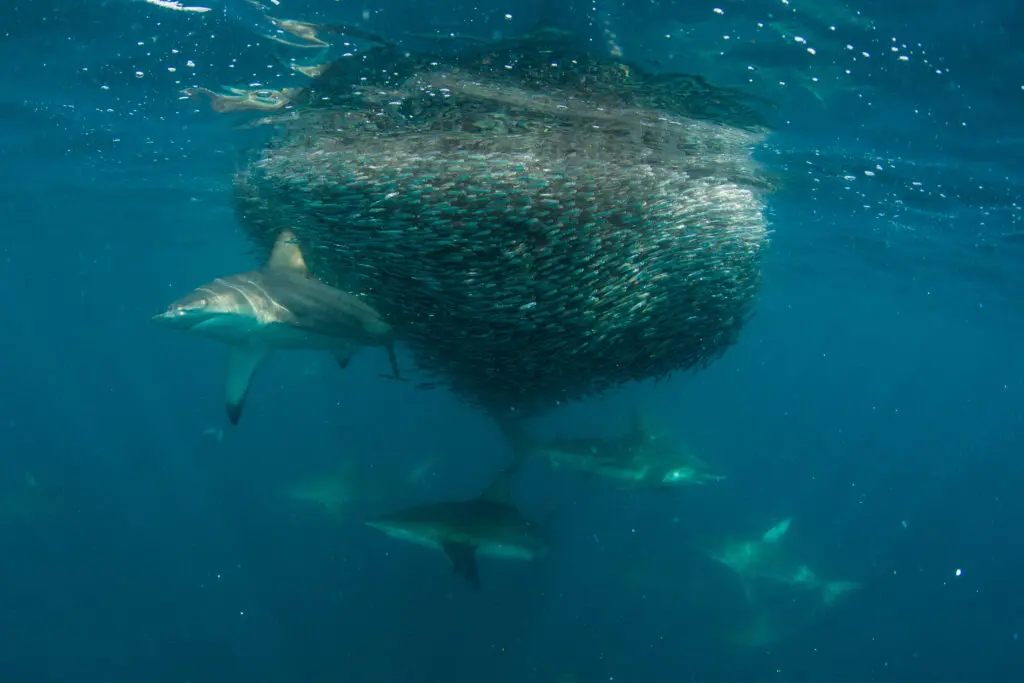
Sharks play a pivotal role in maintaining the delicate balance of marine ecosystems. As top-tier or meso-predators, they influence the behavior, distribution, and population dynamics of countless other marine species. Their presence dictates food web structures, prevents ecological collapse, and safeguards critical habitats.
- Kelp Forests: By actively managing populations of herbivorous sea urchins, sharks prevent these grazing organisms from over-consuming kelp forests. A thriving kelp forest, in turn, sequesters carbon and provides crucial nursery habitat for hundreds of marine species.
- Seagrass Meadows: Sharks act as ecological "sheepdogs" in seagrass ecosystems. Their presence induces a "landscape of fear" that encourages large grazing animals, such as dugongs and sea turtles, to constantly move around. This behavioral conditioning prevents overgrazing, allowing seagrass meadows to regenerate, expand, and store vast amounts of blue carbon.
The Biological Bottleneck: Why Sharks Recover Slowly
Unlike many teleost (bony) fish that broadcast-spawn millions of eggs annually, sharks possess life-history traits that make them exceptionally vulnerable to overexploitation. Most shark species exhibit:
- Late maturity: Many apex species do not reach sexual maturity until they are a decade or more old.
- Long gestation periods: Species such as the scalloped hammerhead or the great white experience gestation periods lasting up to 12 to 18 months.
- Low fecundity: Sharks produce very few offspring per reproductive cycle.
Consequently, once a shark population is depleted by commercial overfishing or lethal coastal management, its recovery takes decades—if it recovers at all.
The Human Threat Matrix
The IUCN and marine conservation bodies categorize the threats facing sharks into four primary vectors:
- Overfishing and Bycatch: Commercial longlining, gillnets, and purse seining target sharks directly for fins and meat, while millions more are caught unintentionally as bycatch in fisheries targeting tuna, swordfish, and billfish.
- Habitat Loss and Degradation: Coastal development, urban runoff, and port construction destroy vital nursery habitats such as mangrove forests and shallow estuaries where juvenile sharks seek refuge.
- Climate Change and Ocean Warming: Rapidly warming ocean waters, shifting marine currents, and ocean acidification alter the distribution of both sharks and their prey, forcing species into unfamiliar or sub-optimal environments.
- Lethal Coastal Control Measures: Shark nets and traditional drumlines deployed off the coasts of South Africa, Australia, Réunion Island, Brazil, and historically Hawaii, act as indiscriminate killing machines.
Bycatch Metrics in Australia (2024/2025 Data)
Data released under Freedom of Information (FOI) requests in New South Wales, Australia, for the 2024/2025 shark-netting season revealed a staggering ecological cost:
- 89% of all marine animals caught in the nets were non-target species.
- Victims included critically endangered gray nurse sharks, leatherback turtles, dolphins, and rays.
- More than 67% of the animals caught died during capture or shortly after release, proving that shark nets fail to act as precise safety barriers and instead function as ecological traps.
Official Statements and Perspectives
The global push to protect sharks is anchored by leading marine scientists, conservation advocates, and Hope Spot Champions who are working on the front lines of ocean defense.
"Sharks are beautiful animals, and if you’re lucky enough to see lots of them, that means that you’re in a healthy ocean. You should be afraid if you are in the ocean and don’t see sharks."
— Dr. Sylvia Earle, Founder & CEO, Mission Blue
Dr. Earle’s perspective underscores the paradigm shift required in human psychology: sharks should not be viewed as bloodthirsty monsters, but rather as biological indicators of ocean vitality.
Local conservation leaders across Mission Blue Hope Spots echo this sentiment, emphasizing that coexistence is both achievable and essential:
- Russel Symcox (Aliwal Shoal Hope Spot, South Africa – Wild Alliance Africa): Leads local initiatives advocating for the protection of ragged-tooth sharks ("raggies") and community-driven marine stewardship.
- Alice Forrest and Dr. Elizabeth Hawkins (Byron Bay Hope Spot – Ocean Education and Conservation): Spearhead educational campaigns to protect rich coastal corridors utilized by sharks, rays, marine turtles, and cetaceans.
- Dr. Olaf Meynecke (Gold Coast Hope Spot – Humpbacks & High-rises): Advances cutting-edge scientific research, community science, and advocacy to foster safe human-wildlife coexistence along Australia’s eastern seaboard.
- Dr. Chris Roelfsema (Moreton Bay Hope Spot – Reef Check Australia): Mobilizes volunteer scuba divers and citizen scientists to monitor reef health and shark habitats in one of Australia’s most biodiverse bays.
- Dr. Alex Hearn, Sandra Bessudo, Randall Arauz, Todd Steiner, Héctor Guzmán, and James Ketchum (Eastern Tropical Pacific Hope Spots – MigraMar): Collaborate across international borders to track the migratory pathways of oceanic sharks, demonstrating how highly mobile species connect vast, disparate marine protected areas.
- Ilena Zanella and Andrés López (Golfo Dulce Sanctuary, Costa Rica – Misión Tiburón): Direct critical conservation initiatives protecting the vulnerable nursery grounds of juvenile scalloped hammerhead sharks.
Future Outlook: Paving the Way for Non-Lethal Coexistence
The future of global shark conservation depends on a decisive break from antiquated, destructive practices and a rapid embrace of modern, science-based innovation.
Transitioning Away from Lethal Control
The era of indiscriminate shark nets and baited drumlines is drawing to a close. Progressive coastal communities are proving that human safety and marine conservation are not mutually exclusive. By phasing out lethal gear, governments can eliminate the tragic slaughter of dolphins, turtles, and endangered sharks.
Embracing Smart, Non-Lethal Alternatives
A suite of advanced, non-lethal technologies is currently transforming coastal safety management:
- SMART Drumlines (Shark Management Alert in Real Time): Equipped with satellite links and GPS, these systems alert marine wildlife teams immediately when a shark is hooked, allowing researchers to tag, relocate, and release the animal alive with minimal stress.
- Drone Surveillance and Real-Time Alerts: Aerial drone patrols equipped with artificial intelligence can detect sharks near swimming beaches in real-time, prompting temporary, safe water closures without harming marine life.
- Eco-Barriers and Personal Deterrents: Physical acoustic barriers, electromagnetic repellent cables, and personal magnetic deterrents offer targeted protection for swimmers and surfers by discouraging sharks from entering specific zones without capturing or injuring them.
- Artificial Reefs: Designed to divert marine life away from high-density human recreation zones while enhancing overall local biodiversity.
Grassroots Advocacy and Citizen Science
True systemic change requires active public participation. Local communities, municipal governments, and international NGOs must collaborate to host educational workshops, clean-up drives, and advocacy campaigns. By transforming public perception—shifting the narrative from fear to fascination—society can consign shark nets to history.
Sharks are not villains of the deep; they are ancient, resilient, and irreplaceable allies in the planetary fight for a healthy, oxygen-rich ocean. A healthy ocean needs sharks, and sharks urgently need humanity to act. Through rigorous science, progressive policy, community engagement, and unwavering advocacy, we can ensure that these majestic monarchs of the sea continue to glide through our blue planet for millions of years to come.