

Executive Overview
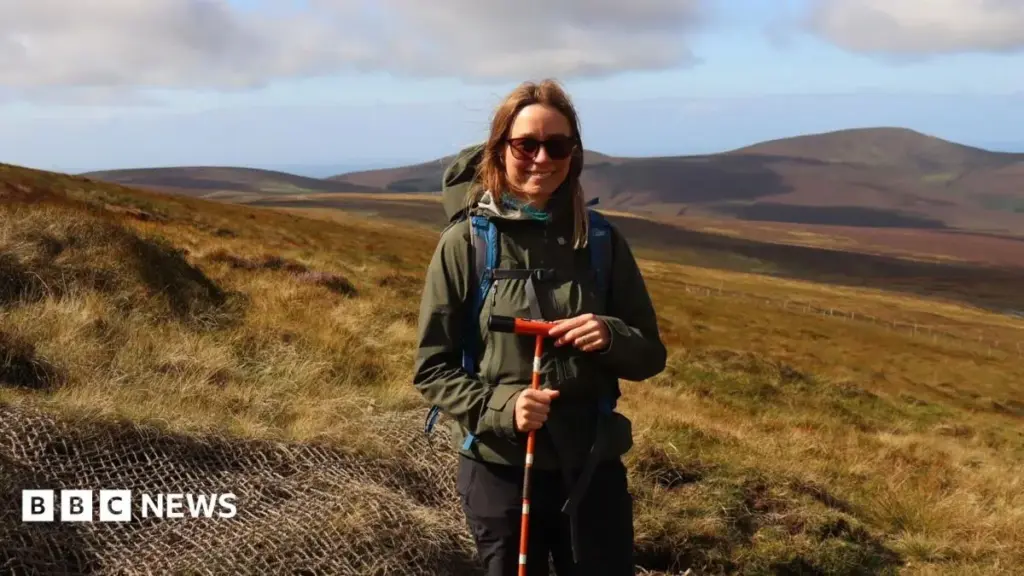
High upon the wind-swept, moody hillsides of the Isle of Man, a quiet environmental battle is being fought against centuries of ecological degradation. Sarah Hickey, the island’s dedicated Peatland Officer, pushes a metre-long metal probe deep into the sodden earth with deceptive ease. In moments, the rod vanishes almost to her hands. "This is pretty deep here," she notes, reading the precise markings etched along the shaft. Beneath her heavy boots lies a fragile, living archive: layers of peat accumulated over millennia, formed from the compressed remains of partially decayed plants and organic matter.
Hickey is one-third of a specialized Uplands team tasked with managing approximately 8,000 hectares of the island’s rugged interior. Her mission is as urgent as it is meticulous: to identify scarred and damaged landscapes, halt their decay, and re-inject life into ecosystems that serve as Earth’s most efficient terrestrial carbon sinks.
Peatlands are far more than muddy wastelands; they are globally critical carbon stores. Globally, while they cover just three percent of the planet’s land surface, they store twice as much carbon as all the world’s forests combined. Keeping this ancient carbon locked away beneath a waterlogged blanket of moss and decayed vegetation is one of the most powerful natural defenses against runaway climate change.
However, centuries of human exploitation have left the Isle of Man’s uplands bruised and vulnerable. Long stripped of its native forests by the 17th century, the island population turned to the hills for survival, harvesting peat as a primary source of domestic fuel. Though the commercial and domestic cutting of peat was finally banned in 2020, the ecological scars remain. Bare, eroding peat faces continue to collapse, bleeding sediment into local reservoirs and releasing long-dormant greenhouse gases into the atmosphere.
Today, a combination of specialized low-impact engineering, botanical restoration, and forward-thinking environmental policy is breathing new life into the Manx hills. This report examines the historical trajectory of the island’s peatlands, the precise restoration methodologies being deployed, the broader environmental stakes, and the long-term outlook for these crucial upland ecosystems.
Detailed Chronology: From Ancient Forests to Industrial Fuel
To understand the current state of the Isle of Man’s uplands, one must journey back through millennia of environmental transformation. The story of Manx peat is a chronicle of ecological succession, human necessity, and belated conservation.
Prehistory and the Birth of the Bogs
Following the retreat of the last ice sheets, the Isle of Man experienced shifts in climate that favoured the growth of dense, sprawling forests of birch, hazel, and oak. As the climate grew wetter and cooler around 6,000 to 8,000 years ago, drainage became impeded across the island’s undulating topography. Waterlogged soils starved falling vegetation of oxygen, preventing complete decomposition. Slowly, layer upon layer of organic matter accumulated, forming the dense, spongy matrix known as peat. These bogs grew vertically at a rate of roughly one millimeter per year, slowly blanketing the uplands in a thick, dark carbon vault.
The Great Deforestation (Pre-17th Century)
For centuries, these uplands existed in a relatively undisturbed state, supporting specialized flora and fauna adapted to waterlogged, acidic conditions. However, human settlement radically altered the landscape. By the 17th century, the island’s demand for timber—driven by shipbuilding, domestic heating, smelting, and agriculture—had largely stripped the Manx landscape of its native woodlands.
With timber resources virtually exhausted, communities faced a severe energy crisis. Deprived of firewood, islanders looked upward toward the hills, identifying the vast, dark expanses of peat as an abundant, accessible alternative fuel source.
The Era of Peat Cutting
For generations, cutting peat—locally known as "turbary"—was an integral part of rural Manx life. Every spring, families would head to the hills with specialized flayed spades to slice the wet peat into uniform blocks. These blocks were stacked in open-air pyramids or "footings" to dry out over the summer sun before being hauled down to homesteads for winter.
Peat burned slowly and steadily, making it an ideal fuel for cooking and heating stone cottages. Yet, this localized survival strategy initiated a slow-motion environmental catastrophe. The removal of surface vegetation exposed the underlying organic layers to the elements. Wind and rain began to scour the unprotected faces of the peat banks, initiating chronic erosion that would plague the island’s watersheds for centuries.
The Turning Point and the 2020 Ban
As the industrial age progressed, reliance on peat diminished with the introduction of coal, gas, and electricity. However, unregulated cutting and recreational damage persisted in pockets of the uplands, preventing natural healing. Recognizing the catastrophic impact of eroding peat on both carbon emissions and water quality, environmental advocates lobbied for strict protections.
A monumental shift occurred in 2020 when the Isle of Man government officially banned the cutting of peat. This legislative milestone brought a definitive end to a centuries-old tradition, pivoting the island’s relationship with its uplands from exploitation to active stewardship. Yet, as Sarah Hickey and her team quickly discovered, passing a law was only the first step; repairing the physical scars left behind by generations of cutters would require an immense, hands-on engineering effort.
Supporting Context & Metrics: The Science of Carbon and Water
The urgency driving the Manx Uplands team is underpinned by robust environmental science. Peatlands are complex, hyper-specialized ecosystems whose value can be measured across multiple ecological vectors.
The Ultimate Carbon Vault
Peat is fundamentally partially decomposed vegetation that accumulates in waterlogged, anaerobic (oxygen-free) conditions. Because oxygen is largely absent, decay-causing microbes and fungi cannot thrive. Consequently, carbon that plants absorbed from the atmosphere via photosynthesis thousands of years ago remains locked within the plant tissues rather than returning to the air as carbon dioxide ($CO_2$) or methane ($CH_4$).
According to global environmental assessments, peatlands store approximately 30% of all global soil carbon, despite covering a fraction of the Earth’s surface. When peat dries out, oxidizes, or erodes, this ancient carbon vault is unlocked. Microbes reactivate, devouring the exposed organic matter and releasing vast quantities of greenhouse gases back into the atmosphere. Restoring damaged bogs by raising the water table chokes off this microbial activity, effectively locking the carbon back away.
Engineering the Landscape Back to Health
Repairing an eroding peatland is not a task suited for heavy, conventional machinery. The restoration process begins with specialized equipment: ultra-low ground-pressure diggers designed specifically not to cause fresh damage to the delicate surrounding terrain.
- Profile Reshaping: The digger carefully pulls the bare, crumbling peat faces back to a gentler, more stable slope.
- Turf Inversion: Intact vegetation mats are folded over the newly graded slopes, preserving native seed banks and root systems to jumpstart natural regrowth.
- Bio-Logs and Netting: To protect the freshly exposed and vulnerable peat from being washed away by sudden upland downpours, workers install biodegradable coir "bio-logs" and secure the ground beneath specialized netting. This stabilization technique keeps the soil shaded, retains vital moisture, and provides a stable micro-environment where new vegetation can take root.
The Marvel of Sphagnum Moss
While mechanical earthworks provide the structural framework for restoration, the true biological engineer of a healthy bog is Sphagnum moss.
"It grows in peatland habitats, but it also creates them," explains Sarah Hickey.
Sphagnum is a remarkable genus of moss with extraordinary ecological properties:
- Water Retention: Individual sphagnum plants can hold up to 20 times their dry weight in water, acting like a giant natural sponge.
- Hydrological Regulation: By absorbing massive volumes of precipitation, sphagnum-rich bogs slow the velocity of rainwater as it travels downhill, significantly mitigating downstream flash flooding.
- Natural Filtration: As water filters through the dense mats of moss, particulate matter and sediment are trapped, resulting in cleaner water reaching the island’s reservoirs and reducing water treatment costs.
- Fire Resistance: A healthy, functioning peatland with high water saturation acts as a natural firebreak. Peat in optimal condition can consist of up to 90% water.
This last characteristic has become increasingly critical. As global temperatures rise and summer heatwaves become more frequent and intense, upland wildfires pose an escalating threat across the British Isles and Europe. Dried-out peat bogs can catch fire easily, burning underground for weeks and releasing catastrophic amounts of stored carbon. Restoring moisture through moss propagation is the ultimate insurance policy against these destructive blazes.
Official Statements & Field Perspectives
The operational reality of managing 8,000 hectares of upland terrain with a tiny team requires immense dedication, strategic prioritization, and cross-sector collaboration.
Operating under the Department of Environment, Food and Agriculture (DEFA), the Uplands team coordinates closely with conservation volunteers, hydrologists, and landowners. Their day-to-day work bridges the gap between high-level climate policy and boots-on-the-ground physical labor.
"People often look at the hills and see barren, empty wilderness," notes a departmental spokesperson reflecting on the historical perception of the Manx uplands. "In reality, these are heavily modified cultural landscapes. Every gully carved by old peat cutting, every eroded drainage ditch cut in the 20th century to improve grazing, has altered the natural hydrology of the island. Our job is to undo those artificial pressures and let nature resume its work."
Sarah Hickey emphasizes that public awareness is just as vital as mechanical restoration. Since the 2000s, community outreach programs have educated landowners, hikers, and local schools about the delicate balance of the uplands. Walkers are increasingly encouraged to stick to established trails to prevent the widening of footpaths, which can breach the protective surface crust of the bogs and initiate new erosion gullies.
Furthermore, academic partnerships have allowed the Isle of Man to benchmark its restoration success against international standards. Data collected from probe measurements—like those conducted by Hickey—are fed into carbon-accounting models to quantify exactly how much carbon emission is avoided through active bog rehabilitation.
Future Outlook: Sustaining the Manx Uplands
As the Isle of Man looks toward its net-zero commitments and broader environmental resilience goals, the restoration of its peatlands stands out as a flagship initiative. The challenges, however, should not be underestimated.
Climate Pressures and Adaptation
The changing climate presents a moving target for conservationists. Unpredictable weather patterns, characterized by prolonged summer droughts punctuated by intense, erosive downpours, test the resilience of newly restored sites. Ensuring that bio-logs and re-vegetated slopes can withstand extreme meteorological events requires constant monitoring and adaptive management.
Scaling Up Operations
Managing 8,000 hectares with a team of three is an extraordinary feat, but long-term success will rely on scaling up capacity. Securing sustained funding, expanding volunteer programs, and integrating technological tools—such as drone-based aerial mapping to track erosion rates across inaccessible terrain—will be essential components of future strategies.
A Beacon of Hope
Despite these hurdles, the progress observed across the Manx hills is a testament to what targeted environmental stewardship can achieve. Bare, bleeding earth is slowly transforming back into velvety, sponge-like carpets of green and red sphagnum moss. Carbon is staying locked safely in the ground, local water supplies are cleaner, and the island is better fortified against the looming threats of drought and wildfire.
High on the Manx hillside, as Sarah Hickey retrieves her metal probe and prepares to move to the next monitoring site, the landscape tells a story of redemption. By recognizing the mistakes of the past and harnessing the ecological genius of nature itself, the Isle of Man is proving that even the deepest ecological scars can be healed, one soggy, moss-covered step at a time.



