Executive Overview
As Massachusetts presses forward in its ambitious trajectory toward deep decarbonization and grid modernization, a high-stakes legislative battle is unfolding over the future of residential and commercial electricity pricing. At the center of this debate are competing visions for how utilities recover their operational and infrastructural costs.
Both the Massachusetts House and Senate have advanced substantial energy bills (H.5175 and S.3166) aimed at enhancing grid reliability, cutting administrative red tape, streamlining residential solar permitting, and introducing progressive programs for retail energy storage and flexible grid interconnection. These measures are critical components of a modern, decentralized energy economy designed to empower consumers and accelerate the state’s clean energy transition.
However, buried within the legislative mechanics is a controversial policy proposal that threatens to undo much of this progress: mandatory fixed utility charges. As a legislative conference committee works to reconcile the House and Senate versions before sending a final package to Governor Maura Healey, clean energy advocates, consumer groups, and environmental organizations are sounding the alarm.
Proponents argue that fixed charges offer predictable revenue streams for aging infrastructure maintenance. Yet, comprehensive data analyses reveal a troubling reality: shifting utility costs from volumetric consumption-based charges to flat, mandatory fees creates a regressive financial burden. Under this model, low-usage households—disproportionately lower-income residents, seniors, and energy-conscious consumers—will find themselves effectively subsidizing high-volume energy users. Furthermore, fixed charges severely dampen the financial incentives for investments in rooftop solar, residential battery storage, and advanced energy efficiency, undermining the very policy goals Massachusetts has spent decades championing.

Detailed Chronology of the Legislative and Regulatory Battle
To understand the gravity of the current legislative showdown, it is necessary to examine the timeline of events that brought Massachusetts to this pivotal energy crossroad.
Late 2025: The Department of Public Utilities Opens Rate Design Review
The debate over fixed charges did not emerge in a vacuum. In late 2025, the Massachusetts Department of Public Utilities (DPU) initiated a comprehensive, sweeping review of all delivery charges embedded within electric and gas utility bills across the Commonwealth. This regulatory proceeding was designed to scrutinize how utilities bill their customers, evaluating whether traditional rate structures adequately reflect the modern grid’s costs and operational realities.
The DPU’s initiative invited widespread participation from stakeholders across the energy ecosystem. Recognizing the profound implications of altering rate design, a diverse coalition of consumer advocacy groups, low-income assistance organizations, business associations, environmental watchdogs, and clean energy enterprises mobilized. They flooded the DPU’s docket with public comments expressing deep concern over any regulatory pivot toward increasing fixed monthly charges on utility bills.
2026 Legislative Sessions: Advancing Twin Energy Bills
While the DPU’s administrative review was underway, the Massachusetts General Court began advancing major legislative reforms to address escalating electricity costs and grid modernization hurdles.

- The House Bill (H.5175): Championed by representatives seeking to ease the cost of living for constituents, the House bill incorporated provisions to modernize residential solar permitting, foster flexible grid interconnections, and support retail-level energy storage.
- The Senate Bill (S.3166): Mirroring many of the House’s objectives, the Senate advanced parallel legislation focused on reinforcing grid reliability and expanding access to distributed energy resources (DERs).
Both bills garnered praise for attempting to dismantle bureaucratic roadblocks that historically plagued clean energy deployment in the state. However, late-stage additions or underlying provisions regarding rate structures introduced the contentious concept of mandated fixed charges, setting up a direct conflict with the ongoing, highly technical proceedings at the DPU.
The Present: Conference Committee Deliberations
Currently, a legislative conference committee is tasked with reconciling the discrepancies between S.3166 and H.5175. This closed-door negotiation will determine the final text of the omnibus energy legislation before it lands on Governor Maura Healey’s desk. Stakeholders from all sides are lobbying fiercely—clean energy advocates urging the committee to strip out mandatory fixed charge mandates, and legacy utilities pushing to lock in guaranteed baseline revenues through flat fees.
Supporting Context, Data, and Metrics
The push for fixed charges is often framed by utility interests as a matter of fairness—the argument being that all customers rely on the physical grid and should pay a flat fee to maintain it, regardless of how much electricity they consume. However, data compiled by the Solar Energy Industries Association (SEIA) through a rigorous examination of major utility data paints a starkly different picture of who wins and who loses under this rate design.
The Anatomy of a Regressive Shift
Under a traditional volumetric rate structure, a customer’s bill rises and falls in direct proportion to their kilowatt-hour (kWh) consumption. This structure inherently rewards conservation: the less energy you use, the less you pay. It also provides a clear economic return on investments that reduce grid dependency, such as energy-efficient appliances, insulation, rooftop solar panels, and home battery storage systems.
Fixed charges disrupt this dynamic by decoupling a portion of utility revenue from consumption. Under a mandatory fixed charge model, utilities shift fixed recovery costs away from variable usage tiers onto a flat monthly fee applied to every account equally.
Case Studies: Eversource and National Grid Data
SEIA’s review of localized data from Massachusetts’ two largest investor-owned utilities demonstrates the profound inequities baked into proposed fixed-charge regimes:
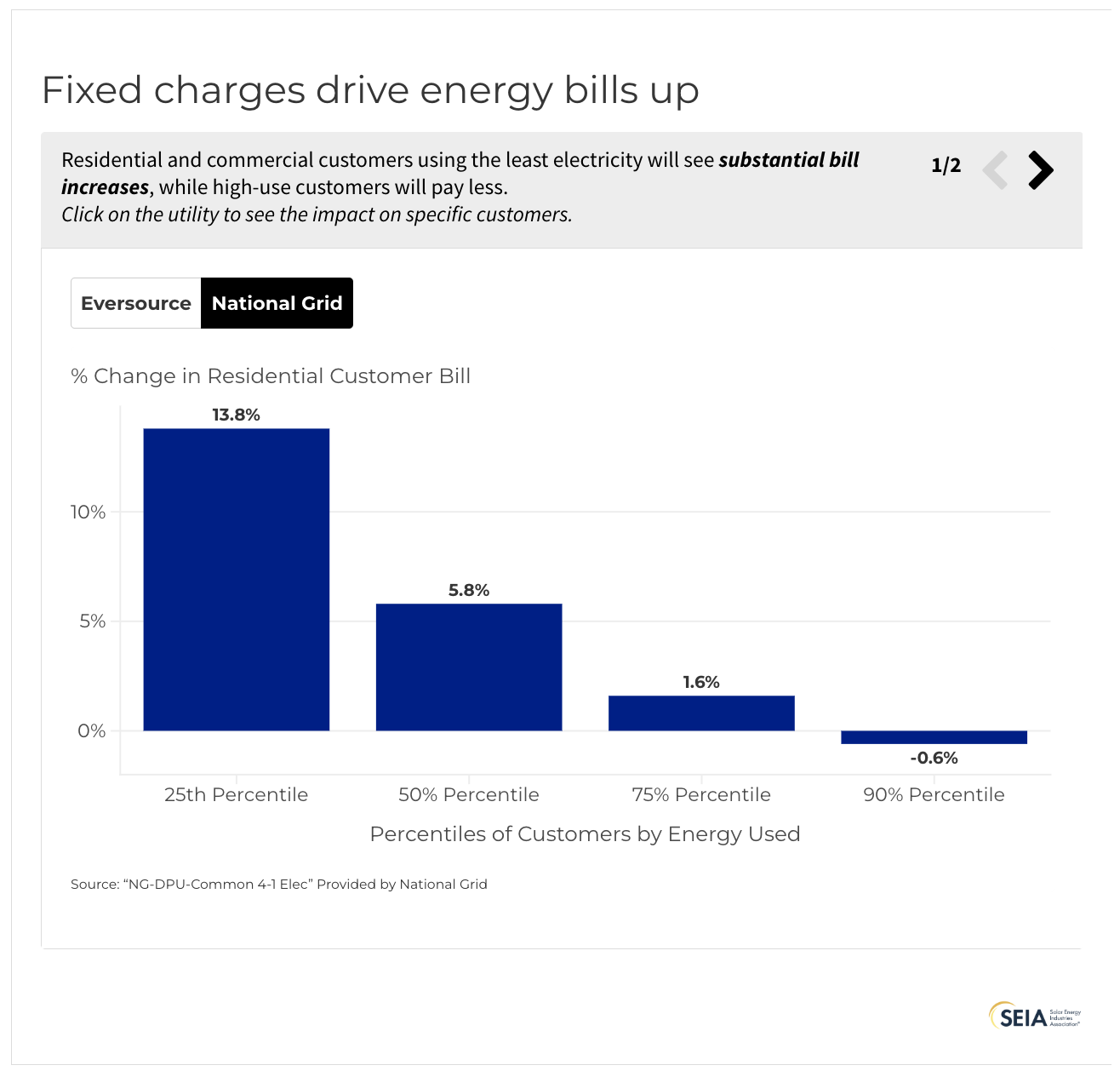
- Eversource (Serving Over 1.4 Million Customers): Data modeling indicates that under a transitioned fixed-charge structure, low-use residential customers—who are frequently lower-income families living in apartments, seniors on fixed incomes, or individuals who have invested heavily in energy efficiency—will experience significant, mandatory bill hikes. Conversely, the largest energy consumers see net bill reductions.
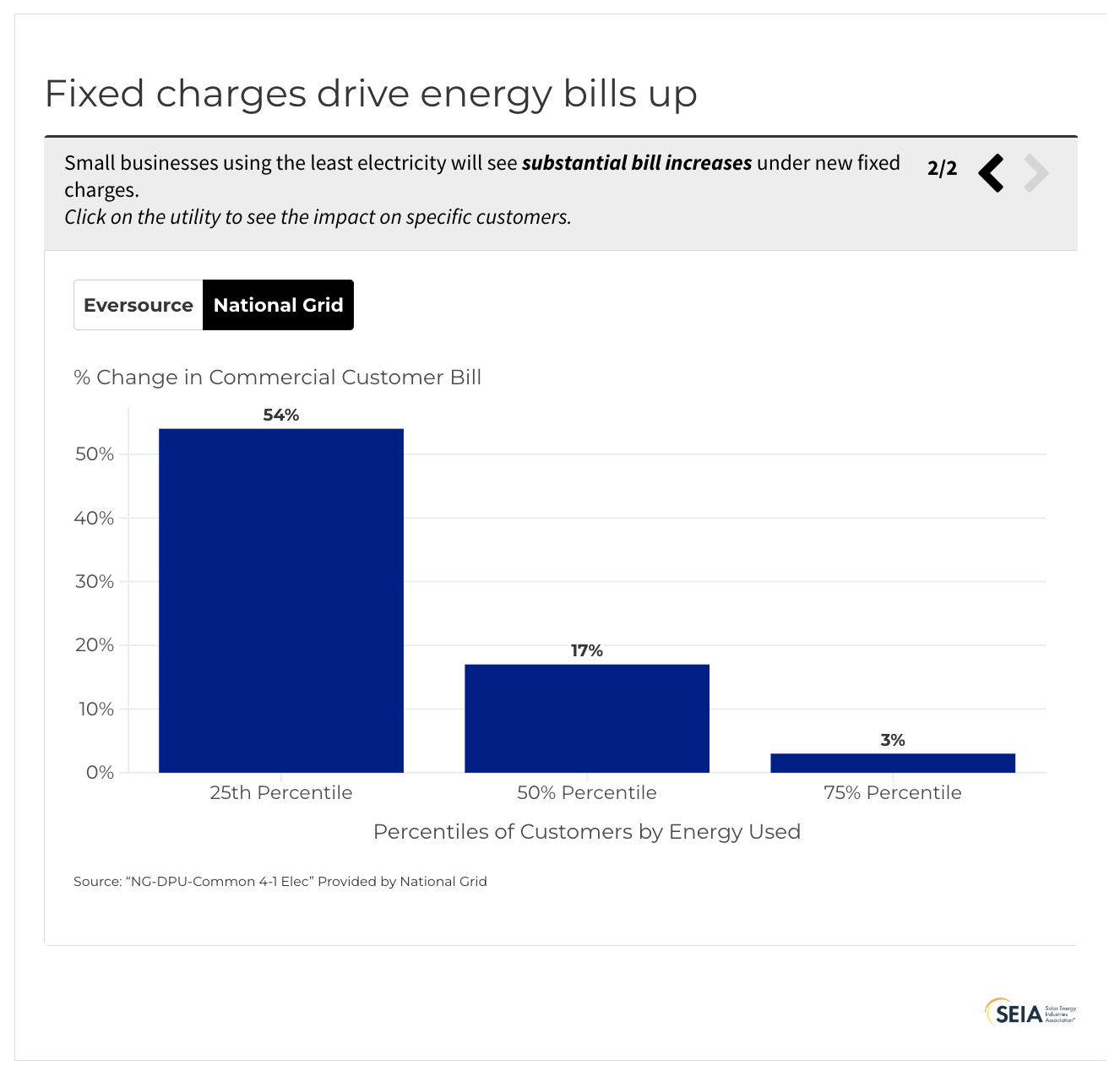
- National Grid (Serving 1.3 Million Residential and Commercial Customers): Findings from National Grid’s service territory mirror those of Eversource. Residential customers who utilize the least amount of electricity face projected bill increases averaging 13.8%, while the state’s largest commercial and residential energy consumers enjoy financial relief.
This inversion creates a perverse economic subsidy: the state’s most vulnerable and energy-conscious residents are forced to subsidize the electricity infrastructure costs of high-volume energy users.
Undermining the Financial Case for Clean Energy
Beyond equity concerns, fixed charges fundamentally compromise the financial viability of distributed energy resources (DERs).

When a substantial portion of a utility bill is converted into a non-negotiable fixed fee, the marginal value of saving a kilowatt-hour drops precipitously. For a homeowner considering an investment in rooftop solar or a home energy storage battery, the financial calculation relies on offsetting volumetric charges. If those volumetric charges are shrunken and replaced by a flat monthly fee, the monthly savings generated by solar panels and storage systems shrink accordingly.
This lengthens the payback period for clean energy technologies, making rooftop solar less accessible for middle- and working-class families and slowing the decentralized generation needed to meet Massachusetts’ statutory climate goals.
Official Statements and Stakeholder Perspectives
The debate over fixed charges has catalyzed a rare alignment between consumer protection advocates and the clean energy sector, both of which argue that the legislature’s rush to mandate fixed charges short-circuits proper regulatory oversight.
The Solar Energy Industries Association (SEIA)
SEIA has been vocal in its critique of the legislative overreach regarding fixed charges. In recent statements, the organization emphasized that while Massachusetts lawmakers deserve immense credit for prioritizing energy affordability through modernizing reforms and supporting Governor Healey’s executive actions on storage and solar, the fixed-charge mandate acts as a Trojan horse.
"The legislature should not undercut the bills’ many positive reforms by mandating fixed charges that raise bills for the customers least able to absorb them," industry analysts noted. SEIA argues that the conference committee and the Healey Administration have a clear path forward: amend the pending legislation to allow the DPU the discretion to evaluate rate design comprehensively, rather than forcing a pre-determined, utility-friendly outcome through statute.
The Department of Public Utilities (DPU) Stance
The DPU itself has repeatedly acknowledged the profound complexity of rate design restructuring. In administrative filings, the department has asserted its commitment to "carefully evaluate this issue" through established quasi-judicial and evidentiary proceedings before determining whether, when, and how existing delivery charges should be modified.
Regulatory experts point out that the DPU possesses the specialized expertise, economic modeling tools, and administrative oversight framework necessary to balance utility financial health with consumer protection. Bypassing this rigorous process via a legislative mandate risks implementing flawed policies that have not been adequately stress-tested against cross-customer impact analyses.
A Broad Coalition of Diverse Interests
Opposition to fixed charges is not isolated to the clean energy industry. A broad, cross-cutting coalition encompassing consumer advocacy groups, low-income assistance advocates, regional business leagues, and environmental justice organizations has submitted formal public comments to the DPU. These groups share a unified message: increasing fixed charges places an unmanageable burden on fixed-income households, dampens statewide energy-saving initiatives, and shields utilities from market pressures to operate efficiently.

Future Outlook: Finding the Path to True Energy Affordability
As the Massachusetts legislative conference committee finalizes its work on the comprehensive energy package, the Commonwealth stands at a critical juncture.
The core objective shared by lawmakers, regulators, utilities, and consumers is clear: electricity in Massachusetts must become more affordable and reliable. The state has already laid the groundwork for success through proactive executive leadership from Governor Maura Healey—including executive orders designed to accelerate the deployment of cost-effective solar and battery storage—and the innovative provisions found within H.5175 and S.3166.
However, locking in mandatory fixed charges threatens to unravel these achievements. To secure a resilient, equitable, and clean energy future, policymakers must take the following steps:
- Remove Fixed-Charge Mandates from Legislation: The conference committee should excise any statutory language that forces the implementation of mandatory fixed charges.
- Empower the DPU: Rate design and cost-recovery mechanisms are inherently technical matters best left to the evidentiary processes of the Department of Public Utilities. Lawmakers should defer to the DPU’s ongoing review, ensuring that any future adjustments to utility bills are transparent, data-driven, and protective of low-usage and low-income customers.
- Protect Consumer Agency: Energy policy must continue to reward conservation, efficiency, and distributed generation. By preserving the financial value of rooftop solar and storage, Massachusetts can empower residents and businesses to take active control of their energy destiny.
Ultimately, Massachusetts has the opportunity to model a balanced, consumer-first clean energy transition. By rejecting regressive fixed charges and trusting the established regulatory process, the Commonwealth can achieve genuine energy affordability without sacrificing its climate commitments.