

Executive Overview
The North American renewable natural gas (RNG) sector is undergoing a high-stakes recalibration, marked by shifting regulatory timelines, aggressive capital deployment, and the harsh operational realities of scaling novel waste-to-energy technologies. In a definitive strategic retreat, Idaho-based developer Sevana Bioenergy has divested the vast majority of its remaining asset portfolio. The centerpiece of this exit is the sale of the high-profile Rialto Bioenergy Facility in Southern California to Berq RNG, a transaction finalized and announced in late February.
This major divestment comes on the heels of another strategic withdrawal just a week prior, when California Bioenergy acquired Sevana’s stake in South Dakota Biogas LLC—a joint venture initially designed to build a vast network of agricultural manure digesters across the state. With these rapid-fire transactions complete, Sevana Bioenergy’s once-sprawling portfolio has been reduced to a single remaining anaerobic digester project in Idaho, according to confirmation from CEO Steve Compton.
The structural dismantling of Sevana’s core holdings highlights the profound financial and operational headwinds facing capital-intensive anaerobic digestion projects, particularly those dependent on municipal organic waste streams. Founded in 2017 with a proven track record of deploying more than 20 agricultural digester tanks across Oregon, Idaho, and South Dakota, Sevana entered a golden era of institutional backing in 2023. The Ontario Teachers’ Pension Plan Board acquired a majority stake in the company that year, injecting a massive $250 million capital commitment designed to supercharge the development of RNG infrastructure across North America.
Yet, despite this robust institutional backing and millions pumped into deferred maintenance and operational upgrades, the timeline to profitability at the Rialto facility outpaced the financial patience and capital allocation limits of its backers. Today, the facility changes hands once more, inherited by Berq RNG—a firm backed by Connecticut-based private equity titan Lotus Infrastructure Partners—which steps into the arena with its own playbook for operational optimization.
As the industry analyzes this seismic shift in ownership, stakeholders are forced to re-evaluate the timelines of organic waste diversion laws, the friction of feedstock acquisition, and the true cost of scaling the circular economy in North America.
Detailed Chronology: From Grand Launch to Bankruptcy and Re-Exits
To understand the current state of the Rialto Bioenergy Facility, one must examine its turbulent history, which serves as a cautionary tale of regulatory reliance and engineering scale-up in the waste sector.
2020: The Launch of a Heavyweight
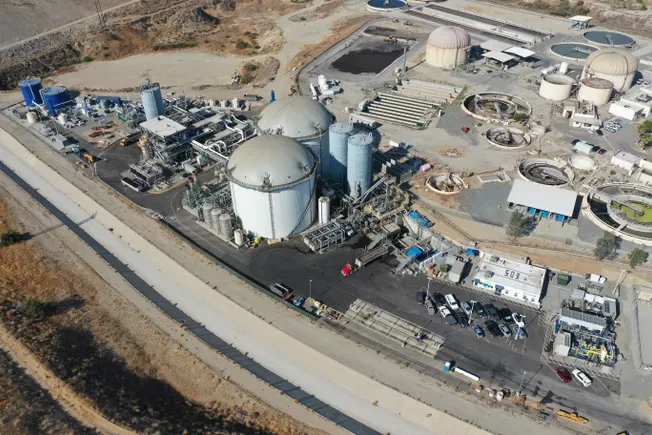
The Rialto Bioenergy Facility was originally designed and engineered by Anaergia, a prominent name in clean energy technology. When the facility opened its doors in Southern California in 2020, it was heralded as a monumental leap forward for the American waste management industry. Touted at its launch as the largest food waste diversion and energy recovery facility in North America, the plant was engineered with the capacity to process an astonishing 1,000 tons of organic material per day.
The facility’s foundational business model was built on a simple premise: divert massive quantities of commercial and residential food waste away from overcrowded landfills, convert that organic slurry through anaerobic digestion, and scrub the resulting biogas into pipeline-grade renewable natural gas, all while producing high-grade organic fertilizer.
The Regulatory Bottleneck: SB 1383 and RecycLA Delays
However, the ambitious throughput targets quickly collided with harsh regulatory delays. The facility was constructed in anticipation of the full implementation and enforcement of California’s landmark SB 1383 law, a sweeping mandate designed to drastically reduce organic waste disposal in landfills and guarantee a reliable, source-separated stream of residential food waste from the greater Los Angeles area.
Crucially, however, the local municipal rollout lagged behind state targets. RecycLA, the agency overseeing Los Angeles commercial waste franchise contracts, delayed the rigorous enforcement and rollout of the required organic waste collection infrastructure. Consequently, the Rialto facility was starved of its intended feedstock. Without a steady, high-volume stream of organic waste, the plant struggled to run at economic capacity, operating well below the thresholds required to service its massive capital expenditure footprint.
2023: Chapter 11 and Restructuring
The compounding financial pressure proved unsustainable for Anaergia’s operating model. In 2023, Anaergia spun off the Rialto asset into a dedicated, ring-fenced Limited Liability Company (LLC) to insulate the broader corporate entity from the project’s liabilities. Immediately following the spin-off, the LLC filed for Chapter 11 bankruptcy protection.
During the bankruptcy proceedings, Anaergia acknowledged that financial difficulties stemmed directly from a painfully slow ramp-up period and chronic feedstock shortages. Nonetheless, the company committed to maintaining continuous operations at the plant throughout the restructuring process to preserve its underlying asset value and maintain relationships with municipal haulers.
2024: Sevana’s $20 Million Lifeline
Sensing an undervalued asset with strong long-term fundamentals tied to California’s eventual green mandates, Sevana Bioenergy stepped in. In 2024, Sevana acquired the Rialto site out of bankruptcy for $20 million.
Upon taking the helm, Sevana announced that Anaergia would remain onboard as the facility’s day-to-day operator. To correct the operational bottlenecks that plagued the plant under its previous ownership, Sevana committed an additional $5 million in targeted capital investments, specifically earmarked for deferred maintenance, mechanical overhauls, and general operational enhancements.
During Sevana’s brief tenure of a little over two years, the facility saw measurable improvements, scaling its operational run rate to a peak of 70% of its total design capacity, according to CEO Steve Compton.
2025: The Berq RNG Acquisition
Despite these operational strides, the burn rate and timeline to sustained profitability continued to stretch. In late February 2025, Sevana elected to divest its remaining major asset, selling the Rialto facility to Berq RNG. This transaction effectively winds down Sevana’s high-profile run as an independent RNG infrastructure developer of scale, leaving the company with only a solitary agricultural digester project in Idaho.
Supporting Context & Metrics: Feedstock Dynamics and Financial Realities
The operational journey of the Rialto Bioenergy Facility is inextricably linked to the mechanics of the Southern California waste hauling ecosystem. Understanding why the plant struggled to achieve profitability requires a granular look at how organic waste is gathered, processed, and transported across Los Angeles County.
The Feedstock Supply Chain
When the site first came online in 2020, Anaergia established critical operational partnerships by selling specialized organics extrusion machines to major regional waste haulers, including Waste Management (WM) and Universal Waste Systems (UWS). These heavy-duty depackaging and extrusion machines are designed to strip packaging from commercial food waste, liquefying the organics into a pumpable slurry suitable for anaerobic digesters.
- Waste Management (WM): Since 2020, WM has successfully operated its extrusion machine, continuously trucking its organic slurry output directly to the Rialto facility.
- Universal Waste Systems (UWS): UWS brought its first extrusion machine online in late 2024 and early 2025. However, the company has faced administrative delays, currently holding off on bringing its second machine online until new municipal hauling contracts with the City of Los Angeles are officially finalized.
Run Rates and the Path to Profitability
According to Yaniv Scherson, Chief Operating Officer at Anaergia, the core issue at Rialto was not a fundamental flaw in the technology, but rather the sheer duration of the ramp-up phase relative to Sevana’s financial runway.
"They bought a site that was not making money, and they probably had a budget of how much capital they were willing to invest until profitability," Scherson noted in post-acquisition commentary. "It must have taken longer than their plan."
Even at a peak run rate of 70% capacity achieved under Sevana’s ownership, the facility appears to have continued operating at a net loss—a financial drain that ultimately necessitated Sevana’s exit strategy backed by its institutional investors.
Regulatory Tailwinds and Offtake Agreements
Despite the historical financial turbulence, incoming operators inherit a regulatory landscape that is slowly pivoting in their favor. The Rialto facility possesses a massive design capacity, capable of producing up to 1 million mmBtus of renewable natural gas annually.
Furthermore, the facility’s crucial gas offtake agreement with SoCalGas remains in the final stages, awaiting formal regulatory approval. Securing this approval is expected to serve as a vital financial catalyst, providing predictable, long-term revenue streams that will fundamentally alter the balance sheet of the plant.
Adding to the optimism is the impending overhaul of municipal waste contracting. RecycLA, the Los Angeles agency overseeing commercial waste franchise agreements, is officially scheduled to phase in a new generation of waste contracts in the first half of the coming year. These contracts are specifically structured to enforce stricter waste diversion metrics, which industry experts predict will force a surge in commercial food waste volumes into the market.
"That event should be a catalyst for more feedstock incremental to the market," Scherson explained, adding a necessary caveat: "But how much, of course, is speculative."
Official Statements and Industry Perspectives
The transition of the Rialto facility from Sevana Bioenergy to Berq RNG has prompted reflections from executive leadership across all involved entities, highlighting a shared determination to stabilize the asset and capture the long-term value of California’s decarbonization goals.
The Outgoing Leadership: Sevana Bioenergy
While Sevana CEO Steve Compton declined to comment directly on the speculative future trajectory of Sevana Bioenergy as a corporate entity—having now parted with its primary revenue-generating assets—he offered a gracious and forward-looking statement regarding the sale:
“We are happy for Rialto’s new owners and confident in the facility’s underlying infrastructure as it enters this next chapter.”
The Operating Partner: Anaergia
Anaergia, which has maintained its operational footprint at the Rialto site through its various ownership iterations, views the change in ownership as a stabilizing force. COO Yaniv Scherson confirmed that Anaergia intends to maintain its active role operating the facility alongside Berq RNG.
Reflecting on the market dynamics, Scherson emphasized that while the transition periods have been punishing for capital allocators, the fundamental thesis of California’s organic waste diversion remains robust. The impending RecycLA contract rollouts represent a light at the end of the tunnel for organic waste processors throughout the Southern California airshed.
The Incoming Owners: Berq RNG and Lotus Infrastructure Partners
Stepping into the operator’s seat is Bas van Berkel, CEO of Berq RNG. Backed by the deep pockets and infrastructure expertise of Connecticut-based private equity firm Lotus Infrastructure Partners, Berq RNG brings a proven track record of managing complex green energy assets.
In the official statement announcing the transaction, van Berkel struck an optimistic and collaborative tone:
“We look forward to applying our operating expertise to optimize performance at Rialto, working closely with the City of Rialto, our feedstock partners, and the local community.”
Berq RNG is no stranger to complex energy infrastructure. The firm has previously developed and successfully divested landfill-gas-to-RNG projects across Kentucky and New York. Additionally, Berq recently made waves in the agricultural biogas sector by securing $110 million in bond financing in Michigan to develop four large-scale dairy manure digester projects. This track record suggests that Berq possesses both the operational grit and the patient institutional capital required to steer the massive Rialto facility across the threshold into sustained profitability.
Future Outlook: The Horizon for California RNG and Organic Diversion
The high-stakes corporate shuffle surrounding the Rialto Bioenergy Facility offers a revealing window into the broader maturation of the North American RNG market. The era of speculative, hyper-growth land grabs in the biogas sector is rapidly giving way to an era of operational discipline, risk mitigation, and balance sheet resilience.
The Agricultural Pivot vs. Municipal Scale
Sevana Bioenergy’s simultaneous retreat from both its municipal waste asset in California and its agricultural biogas joint venture in South Dakota signals a fundamental corporate contraction. By paring down its footprint to a single digester in Idaho, Sevana exemplifies the painful correction experienced by developers who expanded too quickly during the 2021–2023 private equity boom.
Conversely, buyers like Berq RNG—anchored by institutional private equity with multi-decade infrastructure horizons—are positioning themselves to pick up distressed or underperforming assets at a discount. By acquiring Rialto for a fraction of its original development cost, Berq enters the market with a significantly lower cost basis, insulating the project from the debt-servicing pressures that crippled its predecessors.
Regulatory Realism in California
For the broader California clean fuels market, the Rialto transition underscores the danger of building ahead of regulatory enforcement. While the legislative framework established by SB 1383 is among the most aggressive and environmentally visionary in the world, the practical mechanics of municipal implementation, franchise contract renegotiations, and local permitting have repeatedly proven slower and more contentious than initially modeled.
However, as RecycLA prepares to roll out its tightened commercial waste contracts in the coming months, the structural demand for organic waste processing capacity is virtually guaranteed to rise. Facilities that survive this transitional turbulence—such as Rialto, backed by Berq’s operational expertise and bolstered by incoming feedstock streams—are exceptionally well-positioned to reap the rewards.
Conclusion
The sale of the Rialto Bioenergy Facility is neither a death knell for the municipal RNG sector nor an unmitigated triumph; rather, it is a textbook case of asset cleansing and market rationalization. As Berq RNG takes the reins, supported by a strengthening regulatory mandate and deep-pocketed private equity backing, the industry will be watching closely to see if operational optimization can finally unlock the full, promised potential of North America’s largest food waste diversion plant.



