

Executive Overview
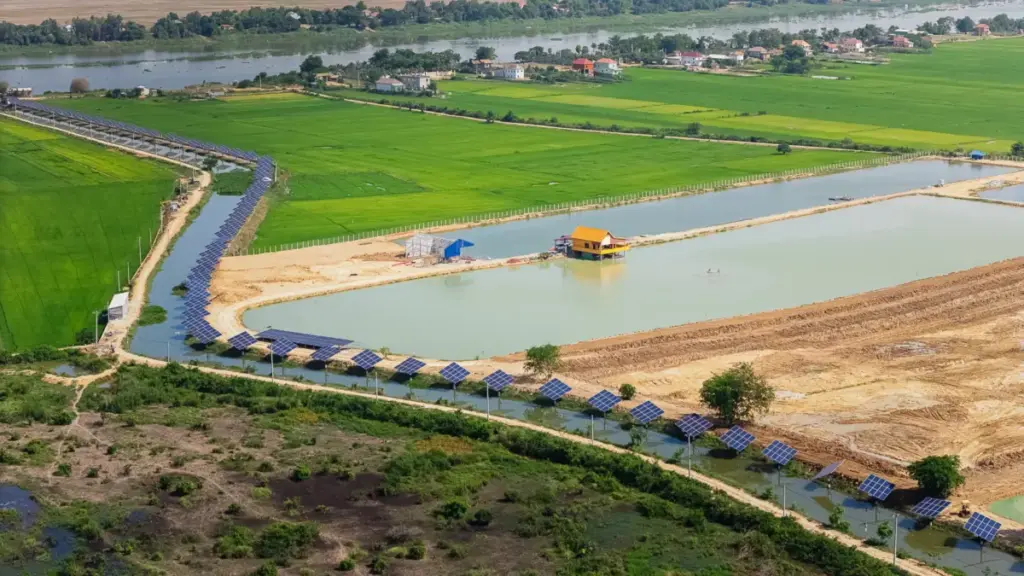
In an era defined by accelerating climate volatility and shifting global market dynamics, the Kingdom of Cambodia is orchestrating one of Southeast Asia’s most notable energy transformations. Once heavily dependent on imported diesel, expensive foreign electricity, and vulnerable hydroelectric networks, the nation has engineered a strategic pivot toward domestic renewable resources. Today, clean energy accounts for nearly half of Cambodia’s total electricity mix—a milestone that highlights the country’s ambitious shift away from fossil fuels.
At the center of this transformation is a commitment by the Royal Government of Cambodia to source 70 percent of its total installed power capacity from renewable energy by 2030. This target is not merely an environmental posture; it is a calculated economic strategy designed to enhance national energy sovereignty, lower long-term industrial tariffs, and position Cambodia as a competitive hub for green manufacturing within the Association of Southeast Asian Nations (ASEAN).
   Cambodia's Target Power Capacity Mix (2030 Target)
   ==================================================
   [#######################################.......] 70% Renewables (Hydro, Solar, Wind, Biomass)
   [.............                                 ] 30% Non-Renewable / Conventional Baseline
However, achieving this decarbonization trajectory requires significant capital, technical integration, and structural market reforms. As energy policy experts observe, Cambodia’s national ambitions depend heavily on international climate diplomacy, concessional finance, and structured cross-border frameworks. The emerging international momentum surrounding the Transitioning Away From Fossil Fuels (TAFF) initiative—driven by discussions leading into the United Nations Climate Change Conference (COP30) under the Brazilian presidency and shaped by high-level dialogues such as the Santa Marta conference in Colombia—offers a potential blueprint for mobilizing the global support Cambodia requires.
Detailed Chronology: The Evolution of Cambodia’s Power Sector
Cambodia’s trajectory from structural power deficits to a regional model for clean energy planning demonstrates how national policy can adapt to evolving climate realities and shifting market dynamics.
+-----------------------------------------------------------------------------------+
|                            HISTORICAL TIMELINE                                    |
+-----------------------------------------------------------------------------------+
| 2000–2010 : Severe grid fragmentations; extreme reliance on heavy fuel oils (HFO).|
| 2011–2018 : Rapid hydro boom; baseline established via domestic utility dams.     |
| 2019      : Historical drought exposes hydro vulnerability; solar expansion begins|
| 2021      : Moratorium on new coal-fired power plant approvals announced.         |
| 2022–2024 : Power Development Plan (PDP 2022–2040) updated; 70% target by 2030 set.|
+-----------------------------------------------------------------------------------+
The Era of Deficits and Heavy Fuel Oil (2000–2010)
At the turn of the 21st century, Cambodia possessed one of the least developed power grids in the region. National electrification rates hovered below 25 percent, with major urban centers relying on localized diesel generators and imported heavy fuel oil (HFO). Rural areas were largely un-electrified or dependent on costly, privately operated battery-charging stations. To satisfy basic industrial and domestic demand, the state power utility, Électricité du Cambodge (EDC), contracted expensive power imports from neighboring Thailand and Vietnam.
The Hydroelectric Boom and Baseline Stabilization (2011–2018)
To address soaring electricity costs and secure baseload generation, the government approved several major public-private partnership (PPP) hydroelectric schemes. Facilities along tributaries of the Mekong River—such as the Lower Sesan 2 and various cascades in the Cardamom Mountains—came online. Hydropower quickly became the primary driver of domestic power generation, raising national electrification rates dramatically. By 2018, domestic generation capacity had expanded significantly, though the grid remained susceptible to seasonal weather variations.
The 2019 Drought and the Solar Shift
The vulnerabilities of an over-reliance on seasonal run-of-river hydro became evident in 2019. An El Niño-induced drought swept across the Greater Mekong Subregion, reducing reservoir levels and triggering rolling blackouts across Phnom Penh and major economic zones. Recognizing that climate change posed a direct threat to energy security, the Ministry of Mines and Energy (MME) accelerated plans to diversify the generation mix.
Supported by multilateral institutions like the Asian Development Bank (ADB), Cambodia launched its flagship National Solar Park program. The competitive bidding process yielded record-low solar tariffs for Southeast Asia, proving that variable renewable energy (VRE) could compete economically with conventional sources.
The Coal Moratorium and the 70% Mandate (2021–Present)
In late 2021, ahead of global climate summits, Cambodia announced a policy shift: the government committed to building no new coal-fired power plants beyond those already under construction or contract. This decision culminated in the formal cancellation of a proposed 700-megawatt coal facility in Koh Kong province in late 2023, with developers instructed to explore clean energy alternatives instead.
This policy evolution formed the foundation for the current Power Development Master Plan (2022–2040). The updated framework prioritizes solar photovoltaic (PV) integration, off-river pumped storage hydro, biomass, and efficiency upgrades, setting the current milestone target of 70 percent renewable capacity by 2030.
Supporting Context & Metrics: Grid Dynamics and Economic Reality
To understand the mechanics of Cambodia’s 70 percent renewable target, one must examine the composition of its installed generation capacity, grid stability parameters, and investment requirements.
Installed Capacity and Generation Dynamics
As of late 2023, Cambodia’s total installed capacity stood at approximately 4,500 megawatts (MW). Hydropower remains the anchor of the domestic grid, complemented by a growing share of grid-connected solar power.
| Generation Source | Approximate Share of Installed Capacity (2023) | Strategic Direction (Target 2030 Matrix) |
|---|---|---|
| Hydropower | ~45% | Expanded via reservoir optimization and pumped storage |
| Solar PV | ~12% | Major expansion through utility-scale parks & rooftop PV |
| Coal & Oil/Gas | ~33% | Phase-down; no new project approvals |
| Biomass & Others | ~1% | Niche expansion tied to agricultural waste |
| Cross-Border Imports | ~9% | Shift toward importing green power & exporting surplus |
Current Installed Energy Capacity Mix (2023)
============================================
[#####################                     ] Hydropower (~45%)
[###############                           ] Coal & Fossil Fuels (~33%)
[######                                    ] Solar PV (~12%)
[####                                      ] Net Imports (~9%)
[#                                         ] Biomass (~1%)
Grid Integration and Storage Requirements
While expanding utility-scale solar generation is cost-effective, integrating variable solar power presents operational challenges for EDC’s transmission network. Solar power generation drops off during late afternoon peaks, creating steep ramping requirements for conventional plants.
To maintain network stability and achieve the 70 percent target, Cambodia requires investment in three critical areas:
- Battery Energy Storage Systems (BESS): Deploying utility-scale BESS is vital to cushion frequency variations, provide secondary reserves, and smooth out output spikes from large-scale solar arrays.
- Pumped Storage Hydropower (PSH): Leveraging the country’s terrain to build energy storage infrastructure that pumps water to upper reservoirs during solar peak periods and releases it through turbines during nighttime demand peaks.
- Smart Grid Transmission Upgrades: Modernizing high-voltage dispatch networks, automated generation control (AGC), and sub-station automation to manage multi-directional power flows.
Regional Connectivity and the ASEAN Power Grid
Cambodia’s clean energy policies are closely tied to regional market integration. As part of the wider ASEAN Power Grid (APG) initiative, the country is strategically positioning itself to both import and export green energy. Recent bilateral agreements—such as proposed subsea transmission projects and cross-border power purchase agreements (PPAs) with Singapore and Vietnam—highlight how domestic clean energy investments can generate foreign exchange revenue while balancing regional supply needs.
Official Statements and Climate Policy Frameworks
The momentum behind Cambodia’s clean energy ambitions reflects coordinated work between domestic policy architects, non-governmental organizations, and international climate finance bodies.
Perspectives from Energy Policy Analysts
Highlighting the strategic alignment required to reach these ambitious goals, Phalkun Out, Manager of Energy Policy and Government Relations at EnergyLab Asia, emphasized the importance of international partnership in driving domestic execution:
"Cambodia has made impressive strides in transitioning from dirty coal and imported electricity to homegrown renewable energy that now accounts for nearly half of the electricity mix. The kingdom has a target to source 70% of its total power capacity from renewables by 2030. This is achievable but requires global support and cooperation."
Out noted that domestic structural reforms must be backed by accessible international capital, adding:
"The recent momentum on developing a formal process to assist countries in transitioning away from fossil fuels (TAFF) is very encouraging. The roadmap process championed by the COP30 Brazil presidency and at the Santa Marta conference in Colombia shows a clear appetite among countries to invest in a just and orderly transition."
International Alignment: TAFF, COP30, and Santa Marta
The reference to the Transitioning Away From Fossil Fuels (TAFF) initiative highlights how global climate policy impacts emerging economies.
               GLOBAL-TO-LOCAL CLIMATE FINANCE PIPELINE
               =======================================

   [COP30 Framework / Santa Marta Declarations]
                     |
                     v
   [Concessional Capital & Multilateral Guarantees]
                     |
                     v
   [Transitioning Away From Fossil Fuels (TAFF) Funds]
                     |
                     v
[Cambodian Infrastructure: BESS, Solar, Grid Upgrades]- The Santa Marta Dialogue: The high-level international gathering in Santa Marta, Colombia, convened global leaders, environmental ministers, and development financiers to establish workable pathways for developing nations seeking to decouple economic growth from fossil fuel expansion.
- The COP30 Brazil Vision: As Brazil prepares to host COP30 in Belém, the presidency is focusing on actionable, just transition frameworks. These frameworks advocate for transparent technology transfers, concessional debt mechanisms, and capital access tailored for middle- and lower-income states pursuing decarbonization.
For Cambodia, these global platforms provide mechanisms to attract private investments, secure risk-mitigation guarantees, and lower borrowing costs for utility-scale green projects.
Future Outlook: Road to 2030 and Beyond
As Cambodia moves toward its 2030 targets, the next five years will determine whether its policy commitments translate into reliable, long-term infrastructure performance.
+-----------------------------------------------------------------------------------+
|                           CRITICAL PATH TO 2030                                   |
+-----------------------------------------------------------------------------------+
| 1. Financial De-Risking: Mobilizing private capital via blended finance.           |
| 2. Grid Modernization  : Scaling BESS and automated transmission controls.         |
| 3. Regulatory Clarity  : Codifying rooftop solar tariffs and open access rules.  |
| 4. Industrial Symbiosis: Linking green power to international supply chains.      |
+-----------------------------------------------------------------------------------+
Strategic Capital Deployment and Financial Mechanisms
Reaching a 70 percent renewable energy capacity share will require billions of dollars in infrastructure investment across generation, storage, and distribution. Because public debt capacity remains limited, the Cambodian government is utilizing structured financial models:
- Blended Finance and Concessional Debt: Partnering with multilateral financial institutions—such as the World Bank, Asian Development Bank, and Climate Investment Funds (CIF)—to provide concessional finance that de-risks private sector investment.
- Green Bonds and Carbon Credit Markets: Exploring sovereign green bond issuances alongside international carbon credit trading under Article 6 of the Paris Agreement, turning verified carbon reductions into revenue streams.
Regulatory Refinement and Private Sector Participation
To support utility-scale solar and wind developments, the Cambodian government is working to clarify its regulatory frameworks. Key focus areas include updating direct power purchase agreement (DPPA) guidelines, streamlining rooftop solar integration regulations for manufacturing facilities, and creating transparent procurement pipelines for competitive private sector bidding.
Industrial Competitiveness in a Low-Carbon Economy
The economic imperative driving Cambodia’s energy shift reaches beyond environmental considerations. Global supply chains—particularly in the textile, garment, footwear, and electronics sectors—are increasingly bound by multinational corporate net-zero commitments and cross-border trade mechanisms like the European Union’s Carbon Border Adjustment Mechanism (CBAM).
By delivering a clean power grid, Cambodia aims to protect its main export sectors against carbon-related trade tariffs, positioning the nation as an attractive destination for foreign direct investment (FDI) in sustainable manufacturing.
A Model for Emerging Economies
Cambodia’s progress shows how developing nations can skip traditional fossil-fuel-intensive growth phases. By combining strategic national policy with international climate financing and regional grid integration, the country demonstrates that an energy transition in the Global South can be ambitious, economically viable, and strategically sound.
If supported by sustained international finance and technical cooperation, Cambodia’s path toward a 70 percent renewable energy matrix by 2030 will serve as an informative case study for nations balancing rapid economic growth with global climate commitments.



