Executive Overview
As the Biodiversity Heritage Library (BHL) marks its momentous 20th anniversary, celebrations naturally gravitate toward the sheer scale of its digital archives—millions of pages of historical scientific literature, rare botanical illustrations, and foundational ecological texts available to anyone with an internet connection. Yet, behind every high-resolution scan lies a story of human persistence, cross-continental coordination, and institutional grit.
In this special contribution to the "BHL at 20: Treasures from the Biodiversity Heritage Library" series, Digital Collections Manager Bianca Crowley shifts the spotlight away from the texts themselves and onto the invisible engine of the library: the people. Specifically, Crowley chronicles the arduous, highly collaborative, 11-year digitization saga of one of the library’s crown jewels: the Journal of The Asiatic Society and its legacy publications.
Spanning from June 2010 to June 2021, the complete digitization of all public-domain volumes of this historic journal required navigating shifting institutional priorities, fluctuating grant funding, complex international workflows, and a rotating cast of 19 dedicated contributors spread across nine distinct organizations. The resulting digital collection not only safeguards centuries of interdisciplinary research originating from South Asia but also serves as a masterclass in how a globally distributed consortium can achieve monumental goals without dedicated central digitization staff. This is the definitive account of how a single scanning request ticket in an issue-tracking system transformed into an 11-year monument to open-access scientific preservation.
Detailed Chronology: An 11-Year Archival Marathon
The story of the Journal of The Asiatic Society begins long before the advent of digital libraries. Founded in 1784 in Kolkata by Sir William Jones through British India’s highest court, the Asiatick Society was established with a sweeping, ambitious mandate: to study the "History, Civil and Natural, the Antiquities, Arts, Sciences, and Literature of Asia." More than 240 years later, The Asiatic Society endures as a foundational pillar of learning in India, celebrated as the country’s oldest surviving publishing house. Recognized by the Indian government as an Institution of National Importance, its publications span centuries, documenting an extraordinary breadth of research across cultural, natural, and medical sciences.

Bringing this sprawling intellectual legacy into the 21st-century digital ecosystem, however, was a logistical labyrinth.
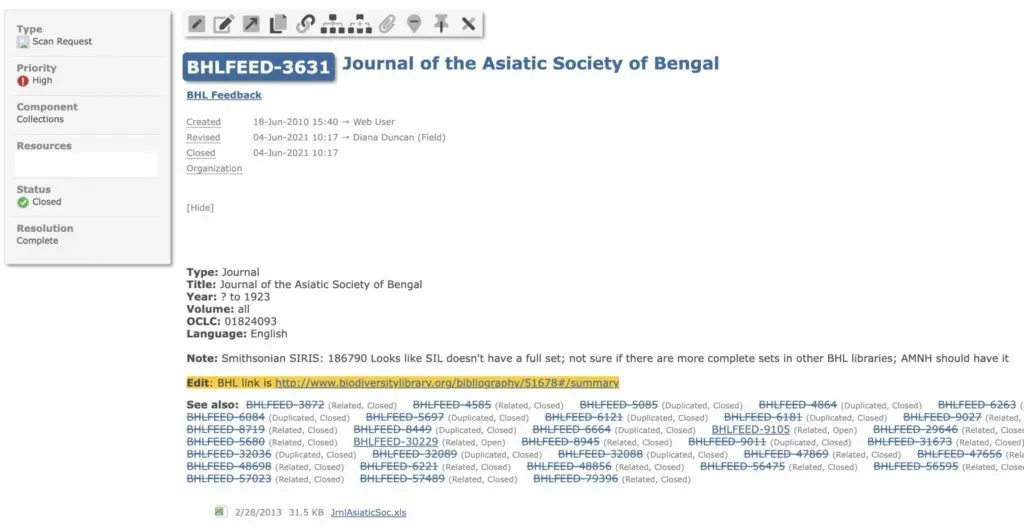
- June 2010: The foundational institutions of the BHL consortium initiated what would become a marathon digitization project. A scan request ticket was opened within BHL’s Gemini issue-tracking system, targeting the legacy volumes of the Journal of the Asiatic Society of Bengal. At this stage, no one involved anticipated that the task would take over a decade to complete.
- 2013: A critical turning point arrived with the tapering off of major grant funding through the MacArthur Foundation, which had historically supported much of BHL’s early infrastructure. Without centralized financial backing for digitization, the project entered a volatile phase where participating institutions had to rely entirely on whatever local staff and equipment resources they could spare.
- 2010–2021: Over these 11 years, the workflow relied on a patchwork of decentralized efforts. 9 separate institutions, 19 individual contributors, 40 distinct tickets in the issue-tracking system, and upwards of 82 detailed comments coordinated the step-by-step rescue of the texts. Partners tackled physical book degradation, missing catalog records, software bugs, and the complexities of matching disparate institutional workflows.
- June 2021: More than a decade after the initial ticket was stamped into the system, BHL officially marked the digitization of all public-domain volumes of the Journal of The Asiatic Society and its legacy publications as "complete" to the best of its ability. Today, BHL proudly provides open access not only to the flagship journal—across its various historical name changes—but also to complementary publications like the Memoirs and other specialized Asiatic Society titles.
Supporting Context & Metrics: The Anatomy of a Distributed Library
To understand why a single journal series took 11 years to digitize is to understand the unique operational model of the Biodiversity Heritage Library. As the world’s largest open-access digital library for biodiversity literature, BHL operates entirely without dedicated, centralized digitization or cataloging staff.
Instead, BHL functions as a decentralized consortium. Its strength lies in its network of partner institutions, which contribute voluntarily from their own collections, using their own personnel and equipment. This distributed labor model allows participating organizations to "come as they are," contributing to the collective mission when institutional time, funding, and resources permit. However, this flexibility comes with a structural cost: projects are vulnerable to the ebb and flow of institutional budgets, staff turnover, and shifting grant landscapes.
The coordination of such a fluid, international workforce requires robust communication infrastructure. BHL relies heavily on Gemini, an issue-tracking system originally designed for software development and IT troubleshooting. For over a decade, Gemini served as the single source of truth for BHL’s internal projects. Within its architecture, the Asiatic Society project was tracked through 40 interconnected tickets and 82 comments, managing everything from gap identification and physical book curation to cataloging needs and quality control.

While managing a globally distributed workforce across 11 years using an issue-tracking system designed for IT bugs presents clear administrative friction, it ultimately proved to be the backbone of BHL’s collaborative success. It provided a transparent, structured platform where candid communication could bridge institutional and international boundaries.
Official Perspectives: The Human Element Behind the Screen
Reflecting on the milestone, Bianca Crowley emphasizes that the true "treasures" of the Biodiversity Heritage Library extend far beyond rare bindings, yellowed pages, or historical significance.
"My take on the treasures of BHL’s collection is less about the content or significance of any particular title," Crowley notes, "and more about the work over many (many) years behind the scenes by the people within BHL partner institutions to bring these treasures from the shelves to the screen and make them accessible and discoverable for anyone with an internet connection."
This philosophy is deeply rooted in BHL’s guiding principles, especially following its recent structural transition into a more autonomous, globally distributed organization operating independently of any single host institution. For two decades, the library’s survival has depended not on massive corporate endowments, but on a shared cultural commitment among librarians, archivists, technologists, and researchers across the globe.

Yet, Crowley is candid about the systemic inefficiencies that must be addressed moving forward. An 11-year timeline for a single journal series—while a testament to sheer persistence—highlights the urgent need for streamlined workflows. As BHL drafts its next strategic chapter, modernizing its platform and forging new partnerships, the organization is actively evaluating how to minimize friction in the digitization pipeline, improve metadata synchronization, and enhance long-term collection sustainability.
Future Outlook: Charting BHL’s Next Chapter
As the Biodiversity Heritage Library steps past its 20th anniversary, the lessons learned from the Journal of The Asiatic Society project serve as both a cautionary tale and an inspiring roadmap. The project encapsulates the core tension of modern digital libraries: balancing grand ambitions of universal knowledge access against the stark realities of resource scarcity and decentralized labor.
Looking ahead, BHL’s leadership recognizes that true institutional sustainability requires more than just keeping website servers running; it demands the continuous, active growth and curation of its unique biodiversity archives. To accelerate the digitization process and ease the burden on its volunteer partner network, future initiatives must focus on:
- Platform Modernization: Upgrading internal tools to reduce administrative overhead and streamline the transition from physical shelf to digital screen.
- Enhanced Information Architecture: Refining tracking systems and metadata standards to prevent bottlenecks during multi-institutional projects.
- Sustainable Funding Models: Actively seeking long-term philanthropic support and recurring donations to transition from a purely ad-hoc volunteer model toward more reliably resourced processing pipelines.
The successful preservation of the Journal of The Asiatic Society proves that when a global community shares a deep commitment to open science and cultural heritage, even the most formidable archival mountains can be moved—one scanned page at a time.

To support the ongoing preservation efforts of the Biodiversity Heritage Library and help fund its next 20 years of open-access discovery, consider making a recurring donation or planned gift via the BHL Donation Portal.