

Executive Overview
The Royal Society for the Protection of Birds (RSPB) has issued critical new guidance regarding the supplementary feeding of garden birds, introducing the definitive mantra: "Feed Seasonally. Feed Safely."
This directive is built upon rigorous, modern ornithological research demonstrating that garden feeding stations, while popular among wildlife enthusiasts, can inadvertently act as vectors for the transmission of highly contagious avian diseases—chiefly trichomonosis.

By fundamentally reshaping how and when we provide sustenance for local avifauna, conservationists hope to curb disease outbreaks while concurrently encouraging a more holistic, sustainable approach to garden management.
At the heart of this paradigm shift is a call to action: rather than relying solely on artificial feeders, homeowners are encouraged to integrate wildlife-friendly flora into their garden borders. Natural planting provides a diverse, self-sustaining buffet of seeds, berries, and insect life. To bridge the gap between conservation science and practical horticulture, this report explores the RSPB’s updated protocols alongside a curated masterclass of 26 exceptional plants designed to feed garden birds naturally, beautifully, and safely.

Detailed Chronology & Scientific Background
The Rise of Supplementary Feeding and the Pathogen Threat
Over the past several decades, the practice of putting out fatballs, peanuts, and seeds has become a staple of British gardening. Millions of households invest time and money into supporting local bird populations through harsh winters and lean springs. However, scientific monitoring has revealed a darker side to this human-wildlife interaction.
High-density feeding stations concentrate multiple species in close proximity. This unnatural congregation allows pathogens to spread rapidly through shared food sources and contaminated surfaces. Among the most destructive of these pathogens is Trichomonas gallinae, a microscopic parasite responsible for trichomonosis.

While historically associated with pigeons and doves, the disease crossed over into passerine populations—most notably greenfinches and chaffinches—causing catastrophic population declines across the United Kingdom.
The RSPB Intervention: "Feed Seasonally. Feed Safely"
Responding to mounting empirical evidence, the RSPB formalized its updated guidance earlier this year, urging the public to exercise restraint and heightened hygiene:

- Feed Seasonally: The RSPB advises restricting high-energy supplementary foods (such as suet, fatballs, and mealworms) to the leaner months, specifically keeping them limited between 1 May and 31 October. During this window, natural food sources—most notably protein-rich insects—are widely available in the ecosystem. Peanuts and high-grade seeds can be reintroduced during the autumn and winter periods when natural reserves dwindle.
- Feed Safely: For those who continue to feed birds, strict husbandry is non-negotiable. Gardeners must relocate and clean feeders regularly, eliminate flat-surface feeders (such as traditional bird tables where droppings easily contaminate food), sweep away spilled debris, and exercise strict personal hygiene. When scrubbing equipment, handlers should wear rubber gloves, wash items strictly outdoors, dedicate specific long-handled brushes solely to this task, and thoroughly sanitize hands and forearms afterward.
To permanently break the cycle of disease transmission, the RSPB advocates for a return to nature: cultivating living, breathing landscapes that supply wild birds with their evolutionary dietary requirements.
Supporting Context & Metrics: The Horticultural Solution
Transforming garden borders into natural feeding habitats offers a multi-layered benefit. It mitigates the infection risks of artificial tables while supporting the broader food web, from soil-dwelling invertebrates to canopy-dwelling insectivores.

The 26 Best Plants for Feeding Garden Birds
Below is the definitive guide to 26 plants categorized by their structural type, wildlife utility, and aesthetic value, providing an immediate framework for gardeners looking to future-proof their local bird populations.
1. Sunflower (Helianthus annuus)
- Type: Annual
- Wildlife Rating: 4/5
- Beauty Rating: 4/5
From towering traditional varieties to compact dwarf cultivars like ‘Choco Sun’ (which fit neatly at the front of borders without requiring staking), sunflowers are unmatched autumn powerhouses. While their summer blooms dazzle human eyes, leaving the seedheads standing through the cooler months creates a natural banquet for blue tits and greenfinches. Note: Avoid pollenless modern cultivars; seed-eating birds require traditional, pollen-producing variants.

2. Ornamental Millet (Pennisetum glaucum ‘Purple Baron’)
- Type: Annual
- Wildlife Rating: 3/5
- Beauty Rating: 3/5
Standing at around 90cm tall, this arching grass features deep purple linear leaves and feathery summer flower spikes that introduce dramatic architectural contrast. When paired with hot red and orange perennials like dahlias and rudbeckias, it looks stunning. Once flowering concludes, seed-eating specialists descend upon the fading spikes.
3. Cornflower (Centaurea cyanus)
- Type: Annual
- Wildlife Rating: 3/5
- Beauty Rating: 4/5
These airy annuals introduce vibrant washes of blue, white, pink, and purple into wild meadow schemes and mixed perennial borders. Compact selections like ‘Polka Dot Mixed’ thrive effortlessly in containers. Their blossoms attract a thriving population of flying insects—a vital protein source for breeding birds—while their mature seeds are heavily targeted by goldfinches.

4. Teasel (Dipsacus fullonum)
- Type: Perennial
- Wildlife Rating: 3/5
- Beauty Rating: 3/5
A statuesque biennial producing bristly white or lavender flowerheads through mid-to-late summer. Teasel is an exceptional dual-purpose plant: it acts as a magnet for pollinating insects before drying into a striking winter silhouette. Goldfinches adore probing the stiff seedheads with their fine, pointed beaks.
5. Knapweed (Centaurea nigra)
- Type: Perennial
- Wildlife Rating: 5/5
- Beauty Rating: 5/5
Featuring thistle-like purple blooms, common knapweed is an absolute magnet for bumblebees and beneficial insects. This surge in invertebrate activity draws ground-feeders like dunnocks, while goldfinches eagerly harvest the seeds while they are still half-ripe.

6. Field Scabious (Knautia arvensis)
- Type: Perennial
- Wildlife Rating: 4/5
- Beauty Rating: 4/5
Rising on delicate 1.5m stems, field scabious produces soft blue flowerheads that anchor traditional grassland and wildflower plantings. It supports local moth and butterfly populations by supplying larval food plants, and its subsequent seedheads sustain local finch and sparrow populations well into autumn.
7. Michaelmas Daisy (Symphyotrichum novi-belgii)
- Type: Perennial
- Wildlife Rating: 4/5
- Beauty Rating: 5/5
When the energetic blooms of early summer fade, Michaelmas daisies step into the spotlight, blanketing garden borders in rich palettes of white, blue, pink, and purple. Their late-season flowers extend the foraging window for pollinators, while their seed production feeds goldfinches and allied granivores.

8. Self-heal (Prunella vulgaris)
- Type: Perennial
- Wildlife Rating: 4/5
- Beauty Rating: 3/5
An understated yet invaluable native wildflower, self-heal forms a low-growing, creeping carpet of violet flowers from June through October. Thriving in sun or partial shade, it naturalizes easily in lawns and borders. Its seeds provide a dependable food source for ground-feeding house sparrows and dunnocks.
9. Coneflower (Rudbeckia fulgida)
- Type: Perennial
- Wildlife Rating: 3/5
- Beauty Rating: 5/5
For unwavering golden-yellow color spanning July to October, Rudbeckia fulgida (particularly varieties like ‘Goldsturm’) is peerless. Their open, dark-centered daisy heads offer easy physical access for smaller birds like finches and sparrows seeking unhindered access to nutritious seeds.

10. Fennel (Foeniculum vulgare)
- Type: Perennial
- Wildlife Rating: 4/5
- Beauty Rating: 4/5
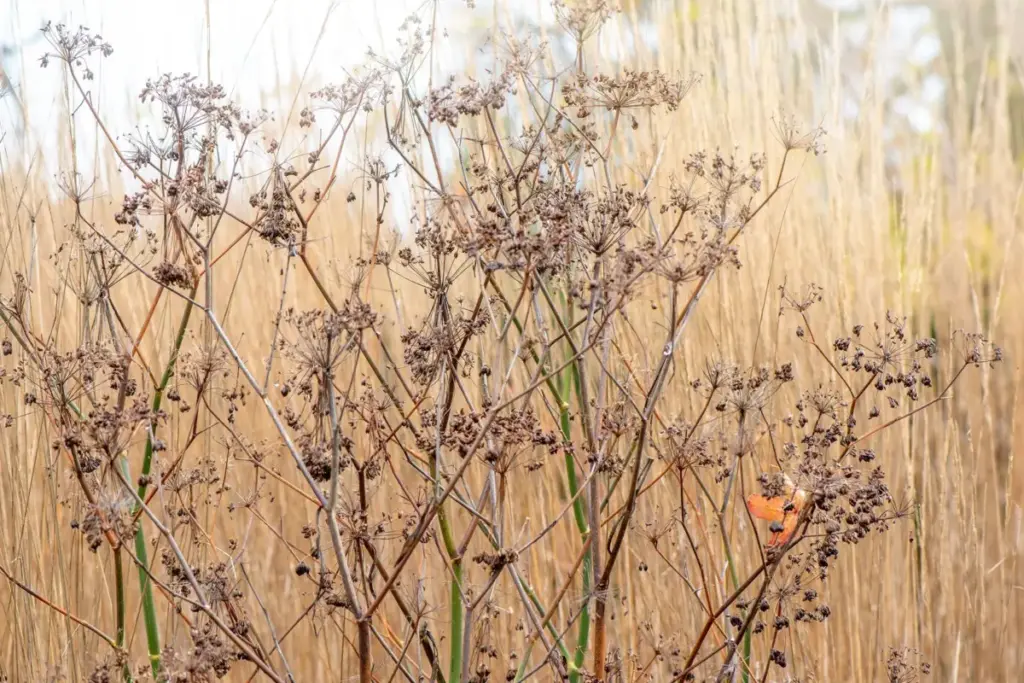
With its towering height and finely textured, feathery foliage, fennel brings an ethereal quality to the back of herb and wildlife borders. It frequently plays host to aphid colonies, which in turn draw predatory insectivores like blue tits that quickly clear the infestation. Later, the umbrella-like seedheads provide rich nutrition.
11. Verbena (Verbena bonariensis)
- Type: Perennial
- Wildlife Rating: 4/5
- Beauty Rating: 5/5
Characterized by wiry, see-through stems topped with purple clusters, Verbena bonariensis handles poor soils and baking sun with ease. In autumn, sparrows and finches exhibit delightful acrobatic displays, bouncing up and down the slender stems to pluck ripe seeds.

12. Chicory (Cichorium intybus)
- Type: Perennial
- Wildlife Rating: 4/5
- Beauty Rating: 5/5
Wild chicory features pale cornflower-blue flowers that support mid-to-late summer pollinators. Highly drought-resistant and easily established from seed, its mature flower stalks dry into exceptional foraging platforms favored by local finch populations.
13. Firethorn (Pyracantha spp.)
- Type: Evergreen shrub
- Wildlife Rating: 4/5
- Beauty Rating: 4/5
A stalwart of wildlife gardening, firethorn produces abundant spring blossoms that draw insects—attracting insectivorous birds—followed by dense clusters of red and orange berries. These fruits are vital for song thrushes, blackbirds, and winter visitors like redwings and fieldfares. Its thorny growth also provides safe nesting cover away from predators.

14. Wild Honeysuckle (Lonicera periclymenum)
- Type: Semi-evergreen climber
- Wildlife Rating: 5/5
- Beauty Rating: 5/5
Honeysuckle serves as a cornerstone wildlife plant, acting as a primary larval food source for dozens of moth species whose caterpillars feed garden chicks. In autumn, robins, blackcaps, and thrushes gorge on its vivid red berries, while humans enjoy its nocturnal, sweet-scented blooms.
15. Ivy (Hedera helix)
- Type: Evergreen climber
- Wildlife Rating: 5/5
- Beauty Rating: 3/5
Often misunderstood, ivy is an ecological powerhouse. Its late-season green flowers sustain hoverflies and moths when other nectar sources vanish, supplying insectivores with rich hunting grounds. Its high-calorie berries are saved by thrushes and wood pigeons for the harshest depths of winter.

16. Mistletoe (Viscum album)
- Type: Evergreen shrub
- Wildlife Rating: 3/5
- Beauty Rating: 3/5
This hemiparasitic shrub grows high in the canopies of host trees like hawthorn, lime, and poplar. Mistle thrushes derive both their name and their dietary habits from this plant, aggressively defending their berry caches. Overwintering blackcaps also utilize these sticky white fruits.
17. Lavender (Lavandula angustifolia)
- Type: Evergreen shrub
- Wildlife Rating: 4/5
- Beauty Rating: 5/5
While standard horticultural practice dictates shearing lavender after flowering to prevent legginess, leaving a few non-sterile plants (such as Lavandula angustifolia) untouched allows them to set seed. Sparrows and finches will systematically harvest the dried floral spikes.

18. Elder (Sambucus nigra)
- Type: Deciduous shrub
- Wildlife Rating: 4/5
- Beauty Rating: 4/5
Elder delivers heavy crops of nutrient-dense berries in autumn. Starlings, warblers (including migratory blackcaps fueling up for long journeys), and thrushes consume the fruit eagerly. Meanwhile, foliage gleaners like chiffchaffs patrol the leaves for hidden invertebrate prey.
19. Guelder Rose (Viburnum opulus)
- Type: Deciduous shrub
- Wildlife Rating: 4/5
- Beauty Rating: 4/5
A native hedgerow classic featuring immaculate white lacecap flowers in spring and translucent red berries by autumn. Gardeners must ensure they select fertile wild species rather than sterile garden cultivars (such as ‘Roseum’) to guarantee a functional harvest for bullfinches and thrushes.

20. Oregon Grape (Mahonia aquifolium)
- Type: Evergreen shrub
- Wildlife Rating: 4/5
- Beauty Rating: 3/5
Bridging the lean winter-spring gap, Mahonia aquifolium produces bright yellow racemes packed with early nectar, providing an essential lifeline for blue tits. By early summer, these transition into deep blue-black berries that coincide perfectly with the fledging of young blackbirds.
21. Hawthorn (Crataegus monogyna)
- Type: Deciduous tree
- Wildlife Rating: 5/5
- Beauty Rating: 4/5
Often described as the ultimate British wildlife tree, hawthorn supports over 500 invertebrate species. These insects feed coal tits and other gleaners, while winter flocks of fieldfares, redwings, and finches strip the nutrient-rich haws from the branches.

22. Crab Apple (Malus)
- Type: Deciduous tree
- Wildlife Rating: 5/5
- Beauty Rating: 5/5
Crab apples offer seasonal value: caterpillars and aphids feed nestlings in spring, while the small, tart fruits sustain thrushes and rare winter-visiting waxwings. Bullfinches will also actively target the unopened buds during early spring.
23. Hazel (Corylus avellana)
- Type: Deciduous tree
- Wildlife Rating: 5/5
- Beauty Rating: 4/5
Hazel catkins and foliage host winter moth caterpillars, giving tits high-protein fuel during chick-rearing season. In autumn, hard-billed specialists like jays, nuthatches, and great-spotted woodpeckers arrive to feast on or cache the nutritious nuts.

24. Holly (Ilex aquifolium)
- Type: Evergreen tree
- Wildlife Rating: 4/5
- Beauty Rating: 4/5
To secure a winter display of crimson berries for hungry thrushes, gardeners must plant female selections (such as Ilex aquifolium ‘Argentea Marginata’ or Ilex x altaclerensis ‘Golden King’) alongside a compatible male pollinator (such as ‘Silver Queen’).
25. Silver Birch (Betula pendula)
- Type: Deciduous tree
- Wildlife Rating: 5/5
- Beauty Rating: 5/5
Graceful and striking, the silver birch hosts vast colonies of moth caterpillars in its canopy. Through the winter months, flocks of siskins and goldfinches scale the drooping catkins to extract tiny winged seeds, while woodpeckers frequently excavate nesting hollows in aging trunks.

26. Rowan (Sorbus aucuparia)
- Type: Deciduous tree
- Wildlife Rating: 5/5
- Beauty Rating: 4/5
Supporting upwards of 150 insect species, the rowan tree is an absolute cornerstone of the wildlife garden. Its heavy clusters of bright red autumn berries are legendary; nomadic waxwings can consume twice their body weight in rowan berries daily, making it one of the most exciting trees a homeowner can plant.
Official Statements & Conservation Perspective
Speaking on the launch of the updated guidelines, RSPB wildlife advisors emphasized that supplementary feeding should always be viewed as an addition to—rather than a replacement for—a rich, naturally balanced garden environment.

"Supplementary feeding has brought immense joy to millions and helped sustain individuals through harsh conditions, but our scientific data shows that we must adapt to protect birds from preventable disease transmission," an RSPB spokesperson noted. "By shifting our focus toward seasonal feeding limits, immaculate hygiene protocols, and diversifying our borders with native and wildlife-friendly plants, we can foster resilient, self-sustaining bird populations that thrive naturally throughout the year."
Future Outlook
The integration of the RSPB’s "Feed Seasonally. Feed Safely" mandate marks a maturation in backyard conservation. As climate pressures, habitat fragmentation, and pathogen strains continue to evolve, the modern British garden is no longer viewed merely as an ornamental space, but as a crucial ecological refuge.

By scaling back artificial feeding between May and October, maintaining rigorous cleaning standards, and establishing layered native plantings—from ground-covering self-heal to towering rowan and birch trees—gardeners hold the power to turn the tide.
Embracing this holistic approach ensures that future generations will continue to enjoy the vibrant colors, complex songs, and dynamic energy of healthy garden birds across the United Kingdom.



