

Executive Overview
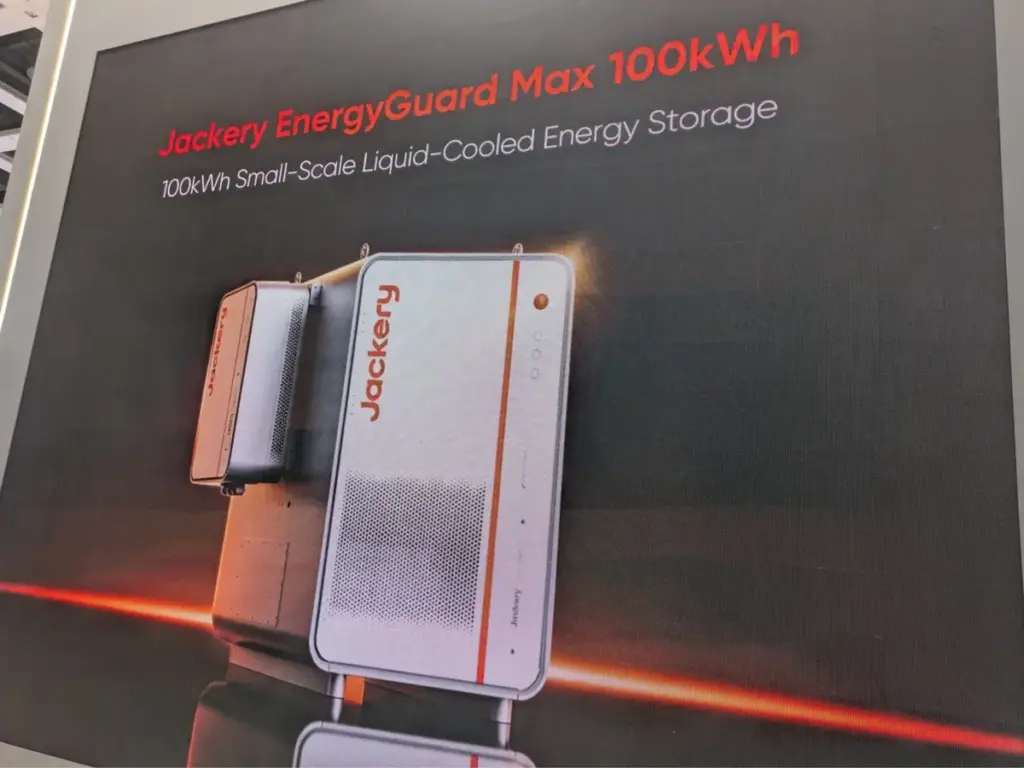
At the IFA Berlin trade show, portable power pioneer Jackery made a bold statement about the future of residential electrification. Stepping far beyond the camping power stations and modular balcony solar kits that built its household name, the company unveiled the Jackery EnergyGuard Max—a colossal whole-home energy storage system designed to fundamentally reshape what consumers expect from domestic power infrastructure.
Pairing a massive 100-kWh Energycore battery module with the robust PowerVault 50 inverter inside rugged, weather-resistant enclosures, the EnergyGuard Max is engineered for a world transitioning rapidly toward all-electric homes and widespread electric vehicle (EV) adoption. While standard residential batteries typically hover between 10 kWh and 15 kWh—designed primarily for short-term evening load shifting or emergency storm backups—Jackery’s commercial-grade-leaning residential system introduces industrial-tier capacity to the suburban landscape.
Weighing in at 1.5 tons and operating on a liquid-cooled Lithium Iron Phosphate (LFP) architecture, this pre-production giant points to a looming era where homes function more like microgrids than simple utility consumers. As electrification drives up domestic power requirements through multi-EV households, residential heat pumps, and aggressive climate control demands, heavy-duty storage solutions are shifting from a luxury for the ultra-prepared to an operational necessity.
Detailed Chronology: The Journey to IFA Berlin and the Genesis of EnergyGuard Max
The path to Jackery’s high-capacity residential debut at IFA Berlin reflects a calculated, evolutionary corporate strategy. Founded with a vision to make mobile power accessible, the company spent years dominating the outdoor recreation and emergency preparedness sectors with its portable Explorer series. However, as global energy landscapes shifted—marked by compounding grid instabilities, volatile fossil fuel prices, and the accelerating electrification of residential heat and transport—Jackery’s leadership recognized a widening chasm between consumer energy demands and available residential hardware.

The Product Philosophy: "What Problem Are You Fixing?"
During exclusive discussions at the IFA Berlin exhibition floor, CleanTechnica sat down with Jackery CEO and founder Jack Sun. Reflecting on the brand’s pivot toward heavy-duty, whole-home decarbonization, Sun emphasized a singular, uncompromising corporate objective: identifying the core pain points in the global transition to sustainable energy and engineering direct, elegant solutions.
When interviewing members of Jackery’s product development teams, a recurring internal mantra emerged. According to engineers, CEO Jack Sun routinely halts product meetings with a deceptively simple question: “What problem are you fixing?”
That exact question dictates the architecture of the EnergyGuard Max. Traditional home batteries often leave glaring gaps in resilience, affordability, usability, and aesthetic integration. More importantly, they frequently fall short of the brute-force energy volume required when a modern household completely severs its reliance on fossil fuels. By stripping away gimmicks and focusing strictly on structural deficits in modern home energy ecosystems—such as inadequate backup runtimes, sluggish EV charging speeds, and restrictive electrical panel limitations—Jackery developed a system designed to solve vulnerabilities that many consumers do not yet realize they possess.
Supporting Context, Hardware Specs, & Technical Metrics
To understand the disruptive potential of the EnergyGuard Max, one must examine the engineering specifications underpinning its weather-resistant enclosures. While still in its pre-production phase at IFA Berlin, the hardware framework reveals a level of sophistication typically reserved for commercial and industrial (C&I) microgrids.
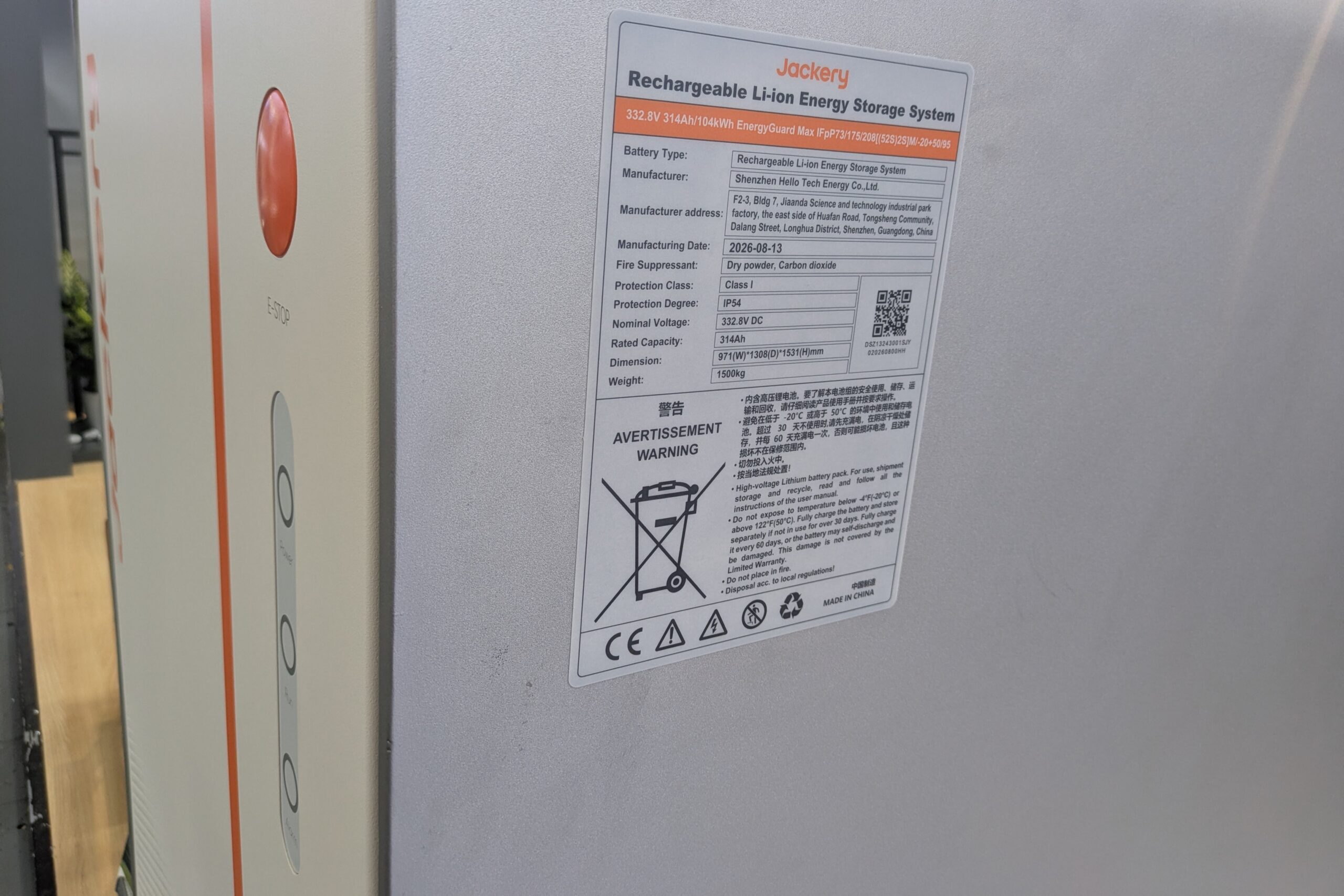
Core Architecture and Durability
- Battery Chemistry: Lithium Iron Phosphate (LFP), renowned for thermal stability, safety, and longevity.
- Nominal Capacity: 104 kWh.
- Operating Voltage: 332.8 V.
- Physical Dimensions: 971 mm wide × 1531 mm high × 1308 mm deep.
- Weight: Approximately 1.5 tons.
- Thermal Management: Advanced liquid-cooling system (mirroring modern EV architectures) to ensure optimal operating temperatures during high-current charging and discharging cycles.
- Software Integration: Over-The-Air (OTA) update capability for continuous firmware optimization.
- Environmental Tolerance: Rated down to -20°C (-4°F), making it viable for harsh winter climates across Central and Eastern Europe (though likely pushing limits in extreme Arctic regions like Scandinavia).
The PowerVault 50 Inverter and EV Synergies
The accompanying PowerVault 50 Inverter acts as the dynamic brain and muscle of the system. Boasting a DC battery input voltage range of 150 V to 950 V and a maximum charging/discharging current of 2 × 80A, the inverter opens the door to advanced bidirectional integration and high-speed energy transfer.
With a DC voltage range reaching up to 950 V, the setup hints at home-based Level 3 DC fast-charging capabilities. While not matching commercial highway superchargers, it could theoretically replenish an electric vehicle in roughly an hour—far outpacing traditional Level 2 residential chargers. For households charging daily via solar yields or off-peak utility hours, this removes scheduling constraints, allowing vehicles to be refueled rapidly at a moment’s notice.
Furthermore, the system facilitates advanced Vehicle-to-Home (V2H) and Vehicle-to-Grid (V2G) workflows. Rather than keeping a vehicle tethered during a grid outage, a car could theoretically drive to an operational public charger, top off its battery, and return home to replenish the 104-kWh home battery—functioning essentially as an "electric jerry can."
Safety Protocols: The FortiShield Framework
Residential energy storage demands immaculate safety standards. The EnergyGuard Max integrates Jackery’s proprietary FortiShield Safety System, a rigorous 7-layer security framework. The PowerVault 50 inverter complements this with comprehensive protections, including:

- DC/AC surge protection
- Insulation resistance detection
- PV string and battery input reverse polarity protection
- Ground fault monitoring
- Residual current monitoring
- AC short circuit protection
- Anti-islanding protection
With a rated AC input/output power of 50 kW at a nominal voltage of 230V/400V, the system supports unbalanced 3-phase power with a grid output current of 72.2 A at 400V. Crucially, its sub-10-millisecond (10 ms) switching time outpaces many Uninterruptible Power Supplies (UPS), safeguarding sensitive household electronics against sudden micro-outages.
Official Statements & Industry Analysis
The introduction of a 104-kWh residential battery has sparked immediate debate regarding the necessity of such colossal scale for single-family homes. Average daily electricity consumption varies wildly; in the United States, a typical home consumes roughly 29 kWh per day, whereas European households often utilize a third to half that volume.
However, looking at averages misses the point of extreme weather vulnerability and structural energy deficits.
Bridging the Northern European Solar Gap
Many observers underestimate Europe’s geographic latitude. Because of warm oceanic currents, cities like Monaco sit farther north than harsh North American winter hubs like Portland, Maine. Consequently, European winters bring severely truncated daylight hours and prolonged stretches of overcast, gloomy weather.

For a moderately sized European home striving for energy independence via solar power, capturing intermittent photons during bleak winter months requires massive storage reservoirs. A 104-kWh battery acts as a temporal sponge, soaking up every available kilowatt-hour during solar production peaks and securely bridging the energy deserts of winter.
Relieving Electrical Service and Transformer Bottlenecks
Beyond backup resilience and solar optimization, the EnergyGuard Max addresses an insidious infrastructure problem: aging home electrical services.
Many older residential properties were constructed decades ago when air conditioning was rare and space heating relied on fossil fuels. Today, homeowners attempting to electrify—adding heat pumps, induction cooktops, Level 2 EV chargers, and central cooling—frequently hit the ceiling of their existing electrical service panels. Upgrading a home’s utility drop or neighborhood transformer can trigger exorbitant costs and multi-month delays.
By positioning a high-capacity battery as an energetic buffer, households can draw continuous, controlled power from the grid during off-peak hours, storing it locally to absorb high instantaneous power spikes. This eliminates the immediate necessity for costly utility service upgrades.

Future Outlook: The Paradigm Shift to Heavy-Duty Home Storage
To contextualize the arrival of the EnergyGuard Max, one can look back at the evolution of electric vehicles. When the first-generation Nissan LEAF debuted with a 24-kWh battery and a 73-mile EPA range, critics and early adopters hailed it as revolutionary. Thirty-minute DC fast-charging to 80% was deemed an acceptable compromise.
Today, that specification sheet would be laughed off the showroom floor. Consumer expectations evolved, EV technology matured, and the industry transitioned smoothly from niche early adopters to global mass adoption.
A similar psychological barrier currently exists around home energy storage. To many consumers, a 104-kWh battery feels excessive—akin to driving a semi-truck to the grocery store. For urban apartment dwellers, compact solutions like Jackery’s balcony-oriented SolarVault 3 remain the ideal fit. But for detached suburban homes, rural farmsteads, and energy-intensive modern households, mega-batteries represent the logical next evolution.
Economics and Virtual Power Plants (VPPs)
While official pricing has not yet been finalized by Jackery, industry insiders note that while a 104-kWh system will naturally carry a higher absolute price tag than a standard Tesla Powerwall, its per-kWh cost will likely be significantly lower. Industry pricing trends indicate that a battery of this scale will cost a fraction of a new car, bringing industrial-grade storage within reach of affluent homeowners and rural homesteaders.

In markets like Germany—characterized by punishingly high electricity rates and volatile dynamic pricing schemes—the Return on Investment (ROI) timeline for high-capacity storage is sharply compressed. When integrated into Virtual Power Plants (VPPs), where aggregated home batteries feed stored energy back into the grid during high-demand pricing spikes, systems of this magnitude have the potential to actively amortize their own purchase costs.
Conclusion
Jackery’s EnergyGuard Max is more than just a larger box of lithium-ion cells; it is a manifestation of an altered engineering philosophy. By directly answering CEO Jack Sun’s guiding question—“What problem are you fixing?”—the company has delivered a comprehensive solution to energy resilience, EV integration, structural grid strain, and sustainable heating. As the global energy transition accelerates, mega-scale home storage is poised to shed its "excessive" label and become the foundational bedrock of the modern smart home.



