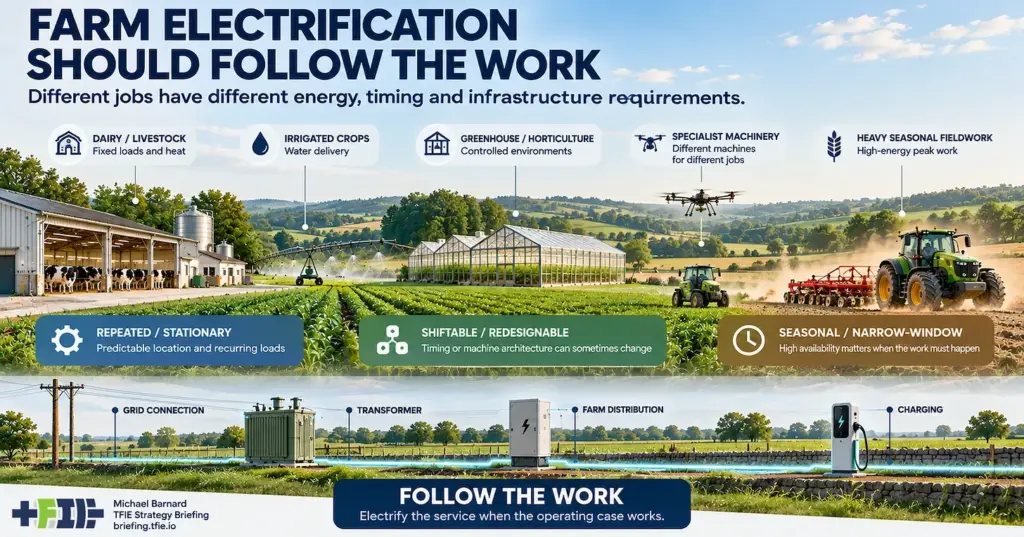
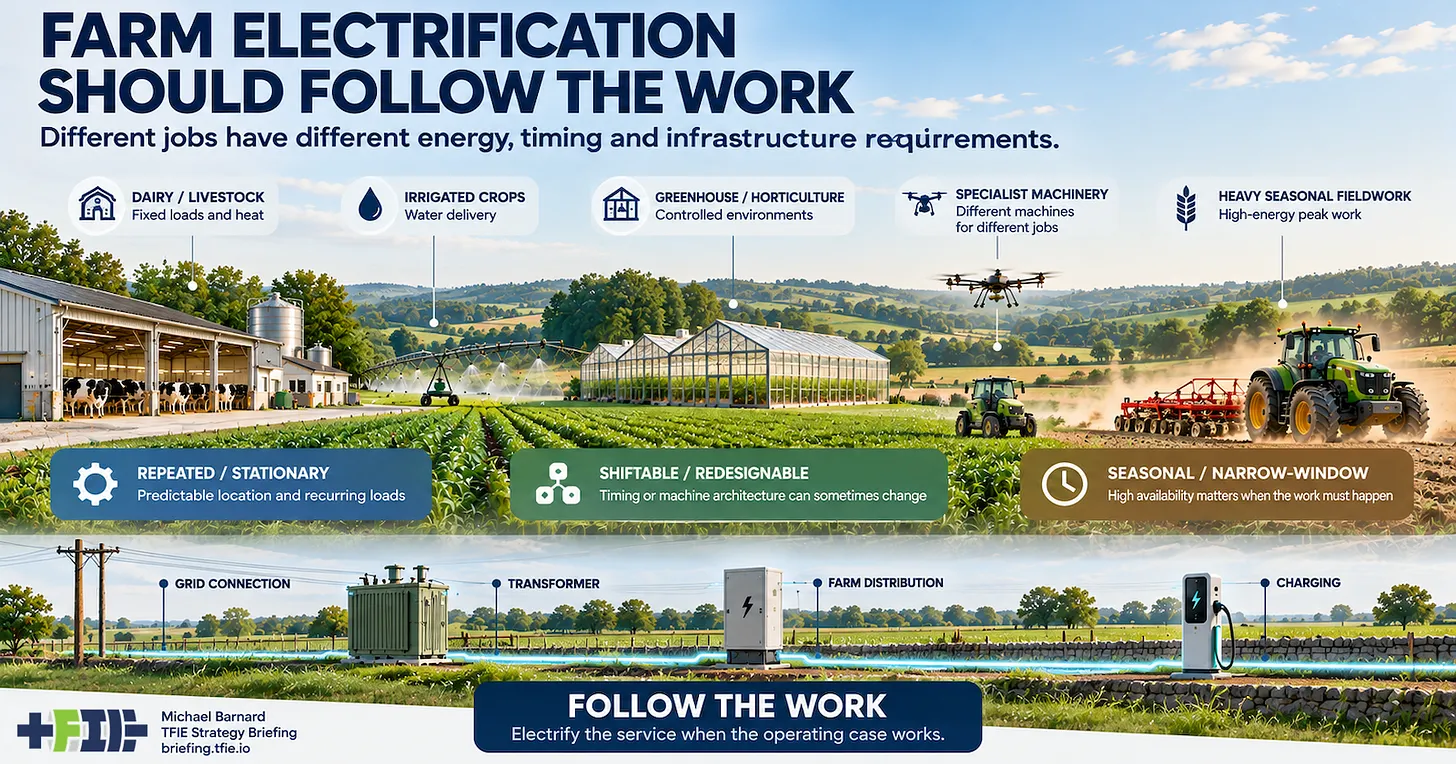
When conversations turn to the feasibility of agricultural decarbonization, the dialogue almost invariably zeroes in on a single, formidable piece of machinery: the heavy diesel tractor. For decades, the internal combustion engine has reigned supreme across wide-acre fields, pulling heavy loads through the narrow, high-stress seasonal windows of planting and harvest.
While transitioning these high-horsepower mobile beasts remains a legitimate, complex engineering hurdle, it serves as a fundamentally flawed organizing principle for the broader electrification of the agricultural sector.
Farms are not monoliths; they are decentralized, multi-faceted industrial ecosystems performing a dizzying array of distinct operational tasks. Milk must be rapidly chilled, water meticulously pumped, livestock housing continuously ventilated and heated, greenhouses thermally regulated, and harvested grains aggressively dried.
These services demand vastly different energy quantities, power requirements, timing constraints, and infrastructural ecosystems. The simple reality that a battery-electric tractor cannot yet seamlessly replace every 200-horsepower diesel workhorse says almost nothing about whether a farm’s kerosene heating systems, irrigation pumps, or milk chillers should continue burning fossil fuels.
To build a resilient, economically viable agricultural energy strategy, stakeholders must invert the traditional approach. The path forward does not begin with a shopping list of gleaming electric machinery; it begins with a rigorous analysis of the underlying work the farm needs performed.
Detailed Chronology: The Evolution of Agricultural Energy Vulnerability
The strategic imperative to rethink farm electrification stems directly from recent vulnerabilities exposed on the global stage.
The Catalyst: Fuel Protests and Diesel Dependence
The cracks in traditional agricultural energy frameworks became starkly visible during the agricultural fuel protests—notably in regions like Ireland—where farmers faced severe financial vulnerabilities driven entirely by an unyielding dependence on subsidized diesel and imported fossil fuels. These disruptions laid bare a systemic risk: when global fuel markets experience volatility, primary food producers bear the immediate brunt of the economic shock.
Initial Missteps: The Equipment-First Trap
In the wake of these crises, early analytical frameworks often prioritized a hardware-first transition. Analysts and policymakers cataloged fossil-fueled equipment—tractors, harvesters, heaters—and attempted to map out a direct, one-to-one electric replacement schedule.
This approach quickly bogged down. Heavy seasonal machinery often sits idle for months at a time before facing punishing, continuous workloads during harvest. Forcing an immediate technological transition on these specific assets without upgrading underlying rural grid capacities or accounting for exorbitant battery costs led to severe economic friction.
Shifting to a Service-Based Paradigm
Recognizing the limitations of the equipment-first model, modern agricultural analysts have pivoted toward a work-first framework. By decoupling the decarbonization timeline of stationary and minor operational loads from heavy broadacre mobility, researchers have unlocked immediate, highly profitable pathways for farm electrification. This evolution recognizes that the electrification sequence must match the physical and economic reality of distinct agricultural systems—whether dairy, swine production, horticulture, or broadacre cultivation.
Supporting Context & Metrics: Case Studies in Agricultural Transition
To understand how a work-first strategy operates in practice, one must examine the micro-economics of specific farm operations, ranging from dairy production to intensive livestock and irrigation.
1. The Dairy Solar Paradox: Energy Balance vs. Useful Delivery
Consider the implementation of solar photovoltaics (PV) on a typical dairy operation. According to models from agricultural authorities like Teagasc, a 100-cow dairy farm consuming roughly 25,000 kWh annually can theoretically achieve near energy independence with a 25 kWp solar array producing 23,484 kWh per year.
On paper, generation equals 94% of consumption. However, without a localized storage solution, the farm typically utilizes only 30% of that PV generation on-site.
Adding a 12.5 kWh battery increases self-consumption to 45%. Yet, under standard utility tariff structures, the unsubsidized simple payback period can actually worsen—stretching from eight years out to ten.
This counterintuitive metric encapsulates a vital lesson for the sector: Annual energy balance is not synonymous with useful energy delivery. Higher self-consumption percentages are meaningless unless they solve a clearly defined operational problem, such as shaving peak demand, providing emergency backup, or capitalizing on favorable tariff spreads.
2. Stationary Thermal Loads: Low-Hanging Fruit
By contrast, stationary thermal loads offer exceptionally clean, immediate investment cases. Historical data from pig-farming operations—such as an 800-sow facility consuming approximately 900 liters of kerosene weekly for farrowing and weaner heating—demonstrate the immense potential of mature electric alternatives.
When such facilities transition to industrial heat-pump architectures, the long-term operational expenditure drops precipitously. Even accounting for capital outlays, the simple payback periods for high-efficiency thermal systems can shrink to under two years prior to financing. While equipment costs fluctuate, the core lesson remains unaltered: many agricultural fossil-fuel problems are, at their root, conventional stationary heating loads that can be electrified using technology that has been mature for decades.
3. Irrigation and the Water-Energy Nexus
Irrigation provides another glaring example of why the service delivered matters far more than the machine deployed. At a macro scale, initiatives like India’s PM-KUSUM dashboard demonstrate massive deployment of solar irrigation infrastructure, with hundreds of thousands of standalone solar pumps and feeder-level solarizations rolled out nationwide.
Yet, the core objective is not simply to "operate a solar pump"; it is to deliver the precise volume of water at the required pressure and time without depleting local aquifers. Because solar power drastically reduces the marginal energy cost of pumping, uncoordinated solarization can inadvertently accelerate groundwater depletion rather than merely swap diesel for photons.
Consequently, modern strategies dictate that pumping technology, energy pricing, and water governance must be tightly integrated. Utilizing variable-speed drives and smart water storage can optimize both energy consumption and resource preservation.
4. The Commercial Reality of Mobile Machinery
When evaluating mobile machinery, commercial benchmarks like the Fendt e107 Vario tractor provide a grounded reality check. Equipped with a 100 kWh battery, 55 kW of continuous power, and a 66 kW peak output, this machine offers roughly four to seven hours of runtime in partial-load applications such as mechanical weed control or planting.
Energy-intensive transport, however, rapidly diminishes this runtime. This is not proof that electric tractors are unviable; rather, it underscores that duty cycle dictates feasibility. An electric tractor optimized for light, specialist daily operations can be commercially transformative long before battery technology can support every heavy, continuous broadacre tillage operation.
Official Statements & Expert Frameworks
Agricultural economists and energy strategists emphasize that policymakers must align their interventions with the actual bottlenecks of the industry rather than arbitrary decarbonization dates.
"Good farm-electrification strategy should begin with the work the farm needs performed, not with a shopping list of electric equipment."
This sentiment, underscored by comprehensive strategy briefings from groups like TFIE, highlights the danger of top-down mandates. When governments incentivize equipment purchases without evaluating infrastructure readiness or utility capacity, they often create bottlenecks rather than progress.
Furthermore, international organizations such as the Food and Agriculture Organization (FAO) have repeatedly issued warnings regarding the unmanaged expansion of solar-powered water extraction. Official guidance stresses that energy policy in agriculture must be inextricably linked with environmental stewardship:
"Pumping technology, energy pricing, and water governance have to be considered together to prevent catastrophic groundwater depletion under subsidized solar initiatives."
Future Outlook: Infrastructure Traps, Shared Services, and the Path Ahead
As the agricultural sector looks toward the coming decades, several strategic shifts will define successful electrification.
Avoiding the Infrastructure Trap
One of the most insidious risks facing modern farms is the infrastructure lag. Upgrading rural grid connections, installing high-capacity transformers, and provisioning multi-megawatt charging depots can take years of bureaucratic planning and engineering execution.
Farms that wait until the "perfect" electric tractor hits the commercial market before upgrading their electrical supply will find themselves stranded with advanced machinery they cannot charge. Forward-thinking operations are proactively upgrading their electrical headroom through stationary loads—such as refrigeration, dairy hot water systems, and heat pumps—paving the way for mobile charging infrastructure down the road.
The Rise of Shared Services and Contractor Depots
Because heavy broadacre machinery spends much of the year sitting idle, the traditional model of individual ownership for every expensive asset faces mounting economic pressure. Contractor depots represent a powerful alternative. By concentrating high-value, specialized electric equipment in the hands of commercial service providers, the industry can drastically increase annual utilization rates.
A single robust grid connection at a contractor yard can support heavy-duty electric machinery servicing dozens of surrounding farms, amortizing capital costs far more efficiently than individual smallholdings ever could.
Tailored Electrification Sequences by Farm Type
Ultimately, the roadmap looks radically different depending on the agricultural sub-sector:
Dairy & Intensive Livestock: Prioritize cooling, hot water, ventilation, heat recovery, and automated feeding systems.
Irrigation-Heavy Systems: Focus on pump efficiency, intelligent scheduling, water storage, and grid-tied or hybrid power supplies.
Broadacre Farming: Defer full mobile tractor electrification until duty-cycle economics and rural grid capacities align, focusing first on stationary operations and selective light-utility tasks.
Smallholder Access: Prioritize basic productive energy access—refrigeration, processing, and localized water pumping—to maximize socio-economic uplift.
Conclusion
The ultimate measure of agricultural electrification is not the date on which the final diesel tractor is permanently parked. Success will be judged by whether successive equipment replacements, infrastructure upgrades, and operational modifications successfully strip away fossil-fuel exposure while safeguarding—and ideally enhancing—the cost, resilience, and reliability of global food production. The tractor will electrify when the convergence of battery chemistry, duty cycles, grid infrastructure, and economic reality makes sense. Until then, the rest of the farm has plenty of vital work to do.