Executive Overview
In an era defined by rapid biodiversity loss and unprecedented ecological challenges, the preservation of scientific literature is more critical than ever. For nearly two decades, the Biodiversity Heritage Library (BHL) has served as the world’s definitive open-access digital repository for biodiversity literature and archives. Containing more than 64 million pages of foundational scientific texts, field notes, illustrations, and taxonomic descriptions, BHL is the digital ark upon which modern ecological research, historical analysis, and conservation strategies rely.
Yet, between 2025 and 2026, this vital global resource faced an existential crisis. Following the sudden loss of the institutional support it had depended on for nearly twenty years—its foundational home at the Smithsonian Institution—BHL was thrust into a precarious vacuum with no guaranteed future. The challenge was monumental: staff, core technical infrastructure, governance models, global partnerships, and sustainable funding streams all had to be independently secured within a matter of months.
Thanks to an extraordinary mobilization of the international scientific and conservation community, BHL survived. Through public fundraising campaigns, strategic relocations, and a newly established distributed governance model, the library successfully transitioned to an independent future. However, survival is only the first step. Today, as the library completes its historic administrative and infrastructural migration, BHL is launching its next critical phase: the "BHL Sustainers" initiative. This comprehensive report examines the timeline of BHL’s harrowing transition, the metrics of its community-led rescue, and the ongoing imperative to secure long-term, predictable funding for the world’s largest open-access biodiversity library.
Detailed Chronology: The Anatomy of a Crisis and Transition
The survival of the Biodiversity Heritage Library is a masterclass in institutional resilience, global cooperation, and community-driven philanthropy. To understand the magnitude of BHL’s current standing, one must examine the rapid, high-stakes timeline that defined its transition from a Smithsonian-backed project to a globally governed independent entity.
The Threat of 2025: Loss of Institutional Anchorage
For almost twenty years, BHL operated under the robust institutional umbrella of the Smithsonian Institution. This partnership provided stability, technical hosting, administrative backing, and international prestige. However, when that foundational support was abruptly removed, BHL was left without a permanent institutional home.
The implications were catastrophic. Without intervention, the world would lose free access to centuries of irreplaceable biodiversity literature. Technical systems risked going offline, staff faced displacement, and the vast digital architecture connecting taxonomic literature across continents threatened to fracture. The leadership team faced a daunting reality: reinvent BHL as an independent, globally governed entity, or watch decades of open-access infrastructure dissolve.
The Rally: Launching "#GiveBHLWings"
Faced with this existential threat, BHL leadership chose transparency and mobilization. On October 17, 2025, the organization launched public fundraising efforts under the banner "#GiveBHLWings." The campaign was designed not only to raise immediate operational capital but also to demonstrate to institutional partners and the global scientific community that BHL was a vital public asset worth fighting for.
The response was immediate and international. Over a rigorous seven-week fundraising push leading up to the end-of-year deadline, supporters from 46 countries stepped forward. By the time the clock struck midnight on the transition threshold, the global community had contributed more than $113,000 USD to secure BHL’s independent future. Crucially, $51,000 of this total was raised during the final seven-week sprint leading up to January 1, 2026.
The Operational Pivot and Infrastructure Migration
While financial contributions provided the immediate oxygen BHL needed to retain core staff and keep services online, the structural transition was far from complete. The first half of 2026 was defined by complex administrative realignment and physical asset relocation.
By the end of June 2026, BHL’s formal transition period concluded. However, the final, most logistically challenging piece of the puzzle remained: moving BHL’s servers and core technical infrastructure. In July 2026, the library completed a massive migration, transferring its digital core from the Smithsonian Institution to the Field Museum in Chicago.
This move marked the birth of BHL’s new operational model. Moving away from total reliance on a single host institution, BHL adopted a resilient, distributed, partner-supported governance framework. Today, this administrative and technical foundation ensures that BHL is no longer vulnerable to a single point of failure, positioning the library for a more decentralized, globally collaborative future.
Supporting Context & Metrics: The Global Impact of BHL
To fully grasp why the international community rallied so fiercely to save BHL, one must look at the sheer scale of the library’s holdings and its indispensable role in global science, education, and culture.
By the Numbers: The Scale of BHL
- 64 Million+ Pages: The total volume of digitized biodiversity literature, field notes, and historic taxonomic plates freely available online.
- 46 Countries: The geographic breadth of the donor base that contributed to the emergency fundraising campaign, proving that BHL’s value transcends national borders.
- $113,000+ USD: The total amount raised during the transition fundraising push, demonstrating grassroots commitment to open-access science.
- $51,000 USD: The funds raised during the intense seven-week #GiveBHLWings campaign leading up to the January 1, 2026 transition.
- 135+ Currencies: The donation capacity now supported through BHL’s fiscal sponsor, ensuring that contributors worldwide can give in their local currency.
Who Relies on BHL?
BHL is not merely an archive for historians; it is a dynamic working tool used daily by professionals across a multitude of disciplines:
- Taxonomists and Evolutionary Biologists: Researchers rely on BHL to access original species descriptions, historic type specimens, and baseline ecological data that are often locked in rare, centuries-old volumes.
- Conservationists: Field scientists use historic distribution records and ecological surveys to map environmental changes over centuries, informing modern habitat restoration and endangered species protection.
- Artists and Writers: Natural history illustrators, authors, and creators draw inspiration from BHL’s vast repository of public-domain botanical and zoological plates.
- Educators and Students: Universities and K-12 educators utilize BHL’s digital collections to teach biology, history of science, and environmental ethics, bringing primary sources directly into virtual and physical classrooms.
As Nicole Kearney, BHL Communications Director, Manager of BHL Australia, and Chair of BHL’s Persistent Identifier Working Group, aptly emphasizes, the library exists because of a global community deeply committed to open access, shared infrastructure, and the democratization of knowledge.
Official Statements and Leadership Insights
The successful navigation of BHL’s transition was guided by strategic foresight, transparent communication, and an unwavering belief in the power of open science.

Reflecting on the milestone, BHL leadership has consistently underscored that the survival of the library was a collective victory. In statements released across the network’s official channels, representatives noted:
"Last year, our community gave BHL wings. Because our community rallied around BHL, staff were retained, services continued, and more than 64 million pages of biodiversity literature and archives remain freely accessible online."
However, leadership has been equally vocal about the realities of operating a distributed, independent digital library. The transition period established a new foundation, but maintaining that foundation requires a paradigm shift in how BHL is funded. Nicole Kearney and the BHL steering committees have framed the current moment as a transition from emergency rescue to sustainable cultivation:
"Together, we saved BHL. Now we need to sustain it. For 20 years, BHL has opened biodiversity literature to the world. It exists because of a global community committed to open access, shared infrastructure, and the belief that biodiversity knowledge should be available to everyone. Last year, that community gave BHL wings. Now we’re asking you to help us keep flying."
The message from the executive level is clear: while emergency fundraising kept the lights on and servers running during a moment of profound uncertainty, long-term stability demands predictable, recurring revenue streams.
Future Outlook: The "BHL Sustainers" Campaign
With its technical migration to the Field Museum complete and its governance decentralized, BHL is officially entering its next chapter. Yet, the work of maintaining a digital archive of 64 million pages is continuous and resource-intensive.
Why Monthly Support Matters
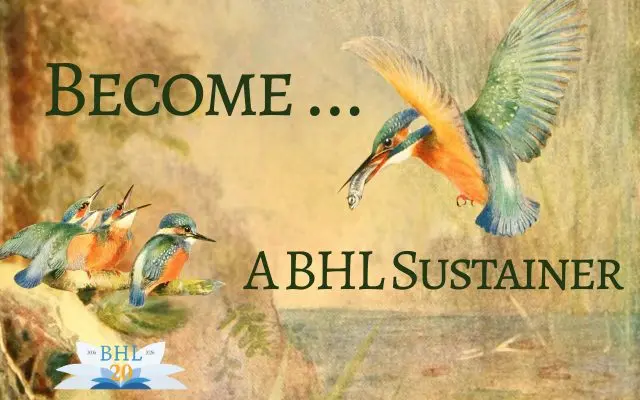
Like the delicate ecosystems BHL documents—symbolized poignantly in the library’s communications by imagery of baby kingfishers and historic natural history egg plates—the library requires dependable, ongoing care to thrive.
Infusion-style funding, while vital for emergencies, cannot support day-to-day operations. Monthly financial support provides predictable income that allows BHL to:
- Sustain Core Staff: Retain the expert bibliographers, technicians, and administrative personnel who manage digitizations, metadata, and user services.
- Modernize Technical Infrastructure: Continuously upgrade servers, software, and data pipelines across its newly distributed network to ensure high-speed, reliable access for global users.
- Improve Access and Discoverability: Implement advanced search algorithms, persistent identifiers, and machine-learning tools to make millions of pages of complex scientific text easier to find and cite.
- Grow and Connect Collections: Forge new partnerships with libraries, museums, and research institutions worldwide to ingest new literature and link taxonomic names across global biodiversity databases.
Becoming a BHL Sustainer
To achieve this stability, BHL is launching the BHL Sustainers initiative. The program invites individuals, researchers, educators, and nature enthusiasts from around the globe to commit to a recurring monthly gift.
Emphasizing that inclusivity is core to BHL’s mission, the sustainer program is designed to accommodate contributors of all financial capacities. Gifts can be made in over 135 currencies, ensuring that a supporter in Sydney, London, Nairobi, or Buenos Aires can contribute an amount that fits their circumstances. Whether a modest monthly contribution or a larger legacy gift, every dollar directly reinforces the digital foundation of global biodiversity science.
Additional Ways to Give
For those wishing to support BHL beyond monthly contributions, the library offers several alternative philanthropic pathways:
- Major Gifts & Wire Transfers: For high-impact donors looking to fund specific infrastructural upgrades or digital preservation projects.
- Bequests & Legacy Gifts: Ensuring that BHL remains a permanent fixture for future generations of scientists and nature lovers.
- Fiscal Sponsorship Transparency: Donations are securely processed through BHL’s trusted fiscal sponsor, the Council on Library and Information Resources (CLIR), with tax-deductibility status varying depending on the donor’s country of residence and individual circumstances.
Conclusion
The story of the Biodiversity Heritage Library over the past two years is a testament to what can be achieved when a global community refuses to let vital knowledge vanish. By mobilizing across 46 countries, supporters didn’t just rescue a digital repository—they safeguarded the historical memory of life on Earth.
Now, as BHL settles into its new, resilient home at the Field Museum and operates through a collaborative international framework, the responsibility shifts to long-term stewardship. The emergency phase is over; the era of sustainable growth has begun. For anyone whose work, research, teaching, art, or personal passion is touched by the natural world, becoming a BHL Sustainer is more than a donation—it is an investment in the permanence of open science.
Last year, the global community gave BHL wings. Today, the call is clear: help us keep flying.