

Executive Overview
In the landscape of global scientific research, few digital repositories hold as much historical and ecological significance as the Biodiversity Heritage Library (BHL). For nearly two decades, this unprecedented initiative has served as the world’s largest open-access digital library for biodiversity literature and archives. Operating as a borderless, democratic portal, BHL has democratized access to more than 64 million pages of priceless scientific heritage, ranging from foundational botanical illustrations and centuries-old taxonomic treatises to obscure field journals documenting rapidly vanishing ecosystems.
However, the edifice of open science is fragile. In 2025, BHL faced an existential crisis that threatened to erase two decades of collaborative progress. Following the sudden loss of long-term institutional backing from the Smithsonian Institution—the primary anchor of its operational stability—BHL was cast adrift without a guaranteed future. The challenge was monumental: decouple, redesign, and re-establish a massive digital infrastructure, administrative network, and governance model independently, all while ensuring continuous public access to tens of millions of pages of irreplaceable data.
What followed was a masterclass in global community resilience. Through the "#GiveBHLWings" campaign and broader public fundraising initiatives, supporters from 46 countries rallied to raise over $113,000 USD, proving that the international scientific, educational, and conservation communities would not let the library fall. By July 2026, the transition period successfully concluded with the physical relocation of BHL’s core servers to the Field Museum in Chicago, solidifying a new distributed, partner-supported governance model.
Yet, as leadership is quick to emphasize, surviving an existential crisis is only the first step. Having successfully given BHL "wings" to navigate its transition to independence, the global community now faces the ongoing task of keeping it aloft. This report details the chronology of BHL’s harrowing transition, the metrics of its community-driven rescue, the mechanics of its new operational framework, and the critical imperative for sustained monthly support in an era where open-access scientific infrastructure remains chronically underfunded.
Detailed Chronology: Anatomy of an Existential Crisis and Rebirth
To understand the magnitude of BHL’s 2025–2026 transition, one must examine the precarious nature of digital public goods. For nearly twenty years, BHL functioned under the robust institutional shelter of the Smithsonian Institution. This partnership provided core technical infrastructure, administrative oversight, and financial predictability.
The turning point arrived abruptly in 2025 when structural shifts forced the sudden withdrawal of this foundational support. Overnight, BHL faced the daunting prospect of homelessness in the digital realm. The library’s core operational needs—ranging from software maintenance and metadata cataloging to server hosting and staff retention—were thrown into profound uncertainty. Without swift intervention, the digital archives risked disconnection, paywalling, or complete abandonment.
Phase 1: The Mobilization (October 2025)
Recognizing that time was of the essence, BHL leadership initiated a public transition strategy. On October 17, 2025, the organization officially launched its public fundraising drive, signaling to the world that its survival depended on collective action. The strategy was clear: transform a centralized, institutionally dependent library into a globally governed, decentralized open-access utility.
Phase 2: The #GiveBHLWings Campaign (November – December 2025)
As the calendar wound down toward the self-imposed transition deadline of January 1, 2026, BHL launched its intensive #GiveBHLWings campaign during the final seven weeks of the year. The campaign struck a chord with researchers, librarians, historians, artists, and nature enthusiasts worldwide. Donations poured in not just from major philanthropic entities, but from individual citizens across 46 nations. During this sprint alone, supporters contributed $51,000 USD, bridging immediate operational gaps and ensuring that staff could be retained as the clock ticked down to the new year.
Phase 3: The Transition to Independence (January 2026)
On January 1, 2026, BHL officially crossed the threshold into independence. Thanks to the immediate influx of funds and strategic planning, the lights stayed on. Services continued uninterrupted, and the massive repository of 64 million pages remained completely free and open to the public. However, the operational machinery of the library was still undergoing major reconfiguration behind the scenes.
Phase 4: Infrastructure Migration and Stabilization (June – July 2026)
The formal transition period officially concluded at the end of June 2026. Nevertheless, the most complex technical hurdle remained: moving BHL’s digital heartbeat. In July 2026, the library executed the massive migration of its core servers and technical infrastructure from the Smithsonian Institution to its new home at the Field Museum in Chicago.
This migration marked the birth of BHL’s new distributed, partner-supported operational model. Rather than relying on a single institutional benefactor, BHL now operates as a collaborative network, pooling resources, expertise, and governance across multiple international institutions. While this model offers greater long-term resilience and democratization, it also requires a diversified and continuous stream of operational revenue.
Supporting Context & Metrics: By the Numbers
The story of BHL’s survival is best told through data—metrics that illustrate both the immense scale of the resource saved and the global footprint of the community that rescued it.
- 64,000,000+: The number of pages of biodiversity literature, field notes, taxonomic monographs, and historical illustrations safely maintained and kept freely accessible online.
- $113,000+ USD: The total amount raised from public supporters since the transition fundraising initiative began.
- $51,000 USD: The funds raised specifically during the final seven-week
#GiveBHLWingssprint leading up to the January 1, 2026 independence date. - 46 Countries: The global spread of donors who contributed to the campaign, highlighting BHL’s status as a truly international public good.
- 135+ Currencies: The financial flexibility built into BHL’s modern donation framework, allowing supporters from virtually every corner of the globe to contribute in local denominations through fiscal sponsor the Council on Library and Information Resources (CLIR).
These numbers represent more than just financial accounting; they reflect a profound validation of the open-access ethos. In a geopolitical and economic climate where scientific data is increasingly commercialized or locked behind prohibitive subscription walls, the global community’s willingness to fund a decentralized biodiversity library stands as a powerful testament to the democratization of knowledge.

Official Perspectives: The Imperative of Open Knowledge
The successful preservation of BHL has prompted reflection from administrators, archivists, and researchers regarding the vulnerability of digital infrastructure in the 21st century.
“When we lost our primary institutional home, the immediate fear was not just operational collapse, but the severing of a global lifeline for biodiversity research,” noted a senior BHL administrative representative during the conclusion of the transition period. “Taxonomists trying to verify a species description, historians tracking climate change impacts through centuries-old ship logs, and educators inspiring the next generation of conservationists all rely on BHL being open, free, and stable. Our community understood that reality instantly.”
Scholars and researchers who utilize the archive have echoed these sentiments, pointing out that biodiversity literature is uniquely fragile. Much of the physical material housed within BHL exists in only a handful of specialized rare-book libraries around the globe. Without digitization and open-access curation, this knowledge remains physically inaccessible to scientists in the Global South, independent researchers, and grassroots conservationists who lack access to well-funded academic library networks.
Furthermore, historians of science emphasize the irreplaceable nature of BHL’s collections. The literature bridges the gap between historical natural philosophy and modern conservation biology. By securing BHL at the Field Museum and establishing a distributed governance model, the library has insulated itself against future single-point-of-failure vulnerabilities—provided that sustainable funding streams can be secured to maintain the physical and digital architecture.
Future Outlook: The Campaign to Sustain BHL
With its technical infrastructure successfully migrated to Chicago and its administrative independence secured, BHL has transitioned from an emergency rescue mission to a long-term sustainability campaign. The core message from leadership is unequivocal: Together, we saved BHL. Now we need to sustain it.
Why Monthly Support Matters
Digital libraries are not static monuments; they are living systems. Maintaining 64 million pages of high-resolution literature requires continuous investment in software updates, server maintenance, cybersecurity, metadata enhancement, and discoverability tools. It requires retaining skilled archivists, software engineers, and catalogers who understand the complex nuances of biodiversity nomenclature and historical text digitization.
While major gifts, bequests, and legacy endowments play a critical role in long-term financial planning, the day-to-day resilience of BHL relies heavily on predictable, recurring revenue. This is why the library has launched its latest initiative: inviting supporters to become BHL Sustainers through monthly giving.
The BHL Sustainers Initiative
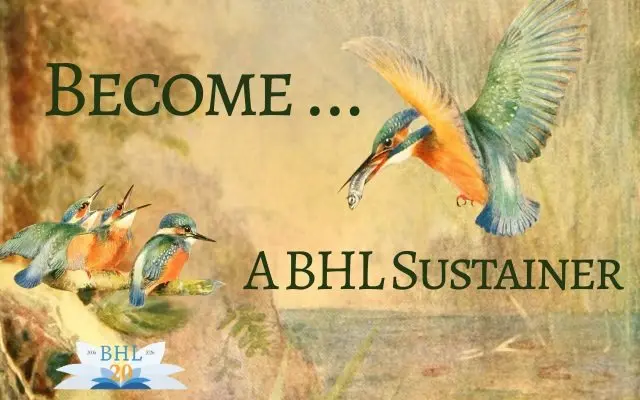
Drawing inspiration from the natural world—such as the historic natural history illustrations of bird eggs and hatchlings preserved within its own collections—BHL emphasizes that contributions of all sizes matter.
- Predictability: Monthly gifts create a stable financial baseline, allowing administrators to forecast operational expenses accurately and plan long-term technological upgrades.
- Accessibility: Designed to be inclusive, monthly giving tiers accommodate supporters at every economic level. A modest monthly contribution, multiplied across a global community, aggregates into a powerful financial safety net.
- Global Participation: Donations can be processed seamlessly in over 135 currencies, ensuring that geographic barriers do not impede a supporter’s ability to contribute. Tax deductibility is managed transparently through BHL’s fiscal sponsor, the Council on Library and Information Resources (CLIR), varying by country of residence and individual circumstances.
How to Get Involved
As BHL looks toward its third decade of operation, its leadership issues a direct call to action to anyone whose work, research, teaching, art, or love of the natural world touches upon biodiversity:
"For 20 years, BHL has opened biodiversity literature to the world. It exists because of a global community committed to open access, shared infrastructure, and the belief that biodiversity knowledge should be available to everyone. Last year, that community gave BHL wings. Now we’re asking you to help us keep flying."
Supporters interested in joining the BHL Sustainers program can set up recurring monthly contributions via the official BHL Donor Support Portal. For those wishing to contribute through alternative avenues—such as major philanthropic gifts, wire transfers, or legacy bequests—comprehensive guidelines are available through the BHL Ways to Give page.
In an age defined by ecological crises and rapid biodiversity loss, the preservation of our shared scientific heritage has never been more urgent. By ensuring the financial sustainability of the Biodiversity Heritage Library, the global community is not merely archiving the past—it is securing the empirical foundation required to understand and protect our planet’s future.



