There is a distinct, deeply evocative sensory experience that defines the British summertime: the sudden parting of heavy grey clouds, a modest ambient temperature barely climbing into the double digits, and the unmistakable, rich aroma of smoky, charcoal-cooked food drifting down the street. While gas barbecues offer undeniable convenience with their clean lines, rapid ignition, and precise dial controls, they often come at a steeper financial cost and require unwieldy, heavy propane tanks. For purists and flavor enthusiasts alike, nothing truly replicates the authentic woody, smoky depth imparted by traditional charcoal cooking.
To help consumers navigate the crowded market, the reviews team at BBC Gardeners’ World Magazine joined forces with the culinary experts at Good Food Magazine. Combining elite gastronomic knowledge with decades of horticultural and outdoor-living expertise, the testing panel put a comprehensive range of new and consistently popular charcoal barbecues through rigorous, real-world trials. Every model was unpacked, assembled, cleaned, and used to cook a wide variety of fresh ingredients—from delicate vegetables and halloumi to massive spatchcock chickens.
Barbecues were evaluated on a strict set of criteria encompassing assembly ease, cooking performance, temperature control, and overall value for money. This comprehensive report breaks down the top-performing charcoal barbecues across multiple budget categories, detailing their dimensions, grilling areas, warranties, and standout features to ensure you find the perfect fit for your outdoor space.
Detailed Chronology & Testing Methodology
The collaborative testing process between BBC Gardeners’ World Magazine and Good Food Magazine relies on a rigorous, multi-stage evaluation protocol designed to simulate genuine domestic use.
1. The Unboxing and Assembly Phase
Every selected barbecue arrives in its retail packaging to test the out-of-the-box experience. Reviewers assess the clarity of the instruction manuals, the presence of required tools, the intuitiveness of component integration, and the overall build time. Models that utilize modern digital aids—such as 3D step-by-step building applications—frequently score higher due to the elimination of frustrating, diagram-only instruction sheets.
2. The Firing and Thermal Phase
Once assembled, the units are loaded with sustainable charcoal and subjected to ignition tests. Testers monitor how quickly each barbecue reaches optimum searing temperatures (often targeting around 200°C to 400°C depending on the model style) and how effectively its air vents, dampers, or electric fans manage airflow. The presence of responsive, accurate lid-mounted temperature gauges is closely scrutinized.
3. The Gastronomic Trial
Culinary performance is the ultimate metric. Testers prepare a standardized menu designed to test both direct searing and indirect convection cooking. This includes:
Sizzling Proteins: Burgers and sausages to test direct heat distribution and flare-up management.
Delicate Items: Halloumi and vegetable skewers to check for grid-gap spacing, sticking, and char-line definition.
Large Joints: Whole spatchcock chickens and large cuts of meat to evaluate moisture retention, convection efficiency, and roasting capabilities.
4. Post-Cooking Maintenance
After cooling, each barbecue is evaluated on its ease of cleaning. Features such as removable ash catchers, porcelain-enamelled bowls, and non-stick grill grates earn high praise, while grease traps or internal moats that stain easily or prove difficult to scour are noted as drawbacks.
Supporting Context & Metrics: The Top Charcoal Barbecues at a Glance
The comprehensive testing panel evaluated models spanning entry-level portable units to ultra-premium ceramic kamado cookers. Below is a detailed breakdown of the top performers, organized by price tier.
Comparison Table: Best Charcoal BBQs
Product
Rating
RRP (Approx.)
Grill Area
Warranty
Kamado Joe Big Joe Series III
4.8/5
£2,899
2,992 cm²
Lifetime
Big Green Egg (Large)
4.8/5
£1,495
1,662 cm²
Limited Lifetime
Napoleon Premium 14 Portable
4.5/5
£79.99
910 cm²
10 years (limited)
Lotus Grill G340
4.5/5
£175
804 cm²
2 years (defects)
Weber Master-Touch GBS E-5755
4.5/5
£335
2,342 cm²
10 years (limited)
Kasai Konro Grill (Little)
4.5/5
£399
1,040 cm²
1 year
Vonhaus Barrel
4.3/5
£79.99
2,485 cm²
2 years
Napoleon 22-inch Kettle Grill
4.3/5
£299.99
2,551 cm²
10 years
Weber Classic Kettle E5710
4.3/5
£239
2,342 cm²
10 years (limited)
Char-Broil Kettleman
4.3/5
£259.99
3,421 cm²
2 years
Top-Rated Charcoal Barbecues Under £200
Napoleon Premium 14 Charcoal Portable
Our Rating: 4.5 / 5
Grill Area: 910 cm²
Verdict: The ultimate disposable barbecue alternative. Light, sturdy, and featuring a 14-inch grill spacious enough for a family of four, it stands out by including a lidded design with dual air vents for precise temperature regulation. Its dual-zone charcoal basket enables both direct and indirect grilling, and a standard bag of lumpwood charcoal fits neatly under the lid for easy transport to parks, beaches, or campsites.
Vonhaus Barrel Charcoal Barbecue
Our Rating: 4.3 / 5
Grill Area: 2,485 cm²
Verdict: Built for larger crowds, this barrel cooker features an efficient surface that reaches cooking temperature in just 20 minutes. In testing, it roasted an entire spatchcock chicken to juicy perfection in 15 minutes. It features a convenient front lid thermometer, smooth opening action, and a handle that doubles as a tool rest, though its wheels are of lower quality.
Lotus Grill G340
Our Rating: 4.5 / 5
Grill Area: 804 cm²
Verdict: Uniquely assisted by an internal electric fan, this portable marvel reaches cooking temperature in minutes while producing virtually zero smoke. Its cool-touch exterior walls make it exceptionally safe for table-top deployment in small courtyards and ideal for introducing teenagers to charcoal grilling.
Top-Rated Charcoal Barbecues Between £200 and £500
Weber Master-Touch GBS E-5755 Charcoal Barbecue
Our Rating: 4.5 / 5
Grill Area: 2,342 cm²
Verdict: A magnificent all-rounder that blends traditional kettle grilling with smoking and modular cooking accessory support (such as pizza stones and woks). Guided assembly via the 3D Bilt app makes building a breeze. It delivers scorching central searing temperatures framed by a cooler outer ring for controlled cooking.
Napoleon 22-inch Charcoal Kettle Grill Barbecue
Our Rating: 4.3 / 5
Grill Area: 2,551 cm²
Verdict: Designed for user-friendly operation, this kettle grill features hinged grates for easy fuel top-ups, an integrated lid hanging hook, a removable ash catcher, and a temperature gauge with clear cooking zones. It distributes heat evenly, though assembly can be somewhat fiddly.
Kasai Konro Grill (Little)
Our Rating: 4.5 / 5
Grill Area: 1,040 cm²
Verdict: Bringing authentic Japanese robata-style cooking to UK gardens, this compact unit utilizes a brushed stainless-steel frame and vermiculite insulation to keep its exterior cool and safe. It delivers intensely juicy, well-charred results across meats, fish, and vegetables alike.
Premium Charcoal Barbecues (£500+)
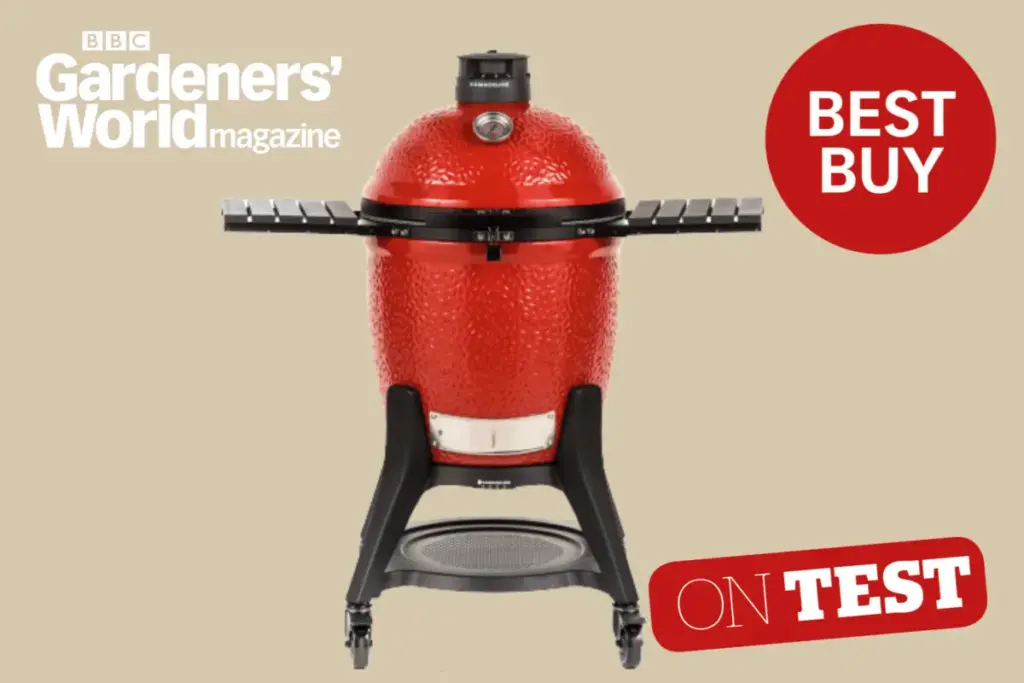
Kamado Joe Big Joe Series III
Our Rating: 4.8 / 5
Grill Area: 2,992 cm²
Verdict: A monumental, 130kg ceramic cooking beast engineered for serious outdoor chefs. Equipped with a patented Slǫtroller smoking insert, heavy-duty hardware, and precision venting, it maintains stable temperatures for hours—easily hitting a scorching 400°C or executing low-and-slow smoking sessions with near-perfection.
Big Green Egg (Large)
Our Rating: 4.8 / 5
Grill Area: 1,662 cm²
Verdict: The gold standard of ceramic kamado cookers. It multitasks effortlessly as a smoker, oven, and grill, providing unmatched thermal retention and precise temperature control. While investment-heavy, its lifetime durability and gourmet cooking output make it a prized centerpiece for dedicated food enthusiasts.
Official Statements & Expert Guidance
When investing in a charcoal barbecue, understanding the nuances of fuel selection and operational safety is paramount. The expert testing panel emphasizes several key principles for optimal results:
"Sustainable charcoal is now widely accessible and represents a vital investment in both the environment and your culinary output. Look for the FSC (Forest Stewardship Council) logo on packaging to ensure your timber is sourced from properly managed forests. While premium sustainable charcoal carries a higher initial price tag, it burns significantly slower and delivers superior, consistent heat output that ultimately offsets the cost."
— Oliver Parsons, Strategic Projects Editor
Furthermore, experts advise strict adherence to lighting safety. Consumers should consistently avoid chemical-laden briquettes and self-lighting charcoals that emit pungent odors capable of ruining the delicate flavors of grilled food. Never use liquid petroleum or indoor coal firelighters; instead, opt for natural, chemical-free firelighters.
Future Outlook: The Evolution of Outdoor Cooking
As outdoor living spaces continue to evolve into seamless extensions of the modern British home, the barbecue market is undergoing a parallel transformation. Looking ahead toward future product cycles, testing standards implemented by BBC Gardeners’ World Magazine are tightening: newly awarded Best Buy badges will be exclusively reserved for equipment achieving elite scores of 4.5 out of 5 or higher, ensuring that consumers receive recommendations of only the highest engineering and functional caliber.
Simultaneously, manufacturers are placing greater emphasis on modular versatility—allowing a single chassis to transition effortlessly from high-heat searing to low-temperature smoking, baking, and rotisserie cooking. Whether opting for a compact, highly portable table-top unit for impromptu park visits or investing in a generational ceramic kamado cooker for grand garden entertaining, the future of charcoal grilling promises greater efficiency, refined temperature control, and—above all—uncompromising flavor.