

Executive Overview
In the wake of a catastrophic glacial collapse on the Tibetan Plateau that sent a destructive wall of water and debris roaring across the Nepal-China border, the true vulnerability of the Hindu Kush Himalayan region has been laid bare. Official tallies confirm that more than 1,000 people have lost their lives, with over 4,000 individuals still missing across Nepal and China. Search and rescue personnel continue a grueling, high-risk effort, digging through deep, viscous silt inside massive infrastructure tunnels on the Trishuli River—tunnels large enough to accommodate heavy trucks, now choked with geologic debris.
This tragedy is not merely an isolated natural disaster; it serves as a terrifying preview of the structural and humanitarian crises climate change has in store for the Himalaya. Furthermore, it functions as an urgent wake-up call regarding Nepal’s aggressive, headlong rush to dam nearly every river within its borders.
Authored by international river conservation veterans—who collectively bring six decades of experience running rivers and spearheading conservation movements from Kathmandu to the American West—this report underscores a unified conclusion: Nepal’s flood catastrophe is a definitive warning. It must fundamentally change how the nation, alongside the international financiers underwriting its hydropower boom, approaches river management. Most importantly, it must alter the fate of the Karnali River, Nepal’s last major, completely undammed waterway.
Detailed Chronology & Anatomy of the Disaster
The roots of the disaster stretch far beyond a single momentary flash flood. For years, climatologists and cryosphere researchers have documented rapid, alarming shifts in the high-altitude landscapes of High Asia.

Years of Warnings Ignored
Glaciers across the Hindu Kush Himalaya are thinning at an accelerating pace. Permafrost degradation is destabilizing mountain slopes, while glacial lakes continue to swell, engorged by meltwater, and burst with increasing frequency. Institutions such as the Kathmandu-based International Centre for Integrated Mountain Development (ICIMOD) have meticulously tracked these trends for over a decade. While Nepal’s domestic disaster management agencies were well aware of these exponentially rising risks, the government and the booming hydropower industry proceeded with construction regardless, favoring economic yields over geographic realities.
The Strike on Infrastructure
When the recent glacial outburst flood struck the Rasuwa and Nuwakot districts, it hit a landscape heavily dotted with modern energy infrastructure. The tragic irony at the heart of this event is that Nepal now generates nearly all of its electricity from hydropower, with a vast majority of its "run-of-river" facilities squeezed tightly into the exact steep, narrow river corridors where catastrophic floods, landslides, and debris flows naturally funnel.
The sudden deluge severely damaged 11 operating hydropower plants, instantly knocking out roughly 10% of the nation’s total electricity-generating capacity. Consequently, Nepal—ordinarily a reliable electricity exporter to power-hungry India—was forced to abruptly halt exports and instead scramble to purchase power from its southern neighbor. Additionally, 15 more plants currently under construction sustained heavy damage.
Environmental researchers specializing in dam development across South Asia note a compounding peril: these massive concrete structures, diversion tunnels, and artificially altered river channels do not merely sit passively in the path of natural disasters. Instead, they can act as "force multipliers," transforming a severe flood into an unmitigated catastrophe when they are overtopped, structurally compromised, or abruptly blocked.

Supporting Context, Metrics, and Ecological Stakes
Despite the overwhelming devastation, plans for further expansion continue unabated. International financiers, development banks, and energy corporations have pledged support to more than triple Nepal’s hydropower capacity over the next decade, primarily to feed India’s sprawling energy grid. Out of Nepal’s estimated 6,000 rivers and streams, virtually every single one has either been dammed or is actively slated for development—except for one.
The Karnali: Nepal’s Last Wild River
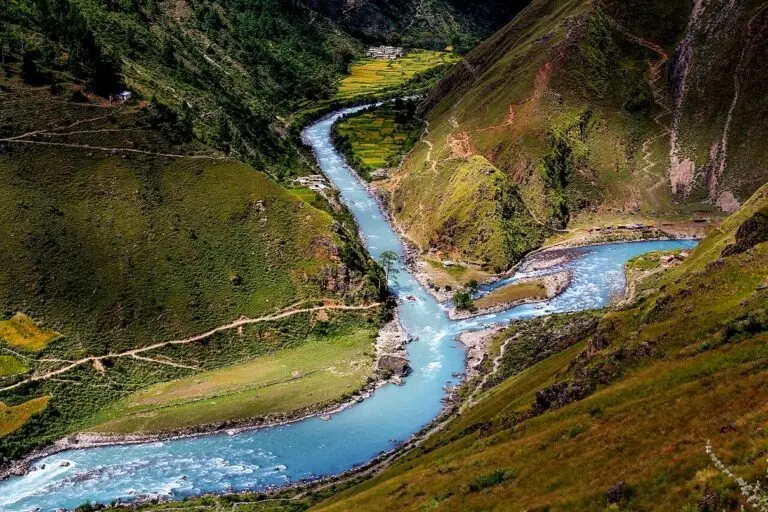
Beginning near Mount Kailash on the Tibetan border, the Karnali River rages—glacier-fed and entirely free—through the dramatic canyons of western Nepal before spilling onto the fertile plains toward India, where it merges with the sacred Ganges. It stands as Nepal’s last wild river and the final frontier where indigenous communities, including the country’s few remaining nomadic Raute people, continue to inhabit an undammed, living watershed.
The ecological stakes within the Karnali basin are globally significant:
- Endangered Megafauna: The river provides a critical sanctuary for the giant migratory mahseer (Tor putitora), an apex river predator often referred to as the "tiger of the river," as well as a vulnerable species of giant catfish (Bagarius yarrelli).
- The Gharial Recovery Zone: In the lower stretches of the Karnali, winding through Bardiya National Park, lies a crucial habitat for the critically endangered gharial crocodile (Gavialis gangeticus). This species is a primary focus of the Phoenix Species Project, conservation efforts recently backed by high-profile philanthropists like Leonardo DiCaprio and Jeff Bezos. A catastrophic upstream glacial collapse or dam failure would spell localized extinction for these fragile populations.
- Cultural and Civilizational Confluence: The Karnali connects three major historic and spiritual landscapes: the Kailash Civilization of Tibet and China, the Khas Civilization of western Nepal, and the Ganga Civilization of India. Together, the watershed serves as a spiritual anchor for nearly two billion people across South Asia.
- Ecotourism and Livelihoods: The river features some of the finest Class V whitewater rapids on the planet, sustaining a burgeoning ecotourism and rafting economy that provides local communities with a sustainable, non-extractive alternative to heavy resource exploitation.
Despite these values, the Karnali has spent two decades trapped in the crosshairs of competing development proposals—some backed by major Indian engineering firms, others championed by the Nepali government itself. These proposals involve boring massive diversion tunnels through sacred mountains, draining miles of riverbed dry, and converting whitewater into commercial megawatts. Although stalled by political instability, financing gaps, and fierce public resistance, these plans have never truly disappeared.

Official Statements and Institutional Perspectives
Critics and environmental advocates argue that the recent disasters on the Bhotekoshi and Trishuli rivers should once and for all force a permanent halt to such high-risk propositions.
"We are not arguing that Nepal should abandon renewable energy—far from it. We are arguing that the flood has proven, in the most devastating way possible, that piling ever more concrete and tunnel infrastructure into unstable Himalayan river corridors is a gamble the country cannot keep making in the face of climate change," state commentary co-authors Dr. Gary Wockner, executive director of Save The World’s Rivers, and Megh Ale, Karnali River Waterkeeper and founding president of the Nepal River Conservation Trust.
Rather than reflexively rebuilding what was lost in the exact same hazardous manner, the authors suggest Nepali energy officials must confront a more challenging question: What should never be built at all?
The Karnali River is framed as the clear answer to that question. Conservationists, Indigenous leaders, and river advocates have spent years organizing a campaign to permanently protect the river—modeled spiritually on the United States’ Wild and Scenic Rivers Act—while seeking international recognition of its outstanding natural and cultural heritage via a UNESCO World Heritage designation. This campaign, alongside a pending public petition before Nepal’s Supreme Court challenging proposed dams, represents a critical legal and political bulwark.

Future Outlook and Technological Alternatives
True development does not require the destruction of a nation’s final ecological lifelines. While energy independence and economic growth are legitimate priorities for Kathmandu, the narrow fixation on large-scale hydropower ignores viable technological alternatives.
- Solar Energy Potential: Nepal enjoys approximately 300 days of intense sunlight annually, offering vast, decentralized potential for solar energy deployment that does not rely on fragile mountain corridors.
- Wind Energy: The nation’s countless blustery mountain passes and deep river gorges present untapped opportunities for wind power generation.
A free-flowing Karnali River functions as an essential insurance policy—ecological, cultural, and physical—against the worsening impacts of a warming planet. As Himalayan ecosystems destabilize in real time, Nepal faces a stark choice: continue gambling with high-risk infrastructure in volatile geological zones, or pivot toward climate-resilient energy strategies while preserving its natural heritage.
Ultimately, Nepal does not need to dam its last wild river. It needs to save it.



