

Executive Overview
As the impacts of climate change accelerate across the globe, extreme weather events have shifted from occasional anomalies to a relentless, compounding crisis. Rising sea levels, erratic precipitation patterns, and more frequent, high-intensity storms are placing unprecedented pressure on both urban infrastructure and rural agrarian economies. According to recent scientific projections, nearly 2 billion people will be directly exposed to severe flooding by the year 2100—an alarming increase of 300 million individuals compared to 2020 baselines. Traditional engineering paradigms, which rely on heavy, permanent concrete levees and massive civil infrastructure projects, are increasingly proving to be too slow, too inflexible, and far too expensive to meet the scale of the challenge.
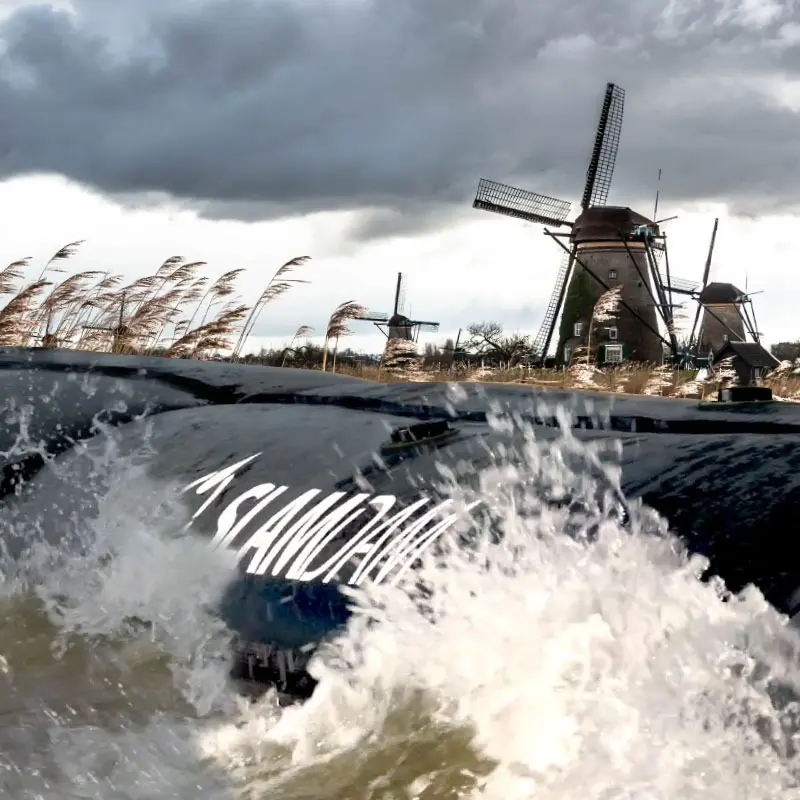
Enter the SlamDam: a deceptively simple, highly portable rubber flood barrier engineered to meet the chaotic reality of modern climate emergencies. Developed in the Netherlands in 2013 by Dutch firm WaveSave, the SlamDam offers an agile alternative to conventional flood defenses. Unfurled rapidly on the ground along a riverbank, shoreline, or vulnerable property perimeter, the heavy-duty rubber tube can be quickly filled with water using standard, locally available pumps. As it swells, it forms a sturdy, water-ballasted barrier standing up to 1.3 meters high, capable of holding back rising tides and swollen river currents before they can devastate homes, farmlands, and critical facilities like hospitals or water treatment plants.
What elevates the SlamDam from a clever piece of emergency hardware to a potentially transformative climate adaptation tool is its dual utility. While engineered primarily as a defensive shield during a crisis, its water-filled core doubles as an invaluable reservoir in the aftermath of freshwater floods. In drought-prone regions and vulnerable farming communities across Africa and Southeast Asia, the millions of liters of water trapped inside these barriers can be tapped during the dry season to irrigate crops. In places like the rural Mpanda commune in Burundi, this secondary function has proven revolutionary, helping local farmers double their incomes by dramatically increasing crop yields.
Yet, scaling such a technology is fraught with complex logistical, financial, and organizational hurdles. While WaveSave has successfully expanded its footprint into at least a dozen countries, the company faces persistent challenges regarding up-front equipment costs, community governance models, and reliance on centralized European manufacturing. As WaveSave prepares for a major strategic pivot—including localized manufacturing hubs in Southeast Asia and East Africa by 2027 and innovative "barrier-as-a-service" financial models—the company’s trajectory offers a fascinating case study in how grassroots, low-tech innovations can scale to meet a planetary crisis.
Detailed Chronology
Genesis and Early Adoption in the Netherlands (2013–2018)
The conceptualization of the SlamDam was born out of a pragmatic Dutch approach to water management—a country historically defined by its precarious relationship with rising sea levels and river management. Designed in 2013, the initial iterations of the SlamDam were subjected to rigorous testing by regional water authorities (waterschappen) in the Netherlands. Known for their meticulous technical standards, these Dutch authorities integrated the mobile rubber dams into their rapid-response flood protocols.
During these formative years, the technology was refined based on field feedback. The primary engineering goals were clear: create a barrier that required no specialized heavy machinery, could be deployed by a minimal crew in the dead of night when flash floods typically strike, and could be easily drained, rolled up, and stored for future use once the waters receded. With an anticipated lifespan of more than 40 years, the SlamDam established a reputation for exceptional material durability, paving the way for international exploration.
International Expansion and Global Pilot Programs (2019–2022)
Buoyed by its success in Western Europe, WaveSave began looking outward toward emerging economies where climate vulnerability intersects with severe infrastructure deficits. The company expanded its outreach into regions across Africa and Southeast Asia, where rising flood risks frequently threaten subsistence farming and under-resourced municipal facilities.
A watershed moment for the technology occurred during the 2022 flood season in the East African nation of Burundi. Deployed at the rural Mpanda commune, the SlamDam did more than simply protect local arable land from destructive inundation; it served as a lifeline during the subsequent dry season. By strategically tapping the clean, trapped freshwater stored inside the rubber barriers weeks after the floodwaters had subsided, local smallholder farmers were able to maintain continuous crop irrigation. According to a United Nations Environment Programme (UNEP) Climate Technology Centre and Network (CTCN) report, farmers who leveraged this stored water achieved dramatically higher crop yields, effectively doubling their annual incomes.
Scaling Pains, Research, and Strategic Evolution (2023–Present)
As deployments increased, independent research teams began analyzing the real-world friction of introducing mobile flood barriers into developing contexts. A notable study examining the deployment of SlamDams in Kenya highlighted several critical operational bottlenecks. Beyond the baseline technical mechanics of the dam, communities faced thorny questions of institutional governance: Who legally owns the dam? Who is responsible for coordinating its rapid deployment when a middle-of-the-night flood warning is issued? Who maintains the pumps and ensures the rubber is properly cleaned and stored afterward?
Concurrently, financial barriers emerged as a primary impediment to widespread adoption. While competitively priced compared to permanent civil works, the initial capital expenditure remains out of reach for many individual farmers and cash-strapped local governments. Recognizing these constraints, WaveSave’s leadership began re-evaluating its business model, moving away from a purely transactional hardware sales approach toward integrated service models and localized production economics.
Supporting Context & Metrics
The Global Flood Crisis by the Numbers
To understand the commercial and humanitarian urgency driving companies like WaveSave, one must examine the macroeconomic and demographic trajectories of global climate risk.
- The 2100 Horizon: According to authoritative demographic and climate modeling published in scientific literature, nearly 2 billion people will be directly exposed to catastrophic flooding by the end of the 21st century. This represents a staggering net increase of 300 million people compared to baseline data from 2020.
- Cost Efficiency of Temporary Defense: Traditional flood mitigation—such as constructing concrete levees, raising entire municipal facilities, or building massive seawalls—requires astronomical capital investments and years of bureaucratic planning and environmental review. In stark contrast, mobile solutions like the SlamDam offer immediate, modular protection at a fraction of the cost.
- The Unit Economics: A standard SlamDam unit is sold in five-meter sections, priced between €1,000 and €3,000 (approximately $1,140 to $3,400 USD), varying according to the specific height requirements (with maximum heights reaching 1.3 meters). While protecting a single residential entryway may require only 10 meters of barrier, encircling a critical community asset—such as a rural health clinic, a local school, or a water treatment plant—or shielding an expansive farm perimeter typically demands between 200 and 300 meters of product. For many vulnerable communities, this aggregate cost remains a formidable hurdle.
- Longevity and Sustainability: Engineered with heavy-duty, puncture-resistant rubber polymers, each SlamDam boasts a functional lifespan exceeding four decades. This high durability index ensures a favorable lifecycle cost-benefit ratio when compared to single-use sandbags or rapidly degrading improvised barriers.
The Water-Energy-Food Nexus in Action
The secondary economic benefit observed in Burundi underscores the profound interconnectedness of climate resilience strategies. In arid, semi-arid, or drought-stricken regions, water is simultaneously a destructive hazard during the wet season and a precious commodity during the dry months.
By functioning as a temporary storage vessel, the SlamDam elegantly bridges the gap across the water-energy-food nexus. Instead of allowing millions of liters of precious freshwater to mix with contaminated runoff or dissipate harmlessly, the barrier acts as an organic rainwater and river-overflow harvesting system. This transforms a classic disaster-relief expense into a revenue-generating asset for agrarian communities, shifting the psychological perception of flood barriers from a costly insurance policy to an investment in agricultural productivity.

Competitive Landscape
While WaveSave operates in a specialized niche, it shares the mobile flood barrier market with several established international competitors:
- AquaFence: Known primarily for its patented, gravity-based rigid panel systems widely adopted in urban commercial and municipal settings.
- MegaSecur: Specializes in flexible water-filled tubes and damming systems geared toward industrial spill containment and municipal flood control.
- NOAQ Flood Protection: Manufactures lightweight, self-anchoring boxwall systems that snap together rapidly without requiring heavy filling equipment.
WaveSave distinguishes itself from these competitors through a two-pronged strategy: an intense operational focus on rapid emergency deployment within developing and climate-vulnerable nations, and an intentional emphasis on the dual-purpose functionality of water retention and post-flood agricultural irrigation.
Official Statements and Leadership Perspectives
Navigating the delicate balance between rapid global expansion and sustainable organic growth requires steady, visionary leadership. Omar Saleh, Managing Director of WaveSave, has been vocal about the strategic trajectory of the firm, acknowledging both the immense market opportunities and the operational growing pains facing the enterprise.
Addressing the persistent challenge of upfront capital costs, Saleh noted that the company is actively pioneering new delivery frameworks. Rather than relying solely on outright municipal or agricultural purchases, WaveSave is exploring a "SlamDam-as-a-Service" model. Under this paradigm, barriers would be strategically prepositioned in regional hubs and deployed on demand, significantly lowering the barrier to entry for cash-strapped local communities.
Furthermore, Saleh emphasizes that the company’s future is deeply rooted in decentralization. Reflecting on the company’s current operational setup—which remains strictly self-financed with a lean team of just seven employees—Saleh maintains a philosophy of organic, profit-reinvestment growth rather than risky venture capital dilution.
"We are not just selling a rubber tube to keep water out; we are partnering with communities to fundamentally rethink how they manage water stress across seasons," Saleh explains, framing the company’s long-term vision. This philosophy underpins WaveSave’s upcoming transition toward localized manufacturing and comprehensive advisory services.
Future Outlook
Localization and Supply Chain Transformation (2027 Horizon)
Up to this point in its operational history, WaveSave has maintained a centralized manufacturing model. All SlamDam units are fabricated by an external partner facility in the Netherlands and subsequently crated and shipped globally to international clients. While this ensures strict quality control, it introduces significant shipping overhead, import tariffs, and carbon footprints that conflict with the sustainable ethos of climate tech enterprises.
To mitigate these friction points, WaveSave has outlined an ambitious geographic expansion of its manufacturing footprint:
- Southeast Asian Production Facility: Scheduled to break ground or become operational in early 2027, this localized manufacturing hub will dramatically reduce logistical lead times and shipping costs for customers across the Mekong Delta and surrounding flood-prone archipelagos.
- East African Hub: Following the Southeast Asian rollout, WaveSave plans to establish a parallel manufacturing and assembly facility in East Africa. By producing units closer to active project sites in countries like Burundi, Djibouti, and Guinea, the company aims to make the technology substantially more affordable for regional governments and agricultural cooperatives.
This industrial decentralization aligns seamlessly with recent commercial momentum. Saleh reports that WaveSave has recently secured four major new project contracts totaling approximately $5.3 million across Burundi, Djibouti, and Guinea. Simultaneously, the company is nurturing a "substantial pipeline" of municipal and agricultural projects across Latin America and Southeast Asia.
Evolving into Comprehensive Water Management
Looking beyond hardware sales and regional manufacturing, WaveSave’s ultimate strategic evolution involves transforming into a holistic water advisory partner.
Future growth phases will see the company offering specialized consulting services directly to local communities. This includes advising municipalities and farming collectives on how to integrate SlamDams with simple, off-the-shelf rainwater harvesting and micro-irrigation systems. By pairing immediate flood defense with long-term drought resilience infrastructure, WaveSave aims to provide a comprehensive playbook for climate adaptation in vulnerable regions worldwide.
As the atmospheric impacts of climate change continue to intensify over the coming decades, low-tech, highly adaptable innovations like the SlamDam demonstrate that resilience does not always require massive, permanent infrastructure. Through strategic localization, innovative financing models, and a visionary dual-use utility mindset, WaveSave is proving that the tools to weather the climate crisis can be rolled up, stored away, and deployed precisely when—and where—they are needed most.



