Executive Overview
When South Korea’s battery powerhouse LG Energy Solution (LGES) quietly backed out of its planned $8.45 billion investment in Indonesia’s flagship "Project Titan" last year, Jakarta was left staring at a catastrophic hole in its industrial playbook. The project—designed to establish a fully integrated end-to-end electric vehicle (EV) battery manufacturing ecosystem—was meant to be the crown jewel of Indonesia’s ambitious economic transition.
For years, the Southeast Asian nation has leveraged its position as home to the world’s largest nickel reserves to transform itself from a mere raw-material exporter into a dominant global hub for EV production. LGES’s unexpected withdrawal, following years of agonizing delays and stalled feasibility studies, threatened to undermine the entire thesis of Indonesia’s mineral-driven industrialization.
Yet, where Western-aligned capital hesitated, Chinese enterprise surged forward. In a rapid geopolitical and industrial pivot, a consortium of Chinese mining giants and battery component producers stepped into the breach left by South Korea. By acquiring non-controlling and controlling stakes across the project’s supply chain stages, these Chinese players rescued the initiative, securing the flow of capital and technology needed to turn raw ore in remote archipelagos into finished EV cells near the nation’s capital.
This shift underscores a critical reality in the global clean-tech race: despite Western efforts to "de-risk" critical mineral supply chains, Beijing’s stranglehold on nickel processing, combined with its appetite for high-risk industrial ventures, has rendered it an indispensable partner for emerging economies. Project Titan’s transformation highlights the friction between Western supply chain compliance, corporate risk aversion, and Indonesia’s unyielding drive toward value-added mineral processing (hilirisasi).
Detailed Chronology: From Grand MoU to Abrupt Pivot
========================================================================================
TIMELINE: THE TRANSFORMATION OF PROJECT TITAN
========================================================================================
 2020 (Q4)     : Indonesia bans raw nickel exports; announces masterplan for downstreaming.
 2022 (April)  : LG Consortium signs framework agreement ($9B+) for Project Titan.
 2023 (Mid)    : Feasibility studies stall over mine concessions and US IRA rules.
 2024 (Early)  : Global EV slowdown begins; LGES signals capital reallocation.
 2024 (Late)   : LGES formally exits; Chinese consortium steps in to plug funding gap.
========================================================================================
The Genesis of Project Titan (2020–2022)
The blueprint for Project Titan emerged in late 2020 following Indonesia’s decisive ban on raw nickel ore exports. Seeking to captivate foreign investors, the Indonesian government envisioned a closed-loop battery ecosystem. In April 2022, a consortium led by South Korea’s LG Energy Solution—alongside LX International, POSCO, state mining holding company MIND ID, and national miner PT Aneka Tambang (Antam)—signed a non-binding framework agreement valued at nearly $9 billion.
The masterplan was breathtaking in its geographic and operational scope:
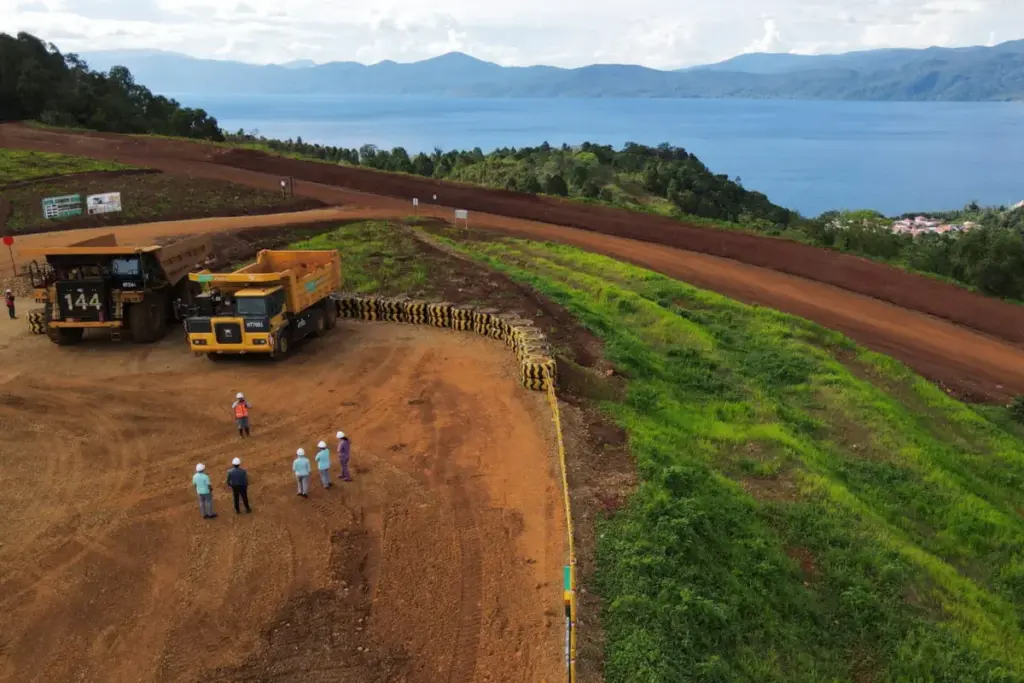
- Upstream: Mining raw laterite nickel ore in the dense rainforests of East Halmahera, North Maluku.
- Midstream: Refining low-grade limonite ore into battery-grade chemicals—specifically Mixed Hydroxide Precipitate (MHP), nickel sulfate, and precursor materials—via High-Pressure Acid Leach (HPAL) plants.
- Downstream: Transporting processed chemicals over 2,000 kilometers across the Java Sea to a high-tech gigafactory in Karawang, West Java, to manufacture advanced battery cells and packs.
Friction and Stagnation (2023)
Despite the public fanfare, behind-the-scenes negotiations hit an immediate wall. Central to the gridlock was the valuation of Antam’s mining concessions in Buli, East Halmahera, and the complex profit-sharing structures between state-owned entities and foreign partners.
Concurrently, external macroeconomic pressures intensified. The passage of the U.S. Inflation Reduction Act (IRA) in late 2022 introduced strict "Foreign Entity of Concern" (FEOC) rules, which penalized EV batteries utilizing components or critical minerals processed by Chinese-linked firms or non-compliant supply chains. Because Indonesia’s broader nickel processing ecosystem was already heavily dominated by Chinese joint ventures, South Korean executives grew increasingly anxious that capital deployed in Indonesia would yield batteries disqualified from lucrative U.S. tax subsidies.
The Breakdown and Exit (Late 2024)
By mid-2024, years of inconclusive feasibility studies coincided with a sharp deceleration in global EV adoption growth and plummeting market prices for battery-grade nickel. Citing a necessity to optimize capital allocation and adapt to volatile market conditions, LG Energy Solution quietly notified the Indonesian Ministry of Investment of its withdrawal from the upstream and midstream portions of Project Titan, opting instead to limit its presence to a pre-existing downstream battery joint venture with Hyundai Motor Group in Karawang.
The Chinese Entry
With Indonesia’s flagship initiative facing collapse, Jakarta dispatched high-level delegations to Ningbo and Hangzhou. Within months, a syndicate of Chinese battery materials producers—including entities tied to Zhejiang Huayou Cobalt, Tsingshan Holding Group, and CATL’s investment arms—moved rapidly to assume LG’s abandoned equity shares. Leveraging their vast operational expertise in Maluku and Sulawesi, the Chinese firms committed to funding the HPAL processing units and integrating them directly with Indonesian state miners, effectively rescuing Project Titan under a redesigned, Chinese-backed architectural framework.
Supporting Context & Metrics: The Mechanics of Indonesia’s Nickel Hegemony
To understand why Project Titan became a battleground for global battery dominance, one must analyze the physical, technological, and financial parameters governing Indonesia’s nickel strategy.
       PROJECT TITAN: GEOGRAPHIC & SUPPLY CHAIN ARCHITECTURE
       =====================================================

  [EAST HALMAHERA, NORTH MALUKU]           [KARAWANG, WEST JAVA]
  +----------------------------+           +-------------------+
  | - Ore Extraction (Buli)    |           | - Precursor/Cathode|
  | - HPAL Refining (MHP)      |           |   Manufacturing   |
  | - Nickel Sulfate Synthesis |           | - Battery Cell    |
  +--------------+-------------+           |   Gigafactory     |
                 |                         +---------^---------+
                 |    2,000+ KM MARITIME             |
                 +-----------------------------------+
                        LOGISTICS PIPELINE
Resource Dominance vs. Technical Complexity
Indonesia holds an estimated 21 million to 55 million metric tons of nickel reserves—accounting for over one-third of the global total. However, the majority of these reserves exist as low-grade limonite ore (typically containing 0.9% to 1.3% nickel), which historically was treated as overburden waste.
Unlocking limonite ore requires High-Pressure Acid Leach (HPAL) technology, a capital-intensive process that exposes ore to sulfuric acid under extreme temperatures (250°C) and pressures (40 atmospheres). While Western and South Korean firms have historically suffered from massive budget overruns and operational failures in HPAL execution (such as the Ravensthorpe project in Australia or Ambatovy in Madagascar), Chinese companies have mastered HPAL deployment, cutting capital costs per ton of installed capacity by up to 50% and building plants in half the industry-average time.
| Metric / Dimension | South Korean (LG-Led) Framework | Chinese-Backed Restructured Framework |
|---|---|---|
| Estimated Total Capital Expenditure | $8.45 Billion – $9.8 Billion | $7.0 Billion – $8.2 Billion (Cost-optimized) |
| Primary HPAL Tech Supplier | Third-party Western/Japanese Licensing | Domestic Chinese Proprietary (Huayou/GEM) |
| Upstream Mining Partner | PT Antam / MIND ID | PT Antam / MIND ID |
| Core Target End-Market | United States (IRA compliant) & Europe | China, Southeast Asia, Non-IRA Global Markets |
| Estimated Time to Operationalization | Delayed (Target was 2026, stalled) | Accelerated (Phase 1 Target: 2026/2027) |
| Power Generation Source | Hybrid (Captive Coal transitioning to Gas) | On-site Captive Coal / Thermal Grid |
Logistics and Maritime Flow
Project Titan represents an extraordinary supply chain exercise. Raw materials mined in the isolated Buli peninsula of East Halmahera must undergo initial beneficiation and HPAL processing locally due to the sheer bulk of raw ore.
Once transformed into concentrated MHP and nickel sulfate, the intermediate products are loaded onto bulk carriers for a 2,000-kilometer voyage across the Molucca Sea, Java Sea, and internal waterways to the port facilities of West Java. From there, the materials feed into cathode synthesis plants and the Karawang battery cell complex, illustrating the vast logistical challenge inherent in Indonesia’s island-spanning industrial strategy.
Stakeholder Perspectives and Official Statements
The pivot of Project Titan has drawn starkly contrasting reactions from government officials, corporate executives, and industry analysts, reflecting the broader geopolitics of the energy transition.
Indonesian Government: Uncompromising Industrialization
Publicly, Indonesian leaders have maintained a stoic posture, emphasizing that the nation’s mineral resources transcend any single investor.
Speaking on the shift, a senior official within Indonesia’s Coordinating Ministry for Infrastructure and Regional Development noted:
"Our downstream policy (hilirisasi) is non-negotiable. If a partner hesitates due to internal capital constraints or foreign geopolitical pressures, Indonesia cannot afford to wait. We welcome any investor—East or West—who brings capital, offers fair valuation, transfers technology, and respects our national timeline to build an integrated battery ecosystem."
Officials from the Ministry of Investment (BKPM) similarly downplayed the exit of LGES, framing the arrival of Chinese partners as a natural market realignment that ensures Project Titan remains on track to meet national EV integration deadlines.
South Korean Corporate Retrenchment: Capital Allocation and IRA Headwinds
A spokesperson for LG Energy Solution, addressing questions regarding their exit from the upstream portions of the project, cited shifting macroeconomic environments:
"While Indonesia remains a vital partner for our global growth strategy—demonstrated by our operational joint venture in Karawang—we must dynamically manage our capital expenditures in response to global EV market trends and regulatory landscapes. Multiple factors, including extended feasibility assessments and strategic focus areas, led to our decision to adjust our scope of investment."
Off the record, industry analysts close to the South Korean consortium revealed that strict U.S. FEOC definitions imposed by Washington made the inclusion of Indonesian nickel—which is heavily processed using Chinese equipment and coal power—an existential threat to LG’s market share in North America.
The Chinese View: Strategic Execution and Deepening Ties
Executives within the incoming Chinese corporate syndicate expressed high confidence in their ability to fast-track Project Titan. A representative from a major Chinese materials refining firm stated:
"We possess the proven technical capabilities, lower capital costs, and integrated supply chains required to make HPAL facilities commercially viable in Indonesia. Project Titan is a natural extension of our long-term commitment to South-East Asian green industrial development under the Belt and Road Initiative."
Environmental & Social Governance (ESG) Watchdogs
The project’s transfer to Chinese management has reignited sharp criticism from civil society organizations and local communities in North Maluku. Environmental groups have highlighted the heavy ecological footprint of HPAL refining:
- Carbon Intensity: HPAL facilities in East Halmahera remain reliant on dedicated off-grid coal-fired power plants, running directly counter to global carbon-neutrality mandates.
- Waste Management: Concerns persist regarding the disposal of toxic tailings. While deep-sea tailing placement (DSTP) has been deferred due to public outcry, dry-stacking tailings in seismically active tropical regions presents significant risk of soil and watershed contamination.
- Community Displacement: Indigenous populations in East Halmahera continue to voice opposition over forest degradation, loss of traditional hunting grounds, and runoff affecting coastal fisheries.
Future Outlook and Strategic Implications
The restructuring of Project Titan marks a historic turning point for Indonesia, the global nickel trade, and the geopolitical battle for the EV supply chain.
========================================================================================
STRATEGIC IMPLICATIONS OF THE PROJECT TITAN RESTRUCTURING
========================================================================================

 1. DEEPENING CHINESE MONOPOLY IN SOUTHEAST ASIA
    Chinese firms now control over 75% of Indonesia's operational HPAL and smelting
    capacity, solidifying Beijing's control over class-1 battery-grade nickel.

 2. BIFURCATION OF THE GLOBAL EV MARKET
    - U.S. / EU Supply Chains: Seeking non-Chinese, low-carbon nickel (Canada, Australia).
    - Global South / Asian Markets: Powered by cost-competitive Chinese-Indonesian supply chains.

 3. PRESSURE ON WESTERN AUTOMAKERS
    Automakers outside the U.S. regulatory sphere may increasingly rely on cheap
    Indonesian-Chinese batteries, putting cost pressure on Western OEMs.

 4. INDONESIA'S BALANCING ACT UNDER PRABOWO
    President Prabowo Subianto faces the delicate task of maintaining strong economic
    ties with Beijing while trying to negotiate critical mineral trade agreements with
    Washington.
========================================================================================
1. The Realignment of Global Battery Supply Chains
The exit of LGES and the entry of Chinese capital effectively splits the global EV market into two distinct operational spheres:
- The IRA-Compliant Western Loop: Reliant on high-cost, strictly audited nickel sourced from Australia, Canada, and domestic U.S. mines.
- The Asian-Centric Cost-Optimized Loop: Anchored by Indonesia’s massive reserve base and processed via efficient Chinese technology, serving non-U.S. markets across Asia, Europe, South America, and Africa.
By cementing its influence over Project Titan, China has sealed its near-monopolistic control over the most cost-effective battery-grade nickel production on Earth. Western automakers attempting to build affordable EVs without relying on Chinese-linked supply chains will find themselves at a severe cost disadvantage.
2. Technological Shifts: NCM vs. LFP
Project Titan’s viability also hinges on an ongoing technological debate within the EV industry. High-nickel batteries (NCM/NCA) offer superior energy density and range, making them the primary destination for Indonesian nickel. However, Lithium Iron Phosphate (LFP) batteries—which contain zero nickel or cobalt—have seized substantial global market share due to their safety, longevity, and lower cost.
If Chinese battery makers continue to optimize LFP technology (and next-generation sodium-ion alternatives), the long-term demand for high-cost HPAL-refined nickel could face structural headwinds. The incoming consortium will need to ensure that Project Titan’s midstream outputs remain cost-competitive even in a low-nickel price environment.
3. Geopolitical Trajectory under the Prabowo Administration
For President Prabowo Subianto, Project Titan represents a critical test of foreign policy and economic stewardship. Prabowo has pledged to continue his predecessor’s hilirisasi legacy while maintaining a strictly neutral, non-aligned foreign policy (bebas-aktif).
However, as Western nations raise trade barriers against Chinese-influenced supply chains, Jakarta risks being economically boxed in. To prevent total dependence on Beijing, the Prabowo administration is likely to push aggressively for a limited Free Trade Agreement (FTA) or critical mineral deal with the United States. Whether Washington will grant concessions to an Indonesian mineral sector so deeply integrated with Chinese enterprise remains one of the most significant unanswered questions in modern trade diplomacy.
Conclusion
Project Titan was meant to demonstrate how Western-aligned capital and Indonesian natural resources could seamlessly unite to power the global green transition. Instead, its restructuring offers a reality check for the global economy. By stepping into the void left by South Korea, China has demonstrated that in the high-stakes race for critical mineral supremacy, speed, technical execution, and risk tolerance often trump geopolitical posturing. For Indonesia, the project lives on—not as the bridge to Western capital it once envisioned, but as an undeniable monument to Beijing’s expanding industrial domain.