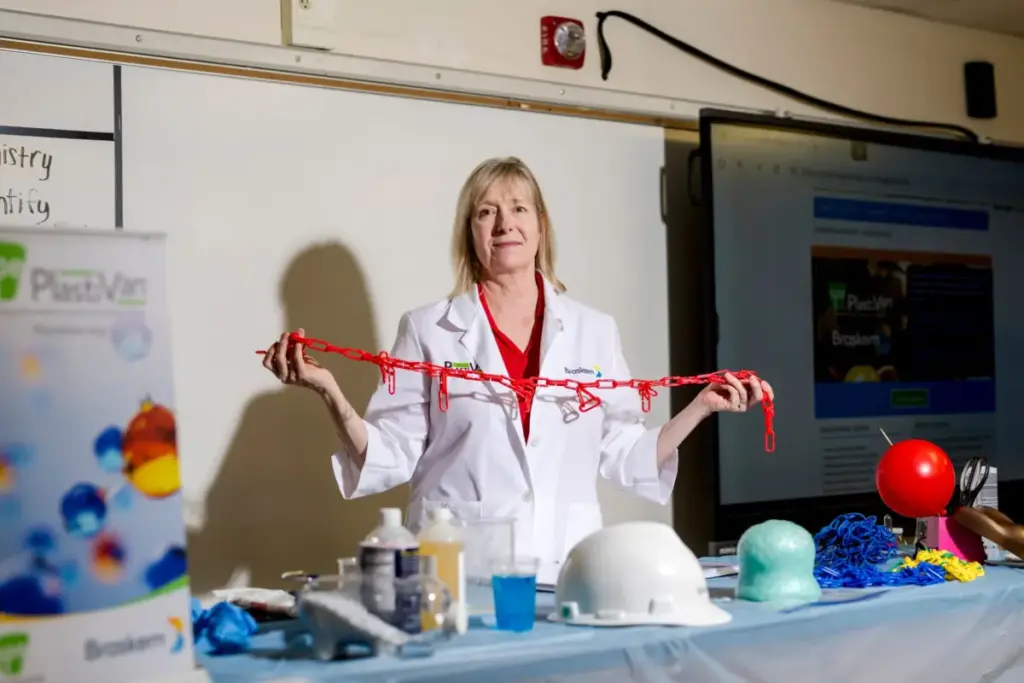
As millions of students return to classrooms across the United States to tackle traditional subjects like mathematics, literature, and biology, a less traditional curriculum is quietly making its way onto lesson plans and interactive whiteboards: the Gospel of Plastics.
A comprehensive new report from the non-profit Plastic Pollution Coalition reveals the extensive, multi-decade campaign waged by the petrochemical and plastics industries to shape public opinion at its root. By embedding themselves into K-12 science, technology, engineering, and math (STEM) education, trade groups and corporate giants have deployed a sophisticated array of free teaching aids, hands-on classroom experiments, and traveling roadshows. These resources present plastics not as an ecological crisis, but as an indispensable marvel of modern life.
While these industry-backed initiatives are packaged as educational enrichment, critics argue they are exercises in corporate propaganda designed to whitewash the environmental and human health costs of fossil fuel derivatives. As teachers grapple with chronic underfunding and resource scarcity, the petrochemical industry has stepped into the vacuum, trading cheap lesson plans for long-term brand loyalty.
Executive Overview
The infiltration of corporate narratives into public education is not entirely new—historical precedents exist with the tobacco, junk food, and fossil fuel industries. However, the systematic saturation of American classrooms by the plastics lobby represents a uniquely persistent threat to environmental literacy.
According to the Plastic Pollution Coalition’s report, industry influence manifests in various guises:
- Curricular Integration: Worksheets, scavenger hunts, and chemistry labs distributed by chemical associations that minimize the negative impacts of synthetic polymers.
- Experiential Outreach: Traveling programs like the Society of Plastics Engineers’ "PlastiVan," which tour schools nationwide to foster an appreciation for polymer science.
- Community Partnerships: Corporate investments in schools situated near petrochemical hubs, where financial contributions for sports facilities and supplies are explicitly tied to pro-recycling curricula.
The ultimate objective of these programs is twofold: to frame plastics as irreplaceable to modern society, and to shift the burden of plastic pollution entirely onto individual consumers while deflecting attention from overproduction. With only 9 percent of global plastics being successfully recycled, experts warn that these educational materials are actively misleading the next generation of voters, consumers, and policymakers.
Detailed Chronology: Decades of Classroom Lobbying
The presence of corporate plastics messaging in schools is far from accidental; it is the product of a long-term, calculated strategy. While the Plastic Pollution Coalition’s latest report brings fresh urgency to the issue, records show that industry-sponsored educational engineering has been active for decades.
Early 2000s to 2010s: The Legislative Push
Plastics advocacy groups have long recognized the value of targeting educational frameworks at the state level. Between 2009 and 2011, a prominent plastics trade group actively lobbied the California Department of Education. Their goal? To ensure that high school textbooks included a dedicated, favorable section highlighting "The Advantages of Shopping Bags," specifically defending single-use plastic bags against emerging municipal bans.
2011: Launch of the PlastiVan Initiative
In 2011, the Society of Plastics Engineers (SPE) scaled up its educational outreach by expanding the "PlastiVan" program. Designed to tour schools across the country, the program uses live demonstrations to teach children about polymer chemistry while explicitly promoting the economic and lifestyle contributions of plastics. By the mid-2020s, SPE claimed the program had reached over 132,000 students.

Recent Years: Petrochemical Investments in Fenceline Communities
In regions heavily burdened by industrial infrastructure, corporate influence has taken on a more localized, deeply embedded character. In Beaver County, Pennsylvania, energy giant Shell operates a massive 386-acre plastics production complex.
To secure social license in the community, Shell has invested millions of dollars into developing plastics-related curricula and recycling programs for local grade schools and community colleges. The company has funded backpacks filled with school supplies and even purchased a school basketball court—interventions that critics argue are direct quid pro quos for incorporating industry-friendly recycling modules into local classrooms.
Supporting Context & Metrics: The Reality Behind the Lesson Plans
To understand the scope of the deception, education and environmental experts urge a side-by-side comparison of what industry-sponsored lesson plans teach versus the empirical reality of plastic pollution.
Case Study 1: The Society of Plastics Engineers (SPE)
Now operating as a division of the Plastics Industry Association, the SPE provides robust instructional toolkits. Among these is the "plastic scavenger hunt," an activity engineered to help students "understand that plastics are ubiquitous and their importance to society and their personal life." Other materials include videos titled Your Bottle Means Jobs, which pivot the conversation toward local employment supported by plastics manufacturing, entirely bypassing the lifecycle costs of the material.
Case Study 2: The American Association of Chemistry Teachers (Dow Chemical)
An initiative supported by the Dow Chemical Company, this association provides elementary and middle school lesson plans that task students with evaluating the strength of various commercial plastic bags found in grocery stores. The exercise culminates in a role-play scenario where students are instructed to "pretend you are an employee for Dow Chemical Company" tasked with designing a retail bag for a customer.
The Pedagogical Critique
Wendy Johnson, a science education specialist at the National Center for Science Education, notes that these lesson plans fundamentally violate core principles of sound pedagogy. Materials frequently claim alignment with state-level STEM standards without providing verifiable mapping. Instead, they require students to memorize industry-specific jargon such as "stretch blow molding" or "thermosetting."
"By using all of these technical terms, it’s tricking people into thinking … that they’re doing science," Johnson explained. "What the materials really teach are ideological perspectives about the economy, like the desirability of cheap consumer goods."
The Myth of Advanced Recycling
A core pillar of industry-backed curricula is the acknowledgment of plastic waste—not as an overproduction crisis, but as a failure of consumer behavior that can be solved entirely through recycling.
The empirical data tells a drastically different story:
- The 9% Reality: According to data from the Organisation for Economic Co-operation and Development (OECD), only 9 percent of all plastic waste generated worldwide is successfully recycled.
- Unmanageable Growth: Scientific consensus indicates that recycling infrastructure can never scale quickly enough to keep pace with projected exponential increases in plastic manufacturing.
- Historical Deception: Investigative reporting and legal findings have revealed that major fossil fuel and petrochemical corporations have known for decades that mass plastic recycling was economically and technically unfeasible, yet promoted it anyway to deflect public outrage and regulatory scrutiny.
Beyond waste management, the lifecycle of plastics poses compounding environmental and health threats. Plastics degrade into microplastics that infiltrate human bloodstreams, clog urban storm drains to exacerbate catastrophic flooding, harm marine ecosystems, and release significant greenhouse gas emissions at every stage of their production and degradation.
Official Statements and Industry Silence
As the Plastic Pollution Coalition report gained national traction, attempts to secure commentary from the targeted organizations and corporate entities yielded zero engagement.
Neither Shell, the Society of Plastics Engineers, the American Association of Chemistry Teachers, nor the administration of the Beaver County school district responded to multiple requests for comment from environmental journalists. This stony silence underscores the defensive posture adopted by corporate actors when confronted with accountability regarding their public relations strategies in youth education.
Future Outlook: Navigating Solutions in Public Education
The debate over corporate influence in schools exposes a deeper systemic fracture within the American public education system: chronic underfunding. Teachers are routinely forced to shoulder out-of-pocket expenses for basic classroom supplies, leaving them vulnerable to free, professionally packaged curricula offered by well-funded special interest groups.
+-------------------------------------------------------------------+
|               The K-12 Educational Funding Trap                   |
|                                                                   |
|   Underfunded Schools + Overworked Teachers =                     |
|   Vulnerability to "Free" Industry-Sponsored Curricula             |
|                                                                   |
|   Result: Corporate PR disguised as STEM education infiltrating   |
|   classrooms, shaping young minds to normalize petrochemicals.    |
+-------------------------------------------------------------------+
The Policy Debate: Bans vs. Critical Thinking
Stakeholders within the environmental and educational spaces diverge sharply on how to resolve this vulnerability.
- The Prohibitionist Approach: Madison Dennis of the Plastic Pollution Coalition advocates for explicit school board policies that ban educational materials sponsored by the chemical, fossil fuel, and plastics industries entirely. Dennis also calls for structural economic reforms, such as stripping lucrative state and local tax breaks from petrochemical facilities—subsidies that currently drain billions of dollars from communities that could otherwise be allocated to fully fund public education.
- The Media-Literacy Approach: Conversely, figures like Katie Allen, executive director of the environmental nonprofit Algalita, caution against outright bans. Allen argues that prohibiting specific entities sets a dangerous precedent and that educators should instead be trusted to use industry-sponsored materials as tools for teaching critical-thinking and media-literacy skills.
Alternative Educational Models
Fortunately, teachers seeking unbiased, scientifically rigorous content have access to alternative resources. Nonprofits such as Algalita offer free lesson plans focusing on ocean garbage patches and biomagnification, while organizations like The Story of Stuff provide comprehensive high-school curricula analyzing the true socioeconomic and environmental costs of consumer goods.
Other educators have chosen to bypass external materials entirely by empowering students to build local solutions. Jacqueline Omania, a retired elementary school teacher in Berkeley, California, famously transformed her classroom into a zero-waste laboratory. Over an 11-year period, Omania and her young students established classroom agreements to minimize daily plastic usage—such as replacing individual glue sticks with communal containers—while actively campaigning for municipal policies to ban single-use plastics in local restaurants.
"There are so many challenges in the world, but plastic is something tangible," Omania noted. "It’s right there in front of them, and they can see the difference that they’re actually making through their actions."
As the educational landscape continues to evolve, the battle over what children learn about plastics serves as a microcosm of a larger societal struggle: whether the next generation will be equipped to dismantle systems of corporate pollution, or trained to accept them as an immutable fact of modern life.